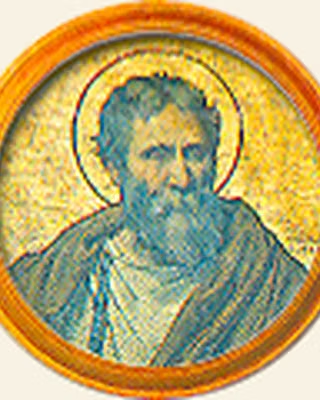
Agatho, Pope
Martyrological notice
Roman Martyrology (traditional English edition; normalized OCR transcription): of St. Agatho, pope, who, famous for holiness and learning, died a natural death.
Baring-Gould: January · S. AGATHO, POPE
[His life by Anastasius, the librarian. Commemorated by the Greeks on Feb. 21st.]
Agatho, a Sicilian by birth, was remarkable for his charity and gentleness. Having been several years treasurer of the Church of Rome, he succeeded Domnus in the Pontificate, in 679. He was represented by three legates in the sixth general council, the third of Constantinople, in 680, against the Monothelite heresy, which he confuted in a learned letter to the Emperor Constantine Pogonatus, appealing to the constant tradition of the Apostolic Church of Rome, "acknowledged," says he, "by the whole Catholic Church to be the mother and mistress of all the churches, and to derive her superior authority from S. Peter, the Prince of the Apostles, to whom Christ committed his whole flock, with a promise that his faith should never fail."
On the 25th day of February, the Council decided against Macarius, author of the Monothelite heresy, and solemnly was the episcopal stole (orarium) removed from his shoulders, and from those of Basil, Bishop of Crete, who followed his opinion, and their thrones were cast out of the council hall, in token that they were removed from their office, and ejected from the communion of the Church. This Pope restored S. Wilfrid to the see of York, from which he had been ejected by the Bishops and King of Northumbria, with the consent of S. Theodore, Archbishop of Canterbury.
Alban Butler: January–March · ST. AGATHO, POPE.
AGATHO, a Sicilian by birth, was remarkable for his charity and benevolence, a profound humility, and an engaging sweetness of temper. Having been several years treasurer of the church of Rome, he succeeded Domnus in the pontificate in 679. He presided by his three legates in the sixth general council, and third of Constantinople, in 680, in the reign of the pious emperor Constantine Pogonatus, against the Monothelite heresy, which he confuted in a learned letter to that emperor, by the tradition of the apostolic church of Rome: "Acknowledged," says he, "by the whole Catholic church, to be the mother and mistress of all other churches, and to derive her superior authority from St. Peter, the prince of the apostles, to whom Christ committed his whole flock, with a promise that his faith should never fail." This epistle was approved as a rule of faith by the same council, which declared, _that Peter spoke by Agatho_. This pope restored St. Wilfrid to the see of York, and was a great benefactor to the Roman clergy and to the churches. Anastatius says, that the number of his miracles procured him the title of Thaumaturgus. He died in 682, having held the pontificate {123} two years and a half. His feast is kept both by the Latins and Greeks. See Anastatius published by Bianchini; also Muratori and Labbe, Conc. t. 6, p. 1109.
The style of this pope's letters is inferior to that both of his predecessors and successors. The reason he alleges in excusing the legates whom he sent to Constantinople for their want of eloquence, because the graces of speech could not be cultivated amidst the incursions of barbarians, while with much difficulty they earned Thor daily subsistence by manual labor; "But we preserve," said he, with simplicity of heart, "the faith, which our fathers have handed down to us." The bishops, his legates, say the same thing: "Our countries are harassed by the fury of barbarous nations. We live in the midst of battles, inroads, and devastations; our lives pass in continual alarms and anxiety, and we subsist by the labor of our hands."
Martyrologium Romanum · Latin witness
Romae sancti Agathonis Papae, qui, sanctitate et doctrina conspicuus, quievit in pace.