
Anthony the Great
Martyrological notice
[S. Antony is famous in the East as in the West, and is named in all Kalendars. His life was written by S. Athanasius, and is quite genuine. S. Antony is also spoken of at length by Sozomen, Socrates, S. Jerome, Ruffinus, Theodoret, Evagrius, &c. The following account is a condensed translation of the life of the great patriarch of monks, by S. Athanasius. It is necessarily very much abbreviated.]
Baring-Gould: January · S. ANTONY THE GREAT, AB
[S. Antony is famous in the East as in the West, and is named in all Kalendars. His life was written by S. Athanasius, and is quite genuine. S. Antony is also spoken of at length by Sozomen, Socrates, S. Jerome, Ruffinus, Theodoret, Evagrius, &c. The following account is a condensed translation of the life of the great patriarch of monks, by S. Athanasius. It is necessarily very much abbreviated.]
Antony was an Egyptian by race, born of noble parents,[62] who had a sufficient property of their own: and as they were Christians, he too was Christianly brought up, and when a boy was nourished in the house of his parents, besides whom and his home he knew nought. But when he grew older, he would not be taught letters,[63] not wishing to mix with other boys; but all his longing was (according to what is written of Jacob) to dwell simply in his own house. But when his parents took him into the Lord's house he was not saucy, as a boy, nor inattentive as he grew older; but was subject to his parents, and attentive to what was read, turning it to his own account. Nor, again, did he trouble his parents for various and expensive dainties; but was content with what he found, and asked for nothing more. When his parents died, he was left alone with a little sister, when he was about eighteen or twenty years of age, and he took care both of his house and of her. But not six months after their death, as he was going as usual to the Lord's house, and collecting his thoughts, he meditated, as he walked, how the Apostles had left all and followed the Saviour; and how those in the Acts brought the price of what they had sold, and laid it at the Apostles' feet, to be given away to the poor; and what, and how great, a hope was laid up for them in heaven. With this in his mind he entered the church. And it befell then that the Gospel was being read; and he heard how the Lord had said to the rich man, "If thou wilt be perfect, go, sell all that thou hast, and give to the poor; and come, follow me, and thou shalt have treasure in heaven." Antony, therefore, as if the remembrance of the saints had come to him from God, and as if the lesson had been read on his account, went forth at once from the Lord's house, and gave away to those of his own village the possessions he had inherited from his ancestors (three hundred plough-lands, fertile and very fair), that they might give no trouble either to him or his sister. All his moveables he sold, and a considerable sum which he received for them he gave to the poor. But having kept back a little for his sister, when he went again into the Lord's house, he heard the Lord saying in the Gospel, "Take no thought for the morrow;" and, unable to endure any more delay, he went out and distributed that too to the needy. And having committed his sister to known and faithful virgins, and given to her wherewith to be educated in a nunnery, he himself thenceforth devoted himself, outside his house, to training; taking heed to himself, and using himself severely. For monasteries were not then common in Egypt, nor did any monks know the wide desert; but each, who wished to take heed to himself, exercised himself alone, not far from his own village. There was then, in the next village, an old man who had trained himself in a solitary life from his youth. When Antony saw him, he emulated him in that which is noble. And first he began to stay outside the village; and then, if he heard of any earnest man, he went to seek him, and did not return till he had seen him. So dwelling there at first, he settled his mind neither to look back towards his parents' wealth nor to recollect his relations; but he put all his longing and all his earnestness on training himself more intensely. For the rest he worked with his hands, because he had heard, "If any man will not work, neither let him eat;" and of his earnings he spent some on himself and some on the needy. He prayed continually, because he knew that one ought to pray secretly, without ceasing. He attended also so much to what was read, that with him none of the Scriptures fell to the ground, but he retained them all, and for the future his memory served him instead of books. Behaving thus, Antony was beloved by all; and submitted truly to the earnest men to whom he used to go. And from each of them he learnt some improvement in his earnestness and his training: he contemplated the courtesy of one, and another's assiduity in prayer; another's freedom from anger; another's love of mankind: he took heed to one as he watched; to another as he studied: one he admired for his endurance, another for his fasting and sleeping on the ground; he laid to heart the meekness of one, and the long-suffering of another; and stamped upon his memory the devotion to Christ and the mutual love which all in common possessed. And thus filled full, he returned to his own place of training, gathering to himself what he had got from each, and striving to show all their qualities in himself. He never emulated those of his own age, save in what is best; and did that so as to pain no one, but make all rejoice over him. And all in the village who loved good, seeing him thus, called him the friend of God; and some embraced him as a son, some as a brother.
But the devil, who hates and envies what is noble, would not endure such a purpose in a youth: but attempted against him all that he is wont to do; suggesting to him the remembrance of his wealth, care for his sister, relation to his kindred, love of money, love of glory, the various pleasures of luxury, and the other solaces of life; and then the harshness of virtue, and its great toil; and the weakness of his body, and the length of time; and altogether raised a great dust-cloud of arguments in his mind, trying to turn him back from his righteous choice. But when the enemy saw himself to be too weak for Antony's determination, then he attacked him with the temptations which he is wont to use against young men; but Antony protected his body with faith, prayers, and fastings. At last, when the evil one could not overthrow Antony even thus, as if beside himself he appeared to the sight as a black child, and falling down before him, no longer tempted him to argue, but using a human voice, said, "I have deceived many; I have cast down many. But now I have been worsted in the battle." Then, when Antony asked him, "Who art thou who speakest thus to me?" he forthwith replied in a pitiable voice, "I am the spirit of impurity."
This was Antony's first struggle against the devil: or rather this mighty deed in him was the Saviour's, who condemned sin in the flesh that the righteousness of the Lord should be fulfilled in us, who walk not after the flesh, but after the Spirit. But neither did Antony, because the evil one had fallen, grow careless and despise him; neither did the enemy, when worsted by him, cease from lying in ambush against him. Antony ate once a day, after the setting of the sun, and sometimes only once in two days, often even in four; his food was bread with salt, his drink nothing but water. When he slept he was content with a rush-mat; but mostly he lay on the bare ground. He would not anoint himself with oil, saying that it was more fit for young men to be earnest in training than to seek things which softened the body; and that they must accustom themselves to labour. So forgetting the past, he daily, as if beginning afresh, took more pains to improve, saying over to himself continually the Apostle's words, "Forgetting what is behind, stretching forward to what is before." Antony then went to the tombs, which happened to be some way from the village; and having bidden one of his acquaintances bring him bread at intervals of many days, he entered one of the tombs, and, shutting the door upon himself, remained there alone. But Satan, terrified lest in a little while he should fill the desert with his training, coming one night with a multitude of daemons, beat him so much with stripes that he lay speechless from the torture. But by the providence of God, the next day his acquaintance came, bringing him the loaves. And having opened the door, and seeing him lying on the ground for dead, he carried him to the Lord's house in the village, and laid him on the ground; and many of his kinsfolk and the villagers sat round him, as round a corpse. But about midnight, Antony coming to himself, and waking up, saw them all sleeping, and only his acquaintance awake, and, nodding to him to approach, begged him to carry him back to the tomb, without waking any one. When that was done, the door was shut, and he remained as before, alone inside. And because he could not stand on account of the daemon's blows, he prayed prostrate. And after his prayer, he said with a shout, "Here am I, Antony: I do not fly from your stripes; yea, do your worst, nothing shall separate me from the love of Christ." And then he sang, "Though an host were laid against me, yet shall not my heart be afraid." So then, in the night, the devils made such a crash, that the whole place seemed shaken, and the daemons, as if breaking in the four walls of the room, seemed to enter through them, changing themselves into the shapes of beasts and creeping things; and the place was forthwith filled with shapes of lions, bears, leopards, bulls and snakes, asps, scorpions and wolves, and each of them moved according to his own fashion. The lion roared, longing to attack; the bull seemed to toss; the serpent writhed, and the wolf rushed upon him; and altogether the noises of all the apparitions were dreadful. But Antony lay unshaken and awake in spirit. He groaned at the pain of his body: but clear in intellect, and as it were mocking, he said, "If there were any power in you, it were enough that one of you should come on; but since the Lord has made you weak, therefore you try to frighten me by mere numbers. And a proof of your weakness is, that you imitate the shapes of brute animals." And taking courage, he said again, "If ye can, and have received power against me, delay not, but attack; but if ye cannot, why do ye disturb me in vain? For a seal to us and a wall of safety is our faith in the Lord." The devils, having made many efforts, gnashed their teeth at him, because he rather mocked at them than they at him. But neither then did the Lord forget Antony's wrestling, but appeared to help him. For, looking up, he saw the roof as it were opened, and a ray of light coming down towards him. The devils suddenly became invisible, and the pain of his body forthwith ceased, and the building became quite whole. But Antony, feeling the succour, and getting his breath again, and freed from pain, questioned the vision which appeared, saying, "Where wert thou? Why didst thou not appear to me from the first, to stop my pangs?" And a voice came to him, "Antony, I was here, but I waited to see thy fight. Therefore, since thou hast withstood, and hast not been worsted, I will be to thee always a succour, and will make thee become famous everywhere." Hearing this, he rose and prayed, and was so strong, that he felt that he had more power in his body than he had before. He was then about thirty-and-five years old. And on the morrow he went out, and was yet more eager for devotion to God; and, going to that old man aforesaid, he asked him to dwell with him in the desert. But when he declined, because of his age, and because no such custom had yet arisen, he himself straightway set off to the mountain. But the fiend cast in his way a great silver plate. But Antony, perceiving the trick of him who hates what is noble, stopped. And he judged the plate worthless; and said, "Whence comes a plate in the desert? This is no beaten way. Had it fallen, it could not have been unperceived, from its great size; and besides, he who lost it would have turned back and found it, because the place is desert. This is a trick of the devil. Thou shalt not hinder, devil, my determination by this: let it go with thee into perdition." Then again he saw gold lying in the way as he came up. Antony, wondering at the abundance of it, stepped over it and never turned, but ran on in haste, until he had lost sight of the place. And growing even more and more intense in his determination, he rushed up the mountain, and finding an empty enclosure full of creeping things, on account of its age, he dwelt in it. The creeping things straightway left the place: but he blocked up the entry, having taken with him loaves for six months (for the Thebans do this, and they often remain a whole year fresh), and having water with him, entering, as into a sanctuary, he remained alone, never going forth, and never looking at any one who came. Thus he passed a long time there training himself, and only twice a year received loaves, let down from above through the roof. But those of his acquaintance who came to him, as they often remained days and nights outside (for he did not allow any one to enter), used to hear as it were crowds inside clamouring, thundering, lamenting, crying, "Depart from our ground. What dost thou even in the desert? Thou canst not abide our onset." At first those without thought that there were some men fighting with him, and that they had got in by ladders: but when, peeping in through a crack, they saw no one, then they took for granted that they were devils. His acquaintances came up continually, expecting to find him dead, and heard him singing, "Let God arise, and let his enemies be scattered; let them also that hate Him flee before Him. Like as the wax melteth at the fire, so let the ungodly perish at the presence of God." And again, "All nations compassed me round about, but in the name of the Lord will I destroy them."
He endured this for twenty years, training himself alone; neither going forth, nor being seen by any one for long periods of time. But after this, when many longed for him, and wished to imitate his training, and others who knew him came, and would have burst in the door by force, Antony came forth, as from some inner shrine, initiated into the mysteries of God. And when they saw him they wondered; for his body had neither grown fat, nor waxed lean from fasting, but he was just such as they had known him before his retirement. They wondered again at the purity of his soul, because it was neither contracted, as if by grief, nor relaxed by pleasure, nor possessed by laughter or by depression; for he was neither troubled at beholding the crowd, nor over-joyful at being saluted by too many; but was altogether equal, as being governed by reason, and standing on that which is according to nature. Many sufferers in body, who were present, did the Lord heal by him. And He gave to Antony grace in speaking, so that he comforted many who grieved, and reconciled others who were at variance, exhorting all to prefer nothing in the world to the love of Christ, and persuading and exhorting them to be mindful of the good things to come, and of the love of God towards us, who spared not His own Son, but delivered Him up for us all. He persuaded many to choose the solitary life; and so, thenceforth, cells sprang up in the mountains, and the desert was colonized by monks.
But when he returned to the cell, he persisted in the noble labours of his youth; and by continued exhortations he increased the willingness of those who were already monks, and stirred to love of training the greater number of the rest; and quickly, as his speech drew men on, the cells became more numerous; and he governed them all as a father.
The cells in the mountains were like tents filled with divine choirs, singing, discoursing, fasting, praying, rejoicing over the hope of the future, working that they might give alms thereof, and having love and concord with each other. And there was really to be seen, as it were, a land by itself, of piety and justice; for there was none there who did wrong, or suffered wrong; but a multitude of men training themselves, and in all of them a mind set on virtue. After these things, the persecution which happened under the Maximinus of that time,[64] laid hold of the Church; and when the holy martyrs were brought to Alexandria, Antony too followed, leaving his cell, and saying, "Let us depart too, that we may wrestle if we be called, or see them wrestling." And he longed to be a martyr himself, but, not choosing to give himself up, he ministered to the confessors in the mines, and in the prisons. And he was very earnest in the judgment-hall to excite the readiness of those who were called upon to wrestle; and to receive and bring on their way, till they were perfected, those of them who went to martyrdom. At last the judge, seeing the fearlessness and earnestness of him and those who were with him, commanded that none of the monks should appear in the judgment-hall, or haunt at all in the city. So all the rest thought good to hide themselves that day; but Antony cared so little for the order, that he washed his cloak, and stood next day upon a high place, and appeared to the Governor in shining white. Therefore, when all the rest wondered, and the Governor saw him, and passed by with his array, he stood fearless. He himself prayed to be a martyr, and was like one grieved, because he had not borne his witness. But the Lord was preserving him for our benefit, and that of the rest, that he might become a teacher to many in the training which he had learnt from Scripture. For many, when they only saw his manner of life, were eager to emulate it. So he again ministered continually to the confessors; and, as if bound with them, wearied himself in his services. And when at last the persecution ceased, and the blessed Bishop Peter had been martyred, he left the city, and went back to his cell. And he was there, day by day, a martyr in his conscience, and wrestling in the conflict of faith; for he imposed on himself a much more severe training than before; and his garment was within of hair, without of skin, which he kept till his end.
When, then, he retired, and had resolved neither to go forth himself, nor to receive any one, one Martinian, a captain of soldiers, came and gave trouble to Antony. For he had with him his daughter, who was possessed by a devil. And while he remained a long time knocking at the door, and expecting him to come to pray to God for the child, Antony could not bear to open, but leaning from above, said, "Man, why criest thou to me? I, too, am a man, as thou art. But if thou believest, pray to God, and it shall come to pass." Forthwith, therefore, he believed, and called on Christ; and went away, his daughter made whole. Most of the sufferers, when he did not open the door, sat down outside the cell, and praying, were cleansed. But when he saw himself troubled by many, and not being permitted to retire, as he wished, being afraid lest he himself should be puffed up by what the Lord was doing by him, or lest others should count of him above what he was, he resolved to go to the Upper Thebaid, to those who knew him not. And, in fact, having taken loaves from the brethren, he sat down on the bank of the river, watching for a boat to pass, that he might embark and go up in it. And as he watched, a voice came to him: "Antony, whither art thou going, and why?" And he, not terrified, but as one accustomed to be often called thus, answered when he heard it, "Because the crowds will not let me be at rest; therefore am I minded to go up to the Upper Thebaid, on account of the many annoyances which befall me; and above all, because they ask of me things beyond my strength." And the voice said to him, "Even if thou goest up to the Thebaid, even if, as thou art minded to do, thou goest down to the cattle pastures,[65] thou wilt have to endure more; but if thou wilt really be at rest, go now into the inner desert." And when Antony said, "Who will show me the way, for I have not tried it?" forthwith he was shown Saracens who were going to journey that road. So, going to them, and drawing near them, Antony asked leave to depart with them into the desert. They willingly received him; and, journeying three days and three nights with them, he came to a very high mountain;[66] and there was water under the mountain, clear, sweet, and very cold, and a plain outside; and a few neglected date-palms. Then Antony, as if stirred by God, loved the spot. Having received bread from those who journeyed with him, he remained alone in the mount, no one else being with him. For he recognized that place as his own home, and kept it thenceforth. And the Saracens themselves seeing Antony's readiness, came that way on purpose, and joyfully brought him loaves; and he had, too, the solace of the dates, which were then small and paltry. But after this, the brethren, having found out the spot, like children remembering their father, were anxious to send things to him; but Antony saw that, in bringing him bread, some were put to trouble and fatigue; so he asked some who came to him to bring him a hoe and a hatchet, and a little corn; and when these were brought, having gone over the land round the mountain, he found a very narrow place which was suitable, and tilled it; and, having plenty of water to irrigate it, he sowed; and, doing this year by year, he got his bread from thence, rejoicing that he should be burdensome to no one on that account. But after this, seeing again some people coming, he planted also a very few pot-herbs, that he who came might have some small solace, after the labour of that hard journey. At first, however, the wild beasts in the desert, coming on account of the water, often hurt his crops and his tillage; but he, gently laying hold of one of them, said to them all, "Why do you hurt me, who have not hurt you? Depart, and, in the name of the Lord, never come near this place." And from that time forward, as if they were afraid of his command, they never came near the place. So he was there alone in the inner mountain, having leisure for prayer and for training. But the brethren who ministered to him asked him that they might bring him olives, and pulse, and oil every month; for, after all, he was old.
Being once asked by the monks to come down to them, and to visit them and their places, he journeyed with the monks who came for him. A camel carried their loaves and their water, for that desert is all dry, and there is no drinkable water except in that mountain where his cell is. But when the water failed on the journey, and the heat was most intense, they all began to be in danger; for finding no water, they could walk no more, but lay down on the ground, and they let the camel go, and gave themselves up. Then the old man, seeing them in danger, was grieved, and departing a little way from them, he bent his knees, and stretching out his hands, he prayed, and forthwith the Lord caused water to come out where he had stopped and prayed. Thus all of them drinking, took breath again; and having filled their skins, they sought the camel, and found her; for it befell that the halter had been twisted round a stone, and thus she had been stopped. So, having brought her back, and given her to drink, they put the skins on her, and went through their journey unharmed. And when they came to the outer cells, all embraced him, looking on him as a father. And there was joy again in the mountains, and comfort through their faith in each other. And he too rejoiced, seeing the willingness of the monks, and his sister grown old in maidenhood, and herself the leader of other virgins. And so, after certain days, he went back again to his own mountain.
And after that many came to him; and others, who suffered, dared also to come. Now to all the monks who came to him he gave continually this command: To trust in the Lord and love Him, and to keep themselves from foul thoughts and fleshly pleasures; and not to be deceived by fulness of bread; and to avoid vainglory; and to pray continually; and to sing before sleep and after sleep; and to lay by in their hearts the commandments of Scripture; and to remember the works of the Saints, in order to have their souls attuned to emulate them. But especially he counselled them to meditate continually on the Apostle's saying, "Let not the sun go down upon your wrath;" and this he said was spoken of all commandments in common, in order that, not on wrath alone, but on every other sin, the sun should never go down; for it was noble and necessary that the sun should never condemn us for a baseness by day, nor the moon for a sin or even a thought by night; therefore, in order that that which is noble may be preserved in us, it was good to hear and to keep what the Apostle commanded: for he said, "Judge yourselves, and prove yourselves." Let each then take account with himself, day by day, of his daily and nightly deeds; and if he has not sinned, let him not boast, but let him endure in what is good and not be negligent, neither condemn his neighbour, neither justify himself until the Lord comes who searches secret things. For we often deceive ourselves in what we do. Giving therefore the judgment to Him, let us sympathize with each other; and let us bear each other's burdens, and examine ourselves; and what we are behind in, let us be eager to fill up. And let this, too, be our counsel for safety against sinning. Let us each note and write down the deeds and motions of the soul as if we were about to relate them to another; and be confident that as we shall be utterly ashamed that they should be known, we shall cease from sinning, and even from desiring anything mean. As therefore, when in each other's sight we dare not commit a crime, so if we write down our thoughts, and confess them, we shall keep ourselves the more from foul thoughts, for shame lest they should be known. And thus forming ourselves we shall be able to bring the body into slavery, and please the Lord on the one hand, and on the other trample on the snares of the enemy. This was his exhortation to those who met him: but with those who suffered he suffered, and prayed with them. And those who suffered he exhorted to keep up heart, and to know that the power of cure was none of his, nor of any man's; but only belonged to God, who works when and whatsoever He chooses. So the sufferers received this as a remedy, learning not to despise the old man's words, but rather to keep up heart; and those who were cured, learned not to bless Antony, but God alone.
But when two brethren were coming to him, and water failed them on the journey, one of them died, and the other was about to die. In fact, being no longer able to walk, he too lay upon the ground expecting death. But Antony, as he sat on the mountain, called two monks who happened to be there, and hastened them, saying, "Take a pitcher of water, and run on the road towards Egypt; for of two who are coming hither one has just expired, and the other will do so if you do not hasten. For this has been showed to me as I prayed." So the monks, going, found the one lying dead, and buried him; and the other they recovered with the water, and brought him to the old man. Now the distance was a day's journey. But this alone in Antony was wonderful, that sitting on the mountain he kept his heart watchful, and the Lord showed him things afar off.
And concerning those who came to him, he often predicted some days, or even a month, beforehand, and the cause why they were coming. For some came only to see him, and others on account of sickness, and all thought the labour of the journey no trouble, for each went back aware that he had been benefited.
But how tolerant was his temper, and how humble his spirit! for though he was so great, he wished to put every ecclesiastic before himself in honour. For to the bishops and priests he bowed his head; and if a deacon came to him, he discoursed with him on what was profitable, but in prayer he gave place to him. He often asked questions, and deigned to listen to all present, confessing that he was profited if any one said aught that was useful. Moreover, his countenance had great and wonderful grace; and this gift too he had from the Saviour. For if he was present among the multitude of monks, and any one who did not previously know him wished to see him, as soon as he came, he passed by all the rest, and ran to Antony himself, as if attracted by his eyes. He did not differ from the rest in stature or in stoutness, but in the steadiness of his temper, and the purity of his soul; for as his soul was undisturbed, his outward senses were undisturbed likewise, so that the cheerfulness of his soul made his face cheerful. And he was altogether wonderful in faith, and pious, for he never communicated with the Meletian[67] schismatics, knowing their malice and apostasy from the beginning; nor did he converse amicably with Manichaeans or any other heretics, save only to exhort them to be converted to piety. For he held that their friendship and converse was injury and ruin to the soul. So also he detested the heresy of the Arians, and exhorted all not to approach them, nor hold their misbelief.[68]
Being sent for by the bishops and all the brethren, he went down from the mountain, and entering Alexandria, he denounced the Arians, teaching the people that the Son of God was not a created thing, but that He is the Eternal Word and Wisdom of the Essence of the Father. Wherefore he said, "Do not have any communication with these most impious Arians; for there is no communion between light and darkness. For you are pious Christians: but they, when they say that the Son of God, who is from the Father, is a created being, differ nought from the heathen, because they worship the creature instead of the Creator." All the people therefore rejoiced at hearing that heresy anathematized by such a man; and all those in the city ran together to see Antony; and the Greeks,[69] and those who are called their priests, came into the church, wishing to see the man of God. And many heathens wished to touch the old man, believing that it would be of use to them; and in fact as many became Christians in those few days as would have been usually converted in a year. And when some thought that the crowd troubled him, he quietly said that they were not more numerous than the fiends with whom he wrestled on the mountain. But when he left the city, and we were setting him on his journey, when we came to the gate, a certain woman called to him: "Wait, man of God, my daughter is grievously vexed with a devil; wait, I beseech thee, lest I too harm myself with running after thee." The old man hearing it, and being asked by us, waited willingly. But when the woman drew near, the child dashed itself on the ground; and when Antony prayed and called on the name of Christ, it rose up sound, the unclean spirit having gone out; and the mother blessed God, and we all gave thanks: and he himself rejoiced at leaving the city for the mountain, as for his own home.
Now he was very prudent; and what was wonderful, though he had never learnt letters, he was a shrewd and understanding man.
When some philosophers met him in the outer mountain, and thought to mock him, because he had not learnt letters, Antony answered, "Which is first, the sense or the letters? And, which is the cause of the other, the sense of the letters, or the letters of the sense?" And when they said that the sense came first, Antony replied, "If then the sense be sound, the letters are not needed." So they went away wondering, when they saw so much understanding in an unlearned man. For though he had lived, and grown old, in the mountain, his manners were not rustic, but graceful and courteous; and his speech was seasoned with the divine salt.
The fame of Antony reached even the kings, for Constantine, and his sons, Constantius and Constans, hearing of these things, wrote to him as to a father, and begged to receive an answer from him. But he did not make much of the letters, nor was puffed up by their messages; and he was just the same as he was before the kings wrote to him. And he called his monks and said, "Wonder not if a king writes to us, for he is but a man: but wonder rather that God has written His law to man, and spoken to us by His own Son." So he declined to receive their letters, saying he did not know how to write an answer to such things; but being admonished by the monks that the kings were Christians, and that they must not be scandalized by being despised, he permitted the letters to be read, and wrote an answer; accepting them because they worshipped Christ, and counselling them, for their salvation, not to think the present life great, but rather to remember judgment to come; and to know that Christ was the only true and eternal king; and he begged them to be merciful to men, and to think of justice and the poor. And they, when they received the answer, rejoiced. Thus was he kindly towards all, and all looked on him as their father. He then betook himself again into the inner mountain, and continued his accustomed training. But often, when he was sitting and walking with those who came unto him, he was astounded, as is written in Daniel. And after the space of an hour, he told what had befallen to the brethren who were with him, and they perceived that he had seen some vision. Often he saw in the mountain what was happening in Egypt, and once he told what he had seen, to Serapion the Bishop, who saw him occupied with a vision. For as he sat, he fell as it were into an ecstasy, and groaned much at what he saw. Then, after an hour, turning to those who were with him, he fell into a trembling, and rose up and prayed, and bending his knees, remained so a long while; and then the old man rose up and wept. The bystanders, therefore, trembling and altogether terrified, asked him to tell them what had happened, and they tormented him so much, that he was forced to speak. And he groaning greatly--"Ah! my children," he said, "it were better to be dead than to live and behold the things that I have seen shall come to pass." And when they asked him again, he said with tears, that "Wrath will seize on the Church, and she will be given over to men like unto brutes, which have no understanding; for I saw the table of the Lord's house, and mules standing all around it in a ring and kicking inwards, as a herd does when it leaps in confusion; and ye all perceived how I groaned, for I heard a voice saying, 'My sanctuary shall be defiled.'"
This the old man saw, and after two years there befell the present inroad of the Arians,[70] and the plunder of the churches, when they carried off the holy vessels by violence, and made the heathen carry them: and when too they forced the heathens from the prisons to join them, and in their presence did on the Holy Table what they would.[71] Then we all perceived that the kicks of those mules foreshadowed to Antony what the Arians are now doing, without understanding, as brute beasts. But when Antony saw this sight, he exhorted those about him, saying, "Lose not heart, children; for as the Lord has been angry, so will He again be appeased, and the Church shall soon receive again her own order and shine forth as she is wont; and ye shall see the persecuted restored to their place, and impiety retreating again into its own dens, and the pious faith speaking boldly everywhere with all freedom. Only defile not yourselves with the Arians, for this teaching is not of the Apostle, but of their father the devil; barren and irrational like the deeds of those mules."
All the magistrates asked him to come down from the mountain, that they might see him, because it was impossible for them to go in thither to him. And when he declined, they insisted, and even sent to him prisoners under the charge of soldiers, that at least on their account he might come down. So being forced by necessity, and seeing them lamenting, he came to the outer mountain. And his labour this time too was profitable to many, and his coming for their good. To the magistrates, he was of use, counselling them to prefer justice to all things, and to fear God, and to know that with what judgment they judged they should be judged in turn. But he loved best of all his life in the mountain. Once again, when he was compelled in the same way to leave it, by those who were in want, and by the general of the soldiers, who entreated him earnestly, he came down, and having spoken to them somewhat of the things which conduced to salvation, he was pressed also by those who were in need. But being asked by the general to lengthen his stay, he refused, and persuaded him by a graceful parable, saying, "Fishes, if they lie long on the dry land, die; so monks who stay with you lose their strength. As the fishes then hasten to the sea, so must we to the mountain, lest if we delay we should forget what is within."
Another general, named Balacius, bitterly persecuted us Christians on account of his affection for those abominable Arians. His cruelty was so great that he even beat nuns, and stripped and scourged monks. Antony sent him a letter to this effect:--"I see wrath coming upon thee. Cease, therefore, to persecute the Christians, lest the wrath lay hold upon thee, for it is near at hand." But Balacius, laughing, threw the letter on the ground, and spat on it; and insulted those who brought it, bidding them tell Antony, "Since thou carest for monks, I will soon come after thee likewise." And not five days had passed, when the wrath laid hold on him. For Balacius himself, and Nestorius, the Eparch of Egypt, went out to the first station from Alexandria, which is called Chaereas's. Both of them were riding on horses belonging to Balacius, and the most gentle in all his stud: but before they had got to the place, the horses began playing with each other, as is their wont, and suddenly the more gentle of the two, on which Nestorius was riding, attacked Balacius and pulled him off with his teeth, and so tore his thigh that he was carried back to the city, and died in three days.
But the rest who came to Antony he so instructed that they gave up at once their lawsuits, and blessed those who had retired from this life. And those who had been unjustly used he so protected, that you would think he, and not they, was the sufferer. And he was able to be of use to all; so that many who were serving in the army, and many wealthy men, laid aside the burdens of life and became thenceforth monks; and altogether he was like a physician given by God to Egypt. For who met him grieving, and did not go away rejoicing? Who came mourning over his dead, and did not forthwith lay aside his grief? Who came wrathful, and was not converted to friendship? What poor man came wearied out, and, when he saw and heard him, did not despise wealth and comfort himself in his poverty? What monk, who had grown remiss, was not strengthened by coming to him? What young man coming to the mountain and looking upon Antony, did not forthwith renounce pleasure and love temperance? Who came to him tempted by devils, and did not get rest? Who came troubled by doubts, and did not get peace of mind? For this was the great thing in Antony's asceticism, that (as I have said before), having the gift of discerning spirits, he understood their movements, and knew in what direction each of them turned his endeavours and his attacks. And not only he was not deceived by them himself, but he taught those who were troubled in mind how they might turn aside the plots of devils, teaching them the weakness and the craft of their enemies. How many maidens, too, who had been already betrothed, and only saw Antony from afar, remained unmarried for Christ's sake! Some, too, came from foreign parts to him, and all, having gained some benefit, went back from him as from a father. He was visiting, according to his wont, the monks in the outer mountain, and having learned from Providence concerning his own end, he said to the brethren, "This visit to you is my last, and I wonder if we shall see each other again in this life. It is time for me to set sail, for I am near a hundred and five years old." And when they heard that, they wept, and kissed the old man. And he, as if he were setting out from a foreign city to his own, spoke joyfully, and exhorted them not to grow idle in their labours, or cowardly in their training, but to live as those who died daily. And when the brethren tried to force him to stay with them and make his end there, he would not endure it, on many accounts, as he showed by his silence; and especially on this:--The Egyptians are wont to wrap in linen the corpses of good persons, and especially of the holy martyrs, but not to bury them underground, but to lay them upon benches and keep them in their houses;[72] thinking that by this they honour the departed. Now Antony had often asked the bishops to exhort the people about this, and, in like manner, he himself rebuked the laity and terrified the women; saying that it was a thing neither lawful, nor in any way holy; for that the bodies of the patriarchs and prophets are to this day preserved in sepulchres, and that the very body of our Lord was laid in a sepulchre, and a stone placed over it to hide it, till He rose the third day. And thus saying, he showed that those broke the law who did not bury the corpses of the dead, even if they were saints; for what is greater or more holy than the Lord's body? Many, then, when they heard him, buried their dead thenceforth underground; and blessed the Lord that they had been taught rightly. Being then aware of this, and afraid lest they should do the same by his body, he hurried himself, and bade farewell to the monks in the outer mountain; and coming to the inner mountain, where he was wont to abide, after a few months he grew sick, and calling those who were by--and there were two of them who had remained there within fifteen years, he said to them, "I indeed go the way of the fathers, as it is written, for I perceive that I am called by the Lord. Promise to bury me secretly, so that no one shall know the place, save you alone, for I shall receive my body incorruptible from my Saviour at the resurrection of the dead. And distribute my garments thus. To Athanasius, the bishop, give one of my sheepskins, and the cloak under me, which was new when he gave it me, and has grown old by me; and to Serapion, the bishop, give the other sheepskin; and do you have the hair-cloth garment. And for the rest, children, farewell, for Antony is going, and is with you no more."
Saying this, when they had embraced him, he stretched out his feet, and, as if he saw friends coming to him, and grew joyful on their account (for, as he lay, his countenance was bright), he departed and was gathered to his fathers. And they forthwith, as he had commanded them, preparing the body and wrapping it up, hid it under ground: and no one knows to this day where it is hidden, save those two servants only.
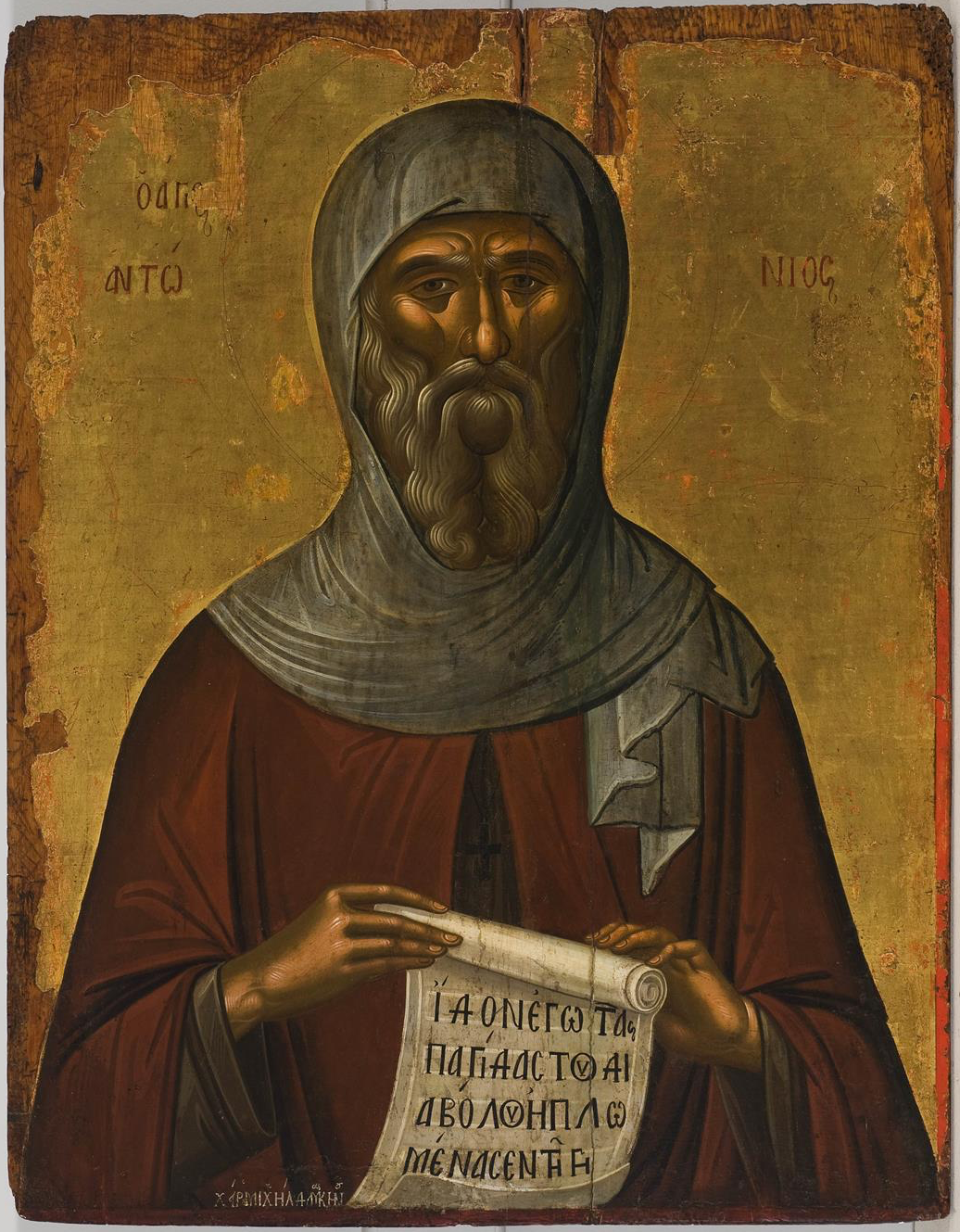
In art, S. Antony appears (1), with a hog which has a bell attached to its neck. Sometimes, however, S. Antony holds the bell. He was regarded as the Patron of the Hospitallers; and when ordinances were passed forbidding the poor from allowing their swine to run loose about the streets, as they were often in the way of horses, an exception was made in favour of the pigs of the hospitallers, on consideration of their wearing a bell round their necks. But it is possible that this did not originate the symbol, but that rather, on account of the hog being the symbol of S. Antony, the Antonine Hospitallers were allowed to preserve theirs, and that the hog represents the flesh which S. Antony controlled, and the bell is a common symbol of hermits; (2), he is represented with his peculiar cross. The cross of S. Antony is a crutch, or the Egyptian cross, like the letter T.
Alban Butler: January–March · ST. ANTONY, ABBOT,
From his life, compiled by the great St. Athanasius, vol. 2, p. 743, a work much commended by St. Gregory Nazianzen, St. Jerom, St. Austin, Rufinus, Palladius, &c. St. Chrysostom recommends to all persons the reading of this pious history, as full of instruction and edification. Hom. 8, in Matt t. 7. p. 128. It contributed to the conversion of St. Austin. Confess. l. 8, c. 6 and 28. See Tillemont, t. 7, Helyot, t. 1, Stevens, Addit. Mon. Anglic. t. 1, Ceillier, &c.
ST. ANTONY was born at Coma, a village near Heraclea, or Great Heracleopolis, in Upper Egypt, on the borders of Arcadia, or Middle Egypt, in 251. His parents, who were Christians, and rich, to prevent his being tainted by bad example and vicious conversation, kept him always at home; so that he grew up unacquainted with any branch of human literature, and could read no language but his own.[1] He was remarkable from his childhood for his temperance, a close attendance on church duties, and a punctual obedience to his parents. By their death he found himself possessed of a very considerable estate, and charged with the care of a younger sister, before he was twenty years of age. Near six months after, he heard read in the church those words of Christ to the rich young man: _Go sell what thou hast, and give it to the poor, and thou shalt have treasure in heaven._[2] He considered these words as addressed to himself; going home, he made over to his neighbors three hundred _aruras_,[3] that is, above one hundred and twenty acres of good land, that he and his sister might be free forever from all public taxes and burdens. The rest of his estate he sold, and gave the price to the poor, except what he thought necessary for himself and his sister. Soon after, hearing in the church those other words of Christ; _Be not solicitous for to-morrow_;[4] he also distributed in alms the moveables which he had reserved; and placed his sister in a house of virgins,[5] which most moderns take to be the first instance mentioned in history of a nunnery. She was afterwards intrusted with the care and direction of tethers in that holy way of life. Antony himself retired into a solitude, near his village, in imitation of a certain old man, who led the life of a hermit in the neighborhood of Coma. Manual labor, prayer, and pious reading, were his whole occupation: and such was his fervor, that if he heard of any virtuous recluse, he sought him out, and endeavored to make the best advantage of his {166} example and instructions. He saw nothing practised by any other in this service of God, which he did not imitate: thus he soon became a perfect model of humility, Christian condescension, charity, prayer, and all virtues. The devil assailed him by various temptations; first, he represented to him divers good works he might have been able to do with his estate in the world, and the difficulties of his present condition: a common artifice of the enemy, whereby he strives to make a soul slothful or dissatisfied in her vocation, in which God expects to be glorified by her. Being discovered and repulsed by the young novice, he varied his method of attack, and annoyed him night and day with filthy thoughts and obscene imaginations. Antony opposed to his assaults the strictest watchfulness over his senses, austere fasts, humility, and prayer, till Satan, appearing in a visible form, first of a woman coming to seduce him, then of a black boy to terrify him, at length confessed himself vanquished. The saint's food was only bread, with a little salt, and he drank nothing but water; he never ate before sunset, and sometimes only once in two, or four days: he lay on a rush mat, or on the bare floor. In quest of a more remote solitude he withdrew further from Coma, and hid himself in an old sepulchre; whither a friend brought him from time to time a little bread. Satan was here again permitted to assault him in a visible manner, to terrify him with dismal noises; and once he so grievously beat him, that he lay almost dead, covered with bruises and wounds; and in this condition he was one day found by his friend, who visited him from time to time to supply him with bread, during all the time he lived in the ruinous sepulchre. When he began to come to himself, though not yet able to stand, he cried out to the devils, while he yet lay on the floor, "Behold! here I am; do all you are able against me: nothing shall ever separate me from Christ my Lord." Hereupon the fiends appearing again, renewed the attack, and alarmed him with terrible clamors, and a variety of spectres, in hideous shapes of the most frightful wild beasts, which they assumed to dismay and terrify him; till a ray of heavenly light breaking in upon him, chased them away, and caused him to cry out: "Where wast thou, my Lord and my Master? Why wast thou not here, from the beginning of my conflict, to assuage my pains!" A voice answered: "Antony, I was here the whole time; I stood by thee, and beheld thy combat: and because thou hast manfully withstood thine enemies, I will always protect thee, and will render thy name famous throughout the earth." At these words the saint arose, much cheered, and strengthened, to pray and return thanks to his deliverer. Hitherto the saint, ever since his retreat, in 272, had lived in solitary places not very far from his village; and St. Athanasius observes, that before him many fervent persons led retired lives in penance and contemplation, near the towns; others remaining in the towns imitated the same manner of life. Both were called ascetics, from their being entirely devoted to the most perfect exercises of mortification and prayer, according to the import of the Greek word. Before St. Athanasius, we find frequent mention made of such ascetics: and Origen, about the year 219,[6] says they always abstained from flesh, no less than the disciples of Pythagoras. Eusebius tells us that St. Peter of Alexandria practised austerities equal to those of the ascetics; he says the same of Pamphilus; and St. Jerom uses the same expression of Pierius. St. Antony had led this manner of life near Coma, till resolving to withdraw into the deserts about the year 285, the thirty-fifth of his age, he crossed the eastern branch of the Nile, and took up his abode in the ruins of an old castle on the top of the mountains; in which close solitude he lived almost twenty years, very {167} rarely seeing any man, except one who brought him bread every six months.
To satisfy the importunities of others, about the year 305, the fifty-fifty of his age, he came down from his mountain, and founded his first monastery at Phaium.[7] The dissipation occasioned by this undertaking led him into a temptation of despair, which he overcame by prayer and hard manual labor. In this new manner of life his daily refection was six ounces of bread soaked in water, with a little salt; to which he sometimes added a few dates. He took it generally after sunset, but on some days at three o'clock; and in his old age he added a little oil. Sometimes he ate only once in three or four days, yet appeared vigorous, and always cheerful: strangers knew him from among his disciples by the joy which was always painted on his countenance, resulting from the inward peace and composure of his soul. Retirement in his cell was his delight, and divine contemplation and prayer his perpetual occupation. Coming to take his refection, he often burst into tears, and was obliged to leave his brethren and the table without touching any nourishment, reflecting on the employment of the blessed spirits in heaven, who praise God without ceasing.[8] He exhorted his brethren to allot the least time they possibly could to the care of the body. Notwithstanding which, he was very careful never to place perfection in mortification, as Cassian observes, but in charity, in which it was his whole study continually to improve his soul. His under garment was sackcloth over which he wore a white coat of sheep-skin, with a girdle. He instructed his monks to have eternity always present to their minds, and to reflect every morning that perhaps they might not live till night, and every evening that perhaps they might never see the morning; and to perform every action, as if it were the last of their lives, with all the fervor of their souls to please God. He often exhorted them to watch against temptations, and to resist the devil with vigor: and spoke admirably of his weakness, saying: "He dreads fasting, prayer, humility, and good works: he is not able even to stop my mouth who speak against him. The illusions of the devil soon vanish, especially if a man arms himself with the sign of the cross.[9] The devils {168} tremble at the sign of the cross of our Lord, by which he triumphed over and disarmed them."[10] He told them in what manner the fiend in his rage had assaulted him by visible phantoms, but that these disappeared while he persevered in prayer. He told them, that once when the devil appeared to him in glory, and said, "Ask what you please; I am the power of God:" he invoked the holy name of Jesus, and he vanished. Maximinus renewed the persecution in 311; St. Antony, hoping to receive the crown of martyrdom, went to Alexandria, served and encouraged the martyrs in the mines and dungeons, before the tribunals, and at the places of execution. He publicly wore his white monastic habit, and appeared in the sight of the governor; yet took care never presumptuously to provoke the judges, or impeach himself, as some rashly did. In 312 the persecution being abated, he returned to his monastery, and immured himself in his cell. Some time after he built another monastery, called Pispir, near the Nile; but he chose, for the most part, to shut himself up in a remote cell upon a mountain of difficult access, with Macarius, a disciple, who entertained strangers. If he found them to be _Hierosolymites_, or spiritual men, St. Antony himself sat with them in discourse; if Egyptians, (by which name they meant worldly persons,) then Macarius entertained them, and St. Antony only appeared to give them a short exhortation. Once the saint saw in a vision the whole earth covered so thick with snares, that it seemed scarce possible to set down a foot without falling into them. At this sight he cried out, trembling: "Who, O Lord, can escape them all?" A voice answered him "Humility, O Antony!"[11] St. Antony always looked upon himself as the least and the very outcast of mankind; he listened to the advice of every one, and professed that he received benefit from that of the meanest person. He cultivated and pruned a little garden on his desert mountain, that he might have herbs always at hand to present a refreshment to those who, on coming to see him, were always weary by travelling over a vast wilderness and inhospitable mountain, as St. Athanasius mentions. This tillage was not the only manual labor in which St. Antony employed himself. The same venerable author speaks of his making mats as an ordinary occupation. We are told that he once fell into dejection, finding uninterrupted contemplation above his strength; but was taught to apply himself at intervals to manual labor, by a vision of an angel who appeared platting mats of palm-tree leaves, then rising to pray, and after some time sitting down again to work; and who at length said to him, "Do thus, and thou shalt be saved."[12] But St. Athanasius informs us, that our saint continued in some degree to pray while he was at work. He watched great part of the nights in heavenly contemplation; and sometimes, when the rising sun called him to his daily tasks, he complained that its visible light robbed him of the greater interior light which he enjoyed, and interrupted his close application and solitude.[13] He always rose after a short sleep at midnight, and continued in prayer, on his knees with his hands lifted up to heaven till sunrise, and sometimes till three in the afternoon, as Palladius relates in his Lausiac history.
St. Antony; in the year 339, saw in a vision, under the figure of mules kicking down the altar, the havoc which the Arian persecution made two years after in Alexandria, and clearly foretold it, as St. Athanasius, St. Jerom, and St. Chrysostom assure us.[14] He would not speak to a heretic, unless to exhort him to the true faith; and he drove all such from his mountain, calling them venomous serpents.[15] At the request of the bishops, about {169} the year 355, he, took a journey to Alexandria, to confound the Arians, preaching aloud in that city, that God the Son is not a creature, but of the same substance with the Father; and that the impious Arians, who called him a creature, did not differ from the heathens themselves, _who worshipped and served the creature rather than the Creator_. All the people ran to see him, and rejoiced to hear him; even the pagans, struck with the dignity of his character, flocked to him; saying, "We desire to see the man of God." He converted many, and wrought several miracles: St. Athanasius conducted him back as far as the gates of the city, where he cured a girl possessed by the devil. Being desired by the duke or general of Egypt, to make a longer stay in the city than he had proposed, he answered: "As fish die if they leave the water, so does a monk if he forsakes his solitude."[16]
St. Jerom and Rufin relate, that at Alexandria he met with the famous Didymus, and told him that he ought not to regret much the loss of eyes. which were common to ants and flies, but to rejoice in the treasure of that interior light which the apostles enjoyed, and by which we see God, and kindle the fire of his love in our souls. Heathen philosophers, and others, often went to dispute with him, and always returned much astonished at his humility, meekness, sanctity, and extraordinary wisdom. He admirably proved to them the truth and security of the Christian religion, and confirmed it by miracles. "We," said he, "only by naming Jesus Christ crucified, put to flight those devils which you adore as gods; and where the sign of the cross is formed, magic and charms lose their power." At the end of this discourse he invoked Christ, and signed with the cross twice or thrice several persons possessed with devils; in the same moment they stood up sound, and in their senses, giving thanks to God for his mercy in their regard.[17] When certain philosophers asked him how he could spend his time in solitude, without the pleasure of reading books, he replied, that nature was his great book, and amply supplied the want of others. When others, despising him as an illiterate man, came with the design to ridicule his ignorance, he asked them with great simplicity, which was first, reason or learning, and which had produced the other? The philosophers answered, "Reason, or good sense." "This, then," said Antony, "suffices." The philosophers went away astonished at the wisdom and dignity with which he prevented their objections. Some others demanding a reason of his faith in Christ, on purpose to insult it, he put them to silence by showing that they degraded the notion of the divinity, by ascribing to it infamous human passions, but that the humiliation of the cross is the greatest demonstration of infinite goodness, and its ignominy appears the highest glory, by the triumphant resurrection, the miraculous raising of the dead, and curing of the blind and the sick. He then admirably proved, that faith in God and his works is more clear and satisfactory than the sophistry of the Greeks. St. Athanasius mentions that he disputed with these Greeks by an interpreter.[18] Our holy author assures us, that no one visited St. Antony under any affliction and sadness, who did not return home full of comfort and joy; and he relates many miraculous cures wrought by him, also several heavenly visions and revelations with which he was favored. Belacius, the duke or general of Egypt, persecuting the Catholics with extreme fury, St. Antony, by a letter, exhorted him to leave the servants of Christ in peace. Belacius tore the letter, then spit and trampled upon it, and threatened to make the abbot the next victim of his fury; but five days after, as he was riding with Nestorius, governor of Egypt, their horses began to play and prance, and the governor's horse, though otherwise remarkably tame, by {170} justling, threw Belacius from his horse, and by biting his thigh, tore it in such a manner that the general died miserably on the third day.[19] About the year 337, Constantine the Great, and his two sons, Constantius and Constans, wrote a joint letter to the saint; recommending themselves to his prayers, and desiring an answer. St. Antony seeing his monks surprised, said, without being moved: "Do not wonder that the emperor writes to us, one man to another; rather admire that God should have wrote to us, and that he has spoken to us by his Son." He said he knew not how to answer it: at last, through the importunity of his disciples, he penned a letter to the emperor and his sons, which St. Athanasius has preserved; and in which he exhorts them to the contempt of the world, and the constant remembrance of the judgment to come. St. Jerom mentions seven other letters of St. Antony, to divers monasteries, written in the style of the apostles, and filled with their maxims: several monasteries of Egypt possess them in the original Egyptian language. We have them in an obscure, imperfect, Latin translation from the Greek.[20] He inculcates perpetual watchfulness against temptations, prayer, mortification, and humility.[21] He observes, that as the devil fell by pride, so he assaults virtue in us principally by that temptation.[22] A maxim which he frequently repeats is, that the knowledge of ourselves is the necessary and only step by which we call ascend to the knowledge and love of God. The Bollandists[23] give us a short letter of St. Antony to St. Theodorus, abbot of Tabenna, in which he says that God had assured him in a revelation, that he showed mercy to all true adorers of Jesus Christ, though they should have fallen, if they sincerely repented of their sin. No ancients mention any monastic rule written by St. Antony.[24] His example and instructions have been the most perfect rule for the monastic life to all succeeding ages. It is related[25] that St. Antony, hearing his disciples express their surprise at the great multitudes who embraced a monastic life, and applied themselves with incredible ardor to the most austere practices of virtue, told them with tears, that the time would come when monks would be fond of living in cities and stately buildings, and of eating at dainty tables, and be only distinguished from persons of the world by their habit; but that still, some among them would arise to the spirit of true perfection, whose crown would be so much the greater, as their virtue would be more difficult, amid the contagion of bad example. In the discourses which this saint made to his monks, a rigorous self-examination upon all their actions, every evening, was a practice which he strongly inculcated.[26] In an excellent sermon which he made to his disciples, recorded by St. Athanasius,[27] he pathetically exhorts them to contemn the whole world for heaven, to spend every day as if they knew it to be the last of their lives, having death always before their eyes, continually to advance in fervor, and to be always armed against the assaults of Satan, whose weakness he shows at length. He extols the efficacy of the sign of the cross in chasing him, and dissipating his illusions, and lays down rules for the discernment of spirits, the first of which is, that the devil leaves in the soul impressions of fear, sadness, confusion, and disturbance.
St. Antony performed the visitation of his monks a little before his death, which he foretold them with his last instructions, but no tears could move him to die among them. It appears from St. Athanasius, that the Christians had learned from the pagans their custom of embalming the bodies of the dead, which abuse, as proceeding from vanity and sometimes superstition, St. Antony had often condemned: this he would prevent, and ordered that his body should be buried in the earth, as the patriarchs were, and privately, on his mountain, by his two disciples Diacarius and Amathas, who had remained with him the last fifteen years, to serve him in his remote cell in his old age. He hastened back to that solitude, and some time after fell sick: he repeated to these two disciples his orders for their burying his body secretly in that place, adding; "In the day of the resurrection, I shall receive it incorruptible from the hand of Christ." He ordered them to give one of his sheep-skins, with a cloak[28] in which he lay, to the bishop Athanasius, as a public testimony of his being united in faith and communion with that holy prelate; to give his other sheep-skin to the bishop Serapion; and to keep for themselves his sackcloth. He added; "Farewell, my children, Antony is departing, and will be no longer with you." At these words they embraced him, and he, stretching out his feet, without any other sign calmly ceased to breathe. His death happened in the year 355, probably on the 17th of January, on which the most ancient Martyrologies name him, and which the Greek empire kept as a holyday soon after his death. He was one hundred and five years old. From his youth to that extreme old age, he always maintained the same fervor in his holy exercises: age to the last never made him change his diet (except in the use of a little oil) nor his manner of clothing; yet he lived without sickness, his sight was not impaired, his teeth were only worn, and not one was lost or loosened. The two disciples interred him according to his directions. About the year 561, his body[29] was discovered, in the reign of Justinian, and with great solemnity translated to Alexandria, thence it was removed to Constantinople, and is now at Vienne in France. Bollandus gives us an account of many miracles wrought by his intercession; particularly in what manner the distemper called the Sacred Fire, since that time St. Antony's Fire, miraculously ceased through his patronage, when it raged violently in many parts of Europe, in the eleventh century.
A most sublime gift of heavenly contemplation and prayer was the fruit of this great saint's holy retirement. Whole nights seemed to him short in those exercises, and when the rising sun in the morning seemed to him too soon to call him from his knees to his manual labor, or other employments, he would lament that the incomparable sweetness which he enjoyed, in the more perfect freedom with which his heart was taken up in heavenly contemplation in the silent watching of the night, should be interrupted or abated. But the foundation of his most ardent charity, and that sublime contemplation by which his soul soared in noble and lofty flights above all earthly things, was laid in the purity and disengagement of his affections, the contempt of the world, a most profound humility, and the universal mortification of his senses and of the powers of his soul. Hence flowed that constant tranquillity and serenity of his mind, which was the best proof of a perfect mastery of his passions. St. Athanasius observes of him, that after thirty years spent in the closest solitude, "he appeared not to others with a sullen or savage, but with a most obliging sociable air."[30] A heart that is filled with inward peace, simplicity, goodness, and charity, is a stranger to a lowering or contracted look. The main point in Christian mortification is the humiliation of the heart, one of its principal ends being the subduing of the passions. Hence, true virtue always increases the sweetness and gentleness of the mind, though this is attended with an invincible constancy, and an inflexible firmness in every point of duty. That devotion or self-denial is false or defective which betrays us into pride or uncharitableness; and whatever makes us sour, morose, or peevish, makes us certainly worse, and instead of begetting in us a nearer resemblance of the divine nature, gives us a strong tincture of the temper of devils.
Footnotes: 1. St. Athanasius commends St. Antony's love of reading, both when he lived with his father, (p. 795, B.) and afterwards when he lived alone, (p. 797, C.) which we cannot naturally understand of his hearing others read, especially when he was alone; therefore, when St. Athanasius says, (p. 795, A.) that in his childhood he never applied himself to the study of letters, [Greek: grammata mathein], fearing the danger of falling into had company at school, he seems to mean only Greek letters, then the language of all the learned; for he must have learned at home the Egyptian alphabet. In the same manner we are to understand Evagrius and others, who relate, that a certain philosopher expressing his surprise how St. Antony could employ his time, being deprived of the pleasure of reading, the saint told him that the universe was his book. (Socr. l. 4, c. 23, Rosweide, Vit. Patr. l. 6, c. 4, St. Nilus, l. 4, p. 60.) Nevertheless, St. Austin imagined that St. Antony could read no alphabet, and learned by heart and meditated on the scriptures only by hearing them read by others (S. Aug. de Doctr. Chr. pr. p. 3, t. 3.) See Rosweide, Not. in Vit. S. Antonii. Bolland. 17 Jan. p. 119, Sec.64, Tillem. note 1, p. 666. 2. Matt. xix. 21. 3. An aura was one hundred cubits of land. See Lexicon Constantini. Fleury, l. 8, p. 418. 4. Ibid. vi. 34. 5. [Greek: Parthenon], as St. Athanasius calls it, t. 2, p. 796, ed. Ben. He mentions that St. Antony, long after, paid her a visit, when she was very old, and superior or mistress of many virgins, [Greek: hathegoumenen allos parthenon], n. 54. p. 837. 6. Orig. lib. 5, p. 264. 7. His first monastery was situated near the confines of Upper and Middle Egypt: it at first consisted of scattered cells. To visit some of these brethren, he is mentioned by St. Athanasius (Vit. p. 461) to have crossed the Arsinotic canal, extremely infested with crocodiles. This is sometimes called his monastery near the river, and was situated not far from Aphroditopolis, the lower and more ancient city of that name, in Heptanomis, or Middle Egypt. St. Athanasius seems to place it in Thebais, or Upper Egypt, because it was near the borders, and the boundaries of Upper Egypt were extended much lower by those who divided Egypt only into two parts, the Upper and the Lower; as Sozomen, l. 2, c. 23, and others, frequently did. St. Antony, finding this solitude grow too public, and not bearing the distraction of continual visits, he travelled up the river to seek a more remote wilderness; but after mounting a little way, while he sat on the bank waiting to see a boat pass by, he changed his design, and instead of advancing southward, he went with certain Saracen merchants to the East, and in three days, doubtless on a camel, arrived at the great mountain towards the Red Sea, where he spent the latter years of his life; yet he frequently visited his first monastery, near Aphroditopolis. St. Hilarion going from this latter to St. Antony's great monastery on the mountain, performed that journey in three days, on camels, which a deacon, named Baisan, let to those who desired to visit St. Antony. This latter, near which the saint died, always continued a famous pilgrimage.
Pispir was the monastery of St. Macarius, but is sometimes called St. Antony's, who often visited it. This was situated on the Nile, in Thebais, thirty measures or [Greek: semeia] from St. Antony's mountain, according to Palladius, (Laus. c. 63.) This some understand of Roman miles, others of Egyptian schaeni of thirty furlongs each; thirty schaeni are nine hundred stadia, or one hundred and thirteen miles. Pispir therefore seems not to have been very far from Aphroditopolis. See Kocher, (comment. In fastos Abyssinorum,) in the journal of Bern, ad an. 1761, t. 1, p. 160 and 169.
A monastery, of which St. Antony is titular saint, still subsists a little above the ancient city of Aphroditon on the Nile. It is now called Der-mar-Antinious-el-Bahr, that is, The monastery of Antony at the river. See Pocock, p. 70, and the map prefixed to that part of his travels. Travelling from hence one day's journey up the river, then turning from the south towards the east, over sandy deserts, and a chain of high mountains, in which springs of water, in other parts very rare, are here and there found, and camels travel for one hundred miles, we arrive at St. Antony's great monastery, about six or seven hours journey from the Red Sea. See Pocock, ib. p. 128. Granger, Relation du Voyage, &c., p. 107. Nouv. Memoires des Missions, t. 5, p. 136. Vanslebius, Nouv. Relat. pp. 299 and 309; and Maillet. Descr. de 'Egypte, p. 320. The Grotto of St. Paul is shown not very far from this great monastery; yet the road wing [sic] round the mountains, and a great way about it, seems to travellers as a great distance from it. 8. St. Athan. Vit. Anton. n. 45, p. 830. 9. P. 814. 10. P. 823, ed. Ben. 11. Rosweide, l. 3, c. 129. Cotelier, &c. 12. S. Nilus, ep. 24. Cotelier, Apoth. Patr. p. 340. Rosweide, Vit. Patr. l. 3, c. 105, l. 5, c. 7. 13. Cassian, Collat. c. 31. 14. S. Athan. n. 82, p. 857. S. Chrys. Hom. 8, in Matt. S. Hier. ep. {}6. Sozom. l. 6, c. 5. 15. S. Athan. n. 68, 69, p. 847. 16. Ibid. n. 85. p. 859. 17. Ibid. n. 80, p. 855. 18. N. 77, p. 858. 19. N. 86, p. 860. 20. Bibl. Patr. Colon. t. 4, p. 26. See S. Antonii. M. Epistolae 20. cura Abr. Eckellens. Paris, 1641. But only the above-mentioned seven letters can be regarded as genuine, except the discourses preserved by St. Athanasius in his life. 21. Ep. 2, ad Arsinoitas. 22. Ib. 23. Maij. t. 3, p. 355. 24. That under his name in Abraham Eckellensis is not of so high a pedigree. A large body of the monks of St. Basil in the East, since the seventh century, take the name of the Order of St. Antony, but retain the rule of St. Basil, comprised in his ascetic writings; and observe the same fasts, and other exercises, with all the other monks of the East, who are called of the order of St. Basil; which even the Maronites follow; though Tillemont denies it by mistake. 25. Rosweide, Vit. Patr. l. 5, c. 8. Abr. Eckellens. in Vit. S. Ant. p. 106. Cotel. p. 344. Mart. Coptor. 26. S. Athan. n. 55, p. 858. 27. N. 16 & 43. 28. The Ependytes of St. Antony, mentioned by St. Athanasius, n. 46, p. 831, has much embarrassed the critics: it seems to have been a cloak of white wool. It is clear, from St. Athanasius, that St. Antony's inner garment was a hair-cloth, over which he wore a cloak made of sheep-skin. 29. This translation of his relics to Alexandria, though doubted of by some Protestants, is incontestably confirmed by Victor of Tunone, (Chron. p. 11, in Scalig. Thesauro,) who lived then in banishment at Canope, only twelve miles from Alexandria; also, by St. Isidore of Seville, in the same age, Bede. Usuard, &c. They were removed to Constantinople when the Saracens made themselves masters of Egypt, about the year 635. (pee Bollandus, pp. 162, 1134.) They were brought to Vienne in Dauphine, by Joselin, a nobleman of that country, whom the emperor of Constantinople had gratified with that rich present, about the year 1070. These relics were deposited in the church of La Motte S. Didier, not far from Vienne, then a Benedictin priory belonging to the abbey of Mont-Majour near Arles, but now an independent abbey of regular canons of St. Antony. In 1089, a pestilential erysipelas distemper, called the Sacred Fire, swept off great numbers in most provinces of France; public prayers and processions were ordered against this scourge; at length it pleased God to grant many miraculous cures of this dreadful distemper, to those who implored his mercy trough the intercession of St. Antony, especially before his relics; the church in which they were deposited was resorted to by great numbers of pilgrims, and his patronage was implored over the whole kingdom against this disease. A nobleman near Vienne, named Gaston, and his son Girond, devoted themselves and their estate to found and serve an hospital near this priory, for the benefit of the poor that were afflicted with this distemper: seven others joined them in their charitable attendance on the sick, whence a confraternity of laymen who served this hospital took its rise, and continued till Boniface VIII. converted the Benedictin priory into an abbey, which he bestowed on those hospitaller brothers, and giving them the religious rule of regular canons of St. Austin, declared the abbot general of this new order, called Regular Canons of St. Antony. An abbey in Paris, which belongs to this order, is called Little St. Antony's, by which name it is distinguished from the great Cistercian nunnery of St. Antony. The general or abbot of St. Antony's, in Viennois, enjoys a yearly revenue of about forty thousand livres according to Piganiol, Descr. de la Fr. t. 4, p. 249, and Dom Beaunier, Rec. Abbayes de Fr. p. 982. The superiors of other houses of this order retain the name of commanders, and the houses are called commaranderies, as when they were hospitallers; so that the general is the only abbot. See Bollandus, Beaunict, F. Longueval, Hist. de l'Eglise de France, l. 22, t. 8, p. 16, and Drouet, in the late edition of Moreri's Hist. Diction V Antoine, from memoirs communicated by M. Bordet, superior of the convent of this order at Paris. 30. S. Athan. n. 67, p. 847, & n. 73, p. 850.