
Benedict of Nursia
Martyrological notice
[Roman Martyrology, Benedictine, that of Bede. Greek Menologium on March 14th. Authorities:--Life written by S. Gregory the Great, in the second book of his dialogues; S. Gregory received his information from the lips of four disciples of the holy patriarch, Constantine, Honoratus, Valentinian, and Simplicius, the two first of whom had succeeded him as abbots respectively of Monte Cassino and Subiaco. Also the Chronicon Casinense, the first three books containing the life of S. Benedict by Leo Marsicanus, B. of Ostia, a monk of Monte Casino; the fourth book was added by Paulus Diacomus. The following life has been condensed from that by M. de Montalembert in his "Monks of the West."]
Baring-Gould: March · S. BENEDICT, AB.
[Roman Martyrology, Benedictine, that of Bede. Greek Menologium on March 14th. Authorities:--Life written by S. Gregory the Great, in the second book of his dialogues; S. Gregory received his information from the lips of four disciples of the holy patriarch, Constantine, Honoratus, Valentinian, and Simplicius, the two first of whom had succeeded him as abbots respectively of Monte Cassino and Subiaco. Also the Chronicon Casinense, the first three books containing the life of S. Benedict by Leo Marsicanus, B. of Ostia, a monk of Monte Casino; the fourth book was added by Paulus Diacomus. The following life has been condensed from that by M. de Montalembert in his "Monks of the West."]
S. Benedict was born in the year of our Lord 480. Europe has, perhaps, never known a more calamitous or apparently desperate period than that which reached its climax at this date. Confusion, corruption, despair, and death were everywhere; social dismemberment seemed complete. Authority, morals, laws, sciences, arts, religion herself, might have been supposed condemned to irremediable ruin. The germs of a splendid and approaching revival were still hidden from all eyes under the ruins of a crumbling world. The Church was more than ever infected by heresy, schisms, and divisions, which the obscure successors of S. Leo the Great in the Holy See endeavoured in vain to repress. In all the ancient Roman world there did not exist a prince who was not either a pagan, an Arian, or an Eutychian. The monastic institution, after having given so many doctors and saints to the Church in the East, was drifting toward that descent which it never was doomed to reascend; and even in the West, some symptoms of premature decay had already appeared.
Germany was still entirely pagan, as was also Great Britain, where the new-born faith had been stifled by the Angles and Saxons. Gaul was invaded on the north by the pagan Franks, and on the south by the Arian Burgundians. Spain was overrun and ravaged by the Visigoths, the Sueves, the Alans, and the Vandals, all Arians. The same Vandals, under the successor of Genseric, made Christian Africa desolate, by a persecution more unpitying and refined in cruelty than those of the Roman emperors. In a word, all those countries into which the first disciples of Jesus Christ carried the faith, had fallen a prey to barbarianism. The world had to be re-conquered.
Amidst this universal darkness and desolation, history directs our gaze towards those heights in the centre of Italy, and at the gates of Rome, which detach themselves from the chain of the Apennines, and extend from the ancient country of the Sabines to that of the Samnites. A single solitary was about to form there a centre of spiritual virtue, and to light it up with a splendour destined to shine over regenerated Europe for ten centuries to come.
Fifty miles to the west of Rome, among that group of hills where the Anio hollows a deep gorge, the traveller, ascending by the course of the river, reaches a basin, which opens out between two immense walls of rock, and from which a limpid stream pours from fall to fall, to a place called Subiaco. This grand and picturesque site had attracted the attention of Nero. He confined the waters of the Anio by dams, and constructed artificial lakes below, before a delicious villa, which, from its position, assumed the name of _Sublaqueum_, and of which some shapeless ruins remain. Four centuries after Nero, when solitude and silence had long replaced the imperial orgies, a young patrician flying from the delights and dangers of Rome, sought there a refuge with God. He had been baptized under the name of Benedictus, or the Blessed. He belonged to the illustrious Anician family; by his mother's side he was the last scion of the lords of Nursia, where he was born, as has been said, in 480. He was scarce fourteen when he resolved to renounce fortune, his family, and the happiness of this world. Leaving his old nurse, who had been the first to love him, and who alone followed him still, he plunged, in 494, into these wild gorges, and ascended those savage hills. On the way he met a monk, named Romanus, who gave him a hair shirt and a monastic habit made of skin.[81] Proceeding on his ascent, and reaching the middle of the abrupt rock, which faces the south, and which overhangs the Anio, he discovered a dark cave, a sort of den, unillumined by the sun. He there took up his abode, and remained unknown to all, except the monk Romanus, who fed him with the remainder of his own scanty fare, but who, not being able to reach his cell, transmitted to him every day, at the end of a cord, a loaf and a little bell, the sound of which warned him of this sustenance which charity had provided for him.
[81] The locality of the meeting is indicated by a chapel called S. Crocella.
He lived three entire years in this tomb. The shepherds who discovered him there at first took him for a wild beast, but by his discourses, and the efforts he made to instil grace and piety into their rustic souls, they recognised in him a servant of God. Temptations were not wanting to him. The allurements of voluptuousness acted so strongly on his excited senses, that he was on the point of leaving his retreat to seek after a woman whose beauty had formerly impressed him, and whose memory haunted him incessantly. But there was near his grotto a clump of thorns and briers: he took off the vestments of skins, which was his only dress, and rolled himself among them naked till his body was all one wound, but also till he had extinguished for ever the infernal fire which inflamed him even in the desert.
Seven centuries later, another saint, father of the most numerous monastic family which the church has produced after that of S. Benedict, S. Francis of Assisi, came to visit that wild site, which was worthy to rival the bare Tuscan rock, where the stigmata of the passion were imprinted on himself. He prostrated himself before the thicket of thorns which had been a triumphal bed to the masculine virtue of the patriarch of the monks, and after having bathed with his tears the soil of that glorious battle-field, he planted there two rose trees. The roses of S. Francis grew, and have survived the Benedictine briers. This garden, twice sanctified, still occupies a sort of triangular plateau, which projects upon the side of the rock, a little before and beneath the grotto which sheltered S. Benedict. The eye, confined on all sides by rocks, can survey freely only the azure of heaven. It is the last of those sacred places visited and venerated in the celebrated and unique monastery of the Iagro Speco, which forms a series of sanctuaries, built one over the other, backed by the mountain which Benedict has immortalized. Such was the hard and savage cradle of the monastic order in the West. It was from this tomb, where the delicate son of the last patricians of Rome buried himself alive, that the definite form of monastic life--that is to say, the perfection of Christian life--was born.
The solitude of the young anchorite was not long respected. The faithful in the neighbourhood, who brought him food for the body, asked the bread of life in return. The monks of a neighbouring monastery, situated near Vico Varo, obtained, by dint of importunity, his consent to become their ruler, but, soon disgusted by his austerity, they endeavoured to poison him. He made the sign of the cross over the vessel which contained the poison, and it broke as if it had been struck with a stone. He left these unworthy monks, to re-enter joyfully his beloved cavern, and to live by himself alone. But it was in vain: he soon found himself surrounded by such a multitude of disciples, that, to give them a shelter, he was compelled to found in the neighbourhood of his retreat twelve monasteries, each inhabited by twelve monks. He kept some with him, in order to direct them himself, and was thus finally raised to be the superior of a numerous community of cenobites.
Clergy and laymen, Romans and barbarians, victors and vanquished, alike flocked to him, attracted by the fame of his virtue and miracles. While the celebrated Theodoric, at the head of his Goths, up to that time invincible, destroyed the ephemeral kingdom of the Hercules, seized Rome, and overspread Italy, other Goths came to seek faith, penitence, and monastic discipline under the laws of Benedict. At his command they armed themselves with axes and hatchets, and employed their robust strength in rooting out the brushwood and clearing the soil, which, since the time of Nero, had again become a wilderness. The Italian painters of the great ages of art have left us many representations of the legend told by S. Gregory, in which S. Benedict restores to a Goth who had become a convert at Subiaco, the tool which that zealous but unskilled workman had dropped to the bottom of the lake, and which the abbot miraculously brought forth. "Take thy tool," said Benedict to the barbarian woodcutter,--"take it, work, and be comforted." Symbolical words, in which we find an abridgment of the precepts and examples lavished by the monastic order on so many generations of conquering races: _Ecce labora._
Beside these barbarians already occupied in restoring the cultivation of that Italian soil which their brethren in arms still wasted, were many children of the Roman nobility, whom their fathers had confided to Benedict to be trained to the service of God. Among these young patricians are two whose names are celebrated in Benedictine annals: Maur, whom the abbot Benedict made his own coadjutor; and Placidus, whose father was lord of the manor of Subiaco, which did not prevent his son from rendering menial services to the community, such as drawing water from the lake of Nero. The weight of his pitcher one day overbalanced him, and he fell into the lake. We shall leave Bossuet to tell the rest, in his panegyric, delivered twelve centuries afterwards before the sons of the founder of Subiaco:--
"S. Benedict ordered S. Maur, his faithful disciple, to run quickly and draw the child out. At the word of his master, Maur went away without hesitation, ... and full of confidence in the order he had received, walked upon the water with as much security as upon the earth, and drew Placidus from the whirlpool, which would have swallowed him up. To what shall I attribute so great a miracle, whether to the virtue of the obedience or to that of the commandment? A doubtful question, says S. Gregory, between S. Benedict and S. Maur. But let us say, to decide it, that the obedience had grace to accomplish the command, and that the command had grace to give efficacy to the obedience. Walk, my fathers, upon the waves with the help of obedience; you shall find solid support amid the inconstancy of human things. The waves shall have no power to overthrow you, nor the depths to swallow you up; you shall remain immovable, as if all was firm under your feet, and issue forth victorious."
However, Benedict had the ordinary fate of great men and saints. The great number of conversions worked by the example and fame of his austerity, awakened a homicidal envy against him. A wicked priest of the neighbourhood attempted first to decry and then poison him. Being unsuccessful in both, he endeavoured at least to injure him in the object of his most tender solicitude--in the souls of his young disciples. For that purpose he sent, even into the garden of the monastery, where Benedict dwelt, and where the monks laboured, seven wretched women, whose gestures, sports, and shameful nudity, were designed to tempt the young monks to certain fall. When Benedict, from the threshold of his cell, perceived these shameless creatures, he despaired of his work; he acknowledged that the interest of his beloved children constrained him to disarm so cruel an enmity by retreat. He appointed superiors to the twelve monasteries which he had founded, and, taking with him a small number of disciples, he left for ever the wild gorges of Subiaco, where he had lived for thirty-five years.
Without withdrawing from the mountainous region which extends along the western side of the Apennines, Benedict directed his steps toward the south, along the Abruzzi, and penetrated into that land of labour, the name of which seems naturally suited to a soil destined to be the cradle of the most laborious men whom the world has known. He ended his journey in a scene very different from that of Subiaco, but of incomparable grandeur and majesty. There upon the boundaries of Sammim and Campania, in the centre of a large basin, half-surrounded by abrupt and picturesque heights, rises a scarped and isolated hill, the vast and rounded summit of which overlooks the course of the Liris near its fountain head, and the undulating plain which extends south towards the shores of the Mediterranean, and the narrow valleys which, towards the north, the east, and the west, lost themselves in the lines of the mountainous horizon. This is Monte Cassino.
It was here, amidst this solemn nature, and upon that predestinated height, that the patriarch of the monks of the west founded the capital of the monastic order. He found paganism still surviving there. Two hundred years after Constantine, in the heart of Christendom, and so near Rome, there still existed a very ancient temple of Apollo, and a sacred wood, where a multitude of peasants sacrificed to the gods and demons. Benedict preached the faith of Christ to these forgotten people; he persuaded them to cut down the wood, to overthrow the temple and the idol.
Upon these remains Benedict built two oratories, one dedicated to S. John the Baptist, the first solitary of the new faith; the other to S. Martin, the great monk-bishop, whose ascetic and priestly life had edified Gaul, and reached as far as Italy.
Round these chapels rose the monastery which was to become the most powerful and celebrated in the Catholic universe; celebrated especially because there Benedict wrote his rule, and at the same time formed the type which was to serve as a model to innumerable communities submitted to that sovereign code. It is for this reason that emulous pontiffs, princes, and nations have praised, endowed, and visited the sanctuary where monastic religion, according to the expression of Pope Urban II., "flowed from the heart of Benedict as from a fountain-head of Paradise."
Benedict ended his life at Monte Cassino, where he lived for fourteen years, occupied, in the first place, with extirpating from the surrounding country the remnants of paganism, afterwards in building his monastery by the hands of his disciples, in cultivating the arid sides of his mountain, and the devastated plains around, but above all, in extending to all who approached him the benefits of the law of God, practised with a fervour and charity which none have surpassed. Although he had never been invested with the priestly character, his life at Monte Cassino was rather that of a missionary and apostle than of a solitary. He was, notwithstanding, the vigilant head of a community which flourished and increased more and more. Accustomed to subdue himself in everything, and to struggle with the infernal spirits, whose temptations and appearances were not wanting to him more than to the ancient fathers of the desert, he had acquired the gift of reading souls, and discerning their most secret thoughts. He used this faculty not only to direct the young monks, who always gathered in such numbers round him, in their studies and the labours of agriculture and building which he shared with them; but even in the distant journeys on which they were sometimes sent, he followed them by a spiritual observation, discovered their least failings, reprimanded them on their return, and bound them in everything to a strict fulfilment of the rule which they had accepted. He exacted from all, the obedience, sincerity, and austerely regulated life of which he himself gave the first example.
Many young men of rich and noble families came here, as at Subiaco, to put themselves under his direction, or were confided to him by their parents. They laboured with the other brethren in the cultivation of the soil and the building of the monastery, and were bound to all the services imposed by the rule. Some of the young nobles rebelled in secret against that equality. Among these, according to the narrative of S. Gregory, was the son of a _defender_--that is to say, of the first magistrate of a town or province. One evening, it being his turn to light the Abbot Benedict at supper, while he held the candlestick before the abbotial table, his pride rose within him, and he said to himself, "What is this man that I should thus stand before him while he eats, with a candle in my hand like a slave? Am I then made to be his slave?" Immediately Benedict, as if he had heard him, reproved him sharply for that movement of pride, gave the candle to another, and sent him back to his cell, dismayed to find himself at once discovered and restrained in his most secret thoughts. It was then that the great legislator inaugurated in his new-formed cloister that alliance of aristocratic races with the Benedictine Order which we shall have many generous and fruitful examples to quote.
He bound all--nobles and plebians, young and old, rich and poor--under the same discipline. But he would have excess or violence in nothing, and when he was told of a solitary in the neighbouring mountain, who, not content with shutting himself up in a narrow cave, had attached to his foot a chain, the other end of which was fixed in a rock, so that he could not move beyond the length of this chain, Benedict sent to tell him to break it, in these words, "If thou art truly a servant of God, confine thyself not with a chain of iron, but with the chain of Christ."
And extending his solicitude and authority over the surrounding populations, he did not content himself with preaching eloquently to them the true faith, but also healed the sick, the lepers and the possessed, provided for all the necessities of the soul and body, paid the debts of honest men oppressed by their creditors, and distributed in incessant alms the provisions of corn, wine, and linen which were sent to him by the rich Christians of the neighbourhood.
A great famine having afflicted Campania in 539, he distributed to the poor all the provisions of the monastery, so that one day there remained only five loaves to feed all the community. The monks were dismayed and melancholy: Benedict reproached them with their cowardice. "You have not enough to-day," he said to them, "but you shall have too much to-morrow." And accordingly they found next morning at the gates of the monastery two hundred bushels of flour, bestowed by some unknown hand. Thus were established the foundations of that traditional and unbounded munificence to which his spiritual descendants have remained unalterably faithful, and which was the law and glory of his existence.
So much sympathy for the poor naturally inspired them with a blind confidence in him. One day, when he had gone out with the brethren to labour in the fields, a peasant, distracted with grief, and bearing in his arms the body of his dead son, came to the monastery and demanded to see Father Benedict. When he was told that Benedict was in the fields with the brethren, he threw down his son's body before the door, and, in the transport of his grief, ran at full speed to seek the saint. He met him returning from his work, and from the moment he perceived him, began to cry, "Restore me my son!" Benedict stopped and asked "Have I carried him away?" The peasant answered "He is dead; come and raise him up." Benedict was grieved by these words, and said, "Go home my friend this is not a work for us; this belongs to the holy apostles. Why do you come to impose upon us so tremendous a burden?" But the father persisted, and swore in his passionate distress that he would not go till the saint had raised up his son. The abbot asked him where his son was. "His body" said he "is at the door of the monastery." Benedict, when he arrived there, fell on his knees, and then laid himself down, as Elijah did in the house of the widow of Sarepta, upon the body of the child, and rising up, extended his hands to heaven, praying thus; "Lord look not upon my sins but on the faith of this man, and restore to the body the soul Thou hast taken away from it." Scarcely was his prayer ended, when all present perceived that the whole body of the child trembled. Benedict took him by the hand, and restored him to his father full of life and health.
His virtue, his fame, the supernatural power which was more and more visible in his whole life, made him the natural protector of the poor husbandmen against the violence and rapine of the new masters of Italy. The great Theodoric had organized an energetic and protective government, but he dishonoured the end of his reign by persecution and cruelty; and since his death barbarism had regained all its ancient ascendancy among the Goths. The rural population groaned under the yoke of these rude oppressors, doubly exasperated, as Barbarians and as Arians against the Italian Catholics. To Benedict, the Roman patrician, who had become a serf of God, belonged the noble office of drawing towards each other the Italians and Barbarians, two races cruelly divided by religion, fortune, language, and manners, whose mutual hatred was embittered by so many catastrophes inflicted by the one, and suffered by the other, since the time of Alaric. The founder of Monte Cassino stood between the victors and the vanquished like an all-powerful moderator and inflexible judge. The facts which we are about to relate, according to the narrative of S. Gregory, could be told throughout all Italy, and, spreading from cottage to cottage, would bring unthought of hope and consolation into the hearts of the oppressed, and establish the popularity of Benedict and his order on an immortal foundation in the memory of the people.
It has been seen that there were already Goths among the monks at Subiaco, and how they were employed in reclaiming the soil which their fathers had laid waste. But there were others who, inflamed by heresy, professed a hatred of all that was orthodox and belonged to monastic life. One especially, named Galla, traversed the country panting with rage and cupidity, and made a sport of slaying the priests and monks who fell under his power, and spoiling and torturing the people to extort from them the little that they had remaining. An unfortunate peasant, exhausted by the torments inflicted upon him by the pitiless Goth, conceived the idea of bringing them to an end by declaring that he had confided all that he had to the keeping of Benedict, a servant of God; upon which Galla stopped the torture of the peasant, but, binding his arms with ropes, and thrusting him in front of his own horse, ordered him to go before and show the way to the house of this Benedict who had defrauded him of his expected prey. Both pursued thus the way to Monte Cassino; the peasant on foot, with his hands tied behind his back, urged on by the blows and taunts of the Goth, who followed on horseback, an image only too faithful of the two races which unhappy Italy enclosed within her distracted bosom, and which were to be judged and reconciled by the unarmed majesty of monastic goodness. When they had reached the summit of the mountain they perceived the abbot seated alone, reading at the door of his monastery. "Behold," said the prisoner turning to his tyrant, "there is the Father Benedict of whom I told thee." The Goth, believing that here, or elsewhere, he should be able to make his way by terror, immediately called out with a furious tone to the monk. "Rise up, rise up, and restore quickly what thou hast received from this peasant." At these words the man of God raised his eyes from his book, and, without speaking, slowly turned his gaze first upon the Barbarian on horseback, and then upon the husbandman bound, and bowed down by his cords. Under the light of that powerful gaze the cords which tied his poor arms loosed of themselves, and the innocent victim stood erect and free, while the ferocious Galla, falling on the ground, trembling, and beside himself, remained at the feet of Benedict, begging the saint to pray for him. Without interrupting his reading, Benedict called his brethren, and directed them to carry the fainting Barbarian into the monastery, and give him some blessed bread, and, when he had come to himself, the abbot represented to him the extravagance, injustice, and cruelty of his conduct, and exhorted him to change it for the future. The Goth was completely subdued, and no longer dared to ask anything of the labourer whom the mere glance of the monk had delivered from his bonds.
But this mysterious attraction, which drew the Goths under the influence of Benedict's looks and words, produced another celebrated and significant scene. The two principal elements of reviving society in their most striking impersonation--the victorious Barbarians and the invincible monks--were here confronted. Totila, the greatest of the successors of Theodoric, ascended the throne in 542, and immediately undertook the restoration of the monarchy of the Ostrogoths, which the victories of Belisarius had half overthrown. Having defeated at Faenza, with only five thousand men, the numerous Byzantine army, led by the incapable commanders whom the jealousy of Justinian had substituted for Belisarius, the victorious king made a triumphal progress through Central Italy, and was on his way to Naples when he was seized with a desire to see this Benedict, whose fame was already as great among the Romans as among the Barbarians, and who was everywhere called a prophet. He directed his steps towards Monte Cassino, and caused his visit to be announced. Benedict answered that he would receive him. But Totila desirous of proving the prophetic spirit which was attributed to the saint, dressed the captain of his guard in the royal robes and purple boots, which were the distinctive marks of royalty, gave him a numerous escort, commanded by the three counts who usually guarded his own person, and charged him, thus clothed and accompanied, to present himself to the abbot as the king. The moment that Benedict perceived him, "My son," he cried, "put off the dress you wear; it is not yours." The officer immediately threw himself upon the ground, appalled at the idea of having attempted to deceive such a man. Neither he nor any of the retinue ventured so much as to approach the abbot, but returned at full speed to the king, to tell him how promptly they had been discovered. Then Totila himself ascended the monastic mountain, but when he had reached the height, and saw from a distance the abbot seated, waiting for him, the victor of the Romans, and the master of Italy was afraid. He dared not advance, but threw himself on his face before the servant of Christ. Benedict said to him three times, "Rise." But as he persisted in his prostration, the monk rose from his seat and raised him up. During the course of their interview, Benedict reproved him for all that was blamable in his life, and predicted what should happen to him in the future. "You have done much evil; you do it still every day; it is time that your iniquities should cease. You shall enter Rome; you shall cross the sea; you shall reign nine years, and the tenth you shall die." The king, deeply moved, commended himself to his prayers, and withdrew. But he carried away in his heart this salutary and retributive incident, and from that time his barbarian nature was transformed.
Totila was as victorious as Benedict had predicted that he should be. He possessed himself first of Benevento and Naples, then of Rome, then of Sicily, which he invaded with a fleet of five hundred ships, and ended by conquering Corsica and Sardinia. But he exhibited everywhere a clemency and gentleness which, to the historian of the Goths, seem out of character at once with his origin and his position as a foreign conqueror. He treated the Neapolitans as his children, and the captive soldiers as his own troops, gaining himself immortal honour by the contrast between his conduct and the horrible massacre of the whole population, which the Greeks had perpetrated ten years before, when that town was taken by Belisarius. He punished with death one of his bravest officers, who had insulted the daughter of an obscure Italian, and gave all his goods to the woman whom he had injured, and that despite the representations of the principal nobles of his own nation, whom he convinced of the necessity of so severe a measure, that they might merit the protection of God upon their arms. When Rome surrendered, after a prolonged siege, Totila forbade the Goths to shed the blood of any Roman, and protected the women from insult. At length, after a ten years' reign, he fell, according to the prediction of Benedict, in a great battle which he fought with the Greco-Roman army, commanded by the eunuch Narses.
Placed as if midway between the two invasions of the Goths and Lombards, the dear and holy foundation of Benedict, respected by the one, was to yield for a time to the rage of the other. The holy patriarch had a presentment that his successors would not meet a second Totila to listen to them and spare them. A noble whom he had converted, and who lived on familiar terms with him, found him one day weeping bitterly. He watched Benedict for a long time, and then, perceiving that his tears were not stayed, and that they proceeded not from the ordinary fervour of his prayers, but from profound melancholy, he asked the cause. The saint answered, "This monastery which I have built, and all that I have prepared for my brethren, has been delivered up to the pagans by a sentence of Almighty God. Scarcely have I been able to obtain mercy for their lives." Less than forty years after, this prediction was accomplished by the destruction of Monte Cassino by the Lombards.
Benedict, however, was near the end of his career. His interview with Totila took place in 542, in the year which preceded his death, and from his earliest days of the following year, God prepared him for his last struggle, by requiring from him the sacrifice of the most tender affection he had retained on earth. The beautiful and touching incident of the last meeting of Benedict with his twin sister, Scholastica, has been already recorded (Feb. 10th). At the window of his cell, three days after, Benedict had a vision of his dear sister's soul entering heaven in the form of a snowy dove. He immediately sent for the body, and placed it in the sepulchre which he had already prepared for himself, that death might not separate those whose souls had always been united in God.
The death of his sister was the signal of departure for himself. He survived her only forty days. He announced his death to several of his monks, then far from Monte Cassino. A violent fever having seized him, he caused himself on the sixth day of his sickness to be carried to the chapel of S. John the Baptist; he had before ordered the tomb in which his sister already slept to be opened. There, supported in the arms of his disciples, he received the holy Viaticum, then placing himself at the side of the open grave, but at the foot of the altar, and with his arms extended towards heaven, he died, standing, muttering a last prayer. Died standing!--such a victorious death became well that great soldier of God. He was buried by the side of Scholastica, in a sepulchre made on the spot where stood the altar of Apollo, which he had thrown down.
The body of S. Benedict was carried by S. Aigulf, monk of the abbey of Fleury, from Monte Cassino, which had been ruined by the Lombards, into France, to his own monastery. This translation took place on July 11th, and is commemorated in all the monasteries of France on that day. Another solemnity, called the Illation, has been instituted in honour of the transfer of the same relics from Orleans, whither they had been conveyed, from fear of the Normans, back again to Fleury-sur-Loire. In 1838, the bishop of Orleans resolved on sending the relics to the Benedictine abbey of Solesmes, in the diocese of Le Mans, but the project met with so great opposition that he contented himself with sending only the skull to Solesmes.
The reliquary which was opened in 1805, by Mgr. Bernier, bishop of Orleans, was found to contain, together with the bones, several papal bulls authenticating the relics. It is, however, necessary to add that the abbey of Monte Cassino claims to possess the body of S. Benedict, and adduces a bull of pope Urban II., declaring anathema against all who deny the authenticity of that body. It is possible that if the relics in both places were examined carefully, it would be found that the portions missing in one place would be found in the other. It is certain that S. Odilo of Cluny sent one of the bones of S. Benedict to Monte Cassino out of France, in the 11th cent., and that it was received there with great joy, so that the monks there cannot have possessed the body at that date.
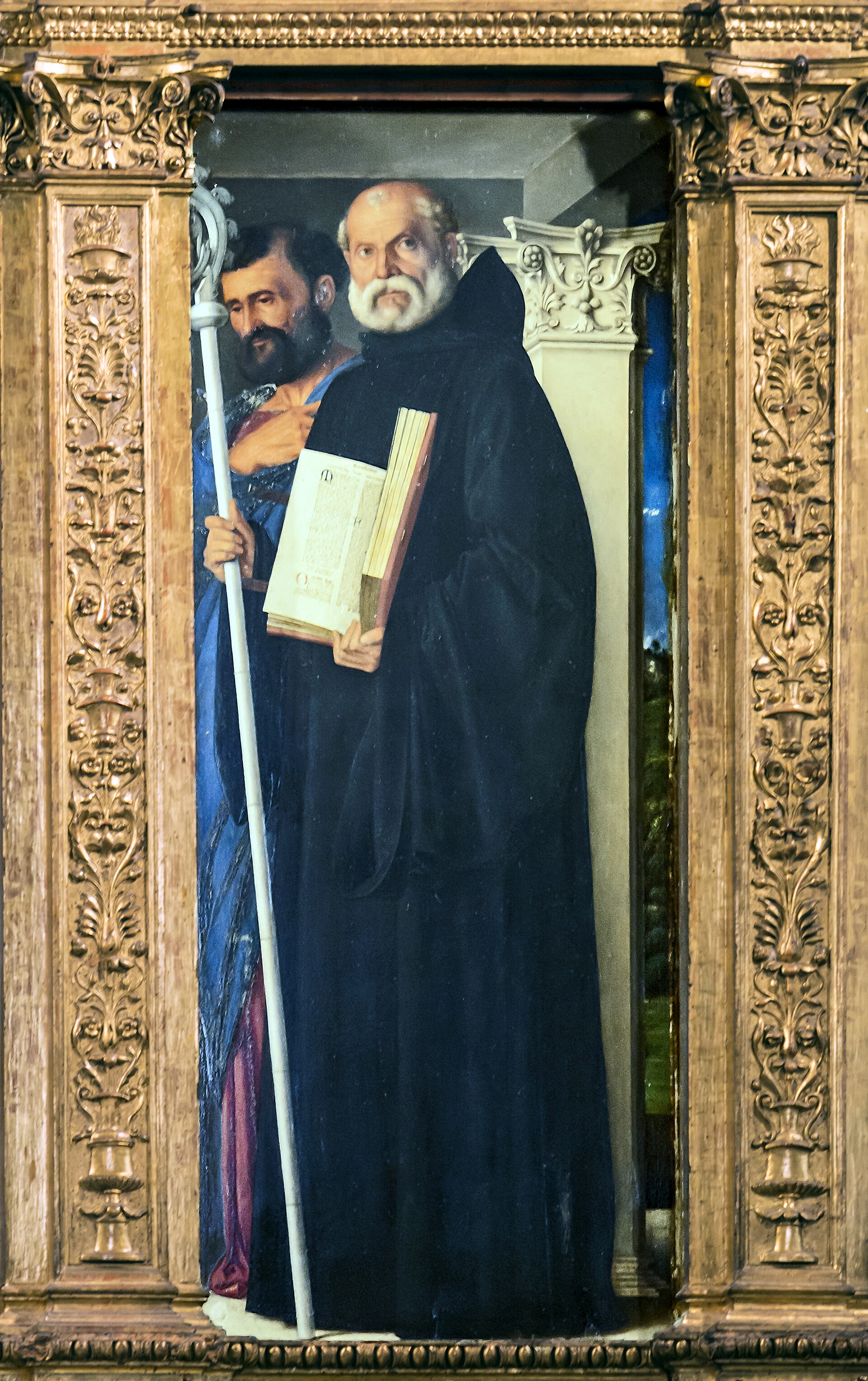
In Art, S. Benedict is represented with his finger on his lip, as enjoining silence, and with his rule in his hand, or with the first words of that rule, "Ausculta, O fili!" issuing from his lips, and with a discipline, _i.e._ a scourge, or a rose bush at his side, or holding a broken goblet in his hand.
Alban Butler: January–March · ST. BENEDICT, ABBOT,
PATRIARCH OF THE WESTERN MONKS.
From St. Gregory, (Dial. l. 2, c. 1,) who assures us that he received his account of this saint from four abbots, the saint's disciples; namely, Constantine, his successor at Monte Cassino, Simplicius, third abbot of that house, Valentinian, the first abbot of the monastery of Lateran, and Honoratus, who succeeded St. Benedict at Subiaco. See the remarks of Mabillon, Annal. Ben. l. 1, p. 3, and l. 2, p. 38. and Act. Sanct. Bened. t. 1, p. 80. Also Dom. Mege, Vie de St. Benoit, avec one Histoire Abregee de son Ordre, in 4to. An. 1690. Haeften's Disquisitions, and abbot Steingelt's abridgment of the same, and Ziegelbauer and Legipont, Historia Literaria Ord. S. Benedicti, Ann. 1754, t. 1, p. 3, and principally t. 3, p. 2.
ST. BENEDICT, or KENNET, was a native of Norcia, formerly an episcopal see in Umbria, and was descended from a family of note, and born about the year 480. The name of his father was Eutropius, and that of his grandfather, Justinian. When he was fit for the higher studies, he was sent by his parents to Rome, and there placed in the public schools. He, who till that time knew not what vice was, and trembled at the shadow of sin, was not a little shocked at the licentiousness which he observed in the conduct of some of the Roman youth, with whom he was obliged to converse; and he was no sooner come into the world, but he resolved to bid an eternal farewell to it, not to be entangled in its snares. He therefore left the city privately, and made the best of his way towards the deserts. His nurse, Cyrilla, who loved him tenderly, followed him as far as Afilum, thirty miles from Rome, where he found means to get rid of her, and pursued his journey alone to the desert mountains of Sublacum,[1] near forty miles from Rome. It is a barren, hideous chain of rocks, with a river and lake in the valley. Near this place the saint met a monk of a neighboring monastery, called Romanus, who gave him the monastic habit, with suitable instructions, and conducted him to a deep narrow cave in the midst of these mountains, almost inaccessible to men. In this cavern, now called the Holy Grotto, the young hermit chose his abode: and Romanus, who kept his secret, brought him hither, from time to time, bread and the like slender provisions, which he retrenched from his own meals, and let them down to the holy recluse with a line, hanging a bell to the cord to give him notice. Bennet seems to have been about fourteen or fifteen years old when he came to Sublacum; St. Gregory says, he was yet a child. He lived three years in this manner, known only to Romanus. But God was pleased to manifest his servant to men, that he might shine forth as a light to many. In 497, a certain pious priest in that country, while he was preparing a dinner for {631} himself on Easter-Sunday, heard a voice which said: "You are preparing for yourself a banquet, while my servant Bennet, at Sublacum, is distressed with hunger." The priest immediately set out in quest of the hermit, and with much difficulty found him out. Bennet was surprised to see a man come to him; but before he would enter into conversation with him, he desired they might pray together. They then discoursed for some time on God and heavenly things. At length the priest invited the saint to eat, saying it was Easter-day, on which it is not reasonable to fast; though St. Bennet answered him, that he knew not that it was the day of so great a solemnity, nor is it to be wondered at, that one so young should not be acquainted with the day of a festival, which was not then observed by all on the same day, or that he should not understand the Lunar Cycle, which at that time was known by very few. After their repast the priest returned home. Soon after certain shepherds discovered the saint near his cave, but at first took him for a wild beast; for he was clad with the skins of beasts, and they imagined no human creature could live among those rocks. When they found him to be a servant of God, they respected him exceedingly, and many of them were moved by his heavenly discourses to embrace with fervor a course of perfection. From that time he began to be known, and many visited him, and brought him such sustenance as he would accept: in requital for which he nourished their souls with spiritual instructions. Though he lived sequestered from the world, he was not yet secure from the assaults of the tempter. Wherever we fly the devil still pursues us, and we carry a domestic enemy within our own breasts. St. Gregory relates, that while St. Bennet was employed in divine contemplation, the fiend endeavored to withdraw his mind from heavenly objects, by appearing in the shape of a little black-bird; but that, upon his making the sign of the cross, the phantom vanished. After this, by the artifices of this restless enemy, the remembrance of a woman whom the saint had formerly seen at Rome, occurred to his mind, and so strongly affected his imagination, that he was tempted to leave his desert. But blushing at so base a suggestion of the enemy, he threw himself upon some briers and nettles which grew in the place where he was, and rolled himself a long time in them, till his body was covered with blood. The wounds of his body stifled all inordinate inclinations, and their smart extinguished the flame of concupiscence. This complete victory seemed to have perfectly subdued that enemy; for he found himself no more molested with its stings.
The fame of his sanctity being spread abroad, it occasioned several to forsake the world, and imitate his penitential manner of life. Some time after, the monks of Vicovara,[2] on the death of their abbot, pitched upon him to succeed him. He was very unwilling to take upon him that charge, which he declined in the spirit of sincere humility, the beloved virtue which he had practised from his infancy, and which was the pleasure of his heart, and is the delight of a God humbled even to the cross, for the love of us. The saint soon found by experience that their manners did not square with his just idea of a monastic state. Certain sons of Belial among them carried their aversion so far as to mingle poison with his wine: but when, according to his custom, before he drank of it he made the sign of the cross over the glass, it broke as if a stone had fallen upon it. "God forgive you, brethren," said the saint, with his usual meekness and tranquillity of soul, "you now see I was not mistaken when I told you that your manners and mine would not agree." He therefore returned to Sublacum; which desert he soon peopled with monks, for whom be built twelve monasteries, {632} placing in each twelve monks with a superior.[3] In one of these twelve monasteries there lived a monk, who, out of sloth, neglected and loathed the holy exercise of mental prayer, insomuch that after the psalmody or divine office was finished, he every day left the church to go to work, while his brethren were employed in that holy exercise; for by this private prayer in the church, after the divine office, St. Gregory means pious meditation, as Dom. Mege demonstrates. This slothful monk began to correct his fault upon the charitable admonition of Pompeian, his superior; but, after three days, relapsed into his former sloth. Pompeian acquainted St. Benedict, who said, "I will go and correct him myself." Such indeed was the danger and enormity of this fault, as to require the most effectual and speedy remedy. For it is only by assiduous prayer that the soul is enriched with the abundance of the heavenly water of divine graces, which produces in her the plentiful fruit of all virtues. If we consider the example of all the saints, we shall see that prayer was the principal means by which the Holy Ghost sanctified their souls, and that they advanced in perfection in proportion to their progress in the holy spirit of prayer. If this be neglected, the soul becomes spiritually barren, as a garden loses all its fruitfulness, and all its beauty, if the pump raises not up a continual supply of water, the principle of both. St. Benedict, deploring the misfortune and blindness of this monk, hastened to his monastery, and coming to him at the end of the divine office, saw a little black boy leading him by the sleeve out of the church. After two days' prayer, St. Maurus saw the same, but Pompeian could not see this vision, by which was represented that the devil studies to withdraw men from prayer, in order that, being disarmed and defenceless, they may easily be made a prey. On the third day, St. Benedict finding the monk still absent from church in the time of prayer, struck him with a wand, and by that correction the sinner was freed from the temptation. Dom. German Millet[4] tells us, from the tradition and archives of the monastery of St. Scholastica, that this happened in St. Jerom's. In the monastery of St. John, a fountain sprung up at the prayers of the saint; this, and two other monasteries, which were built on the summit of the mountain, being before much distressed for want of water. In that of St. Clement, situate on the bank of a lake, a Goth, who was a monk, let fall the head of a sickle into the water as he was cutting down thistles and weeds in order to make a garden; but St. Maur, who with St. Placidus lived in that house, holding the wooden handle in the water, the iron of its own accord swam, and joined it again, as St. Gregory relates. St. Benedict's reputation drew the most illustrious personages from Rome and other remote parts to see him. Many, who came clad in purple, sparkling with gold and precious stones, charmed with the admirable sanctity of the servant of God, {633} prostrated themselves at his feet to beg his blessing and prayers, and some imitating the sacrifice of Abraham, placed their sons under his conduct in their most tender age, that they might be formed to perfect virtue from their childhood. Among others, two rich and most illustrious senators, Eutychius, or rather Equitius, and Tertullus, committed to his care their two sons Maurus, then twelve years old, and Placidus, also a child, in 522.[5] The devil, envying so much good, stirred up his wicked instruments to disturb the tranquillity of the servant of God. Florentius, a priest in the neighboring country, though unworthy to bear that sacred character, moved by a secret jealousy, persecuted the saint, and aspersed his reputation with grievous slanders. Bennet, being a true disciple of Christ, knew no revenge but that of meekness and silence: and not to inflame the envy of his adversary, left Sublacum, and repaired to Mount Cassino. He had not got far on his journey, when he heard that Florentius was killed by the fall of a gallery in which he was. The saint was much afflicted at his sudden and unhappy death, and enjoined Maurus a penance for calling it a deliverance from persecution.
Cassino is a small town, now in the kingdom of Naples, built on the brow of a very high mountain, on the top of which stood an old temple of Apollo, surrounded with a grove in which certain idolaters still continued to offer their abominable sacrifices. The man of God having, by his preaching and miracles, converted many of them to the faith, broke the idol to pieces, overthrew the altar, demolished the temple, and cut down the grove. Upon the ruins of which temple and altar he erected two oratories or chapels; one bore the name of St. John the Baptist, the other of St. Martin. This was the origin of the celebrated abbey of Mount Cassino, the foundation of which the saint laid in 529, the forty-eighth year of his age, the third of the emperor Justinian: Felix IV. being pope, and Athalaric king of the Goths in Italy. The patrician, Tertullus, came about that time to pay a visit to the saint, and to see his son Placidus; and made over to this monastery several lands which he possessed in that neighborhood, and also a considerable estate in Sicily. St. Bennet met on Mount Cassino one Martin, a venerable old hermit, who, to confine himself to a more austere solitude, had chained himself to the ground in his cell, with a long iron chain. The holy abbot, fearing this singularity might be a mark of affectation, said to him: "If you are a servant of Jesus Christ, let the chain of his love, not one of iron, hold you fixed in your resolution." Martin gave proof of his humility by his obedience, and immediately laid aside his chain. St. Bennet governed also a monastery of nuns, situate near Mount Cassino, as is mentioned by St. Gregory: he founded an abbey of men at Terracina, and sent St. Placidus into Sicily to establish another in that island. Though ignorant of secular learning, he was eminently replenished with the Spirit of God, and an experimental science of spiritual things: on which account he is said by St. Gregory the Great to have been "learnedly ignorant and wisely unlettered."[6] For the alphabet of this great man is infinitely more desirable than all the empty science of the world, as St. Arsenius said of St. Antony. From certain very ancient pictures of St. Benedict, and old inscriptions, {634} Mabillon proves this saint to have been in holy orders, and a deacon. Several moderns say he was a priest; but, as Muratori observes, without grounds.[7] By the account which St. Gregory has given us of his life, it appears that he preached sometimes in neighboring places, and that a boundless charity opening his hand, he distributed among the needy all that he had on earth, to lay up his whole treasure in heaven. St. Bennet, possessing perfectly the science of the saints, and being enabled by the Holy Ghost to be the guide of innumerable souls in the most sublime paths of Christian perfection, compiled a monastic rule, which, for wisdom and discretion, St. Gregory the Great preferred to all other rules; and which was afterwards adopted, for some time, by all the monks of the West. It is principally founded on silence, solitude, prayer, humility, and obedience.[8]
St. Bennet calls his Order a school in which men learn how to serve God: and his life was to his disciples a perfect model for their imitation, and a transcript of his rule. Being chosen by God, like another Moses, to conduct faithful souls into the true promised land, the kingdom of heaven, he was enriched with eminent supernatural gifts, even those of miracles and prophecy. He seemed, like another Eliseus, endued by God with an extraordinary power, commanding all nature; and like the ancient prophets, foreseeing future events. He often raised the sinking courage of his monks, and baffled the various artifices of the devil with the sign of the cross, rendered the heaviest stone light in building his monastery by a short prayer, and, in presence of a multitude of people, raised to life a novice who had been crushed by the fall of a wall at Mount Cassino. He foretold, with {635} many tears, that this monastery should be profaned and destroyed; which happened forty years after, when the Lombards demolished it about the year 580. He added, that he had scarce been able to obtain of God that the inhabitants should be saved.[9] It was strictly forbid by the rule of St. Benedict, for any monk to eat out of his monastery, unless he was at such a distance {636} that he could not return home that day, and this rule, says Saint Gregory, was inviolably observed. Indeed, nothing more dangerously engages monks in the commerce of the world; nothing more enervates in them the discipline of abstinence and mortification, than for them to eat and drink with seculars abroad. St. Gregory tells us, that St. Bennet knew by revelation the fault of one of his monks who had accepted of an invitation to take some refreshment when he was abroad on business.[10] A messenger who brought the saint a present of two bottles of wine, and had hid one of them, was put in mind by him to beware of drinking of the other, in which he afterwards found a serpent. One of the monks, after preaching to the nuns, had accepted of some handkerchiefs from them, which he hid in his bosom; but the saint, upon his return, reproved him for his secret sin against the rule of holy poverty. A novice, standing before him, was tempted with thoughts of pride on account of his birth: the saint discovered what passed in his soul, and bid him make the sign of the cross on his breast.
When Belisarius, the emperor's general, was recalled to Constantinople, Totila, the Arian king of the Goths, invaded and plundered Italy. Having heard wonders of the sanctity of St. Bennet, and of his predictions and miracles, he resolved to try whether he was really that wonderful man which he was reported to be. Therefore, as he marched through Campania, in 542, he sent the man of God word that he would pay him a visit. But instead of going in person, he dressed one of his courtiers, named Riggo, in his royal purple robes, and sent him to the monastery, attended by the three principal lords of his court, and a numerous train of pages. St. Bennet, who was then sitting, saw him coming to his cell, and cried out to him at some distance: "Put off, my son, those robes which you wear, and which belong not to you." The mock king, being struck with a panic for having attempted to impose upon the man of God, fell prostrate at his feet, together with all his attendants. The saint, coming up, raised him with his hand; and the officer returning to his master, related trembling what had befallen him. The king then went himself, but was no sooner come into the presence of the holy abbot, but he threw himself on the ground and continued prostrate till the saint, going to him, obliged him to rise. The holy man severely reproved him for the outrages he had committed, and said: "You do a great deal of mischief, and I foresee you will do more. You will take Rome: you will cross the sea, and will reign nine years longer: but death will overtake you in the tenth, when you shall be arraigned before a just God to give an account of your conduct." All which came to pass as St. Benedict had foretold him. Totila was seized with fear, and recommended himself to his prayers. From that day the tyrant became more humane; and when he took Naples, shortly after, treated the captives with greater lenity than could be expected from an enemy and a barbarian.[11] When the bishop of Canusa afterwards said to that saint, that Totila would leave Rome a heap of stones, and that it would be no longer inhabited, he answered "No: but it shall be beaten with storms and earthquakes, and shall be like a tree which withers by the decay of its root." Which prediction St. Gregory observes to have been accomplished.
The death of this great saint seems to have happened soon after that of his sister St. Scholastica, and in the year after his interview with Totila. He foretold it his disciples, and caused his grave to be opened six days before. When this was done he fell ill of a fever, and on the sixth day would be carried into the chapel, where he received the body and blood of our {637} Lord,[12] and having given his last instructions to his sorrowful disciples, standing and leaning on one of them, with his hands lifted up, he calmly expired, in prayer, on Saturday, the 21st of March, probably in the year 543, and of his age the sixty-third; having spent fourteen years at Mount Cassino. The greatest part of his relics remains still in that abbey; though, some of his bones were brought into France, about the close of the seventh century, and deposited in the famous abbey of Fleury, which, on that account, has long borne the name of St. Bennet's on the Loire.[13] It was founded in the reign of Clovis II., about the year 640, and belongs at present to the congregation of St. Maur.
St. Gregory, in two words, expresses the characteristical virtue of this glorious patriarch of the monastic order, when he says, that, returning from Vicovara to Sublaco, he dwelt alone with himself;[14] which words comprise a great and rare perfection, in which consists the essence of holy retirement. A soul dwells not in true solitude, unless this be interior as well as exterior, and unless she cultivates no acquaintance but with God and herself, admitting no other company. Many dwell in monasteries, or alone, without possessing the secret of living with themselves. Though they are removed from the conversation of the world, their minds still rove abroad, wandering from the consideration of God and themselves, and dissipated amid a thousand exterior objects which their imagination presents to them, and which they suffer to captivate their hearts, and miserably entangle their will with vain attachments and foolish desires. Interior solitude requires the silence of the interior faculties of the soul, no less than of the tongue and exterior senses: without this, the enclosure of walls is a very weak fence. In this interior solitude, the soul collects all her faculties within herself, employs all her thoughts on herself and on God, and all her strength and affections in aspiring after him. Thus, St. Benedict dwelt with himself, being always busied in the presence of his Creator, in bewailing the spiritual miseries of {638} his soul and past sins, in examining into the disorders of his affections, in watching over his senses, and the motions of his heart, and in a constant attention to the perfection of his state, and the contemplation of divine things. This last occupied his soul in the sweet exercises of divine love and praise; but the first-mentioned exercises, or the consideration of himself, and of his own nothingness and miseries, laid the foundation by improving in him continually the most profound spirit of humility and compunction. The twelve degrees of humility, which he lays down in his Rule,[15] are commended by St. Thomas Aquinas.[16] The first is a deep compunction of heart, and holy fear of God and his judgments, with a constant attention to walk in the divine presence, sunk under the weight of this confusion and fear. 2. The perfect renunciation of our own will. 3. Ready obedience. 4. Patience under all sufferings and injuries. 5. The manifestation of our thoughts and designs to our superior or director. 6. To be content, and to rejoice, in all humiliations; to be pleased with mean employments, poor clothes, &c., to love simplicity and poverty, (which he will have among monks, to be extended even to the ornaments of the altar,) and to judge ourselves unworthy, and bad servants in every thing that is enjoined us. 7. Sincerely to esteem ourselves baser and more unworthy than every one, even the greatest sinners.[17] 8. To avoid all love of singularity in words or actions. 9. To love and practise silence. 10. To avoid dissolute mirth and loud laughter. 11. Never to speak with a loud voice, and to be modest in our words. 12. To be humble in all our exterior actions, by keeping our eyes humbly cast down with the publican,[18] and the penitent Manasses.[19] St. Benedict adds, that divine love is the sublime recompense of sincere humility, and promises, upon the warrant of the divine word, that God will raise that soul to perfect charity, which, faithfully walking in these twelve degrees, shall have happily learned true humility. Elsewhere he calls obedience with delay the first degree of humility,[20] but means the first among the exterior degrees; for he places before it interior compunction of soul, and the renunciation of our own will.
Footnotes: 1. Called by the Italians, who frequently soften _l_ into _i_, Subiaco. 2. Vicovara, anciently Varronis Vicus, a village between Subiaco and Tivoli. 3. These twelve monasteries were situated in the same neighborhood, in the province Valeria. Moderns disagree in their names and description; according to the account of Dom. Mege, which appears most accurate, the first was called Columbaria, now St. Clement's, and stood within sixty paces from the saint's cave, called the Holy Grotto; the second was named of SS. Cosmos and Damian, now St. Scholastica's; the third, St. Michael's; the fourth, of St. Donatus, bishop and martyr; the fifth, St. Mary's, now St. Laurence's; the sixth, St. John Baptist's, situated on the highest part of the rock, but from a fountain which St. Bennet produced there by his prayers, and which still subsists, it is at present called St. John dell' Acqua; the seventh, St. Jerom's; the eighth, Vita AEterna; the ninth, St. Victorian or Victorin's, called from a martyr of that name, who is patron of the province of Valeria; the tenth, at the neighboring village Trebare; the eleventh, at St. Angelus's; the twelfth, at a fountain near the ancient castle, called Roca de Bore. These monasteries have been all united in that of St. Scholastica, which remains in a very flourishing condition, and is regarded as the mother-house of the whole Order, being certainly more ancient than that of Mount Cassino. It is a member of the Congregation of St. Justina, and though it is usually given in commendam, by a peculiar distinction, it is governed by a regular abbot chosen by the General Chapter. Of the rest of these twelve monasteries, only some cells or ruins remain. Besides the hundred and forty-four monks which were distributed in these twelve monasteries, St. Gregory tells us that the holy patriarch retained a small number with himself, by which it appears that he continued to live ordinarily in a distinct little monastery or hermitage about his grotto, though he always superintended and governed all these houses. 4. See Dom. Mege, p. 84. 5. It has been related in the life of St. Maurus, how he walked on the water to save the life of Placidus, then a child, who, going to the lake to fetch water, had fallen in; for to monasteries no distinction was shown to noblemen or their children, nor were they exempted from their share in manual labor, or other severities of the Rule. Such exemptions and privileges granted to many on pretence of health, first opened the door to a relaxation of monastic discipline. Placidus said, that when he was drawn by Maurus out of the water, he saw over his head the melotes of the abbot, and seemed to be saved by it, whence the miracle was by the disciples ascribed to St. Benedict. Dom Haeften thinks by the melotes is meant a cowl, to which that name is given by Paul the deacon, and the Roman Order or Ceremonial. But most understand a habit made of skins of goats, such as the Eastern monks wore, in imitation of the ancient prophets, as Cassian describes. (Instit. l. 1, c. 8.) 6. Scienter nesciens, et sapienter indoctus. 7. {Footnote not in text} Annal. Bened. t. 5, p. 122, ad an. 543. See also Muratori, Script. Ital. t. 4, p. 217. 8. By it the abbot is charged with the entire government of the monastery. Seven hours a day are allotted the monks for manual labor, and two for pious reading, besides meditation from matins till break or day. But manual labor has been exchanged in most places for sacred studies and spiritual functions. The rule commands perpetual abstinence from flesh-meat, not only of four-footed animals, but also of fowls, which at that time were only served at the tables of princes as most exquisite dainties, as Mabillon shows from the testimony of St. Gregory of Tours. This law of abstinence is restored in the reformed congregation of St. Maur, and others. The hemina of wine allowed by St. Bennet per day, in countries where wine and water are only drunk, has been the subject of many dissertations, this measure having not been the same at all times, nor in all countries. The Roman hemina, which was half a sextarius, contained ten ounces, as Montfaucon demonstrates, (Antiqu. expl. t. 3, l. 4, c. 7, pp. 149, 152,) and as Mabillon allows. (Praef. in Saec. 4.) Lancelot endeavors to show, in a dissertation on this subject, that St. Bennet is to be understood of this Roman hemina. Menard takes it to have been only seven ounces and a half. Mabillon (Pr. in Saec. 4, p. cxv.) and Martenne (in c. 40, Reg.) think the holy founder speaks not of the ordinary of Roman hemina, and understand him of the Grecian, which contained a pound and a half, or eighteen ounces. Calmet looks upon Lancelot's opinion as most probable. He shows from the clear tradition of Benedictin writers and monuments, that St. Benedict's hemina contained three glasses or draughts. See Calmet, (in c. 40, Reg. t. 2, p. 62.) But St. Benedict allows and commends a total abstinence from wine. The portion of bread allowed by this holy patriarch to each monk, was a pound and a half, or eighteen ounces a day, as it is explained by the famous council held at Aix-la-Chapelle in the reign of Charlemagne.
The holy rule of St. Benedict, which the great Cosmus of Medicis, and other wise legislators read frequently, in order to learn the maxims of perfect government, has been explained by a great number of learned and pious commentators, of whom Calmet gives a list, (t. 1. p. 1.) The principal among the moderns are Haeften, prior of Affligem, in twelve books of monastic disquisitions, &c. Steingelt, abbot of Anhusen, gave a judicious abridgment of this work. Dom. Menard has written upon this rule in his Comments on the Concord of Rules of St. Benedict of Anian. Dom. Mege's Commentaires sur le Rege de St. Benoit, in 4to. printed at Paris in 1687, have been much blamed by his brethren for laxity. Dom. Martenne published with more applause his Commentarius in Regulam S. Benedicti, in 4to., in 1690. Son edition de la Regle est la plus exacte qu'on nous a donne; et son Commentaire egalement judicieux et scavant. Il ne parle pas de celui de Dom. Mege, qui avoit parut trois ans avant le sien; parceque ses sentiments relaches ses confreres, de sorte qu'en plusiers monasteres reformes de cet ordre on ne le met pas entre les mains des jeunes religieux Voyez le Cerf, Bibl. des Ecr. de la Congr. de St. Maur, p. 348. Hist. Literaria Ord. St. Bened. t. 3, p. 21. Dom. Calmet printed in 1734, in two volumes, in 4to., Commentaire Literal Historique et Moral sur la Regle de St. Benoit, a work which, both for edification and erudition, is far superior to all the former, and is the masterpiece of this laborious writer, though not entirely exempt from little slips of memory, as when St. Cuthbert is called in it the founder of the monastery of Lindisfarne, (p. 18, t. 1.) The chief modern ascetical treatise on this subject is, La Regle de St. Benoit, traduite et expliquee par M. de Rance, abbe de la Trappe, 2 vols. 4to. 1690, an excellent work for those who are, bound to study, and imbibe the spirit of this holy rule. It is reduced into meditations; which, as Calmet was informed by Mabillon, was done by a Benedictin nun. We have also Meditations on the Rule of St. Benedict, compiled by Dom. Morelle, author of many other works of piety and devotion. We have also very devout reflections on the prayers used in the religious profession of this order, under the following title: Sentiments de Piete sur la Profession religieuse, par un religieux Benedictin de la Congregation de St. Maur. Dom. Berthelet, of the congregation of St. Vannes, proves abstinence from flesh to have been anciently an essential duty of the monastic state, by an express book, entitled, Traite Historique et Moral de l'Abstinence de la Viande, 1731. 9. When the Lombards destroyed this famous abbey, in 580, St. Bennet, the abbot, escaped with all his monks to Rome, carrying with him only a copy of the Rule, written by St. Benedict himself, some of the habits which he and his sister St. Scholastica had worn, and the weight of the bread and measure of the wine which were the daily allowance for every monk. Pope Pelagius II. lodged these fathers near the Lateran church, where they built a monastery. In the pontificate of Gregory II., about the year 720, they were conducted back by abbot Petronax to Mount Cassino. This abbey was again ruined by the Saracens in 884: also by the Normans in 1046, and by the emperor Frederick II. in 1239. But was as often rebuilt. It is at this day very stately, and the abbot exercises an eplscopal jurisdiction over the town of San Germano, three little miles distant, and over twenty-one other parishes. The regular abbot of Saint Scholastica at Subiaco, is temporal and spiritual lord of twenty-five villages. The Benedictins reckon in their order, comprising all its branches and filiations, thirty-seven thousand houses. As to the number of emperors, kings, queens, princes, and princesses, who embraced this order, and that of saints, popes, and writers of note, which it has given the church, see F. Helyot, Dom. Mege, Calmet, and especially F. Ziegellaver, Hist. Liter. Ord. S. Bened., 4 vol. folio, Aug. Vindel. An. 1754.
The monastic order settled by St. Athanasius at Milan and Triers, during his banishment into the West; by St. Eusebius of Vercelli, in his diocese, and by St. Hilary and St. Martin in Gaul, was founded upon the plan of the Oriental monasteries: being brought by those holy prelates from Egypt and Syria. The same is to be said of the first monasteries founded in Great Britain and Ireland. After the coming of St. Columban from Ireland into France, his Rule continued long most in vogue, and was adopted by the greater part of the monasteries that flourished in that kingdom. But it was customary in those ages, for founders of great monasteries frequently to choose out of different rules such religious practices and regulations, and to add such others as they judged most expedient: and the Benedictin Rule was sometimes blended with that of St. Columban, or others. In the reigns of Charlemagne and Louis the Debonnaire. for the sake of uniformity, it was enacted by the council of Aix-la-Chapelle in 802, and several other decrees, that the Rule of St. Benedict should alone be followed in all the monasteries in the dominions of those princes. F. Reyner, a most learned English Benedictin, in his Apostolatus Benedictinorum in Anglia, has, with profound erudition, produced all the monuments and authorities by which it can be made to appear that St. Gregory the Great established the Rule of St. Benedict in his monastery of St. Andrew at Rome, and was settled by St. Austin and the other monks who were sent by St. Gregory to convert the English in all the monasteries which they founded in this island. These proofs were abridged by Mabillon, Natalia Alexander, and others, who have judged that they amount to demonstration. Some, however, still maintain that the monastic rule brought hither by St. Austin, was a compilation from several different rules: that St. Bennet Biscop, and soon after St. Wilfrid, introduced several new regulations borrowed from the Rule of St. Benedict; that St. Dunstan established it in England more perfectly, still retaining several of the ancient constitutions of the English monasteries, and that it was not entirely adopted in England before Lanfranc's time. This opinion is warmly abetted by Dr. Lay, in his additions to Dugdale's Antiquities of Warwickshire, and Tanner's Pref. to Notitia Monastica, in folio.
The Order of St. Benedict has branched out, since the year 900, into several independent congregations, and the Orders of Camaldoly, Vallis Umrosa, Fontevrault, the Gilbertins, Silvestrins, Cistercians, and some others, are no more than reformations of the same, with certain particular additional constitutions.
Among the Reformations or distinct Congregations of Benedictins, the first is that of Cluni, so called from the great monastery of that name, in the diocese of Macon, founded by William the Pious, duke of Aquitaine, about the year 910. St. Berno, the first abbot, his successor St. Odo, afterwards St. Hugh, St. Odilo, St. Mayeul, Peter the Venerable, and other excellent abbots, exceedingly raised the reputation of this reform, and propagated the same. A second Reformation was established in this Congregation in 1621, by the Grand Prior de Veni, resembling those of St. Vanne and St. Maur. Those monks who would not adopt it in their houses, are called Ancient monks of Cluni. The Congregation of Cava was called from the great monastery of that name in the province of Salerno, founded in 980, under the observance of Cluni: it was the head of a Congregation of twenty-nine other abbeys, and ninety-one conventual priories; but a bishopric being erected in the town of Cava, by Boniface IX. in 1394, and the abbot's revenue and temporal jurisdiction being united to it by Leo X. in 1514, the monastery of the Blessed Trinity of Cava was much diminished, but is still governed by a regular abbot. In 1485, it was united, with all its dependencies, to the Congregation of St. Justina and Mount Cassino. The church of St. Justina at Padua, was founded by the Consul Opilius, in the fifth century, and the great monastery of Benedictin monks was built there in the ninth. The Reformation which was established in this house by Lewis Barbus, a patrician of Venice, in 1409, was soon adopted by a great number of monasteries in Italy: but when in 1504 the abbey of Mount Cassino joined this Congregation, it took the name of this mother-house. The Congregation of Savigni, founded by St. Vitalis, a disciple of B. Robert of Arbrissel, in the forest of Savigni, in Normandy in 1112, was united to the Cistercians in 1153. The Congregation of Tiron, founded by B. Bernard of Abbeville, another disciple of B. Robert of Arbrissel, in 1109, in the forest of Tiron, in Le Perche. It parsed into the Congregation of St. Maur, in 1629. These of Savigni and Tiron had formerly several houses in England. The Congregation of Bursfield in Germany, was established by a Reformation in 1461: that of Molck, vulgarly Mock, in Austria, in the diocese of Passaw, in 1418: that of Hirsauge, in the diocese of Spire, was instituted by St. William, abbot of S. Aurel, in 1080. The history of this abbey was written by Trithemius. After the change of religion it was secularized, and, by the treaty of Westphalia, ceded to the duke of Wirtemberg. The independent great Benedictin abbeys in Flanders, form a Congregation subject only to the Pope, but the abbots hold assemblies to judge appeals, in which the abbot of St. Vaast of Arms is president. The Congregation of Monte-Virgine, in Italy, was instituted by St. William, in 1119. That of St. Benedict's of Valladolid, in Spain, dates its establishment in 1390. In England, archbishop Lanfranc united the Benedictin monasteries in one Congregation, which began from that time to hold regular general chapters, and for some time bore his name. This union was made stricter by many new regulations in 1335, under the name of the Black Monks. It is one of the most illustrious of all the orders, or bodies of religious men, that have ever adorned the Church, and, in spite of the most grievous persecutions, still subsists. The congregation of Benedictin nuns of Mount Calvary owes it original to a Reformation, according to the primitive austerity of this order, introduced first in the nunnery at Poitiers, in 1614, by the abbess Antoinette of Orleans, with the assistance of the famous F. Joseph, the Capuchin. It has two houses at Paris, and eighteen others in several parts of France. See Helyot, t. {} and 6. Calmet, Comment. sur la Regle de St. Benoit, t. 2, p. 525. Hermant Schoonbeck, &c. 10. St. Greg. Dial. l. 2, c. 12; Dom. Mege, p. 180. 11. Procop. l. 3, de Bello Gothico. Baronius, &c. 12. Exitum suum Dominici corporis et sanguinis perceptione communivit. St. Greg. Dial. b. 2, c.37. 13. Some have related that Aigulph, a monk of Fleury, and certain citizens from Mans, going to Mount Cassino in 653, when that monastery lay in ruins, brought thence the remains of St. Benedict and St. Scholastics, and placed those of the former at Fleury, and those of the latter at Mans. The author of this relation is either Adrevald or rather Adalbert, a monk of Fleury, whom some imagined contemporary with Aigulph, but he certainly lived at least two hundred years later, as he himself declares, and his account is in many capital circumstances inconsistent with those of the life of Aigulph, and with the authentic and certain history of that age, as is demonstrated by F. Stilting, the Bollandist, in the life of St. Aigulph, (t. 1, Sept. p. 744,) and by others. It is printed in the Bibliotheca Floriacensis, (or of Fleury,) t. 1, p. 1, and more correctly in Mabillon's Acta Ben. t. 2, p. 337, and the Bollandists, 21 Martij, p. 300. Soon after this relation was compiled by Adalbert, we find it quoted by Adrevald, a monk of the same house, in his history of several miracles wrought by the relics of this holy patriarch. (See Dom. Clemencez, Hist. Liter. t. 5, p. 516.) This Adrevald wrote also the life of St. Aigulph, who, passing from Fleury to Lerins, and being made abbot of that house, established there an austere reformation of the order: but by the contrivance of certain rebellious monks, joined in a conspiracy with the count of Usez, and some other powerful men, was seized by violence, and carried to the isle Caprasia, (now called Capraia,) situated between Corsica and the coast of Tuscany, where he was murdered, with three companions, about the year 679, on the 3rd day of September, on which he is honored as a martyr at Lerins. The relics of these martyrs were honorably conveyed thither soon after their death. F. Vincent Barrali, in his History of Lerins, affirms that they still remain there; but this can be only true of part, for the body of St. Aigulph was translated to the Benedictin priory at Provins, in the diocese of Sens, and is to this day honored there, as Mabillon (Saec. 2 Ben. pp. 666 and 742) and Stilting (t. 1. Sept.) demonstrate, from the constant tradition of that monastery, and the authority of Peter Cellensis and several other irrefragable vouchers.
That the greatest part at least of the relics of St. Benedict and St. Scholastica still remain at Mount Casino, is demonstrated by Angelus de Nuce, in his dissertation on this subject, by F. Stilting, in his comments on the life of St. Aigulph, t. 1. Sept., by pope Benedict XIV., De Servor. Dei Beatif. and Canoniz. l. 4, part 2, c. 24, n. 53, t. 5, p. 245, and Macchiarelli, the monk of Camaldoli. Soon after Mount Cassino was restored, pope Zachary visited that monastery and devoutly venerated the relics of St. Benedict and St. Scholastica in 746, as he testifies in his Bull. When pope Alexander II. consecrated the new church of that abbey in 1071, these sacred bones were inspected and found all to remain there, as we learn from his Bull, and by Leo of Ostia, and Peter the deacon. The same is affirmed in the acts of two visitations made of them in 1545 and 1650. Nevertheless, Angelus de Nuce (who relates in his Chronicle of Mount Cassino, that, in 1650, he saw these relics, with all the monks of that house, in the visitation then made) and Stilting allow that some of the bones of this saint were conveyed into France, not by St. Aigulph, but soon after his time, and this is expressly affirmed by Paul the Deacon, in his History of the Lombards, l. 6, c. 2. 14. Habitavit secum. 15. S. Bened. Reg. c. 7. 16. S. Thos. 2. 2. qu. 161. a. 6. 17. No one can, without presumption, pride, and sin, prefer himself before the worst of sinners; first, because the judgments of God are always secret and unknown to us. (See St. Aug. de Virginit. St. Thos 2.2. qu. 161. ad 1. Cassian, St. Bern., &c.) Secondly, the greatest sinners, had they received the graces with which we have been favored, would not have been so ungrateful; and if we had been in their circumstances, into what precipices should not we have fallen? Thirdly, instead of looking upon notorious sinners, we ought to turn our eyes towards those who serve God with fervor, full of confusion to see how far so many thousands are superior to us in every virtue. Thus we must practise the lesson laid down by St. Paul, never to measure ourselves with any one so as to prefer ourselves to another; but to look upon all others as superior to us, and less ungrateful and base than ourselves. Our own wretchedness and sinfulness we are acquainted with; but charity inclines us to judge the best of others. 18. Luke xviii. 18. 19. Orat. ejus inter Apocryph. 20. St. Bened. Reg. p. 210.