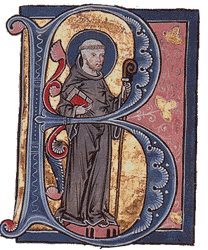
Bernard of Clairvaux
Life and witness
Cistercian abbot, preacher and mystical theologian of the Word, charity and the name of Jesus.
The Lives Of The Saints: Volume 09, August · S. Bernard, Ab. D., of Clairvaux ; a.d. 1153.
S. Bernard, Ab. D., of Clairvaux ; a.d. 1153.
S. Ronald, M. in Orkney ; a.d. 1158.
S. OSWIN, K. M.
(a.d. 651.)
[Anciently venerated in Northumbria. Authorities: — John of Tyne- mouth's Acts of S. Oswin ; mention by Bede, H. E. iii. 14 ; Vita Oswini in the publications of the Surtees Society, 1838. The following is, for the most part, from Montalembert's Monies of the West.]
the death of S. Oswald, Northumbria fell a prey, first to the ravages of Mercian invasion, then to the complications and weakness of a divided succession. Like the Merovingian, and even the Carolingian Franks, the Anglo-Saxons, and particularly the Angles of Northumbria, could not resist the inclination which led them to accept or incite the division of a kingdom among several princes, as soon as there appeared several heirs of a deceased king. Oswald left a son in childhood, whose claims were not at that moment taken into considera- tion. His brother Oswy, still in the flower of his youth, at once took his place in Bernicia — that is to say, in the northern part of Northumbria. As for Deira, it fell to a prince of the Deirian dynasty, grand nephew to Ella, the founder of that race. Osric, after a short reign, had fallen
* *
August 20.]
Biographical overview
Bernard of Clairvaux, O.Cist. (Latin: Bernardus Claraevallensis; 1090 – 20 August 1153), venerated as Saint Bernard, was an abbot, mystic, co-founder of the Knights Templar, and a major leader in the reform of the Benedictines through the nascent Cistercian Order. Bernard was sent to found Clairvaux Abbey only a few years after becoming a monk at Cîteaux. In 1128, Bernard attended the Council of Troyes, at which he traced the outlines of the Rule of the Knights Templar, which soon became an ideal of Christian nobility. On the death of Pope Honorius II in 1130, a schism arose in the church. Bernard was a major proponent of Pope Innocent II, arguing effectively for his legitimacy over the Antipope Anacletus II. The abbot advocated crusades in general and convinced many to participate in the unsuccessful Second Crusade, notably through a famous sermon at Vézelay (1146). Bernard was canonized just 21 years after his death by Pope Alexander III. In 1830, Pope Pius VIII declared him a Doctor of the Church.