Cyril of Jerusalem
Life and witness
Bishop whose catechetical lectures preserve a rich fourth-century account of creed, sacraments and Christian initiation.
Baring Gould March · on doctrinal grounds. Cyril of Jerusalem, and Silvanus of Tarsus were
Acacius had returned to Constantinople with wrath in his heart, resolved to ruin the semi-Arians and Cyril. He persuaded Constantius to allow a council to be summoned to meet at Constantinople next year, January, 360. About fifty bishops were present. Acacius ruled the assembly; Aetius was made a scape-goat by the Acacians for having too boldly given expression to the error which they sought to propagate insidiously. The council then deposed the leading semi-Arians, but not on doctrinal grounds. Cyril of Jerusalem, and Silvanus of Tarsus were deposed, and with the emperor's power to back their decisions, they were driven into banishment. At the same time the unreality of their censure of Aetius was shown by the enthronement of Eudoxius, who was his chief supporter, at Constantinople, on Jan. 27th. On Feb. 15th he dedicated the restored church of the Eternal Wisdom, for the service of which Constantius offered splendid vessels, curtains, altar-cloths, blazing with gold and jewels. In the midst of the ceremonial, Eudoxius began his sermon with these words, "The Father is irreligious, the Son is religious." A commotion followed; the bishop bade the people calm themselves. "Surely the Father worships none, and the Son worships the Father!" A burst of laughter followed this speech, which became a good jest in the society of the capital. This was the man Acacius and his packed council had set up, when they cast down Cyril. Eudoxius was well fitted to hand on the old traditions of Arian profanity.
The emperor Constantius died, Nov. 3rd, 361, and Julian having recalled the exiled bishops, S. Cyril returned to his see.
The unhappy man who was now lord of the empire had been for some ten years a hypocrite in his Christian profession. No sooner was he proclaimed emperor, than he openly professed himself a restorer of the old religion. Then it was that he "washed off the laver" of baptism by a hideous self-immersion in bull's blood,[65] and sought to cleanse his hands from the touch of the bloodless Sacrifice by holding in them the entrails of victims. He set up an image of Fortune in the great church, and while he was sacrificing there, Maris, bishop of Chalcedon, now a blind old man, was led up to him at his own request, and rebuked his impiety. "Will thy Galilæan God cure thy blindness?" asked Julian. "I thank my God," said Maris, "for the blindness which saves me from seeing the face of an apostate."
[65] The Rite of Taurobolia, Prudent. Peristreph. 10.
The last of Julian's attacks upon Christianity was his attempt to rebuild the temple of Jerusalem. He did indeed wish to aid the Jews in their desire of renewing the Levitical sacrifices, and to secure their attachment to his government in spite of its paganism; but his main object was to confound the Gospel by raising up the fabric which it had expressly doomed, and thus reviving the system of which that fabric had been the symbol and centre.
The rapturous hopes of the Jews were expressed in the scene which followed the imperial mandate, when silver spades and mattocks were employed, and earth was carried away from the excavations in the rich dresses of delicate women. The faith of the Christians was expressed by Cyril's denunciations of the predestined failure. Full of confidence he proclaimed that the enterprise, so far from succeeding, would prove to all men the impossibility of resisting the decree of God. Great must have been his faith, for every appearance was against him. The heathen historian, Ammianus Marcellinus, tells us what ensued. After all possible assistance had been given by the authorities, "fearful balls of fire breaking out near the foundations with repeated attacks, scorched the workmen several times, and rendered the place inaccessible; and in this way, after obstinate repulses by the fiery element, the undertaking was brought to a stand." Various details are added by Christian writers, as of an earthquake, a whirlwind, fire from heaven, a luminous cross in the air, and marks of crosses on the garments of the Jews. It is possible that in these particulars there is an element of exaggeration, and that in the fiery eruption itself, natural agencies were employed. But that those agencies should manifest themselves at that particular crisis will appear accidental, as men speak, to those only who do not estimate the exceeding awfulness of the occasion,--the unparalleled historical position of Julian, the mystery of iniquity in his general policy, and the specially anti-Christian malignity of this attempt at a confutation of Christ's words.
"His shafts, not at the Church, but at her Lord addrest," might well be cast back upon himself by a manifestation of "the finger of God," as real and awe-inspiring as any of those natural phenomena, the presence of which under particular circumstances made them a sign of judgment against Pharaoh.
Julian promised, in his vexation, says Orosius, to revenge his failure on S. Cyril on his return from the Persian war. But this return never took place. Cyril was again exiled by the Arian emperor Valens, in 367. He returned in 378, when the emperor Gratian ordered the restoration of the Catholics. He found his diocese rent by schism, corrupted by heresy. Adultery, robbery, and poisoning were general. The council of Antioch in 379, informed of the deplorable condition of the diocese, sent Gregory of Nyssa, already charged with reforming the churches of Arabia, to assist him in pacifying spirits, and repressing immorality; but his labours were without result. In 381, S. Cyril was present at the General Council of Constantinople, and subscribed the condemnation of the semi-Arians and Macedonians. He died in 386, at the age of seventy.
The Lives Of The Saints: Volume 03, March · March 18.] ,S. Cyril of Jerusalem. 3 1 5
March 18.] ,S. Cyril of Jerusalem. 3 1 5
was inexpedient to take too harsh an attitude towards these weak brethren, and drive them into the arms of the Arians, and this Cyril felt Firm in his own faith, deprecating the injudicious fire of some Catholics who were resolved at all costs to produce a rupture between those who walked in the clear light of Catholic certainty, and those who fluttered in the twilight, he laboured with words of conciliation to avert such a catastrophe.
At the end of 357, or the beginning of 358, an important change took place at Jerusalem. For two years Cyril had been forced into opposition to the demands of Acacius.
He maintained for Jerusalem, as the mother Church, possessing an “Apostolic throne,” and marked out for honour in the Nicene Council,1 an independence of Caesarea which Acacius would not grant ; and he was also obnoxious to Acacius on theological grounds, as holding the orthodox doctrine.
Acacius now summoned a small council of bishops of his own party, which Cyril declined to attend. This was regarded as contumacy ; and he was gravely accused of having committed an offence in selling some of the church ornaments to provide food for the famine-stricken poor. Sozomen says that he sold Church treasures and sacred veils. Theoderet mentions a vestment of cloth of gold presented by Constantine to be worn by the bishop when baptizing. Such an accusation does Cyril honour, and ranks him with other illustrious prelates, Ambrose, Augus- tine, Exuperius, Gregory the Great, Ethelwold of Win- chester, who all in like manner sanctioned the principle that the law of love is the highest law of all It is worth remark that in this case, as in that of S. John Chrysostom, the
1 Canon VII. " Since a custom and old tradition has obtained, that the bishop of iClia (Jerusalem) should receive honour, let him hold the second place, the metropolitan (of Ccsarea) being secured in his own dignity.”
* 4
Digitized by v^-ooQie
Lives of the Saints.
[March 18.
alliance of a narrow formalism was found, not with ortho- doxy, but with heresy.
By the synod convened by Acadus, Cyril was condemned and expelled from Jerusalem. He appealed, with more formality, as it appears, than had been usual in such cases, to “ a higher court proceeded to Antioch, where he found that the patriarch Leontius was dead, and that no one had been appointed his successor; and ultimately found a welcome at Tarsus, where Silvanus, the bishop, one of the best of the semi- Arians, received him, in disregard of the remonstrances from Acacius. This circumstance brought Cyril, for the next few years, into connection with the semi- Arian party; and he illustrates the fact that it contained men of whom Athanasius could say, in his noble readiness to discern substantial unity under verbal difference, “We do not treat as enemies those who accept everything else that was defined at Nicaea, and scruple only about the word consubstantial ; for we do not attack them as raging Arians, nor as men who fight against the fathers, but we discuss the matter with them as brothers with brothers, who mean what we mean, and differ only about the word.”
Considerable excitement had been caused in Antioch in 350 by the ordination of Aetius as deacon, by the patriarch Leontius. This man, the most odious of the extreme Arians, had gone through many changes of life, as a vine- dresser’s slave, a goldsmith, a medical man, a guest and pupil of Arian bishops, and a professor of that disputatious logic in which the heresy was at first embodied. He was the first to affirm openly that the Son was essentially un- like the Father. Leontius intended his diaconate to be a means of propagating Arianism. But Flavian and Diodorus, the pillars of Catholicism in Antioch, had threatened formally to renounce his communion; and he thought it best to depose Aetius. Now Leontius was dead,
Biographical overview
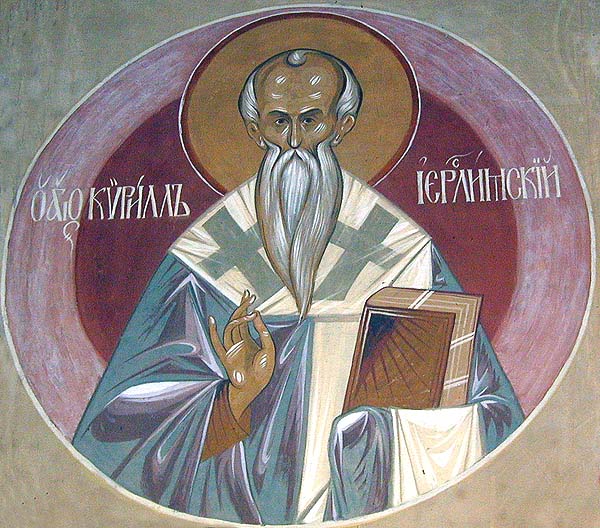
Cyril of Jerusalem (Greek: Κύριλλος Α΄ Ἱεροσολύμων, Kýrillos A΄ Hierosolýmōn; Latin: Cyrillus Hierosolymitanus; c. 313 – 386) was a theologian of the Early Church. About the end of AD 350, he succeeded Maximus as Bishop of Jerusalem, but was exiled on more than one occasion due to the enmity of Acacius of Caesarea, and the policies of various emperors. Cyril left important writings documenting the instruction of catechumens and the order of the Liturgy in his day and his old age Cyril is venerated as a saint within the Roman Catholic Church, the Eastern Orthodox Church, Oriental Orthodox Church, and the Anglican Communion. In 1883, Cyril was declared a Doctor of the Church by Pope Leo XIII. The Roman Catholic Church maintains an Optional Memorial for Cyril on 18 March. Cyril is remembered in the Church of England with a commemoration on 18 March. He should not be confused with Cyril of Alexandria.