Felix of Nola
Life and witness
Priest remembered for suffering during persecution and for humble pastoral charity.
Baring-Gould: January · S. FELIX, P. C., AT NOLA.
[On this day are commemorated two priests, Confessors, of Nola, of the same name, Felix. This has led to almost inextricable confusion among Martyrologists. There is another, a martyr, of this name. The life of S. Felix is given by S. Gregory of Tours, De Glor. Martyr, lib. i. c. 104, and by the Venerable Bede. The miracles wrought by him have also been recorded by S. Paulinus of Nola.]
Saint Felix was a native of Nola, in Campania, where his father, Hermias, who was by birth a Syrian, and had served in the army, had purchased an estate and settled. He had two sons, Felix and Hermias, to whom, at his death, he left his property. The younger, loving the things of Caesar rather than the things of God, says Bede, served in the army, but Felix, more _happy_--as his name implies--enrolled himself as a soldier of Jesus Christ. Having passed the grades of lector and exorcist, he was finally ordained priest by Maximus, Bishop of Nola.
Persecution having broken out, the aged Bishop, mindful of the injunction, "When they persecute you in one city flee to another" (Matt. x. 23), escaped to the hills, and left his flock to the charge of Felix, whom he designated as his successor. The persecutors, not finding the Bishop, seized on Felix, and cast him, heavily ironed, into a dungeon strewn with broken crockery, into which no ray of light entered. In the meantime, Maximus was perishing with cold and hunger in the mountains, hardships which his great age made him unable to endure.
One night an angel appeared to Felix, and bade him go forth out of prison and succour the aged Bishop. Then his chains fell off his neck, and hands, and feet, and the doors opened to him of their own accord, and guided by the angel, he was brought to the hiding place of Maximus, whom he found prostrate and speechless, and apparently dying. He moistened the old man's lips with wine, and forced some food into his mouth, and chafed his frozen limbs. By slow degrees the Bishop was restored, and then laying him upon his shoulders, Felix carried him home before daybreak, where a pious old woman took care of him.
Felix, with the blessing of his pastor, repaired secretly to his own lodgings, and there kept himself concealed, praying for the Church without ceasing, till peace was restored to it by the death of the Emperor Decius in 251. Persecution breaking forth again, the sergeants were sent in quest of Felix. Meeting him in the street, and not recognizing him, they stopped him and asked if he had met Felix on the way. "No," he answered; "I have not met him." They went on, but something arousing their suspicion, they had not gone far before they turned and hastened back. Felix had, in the meantime, crept through a small hole in some old broken walls. The officers came to the place, but seeing a spider's web covering the hole, they did not search the place, thinking that Felix could not have passed that way. But this was the Lord's doing. He had sent the little spider to drop his lines and lace them together, with the utmost rapidity, over the place through which His servant had escaped. Felix, finding among the ruins, between two houses, an old well half dug, hid himself in it for six months; and received during that time wherewithal to subsist from a devout Christian woman.
Peace having been restored to the Church, the Saint quitted his retreat, and was received in the city as an angel from heaven. Soon after, S. Maximus dying, Felix was unanimously elected Bishop; but he persuaded the people to make choice of Quintus, because he was the senior priest, having been ordained seven days before him.
His property having been confiscated in the persecution, S. Felix rented a little spot of barren land, not exceeding three acres, which he tilled with his own hands, and was able by his industry to support himself, and give something in alms to the poor. He died at a good old age, on Jan. 14th, on which day the Martyrology, under the name of S. Jerome, and all others of later date mention him.
Patron of Nola, in conjunction with other Saints.
Relics, in the Cathedral at Nola.
In art, he is represented (1), with an angel striking off his chains; (2), with a bunch of grapes, wherewith he fed S. Maximus; (3), bearing S. Maximus on his shoulders, or in his arms; (4), with a spider.
Alban Butler: January–March · ST. FELIX OF NOLA, P. AND C.
IT is observed by the judicious Tillemont, with regard to the life of this saint, that we might doubt of its wonderful circumstances, were they not supported by the authority of a Paulinus; but that great miracles ought to be received with the greater veneration, when authorized by incontestable vouchers.
St. Felix was a native of Nola, a Roman colony in Campania, fourteen miles from Naples, where his father Hermias, who was by birth a Syrian, and had served in the army, had purchased an estate and settled himself. He had two sons, Felix and Hermias, to whom at his death he left his patrimony. The younger sought preferment in the world among the lovers of vanity, by following the profession of arms, which at that time was the surest road to riches and honors. Felix, to become in effect what his name in Latin imported, that is, _happy_, resolved to follow no other standard than that of the king of kings, Jesus Christ. For this purpose, despising all earthly things, lest the love of them might entangle his soul, he distributed the better part of his substance among the poor, and was ordained Reader, Exorcist, and, lastly, Priest, by Maximus, the holy bishop of Nola; who, charmed with his sanctity and prudence, made him his principal support in these times of trouble, and designed him for his successor.[1]
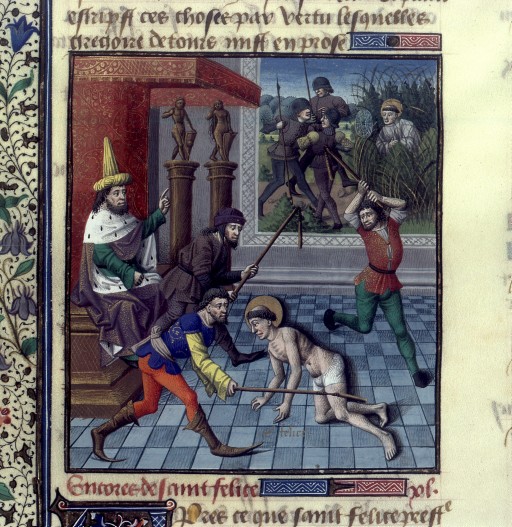
In the year 250, the emperor Decius raised a bloody persecution against the church. Maximus, seeing himself principally aimed at, retired into the deserts, not through the fear of death, which he desired, but rather not to tempt God by seeking it, and to preserve himself for the service of his flock. The persecutors not finding him, seized on Felix, who, in his absence, was very vigilant in the discharge of all his pastoral duties. The governor caused him to be scourged; then loaded with bolts and chains about his neck, hands, and legs, and cast into a dungeon, in which, as St. Prudentius informs us,[2] the floor was spread all over with potsherds and pieces of broken glass, so that there was no place free from them, on which the saint could either stand or lie. One night an angel appearing in great glory, filled the prison with a bright light, and bade St. Felix go and assist his bishop, who was in great distress. The confessor, seeing his chains fall off, and the doors open, followed his guide, and was conducted by heaven to the place where Maximus lay, almost perished with hunger and cold, speechless, and without sense: for, through anxiety for his flock, and the hardships of his solitary retreat, he had suffered more than a martyrdom. Felix, not being able to bring him to himself, had recourse to prayer; and discovering thereupon a bunch of grapes within reach, he squeezed some of the juice into his mouth, which had the desired effect. The good bishop no sooner beheld his friend Felix, but he embraced him, and begged to be conveyed back to his church. The saint, taking him on his shoulders, carried him to his episcopal house in the city, before day appeared, where a pious ancient woman took care of him.[3]
Felix, with the blessing of his pastor, repaired secretly to his own lodgings, and there kept himself concealed, praying for the church without ceasing till peace was restored to it by the death of Decius, in the year 251. {148} He no sooner appeared again in public, but his zeal so exasperated the pagans that they came armed to apprehend him; but though they met him, they knew him not; they even asked him where Felix was, a question he did not think proper to give a direct answer to. The persecutors going a little further, perceived their mistake, and returned; but the saint in the mean time had stepped a little out of the way, and crept through a hole in a ruinous old wall, which was instantly closed up by spiders' webs. His enemies never imagining any thing could have lately passed where they saw so close a spider's web, after a fruitless search elsewhere, returned in the evening without their prey. Felix finding among the ruins, between two houses, an old well half dry, hid himself in it for six months; and received during that time wherewithal to subsist by means of a devout Christian woman. Peace being restored to the church by the death of the emperor, the saint quitted his retreat, and was received in the city as an angel sent from heaven.
Soon after, St. Maximus' dying, all were unanimous for electing Felix bishop; but he persuaded the people to make choice of Quintus, because the older priest of the two, having been ordained seven days before him. Quintus, when bishop, always respected St. Felix as his father, and followed his advice in every particular. The remainder of the saint's estate having been confiscated in the persecution, he was advised to lay claim to it, as others had done, who thereby recovered what had been taken from them. His answer was, that in poverty he should be the more secure of possessing Christ.[4] He could not even be prevailed upon to accept what the rich offered him. He rented a little spot of barren land, not exceeding three acres, which he tilled with his own hands, in such manner as to receive his subsistence from it, and to have something left for alms. Whatever was bestowed on him, he gave it immediately to the poor. If he had two coats, he was sure to give them the better; and often exchanged his only one for the rags of some beggar. He died in a good old age, on the fourteenth of January, on which day the Martyrology, under the name of St. Jerom, and all others of later date mention him. Five churches have been built at, or near the place where he was first interred, which was without the precinct of the city of Nola. His precious remains are at present kept in the cathedral; but certain portions are at Rome, Benevento, and some other places. Pope Damasus, in a pilgrimage which he made from Rome to Nola, to the shrine of this saint, professes, in a short poem which he composed in acknowledgment, that he was miraculously cured of a distemper through his intercession.
St. Paulinus, a Roman senator in the fifth age, forty-six years after the death of St. Damasus, came from Spain to Nola, desirous of being porter in the church of St. Felix. He testifies that crowds of pilgrims came from Rome, from all other parts of Italy, and more distant countries, to visit his sepulchre on his festival: he adds, that all brought some present or other to his church, as wax-candles to burn at his tomb, precious ointments, costly ornaments, and such like; but that for his part, he offered to him the homage of his tongue, and himself, though an unworthy victim. [5] He everywhere expresses his devotion to this saint in the warmest and strongest terms, and believes that all the graces he received from heaven were conferred on him through the intercession of St. Felix. To him he addressed himself in all his necessities; by his prayers he begged grace in this life, and glory after {149} death.[6] He describes at large the holy pictures of the whole history of the Old Testament, which were hung up in the church of St. Felix, and which inflamed all who beheld them, and were as so many books that instructed the ignorant. We may read with pleasure the pious sentiments the sight of each gave St. Paulinus.[7] He relates a great number of miracles that were wrought at his tomb, as of persons cured of various distempers and delivered from dangers by his intercession, to several of which he was an eye-witness. He testifies that he himself had frequently experienced the most sensible effects of his patronage, and, by having recourse to him, had been speedily succored.[8] St. Austin also has given an account of many miracles performed at his shrine.[9] It was not formerly allowed to bury any corpse within the walls of cities. The church of St. Felix, out of the walls of Nola, not being comprised under this prohibition, many devout Christians sought to be buried in it, that their faith and devotion might recommend them after death to the patronage of this holy confessor, upon which head St. Paulinus consulted St. Austin. The holy doctor answered him by his book, _On the care for the dead_: in which he shows that the faith and devotion of such persons would be available to them after death, as the suffrages and good works of the living in behalf of the faithful departed are profitable to the latter. See the poems of St. Paulinus on his life, confirmed by other authentic ancient records, quoted by Tillemont, t. 4, p. 226, and Ruinart, Acta Sincera, p. 256; Muratori, Anecd. Lat.
Footnotes: 1. S. Paulin. Carm. 19, 20. Seu Natali, 4. 2. De Cor. hymn 5. 3. Paulin. Carm. 19. 4. _Dives egebo Deo; nam Christum pauper habebo_. Paulin. Carm. 2. Natali S. Felicia 5. 5. ________________ _Ego munere linguae, Nudus opum, famulor, de me mea debita solvens Meque ipsum pro me, vilis licet hostia pendam._ Natal. 6 6. Nat. 1, 2, &c. 7. Nat. 9, 10. 8. St. Paulin. Ep. 28 & 36. Carm. 13, 18, 21, 22, 23, 29, &c. 9. St. August. Ep. 78, olim 137, lib. De cura pro moritus, c. 16.
Biographical overview
Felix of Nola (died c. 260) was a Christian priest at Nola near Naples in Italy. He sold off his possessions to give to the poor, but was arrested and tortured for his Christian faith during the persecution of Roman Emperor Decius (r. 249–251). He was believed to have died a martyr's death during the persecution of Decius or Valerian (c. 253) but is now listed in the General Roman Calendar as a Confessor of the Faith who survived his tortures.