
Frances of Rome
Life and witness
Roman wife, mother and mystic who united household duty, service to the poor and contemplative prayer.
Baring-Gould: March · S. FRANCES OF ROME, W
[Roman Martyrology. Canonized by Paul V., in 1608. Authorities:--Her life by her confessor, John Mattiotti, and another by Maria Magdalena d'Aguillar. The following life is condensed from that by Lady Georgiana Fullerton.]
Frances of Rome was born in stormy days. War was raging all over Europe. Italy was torn by inward dissentions, and the Church was afflicted, not only by the outward persecutions which strengthens her vitality, though for a while they appear to cripple her action, but by trials of a far deeper and more painful nature. Heresy had torn from her arms a great number of her children, and repeated schisms were dividing those who, in appearance, and even in intention, remained faithful to the Holy See. The successors of S. Peter had removed the seat of their residence to Avignon, and the eternal city presented the aspect of one vast battle-field, on which daily and hourly conflicts were occurring. In the capital of Western Christendom ruins of recent date lay side by side with the relics of past ages; the churches were sacked, burned, and destroyed, and the eyes of the people of Rome were turned beseechingly to Heaven to restore to them that tranquillity to which they had almost become strange.
It was at that time, during the pontificate of Urban VI., in the year 1384, that Francesca was born at Rome; that "she rose as a star in a dark night," according to the expression of the most ancient of her biographers. Her father's name was Paul Russa; her mother's Jacobella de' Roffredeschi; they were both of noble descent. On the day of her birth she was carried to the Church of S. Agnes, and there baptized.
Little could the worshippers who may have been praying there that day for a blessing on their bereaved and distracted city, have guessed in what form that blessing was bestowed, and that that little babe, a few hours old, was to prove a most powerful instrument in the hands of God for the extinction of schism, the revival of piety, and the return of peace.
From her infancy, Francesca was not like other children. At two or three years old she manifested a precocious intelligence and piety. Instead of playing, she loved to retire into a silent corner of her father's palace, and kneeling down join her little hands in prayer.
From the time that Francesca had understood the meaning of the words, her greatest desire had been to enter a convent; it was therefore with profound grief that she received, at the age of twelve, the announcement from her father that he had promised her hand to Lorenzo Ponziano, a young nobleman of illustrious birth, and not less eminent for his virtues and talents than from his fortune and position. She flew to her director and besought his advice. "If your parents persist in their resolution," said he, "take it, my child, as a sign that God expects of you this sacrifice. Offer up to him in that case your earnest desire for the religious life. He will accept the will for the deed; and you will attain at once the reward of that wish, and the peculiar graces attached to the sacrament of marriage." Francesca submitted, and was married to Lorenzo Ponziano, and took up her abode in his palace in the heart of the Trastevere. It is a well-known spot; and on the 9th of March, the people of Rome flock to it in crowds. The modern building erected on the foundations of the old palace is the Casa dei Esercizii Pii. On the day of her festival its rooms are thrown open, every memorial of the gentle saint is exhibited, lights burn on numerous altars, flowers deck the passages, leaves are strewn in the chapel, on the stairs, in the entrance court; figured tapestry and crimson silks hang over the door, and crowds of people go in and out, and kneel before the relics and pictures of the dear saint of Rome, and gaze on each altar, and linger in these chambers, like kinsfolk met on a birthday to rejoice together.
Francesca was received into her new home tenderly and joyfully by her father-in-law Andrew, his wife Cecilia, and Vannozza, the wife of her husband's brother, a holy and loving woman, in whom Francesca found a kindred spirit. The manner of Francesca was so gentle and kind, that it inspired affection in all who approached her; but there was also a profound and awful purity in her aspect and in her demeanour, which effectually checked the utterance of a free or licentious word in her presence. Faithful to her early habits of piety, she continued every Wednesday to visit the church of S. Maria Nuova; and after confessing to her director, Antonio Savelli, she communicated. Rising betimes in the morning, Francesca devoutly said her prayers, made her meditations, and read attentively out of a spiritual book. In the course of the day, whenever she had a moment's leisure, she withdrew into a church, or into her own room, and gave herself up to prayer. At the same time, so devout a life in a young person of twelve years old could not fail to attract the attention and draw down the censures of the worldly. Many such began to laugh at Francesca, and to turn her piety into ridicule. But her husband was to her a shield, as far as in him lay, against spiteful tongues. His young wife was much too precious to him, much too perfect in his sight, her whole life bore too visibly the stamp of God's dealings with her, for him to dream of interfering with the course she had taken. On the contrary, he looked upon her with that affectionate veneration which the presence of true sanctity always awakens in a noble and religious mind.
There was not a single member, friend, or servant, of that noble family into which she had been received, that did not love her. Paluzzo, Lorenzo's brother, delighted in encouraging the intimacy that had arisen between his young sister-in-law and his own wife Vannozza. Day by day her influence--her tender, noiseless, gentle influence--was felt subduing, winning, drawing them all to God.
The happiness which the family of Ponziano had enjoyed since Lorenzo's marriage was interrupted by the sudden and dangerous illness of his wife, which baffled all medical skill, and soon brought her to the verge of the grave. She endured excruciating pain, and was unable to take nourishment. She declined rapidly, and all hope of her recovery was abandoned, when, one night, as she was lying motionless on her couch of suffering, listening to the breathing of her nurses who had fallen asleep, a sudden light filled the room, and she saw standing before her in pilgrim's robe, S. Alexis, the noble Roman penitent, who had passed many years as a despised beggar at the door of his father's palace. Drawing near to Francesca's bed, he said "I am Alexis, and am sent from God to enquire of thee if thou choosest to be healed?" "I have no choice but the good pleasure of God," she answered. "Then live," said he, "for He choosest that thou shouldest remain in the world to glorify His name." Then he drew his mantle over Francesca and vanished, leaving her perfectly recovered.
Confounded at this extraordinary favour, she rose in haste, and slipping out of the room without awaking her nurses, she hurried to the bedside of her sister-in-law. "My dear Vannozza, my own Vannozza!" she exclaimed, putting her arm round her neck, and her cheek next hers. Vannozza suddenly awoke, and distrusting the evidence of her senses, said, "Who are you? Am I dreaming? It sounds like the voice of my little Frances?" "Yes, it is your little sister who is speaking to you." "What! I left you only an hour ago at the point of death!" "It is I, nevertheless, come to thank you, dear companion, for having nursed me so tenderly, and now help me to thank God for his wonderful mercy towards me." Then sitting on her bed, with the hands of her sister clasped in her own, she related to her the vision, and the instantaneous recovery that had followed; and then, as the light began to break into the chamber, she added with eagerness, "Now let us hasten to S. Maria Nuova, and then to the church of S. Alexis, that I may return him my thanks, before others learn what God has done for me."
The year 1400 opened under melancholy auspices. The wars for the succession of the kingdom of Naples between Louis of Anjou and Ladislas were agitating the whole of Italy; and Rome was exposed to all the fury of the contending parties. Lorenzo Ponziano, from his rank and fidelity to the sovereign pontiff, was especially marked out as an enemy by the adverse faction. But while on every side the storm was brewing, and the aspect of public affairs each day became more gloomy, a blessing was granted him, which for the last five years he had ardently desired. Francesca became the mother of a little son, who received at the font the name of John Baptist, or, in Italian, Giovanni Baptista. It was not at that time the custom for ladies of rank to nurse their children; but Francesca set aside all such considerations, and never consented to forego a mother's sacred privilege.
In obedience to her director, and guided by her own sense of duty, she modified, for the time being her usual mode of life, and occupied herself with the care of her child in preference to all other observances of charity or of devotion.
About a year after, Lorenzo's mother died, and Francesca was called to take her place as head of the household, and to superintend all the domestic affairs. Distressed at the proposal, she pleaded her youth and inexperience, and urged that Vannozza, as the wife of the eldest brother, was, as a matter of course, entitled to that position. Vannozza, however, steadily refused it, and at length, overcome by the general importunity, Francesca found herself obliged to comply. Now it was that her merit shone conspicuously. Placed at the head of the most opulent house in Rome, no symptom of pride revealed itself in her looks or in her actions. She was never heard to speak a harsh or impatient word. Firm in requiring every person in her house to fulfil their duties, she did it in the gentlest manner. Always courteous to her servants, she watched over their souls as precious treasures entrusted to her custody by God.
Francesca had just attained the age of twenty when her second son was born. He was baptized on the day of his birth, and received the name of John Evangelist. He might well have been termed his mother's own child; for in his veriest infancy, he showed that he had inherited her sweetness and spirit of devotion. He was to her as one of God's own angels, and tears of joy filled her eyes as she mused on the extraordinary signs of grace which he daily evinced. Evangelista was not quite three years old when his little sister Agnes was born, who in beauty, heavenly sweetness of temper, and precocious piety, proved the counterpart of her brother.
In the year 1409, when she was about twenty-seven years old, Francesca's temporal calamities began. After Ladislas of Naples, befriended by the enemies of the pope, had in 1498 gained possession of Rome, he left behind him as governor of the city the count of Troja, a rough and brutal soldier. In an engagement with the count's soldiers Lorenzo Ponziano was stabbed, and taken up and carried home as if dead. Francesca however found that he still breathed, and by her unremitting attention, he was restored to health.
Meanwhile the count of Troja, pressed on every side, began to foresee the necessity of leaving Rome; but, in his exasperation, resolved previously to wreak his vengeance on the families most devoted to the pope, and especially on that of the Ponziani. He accordingly arrested Paluzzo, Vannozza's husband, and understanding that Lorenzo had a son of eight or nine years old, he commanded that he should be given up into his hands as a hostage.
This was to Francesca a trial almost beyond endurance, as she trembled for the soul of her little one about to be committed to unprincipled soldiers. The report of the order had spread through Rome, and as she passed through the streets clasping the hand of her dear child whom she was about to surrender, crowds of commiserating women pressed round her. She mounted the Capitol, walked straight to where the tyrant was standing, and gave up her son to him, and then, without once looking back, she hastened to the church of Ara Cœli, and falling prostrate before the feet of the Mother of Mercy, poured out her soul in tears and supplication. In the mean time the count of Troja had ordered one of his officers to take little Baptista on his horse, and carry him away to a place he appointed; but from the instant the child was placed on the saddle, no efforts could induce the animal to stir. Four of the knights of Naples renewed the attempt with other horses, and the same result. There is a strength greater than man's will; there is a power that defeats human malice. Struck with a secret terror by this evident prodigy, the count of Troja gave up the unequal contest, and ordered the child to be restored to his mother. Before the altar of Ara Cœli, where in her anguish she had fallen, Francesca received back into her arms the son of her love, and blessed the God who had given her strength to go through this the severest of her trials.
The States of the Church and Rome were again overrun by the troops of Ladislas, in 1410. The horrors of this invasion, and of the sack that followed it, surpassed in atrocity almost all those that had previously afflicted the capital of Western Christendom. Lorenzo, scarcely recovered from his long illness, fled into a distant province. It had been impossible to remove his wife and children; and Francesca remained exposed to a succession of the most trying disasters. The wealth of the family chiefly consisted in their country possessions; and day after day intelligence was brought to her that one farmhouse or another was burnt or pillaged, the cattle dispersed or destroyed, and the peasants murdered by a ruthless soldiery. One fatal morning a troop of savage ruffians, drunk with rage, broke into the palace, and after pillaging, and all but destroying the time-honoured residence of the Ponziani, carried off her son Baptista. In the space of a few hours that gorgeous abode was turned into a heap of ruins. Bereft of her husband, of her son, and of all the conveniences of life, Francesca, with her two younger children, remained alone, and unprotected, for her brother-in-law, Paluzzo, was still a prisoner in the tyrant's hands. How Baptista escaped is not recorded, but by some means or other he was enabled to get away from Rome and rejoin his father.
Francesca took shelter in a corner of her ruined habitation; and there, with Evangelista and Agnese, she managed to live in the most complete seclusion. These two children were now their mother's only comfort, as their education was her principal occupation. Evangelista, as he advanced in age, in no way belied the promise of his infancy. He lived in spirit with the angels and saints, and seemed more fitted for their society than for any earthly companionship. "To be with God," was his only dream of bliss. The hour for another sacrifice was at hand. The second invasion of Rome was succeeded by a dreadful famine, which was followed in its turn by a severe pestilence. Evangelista sickened and died of it. Francesca wept over the loss of her dearly-beloved child, but did not grieve for him. It was not a time for indulgence of sorrow. Want and sickness were turning Rome into a charnel house. Wild voices were screaming for bread on every side. The streets were encumbered by the victims of the plague. The ruin of private property, the general penury occasioned by the extortion of Ladislas, and the sacking of Rome by his soldiers, had cut off almost all the resources of private charity. Francesca, bereaved of everything but her one little girl, and lodged with Vannozza in a corner of their dismantled house, had no longer at her command the resources she had formerly possessed for the relief of the poor. A little food from their ruined estates was now and then supplied to these lonely women; and they stinted themselves, that they might bestow the greatest part on the sick and poor. There was a large hall in the lower part of the palace; the sisters converted it into a temporary hospital; out of the shattered furniture that lay scattered about the house, they contrived to make up beds and covering, and to prepare some clothing for the wretched creatures they were about to receive. When all was ready they brought in sufferers, carrying the weakest in their arms. They washed and dressed their wounds and sores, prepared both medicine and food, watched the sick by day and by night; laboured incessantly for their bodies, and still more for their souls. The example which the ruined and bereaved wives of the Ponziani had given kindled a similar spirit among the hitherto apathetic inhabitants of Rome, and in several places hospitals were opened to the perishing multitudes. Often Francesca and Vannozza were without a morsel of food for themselves and their poor, then they went forth to beg, and gratefully accepted the broken bits that fell from the table of the wealthy. Each remnant of food, each rag of clothing, they brought home with joy; and the best was invariably bestowed on their guests.
Evangelista had been dead about a year, when one morning as Francesca was praying in her oratory, she became conscious that the little room was suddenly and supernaturally illumined. She raised her eyes, and Evangelista stood before her; his familiar aspect unchanged, but his features transfigured and beaming with ineffable splendour. By his side stood an angel of exquisite beauty. Evangelista smiling on his mother, told her of his present happiness, and then bade her prepare to surrender her little Agnese, for God called the child. But a consolation was promised her. Thenceforth the angel who stood beside Evangelista was to be ever with her, as a visible companion. Having said this, Evangelista disappeared, but the angel remained, and to the day of her death was ever present to her sight.
The following is the description of the angel as given by Francesca to her confessor, and written down by her, at his order:--
"His stature is that of a child, of about nine years; his countenance full of sweetness and majesty; his eyes generally turned towards heaven. Words cannot describe the divine purity of that gaze. His brow is always serene; his glances kindle in the soul the flame of ardent devotion. When I look upon him, I understand the glory of the angelic nature, and the degraded condition of our own. He wears a long, shining robe, and over it a tunic, either as white as the lilies of the field, or of the colour of a red rose, or of the hue of the sky, when it is most deeply blue. When he walks at my side his feet are never soiled by the mud of the streets, or the dust of the roads."
The presence of her heavenly guide was to her as a mirror, in which she could see reflected every imperfection of her character. Much as she had discerned, even from her earliest childhood, of the corruption of her heart, yet she often told her director that it was only since she had been continually in the presence of an angelic companion that she had realised its amount. So that this divine favour, far from exalting her in her own eyes, served to maintain her in the deepest humility. When she committed any fault, the angel faded away, and it was only when she had felt compunction and confessed her fault, that he shone out upon her once more in all his brilliancy.
And now her little Agnes was taken from her, and was laid beside her brother Evangelista.
Four long years had elapsed, during which Rome had been given up to war, famine, and pestilence. The exertions of Francesca told at last on her enfeebled frame, and she fell dangerously ill. Vannozza never left her bedside, and nursed her with such love and care that she restored her to health. It was during this illness that Francesca had a vision of Hell. And now, in 1414, Ladislas died, and peace was restored to the States of the Church. The Ponziani were recalled from banishment, and their property was restored. Lorenzo and his son Baptista returned to their home, and to the wife and mother they had so longed to behold again. But the cup of joy was mixed with sorrow. Lorenzo, who a few years back was strong and active, was now broken by long sufferings, aged more through exile and grief than through years. We are told that when he entered his palace and looked upon his wife, deep sobs shook his breast, and he burst into tears. The two beautiful children whom he had left by her side were gone, and Francesca herself, pale with recent sickness, spent with ceaseless labour, was changed in form, and bloom, and brightness, by what she also had endured.
The household life was now to some extent restored. Francesca devoted all her leisure moments to prayer, but never allowed her spiritual exercises to interfere with her duty as a wife and mistress of a household. Her attention to Lorenzo's slightest wants and wishes was unceasing. She never complained of any amount of interruption or of trouble which his claims, or those of the house, or of her position in society, occasioned. One day that she was reciting in her room the office of the Blessed Virgin, her husband sent for her. Instantly rising from her knees, she obeyed his summons. When she had performed the trifling service he required, she returned to her prayers. Four successive times, for the most insignificant of purposes, was she sent for; each time with unwearied good humour she complied, and resumed her devotions without a shadow of discontent or annoyance. On resuming her book the last time that this occurred, great was her astonishment in finding the antiphon which she had begun four times, and had four times left unfinished, written in letters of gold. Vannozza, who was present, witnessed the miracle, and the gilded letters remained in the book to the day of her death.
Her son, Baptista, had now arrived at the age of eighteen, and at his father's advice he married a maiden, named Mobilia, of noble birth and singular beauty. Immediately upon her marriage, the bride came to reside under the same roof as her father and mother-in-law. She was received as a beloved daughter by Francesca and Vannozza, but she neither returned their affection nor appeared sensible to their kindness. Her head was completely turned at finding herself her own mistress, adored by her husband, and furnished with the most ample means of gratifying all her fancies. She gave no thought to anything but her beauty, her dress, and all the amusements within her reach. Wholly inexperienced, she declined to ask or to receive advice, and chose in every respect to be guided by her inclinations alone. Imperious with her equals, haughty with her superiors, she treated her mother-in-law with the most supreme contempt. In the gay societies which she frequented, it was her favourite amusement to turn Francesca into ridicule, and mimic her manners and style of conversation. "How can one feel respect," said she, "for an old woman who thinks of nothing but the poor, dresses plainly, and goes about the streets carrying bread and old clothes?"
It was in vain that Baptista, seriously annoyed at the insults offered to his dearly-loved mother, remonstrated with his wife. Mobilia persisted for long, till struck with sudden illness in the midst of a sharp and bitter speech addressed to her mother-in-law, she became alarmed lest God should punish her with greater severity, and she resolved to behave towards her with respect and love. And this grew till the young wife became passionately fond of Francesca, and venerated her for her virtues, which she strove hard to imitate. Francesca, with the most watchful love, nursed Mobilia in her confinements, and bestowed on her grandchildren the same cares that she had lavished on her own children. It was a great relief to her that Mobilia was able to assume the management of the house, and thus enable her to devote herself more unreservedly to the service of the poor and of the hospitals. A new epoch was now at hand in her career. God had placed in her heart many years ago a hope, which she had nursed in secret, and watered with tears, and fostered by prayer. Never impatient, never beforehand with God's providence, she waited. Lorenzo's admiration and affection for his wife had gone on increasing with advancing years; the perfection of her life, and the miracles he had so often seen her perform, inspired him with unbounded reverence. Taking her aside one day, he offered to release her from all the obligations imposed by the state of marriage, to allow her the fullest liberty of action, and the most absolute control over her person, her time, and her conduct, on one condition, that she would promise never to cease to inhabit his house. She accepted his proposal joyfully and gratefully, but she continued to devote herself to her excellent husband, and with the most attentive solicitude to render him every service in her power. He was now in very declining health, and she rendered him by day and by night all the cares of the tenderest nurse.
Seeing the necessity of a religious society for women living in the world, Francesca now formed a congregation of pious women, which was affiliated to the Olivetian monastery of S. Maria Nuova, and which comprised about ten noble Roman ladies, devoted like herself and Vannozza, to the service of God and the poor. She now lost her beloved sister Vannozza, and her director, Antonio Savelli, who had instructed her childhood, and guided her ever since with wisdom and faithfulness. She chose as her director and that of her congregation, Giovanni Mattiotti, curate of S. Maria in Trastevere, to whom she had already sometimes been to confession. He was a man of distinguished piety, but of an irresolute and vacillating disposition, easily disheartened. Her society, which was called the Congregation of Oblates of Mary, had lasted seven years, when Francesca decided that it would be advisable that it should have a convent in which to dwell. She took a house adapted to the requirements of a religious community, on the spot where an old tower, named "Tor di Specchi," used to stand. Various obstacles arose to the purchase of this house, which disheartened Mattiotti; but they were finally overcome, and the acquisition was completed towards the end of the year 1432. This house, which was at first considered only as a temporary residence, was subsequently added to, and has remained to this day the central house of the order. It was, doubtless, a trial to Francesca that whilst she was providing a home for her disciples, she was unable to avail herself of it, but she never hesitated as to her line of duty. Lorenzo had released her from all obligations but one, that of residing in his house, and watching over his old age. His infirmities were increasing, and her attentions were indispensable to his comfort. The rule adopted by the Oblates of Tor di Specchi remains the same to this day. They are not, strictly speaking, nuns: they take no vows, and are bound by no obligations under pain of sin; they are not cloistered, and their dress is that which was worn at the period of their establishment by the widows of the Roman nobles.
It was on the Feast of the Annunciation, 1433, that the Oblates, ten in number, met in the church of S. Maria in Trastevere, heard Mass, and communicated, then went in procession to the house they were thenceforth to inhabit. That house, which now-a-days is thrown open during the Octave of the Feast of S. Frances, is no gloomy abode. The beautiful chapel; the garden, with its magnificent orange trees; the open galleries, with their little oratories, where a holy picture or figure takes you by surprise, and meets you at every turn; the light, airy rooms, where religious prints and ornaments, with flowers, birds, and ingenious toys, testify that innocent enjoyments are encouraged among the children educated therein by the Oblates of S. Mary.
But on the day when Francesca's companions first entered these walls, there was nothing very fair or beautiful to greet them, though they carried thither, in their hearts, from the altar they had just left, the source of all light and love. With delight they exchanged their ordinary dress for that which the rule prescribed. Francesca alone stood among them no nun in her outward garb, but the truest nun of all, through the inward consecration of her whole being to God.
Francesca had been forty years married to Lorenzo Ponziano, and blessed had that union been by the tender affection which had reigned between the husband and the wife, and sanctified by the exercise of no common virtues, by the pursuit of no transitory object. Francesca had led the way, in meekness, in humility, in subjection, but with a single aim and an unwavering purpose. Lorenzo's health had been breaking up for some years past, and now it utterly failed, and his disease assumed an alarming character. Few men would have shown themselves as worthy as he did of such a wife as Francesca. From the moment of his marriage he had appreciated her virtues, rejoiced in her piety, encouraged her good works, and to a great extent shared in them. He had his reward. Francesca tended him to the last with indefatigable love. He had been a just man, and his death was the death of the righteous. Francesca was now free to follow the bent of her desire. She took leave of Mobilia and her son, and went straight to Tor di Specchi. It was on the 21st of March, the feast of S. Benedict, that she entered its walls, not as the foundress, but as a humble suppliant for admission. At the foot of the stairs, having taken off her black gown, her veil, and her shoes, she knelt down, and made her general confession in the presence of the community, and then asked permission to dwell amongst the Oblates. The spiritual daughters of S. Frances hastened to raise and to embrace her, and clothing her with their habit, they led the way to the chapel, where they all returned thanks to God.
At the same moment, her angel guardian was changed; another, brighter and more beautiful, stood beside her, weaving a golden woof out of threads, which he drew from a palm branch. And this angel, ever busy on this mystic work, remained beside her till her death, in place of the other.
Agnes de Lellis, the superior, then resigned her office, and the sisters with one accord insisted on Francesca assuming the direction of the house. She positively refused to do so, but her objections were overruled by the director, and unable to resist his orders, she assumed the office on March 25th.
We have not space to give an account of the life of the blessed Francesca as a superior, or to detail the miracles she was enabled to work; for these we refer the English reader to the life of this saint by Lady Georgiana Fullerton. On March 3rd, 1440, when Francesca was fifty-six years old, she was sent for to see her son Baptista, who was laid up with a sharp attack of fever. She instantly obeyed the summons, and spent the day at the Ponziano palace; but towards evening she grew so ill that she could scarcely stand. However, she persisted in returning to her convent. On her way she stopped at the church of S. Maria in Trastevere, and found there her confessor, Giovanni Mattiotti, who, noticing her altered looks, ordered her at once to return to her son's house. The order was a trial to her, for she felt that she would never again enter the hallowed walls of Tor di Specchi; but, faithful to the spirit of perfect obedience, she went back to the palace. In the course of the night a virulent fever came on, and she became so seriously ill that all hopes of her recovery were abandoned. And now the angel had nearly done his mystic task, the golden web was complete, and he folded up the glistening tissue about the palm. The day of March 9th was far advanced. "What are you saying?" asked her confessor, seeing her lips move. "The vespers of the Blessed Virgin," she answered, in a scarcely audible voice. As an infant she had begun the practice; and on the eve of her death she had not omitted it.
S. Francesca was canonized May 29th, 1608.
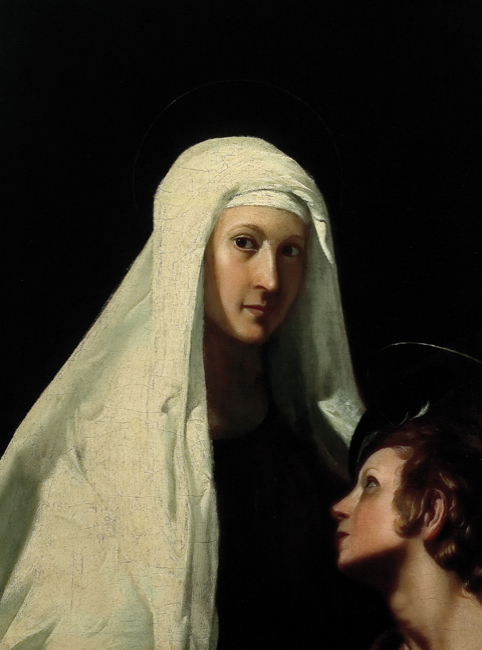
In art she appears with an angel by her side, sometimes contemplating Hell open.
Baring-Gould: March · S. FRANCES OF ROME, W.
[Roman Martyrology. Canonized by Paul V., in 1608. Authorities:--Her life by her confessor, John Mattiotti, and another by Maria Magdalena d'Aguillar. The following life is condensed from that by Lady Georgiana Fullerton.]
Frances of Rome was born in stormy days. War was raging all over Europe. Italy was torn by inward dissentions, and the Church was afflicted, not only by the outward persecutions which strengthens her vitality, though for a while they appear to cripple her action, but by trials of a far deeper and more painful nature. Heresy had torn from her arms a great number of her children, and repeated schisms were dividing those who, in appearance, and even in intention, remained faithful to the Holy See. The successors of S. Peter had removed the seat of their residence to Avignon, and the eternal city presented the aspect of one vast battle-field, on which daily and hourly conflicts were occurring. In the capital of Western Christendom ruins of recent date lay side by side with the relics of past ages; the churches were sacked, burned, and destroyed, and the eyes of the people of Rome were turned beseechingly to Heaven to restore to them that tranquillity to which they had almost become strange.
It was at that time, during the pontificate of Urban VI., in the year 1384, that Francesca was born at Rome; that "she rose as a star in a dark night," according to the expression of the most ancient of her biographers. Her father's name was Paul Russa; her mother's Jacobella de' Roffredeschi; they were both of noble descent. On the day of her birth she was carried to the Church of S. Agnes, and there baptized.
Little could the worshippers who may have been praying there that day for a blessing on their bereaved and distracted city, have guessed in what form that blessing was bestowed, and that that little babe, a few hours old, was to prove a most powerful instrument in the hands of God for the extinction of schism, the revival of piety, and the return of peace.
From her infancy, Francesca was not like other children. At two or three years old she manifested a precocious intelligence and piety. Instead of playing, she loved to retire into a silent corner of her father's palace, and kneeling down join her little hands in prayer.
From the time that Francesca had understood the meaning of the words, her greatest desire had been to enter a convent; it was therefore with profound grief that she received, at the age of twelve, the announcement from her father that he had promised her hand to Lorenzo Ponziano, a young nobleman of illustrious birth, and not less eminent for his virtues and talents than from his fortune and position. She flew to her director and besought his advice. "If your parents persist in their resolution," said he, "take it, my child, as a sign that God expects of you this sacrifice. Offer up to him in that case your earnest desire for the religious life. He will accept the will for the deed; and you will attain at once the reward of that wish, and the peculiar graces attached to the sacrament of marriage." Francesca submitted, and was married to Lorenzo Ponziano, and took up her abode in his palace in the heart of the Trastevere. It is a well-known spot; and on the 9th of March, the people of Rome flock to it in crowds. The modern building erected on the foundations of the old palace is the Casa dei Esercizii Pii. On the day of her festival its rooms are thrown open, every memorial of the gentle saint is exhibited, lights burn on numerous altars, flowers deck the passages, leaves are strewn in the chapel, on the stairs, in the entrance court; figured tapestry and crimson silks hang over the door, and crowds of people go in and out, and kneel before the relics and pictures of the dear saint of Rome, and gaze on each altar, and linger in these chambers, like kinsfolk met on a birthday to rejoice together.
Francesca was received into her new home tenderly and joyfully by her father-in-law Andrew, his wife Cecilia, and Vannozza, the wife of her husband's brother, a holy and loving woman, in whom Francesca found a kindred spirit. The manner of Francesca was so gentle and kind, that it inspired affection in all who approached her; but there was also a profound and awful purity in her aspect and in her demeanour, which effectually checked the utterance of a free or licentious word in her presence. Faithful to her early habits of piety, she continued every Wednesday to visit the church of S. Maria Nuova; and after confessing to her director, Antonio Savelli, she communicated. Rising betimes in the morning, Francesca devoutly said her prayers, made her meditations, and read attentively out of a spiritual book. In the course of the day, whenever she had a moment's leisure, she withdrew into a church, or into her own room, and gave herself up to prayer. At the same time, so devout a life in a young person of twelve years old could not fail to attract the attention and draw down the censures of the worldly. Many such began to laugh at Francesca, and to turn her piety into ridicule. But her husband was to her a shield, as far as in him lay, against spiteful tongues. His young wife was much too precious to him, much too perfect in his sight, her whole life bore too visibly the stamp of God's dealings with her, for him to dream of interfering with the course she had taken. On the contrary, he looked upon her with that affectionate veneration which the presence of true sanctity always awakens in a noble and religious mind.
There was not a single member, friend, or servant, of that noble family into which she had been received, that did not love her. Paluzzo, Lorenzo's brother, delighted in encouraging the intimacy that had arisen between his young sister-in-law and his own wife Vannozza. Day by day her influence--her tender, noiseless, gentle influence--was felt subduing, winning, drawing them all to God.
The happiness which the family of Ponziano had enjoyed since Lorenzo's marriage was interrupted by the sudden and dangerous illness of his wife, which baffled all medical skill, and soon brought her to the verge of the grave. She endured excruciating pain, and was unable to take nourishment. She declined rapidly, and all hope of her recovery was abandoned, when, one night, as she was lying motionless on her couch of suffering, listening to the breathing of her nurses who had fallen asleep, a sudden light filled the room, and she saw standing before her in pilgrim's robe, S. Alexis, the noble Roman penitent, who had passed many years as a despised beggar at the door of his father's palace. Drawing near to Francesca's bed, he said "I am Alexis, and am sent from God to enquire of thee if thou choosest to be healed?" "I have no choice but the good pleasure of God," she answered. "Then live," said he, "for He choosest that thou shouldest remain in the world to glorify His name." Then he drew his mantle over Francesca and vanished, leaving her perfectly recovered.
Confounded at this extraordinary favour, she rose in haste, and slipping out of the room without awaking her nurses, she hurried to the bedside of her sister-in-law. "My dear Vannozza, my own Vannozza!" she exclaimed, putting her arm round her neck, and her cheek next hers. Vannozza suddenly awoke, and distrusting the evidence of her senses, said, "Who are you? Am I dreaming? It sounds like the voice of my little Frances?" "Yes, it is your little sister who is speaking to you." "What! I left you only an hour ago at the point of death!" "It is I, nevertheless, come to thank you, dear companion, for having nursed me so tenderly, and now help me to thank God for his wonderful mercy towards me." Then sitting on her bed, with the hands of her sister clasped in her own, she related to her the vision, and the instantaneous recovery that had followed; and then, as the light began to break into the chamber, she added with eagerness, "Now let us hasten to S. Maria Nuova, and then to the church of S. Alexis, that I may return him my thanks, before others learn what God has done for me."
The year 1400 opened under melancholy auspices. The wars for the succession of the kingdom of Naples between Louis of Anjou and Ladislas were agitating the whole of Italy; and Rome was exposed to all the fury of the contending parties. Lorenzo Ponziano, from his rank and fidelity to the sovereign pontiff, was especially marked out as an enemy by the adverse faction. But while on every side the storm was brewing, and the aspect of public affairs each day became more gloomy, a blessing was granted him, which for the last five years he had ardently desired. Francesca became the mother of a little son, who received at the font the name of John Baptist, or, in Italian, Giovanni Baptista. It was not at that time the custom for ladies of rank to nurse their children; but Francesca set aside all such considerations, and never consented to forego a mother's sacred privilege.
In obedience to her director, and guided by her own sense of duty, she modified, for the time being her usual mode of life, and occupied herself with the care of her child in preference to all other observances of charity or of devotion.
About a year after, Lorenzo's mother died, and Francesca was called to take her place as head of the household, and to superintend all the domestic affairs. Distressed at the proposal, she pleaded her youth and inexperience, and urged that Vannozza, as the wife of the eldest brother, was, as a matter of course, entitled to that position. Vannozza, however, steadily refused it, and at length, overcome by the general importunity, Francesca found herself obliged to comply. Now it was that her merit shone conspicuously. Placed at the head of the most opulent house in Rome, no symptom of pride revealed itself in her looks or in her actions. She was never heard to speak a harsh or impatient word. Firm in requiring every person in her house to fulfil their duties, she did it in the gentlest manner. Always courteous to her servants, she watched over their souls as precious treasures entrusted to her custody by God.
Francesca had just attained the age of twenty when her second son was born. He was baptized on the day of his birth, and received the name of John Evangelist. He might well have been termed his mother's own child; for in his veriest infancy, he showed that he had inherited her sweetness and spirit of devotion. He was to her as one of God's own angels, and tears of joy filled her eyes as she mused on the extraordinary signs of grace which he daily evinced. Evangelista was not quite three years old when his little sister Agnes was born, who in beauty, heavenly sweetness of temper, and precocious piety, proved the counterpart of her brother.
In the year 1409, when she was about twenty-seven years old, Francesca's temporal calamities began. After Ladislas of Naples, befriended by the enemies of the pope, had in 1498 gained possession of Rome, he left behind him as governor of the city the count of Troja, a rough and brutal soldier. In an engagement with the count's soldiers Lorenzo Ponziano was stabbed, and taken up and carried home as if dead. Francesca however found that he still breathed, and by her unremitting attention, he was restored to health.
Meanwhile the count of Troja, pressed on every side, began to foresee the necessity of leaving Rome; but, in his exasperation, resolved previously to wreak his vengeance on the families most devoted to the pope, and especially on that of the Ponziani. He accordingly arrested Paluzzo, Vannozza's husband, and understanding that Lorenzo had a son of eight or nine years old, he commanded that he should be given up into his hands as a hostage.
This was to Francesca a trial almost beyond endurance, as she trembled for the soul of her little one about to be committed to unprincipled soldiers. The report of the order had spread through Rome, and as she passed through the streets clasping the hand of her dear child whom she was about to surrender, crowds of commiserating women pressed round her. She mounted the Capitol, walked straight to where the tyrant was standing, and gave up her son to him, and then, without once looking back, she hastened to the church of Ara Cœli, and falling prostrate before the feet of the Mother of Mercy, poured out her soul in tears and supplication. In the mean time the count of Troja had ordered one of his officers to take little Baptista on his horse, and carry him away to a place he appointed; but from the instant the child was placed on the saddle, no efforts could induce the animal to stir. Four of the knights of Naples renewed the attempt with other horses, and the same result. There is a strength greater than man's will; there is a power that defeats human malice. Struck with a secret terror by this evident prodigy, the count of Troja gave up the unequal contest, and ordered the child to be restored to his mother. Before the altar of Ara Cœli, where in her anguish she had fallen, Francesca received back into her arms the son of her love, and blessed the God who had given her strength to go through this the severest of her trials.
The States of the Church and Rome were again overrun by the troops of Ladislas, in 1410. The horrors of this invasion, and of the sack that followed it, surpassed in atrocity almost all those that had previously afflicted the capital of Western Christendom. Lorenzo, scarcely recovered from his long illness, fled into a distant province. It had been impossible to remove his wife and children; and Francesca remained exposed to a succession of the most trying disasters. The wealth of the family chiefly consisted in their country possessions; and day after day intelligence was brought to her that one farmhouse or another was burnt or pillaged, the cattle dispersed or destroyed, and the peasants murdered by a ruthless soldiery. One fatal morning a troop of savage ruffians, drunk with rage, broke into the palace, and after pillaging, and all but destroying the time-honoured residence of the Ponziani, carried off her son Baptista. In the space of a few hours that gorgeous abode was turned into a heap of ruins. Bereft of her husband, of her son, and of all the conveniences of life, Francesca, with her two younger children, remained alone, and unprotected, for her brother-in-law, Paluzzo, was still a prisoner in the tyrant's hands. How Baptista escaped is not recorded, but by some means or other he was enabled to get away from Rome and rejoin his father.
Francesca took shelter in a corner of her ruined habitation; and there, with Evangelista and Agnese, she managed to live in the most complete seclusion. These two children were now their mother's only comfort, as their education was her principal occupation. Evangelista, as he advanced in age, in no way belied the promise of his infancy. He lived in spirit with the angels and saints, and seemed more fitted for their society than for any earthly companionship. "To be with God," was his only dream of bliss. The hour for another sacrifice was at hand. The second invasion of Rome was succeeded by a dreadful famine, which was followed in its turn by a severe pestilence. Evangelista sickened and died of it. Francesca wept over the loss of her dearly-beloved child, but did not grieve for him. It was not a time for indulgence of sorrow. Want and sickness were turning Rome into a charnel house. Wild voices were screaming for bread on every side. The streets were encumbered by the victims of the plague. The ruin of private property, the general penury occasioned by the extortion of Ladislas, and the sacking of Rome by his soldiers, had cut off almost all the resources of private charity. Francesca, bereaved of everything but her one little girl, and lodged with Vannozza in a corner of their dismantled house, had no longer at her command the resources she had formerly possessed for the relief of the poor. A little food from their ruined estates was now and then supplied to these lonely women; and they stinted themselves, that they might bestow the greatest part on the sick and poor. There was a large hall in the lower part of the palace; the sisters converted it into a temporary hospital; out of the shattered furniture that lay scattered about the house, they contrived to make up beds and covering, and to prepare some clothing for the wretched creatures they were about to receive. When all was ready they brought in sufferers, carrying the weakest in their arms. They washed and dressed their wounds and sores, prepared both medicine and food, watched the sick by day and by night; laboured incessantly for their bodies, and still more for their souls. The example which the ruined and bereaved wives of the Ponziani had given kindled a similar spirit among the hitherto apathetic inhabitants of Rome, and in several places hospitals were opened to the perishing multitudes. Often Francesca and Vannozza were without a morsel of food for themselves and their poor, then they went forth to beg, and gratefully accepted the broken bits that fell from the table of the wealthy. Each remnant of food, each rag of clothing, they brought home with joy; and the best was invariably bestowed on their guests.
Evangelista had been dead about a year, when one morning as Francesca was praying in her oratory, she became conscious that the little room was suddenly and supernaturally illumined. She raised her eyes, and Evangelista stood before her; his familiar aspect unchanged, but his features transfigured and beaming with ineffable splendour. By his side stood an angel of exquisite beauty. Evangelista smiling on his mother, told her of his present happiness, and then bade her prepare to surrender her little Agnese, for God called the child. But a consolation was promised her. Thenceforth the angel who stood beside Evangelista was to be ever with her, as a visible companion. Having said this, Evangelista disappeared, but the angel remained, and to the day of her death was ever present to her sight.
The following is the description of the angel as given by Francesca to her confessor, and written down by her, at his order:--
"His stature is that of a child, of about nine years; his countenance full of sweetness and majesty; his eyes generally turned towards heaven. Words cannot describe the divine purity of that gaze. His brow is always serene; his glances kindle in the soul the flame of ardent devotion. When I look upon him, I understand the glory of the angelic nature, and the degraded condition of our own. He wears a long, shining robe, and over it a tunic, either as white as the lilies of the field, or of the colour of a red rose, or of the hue of the sky, when it is most deeply blue. When he walks at my side his feet are never soiled by the mud of the streets, or the dust of the roads."
The presence of her heavenly guide was to her as a mirror, in which she could see reflected every imperfection of her character. Much as she had discerned, even from her earliest childhood, of the corruption of her heart, yet she often told her director that it was only since she had been continually in the presence of an angelic companion that she had realised its amount. So that this divine favour, far from exalting her in her own eyes, served to maintain her in the deepest humility. When she committed any fault, the angel faded away, and it was only when she had felt compunction and confessed her fault, that he shone out upon her once more in all his brilliancy.
And now her little Agnes was taken from her, and was laid beside her brother Evangelista.
Four long years had elapsed, during which Rome had been given up to war, famine, and pestilence. The exertions of Francesca told at last on her enfeebled frame, and she fell dangerously ill. Vannozza never left her bedside, and nursed her with such love and care that she restored her to health. It was during this illness that Francesca had a vision of Hell. And now, in 1414, Ladislas died, and peace was restored to the States of the Church. The Ponziani were recalled from banishment, and their property was restored. Lorenzo and his son Baptista returned to their home, and to the wife and mother they had so longed to behold again. But the cup of joy was mixed with sorrow. Lorenzo, who a few years back was strong and active, was now broken by long sufferings, aged more through exile and grief than through years. We are told that when he entered his palace and looked upon his wife, deep sobs shook his breast, and he burst into tears. The two beautiful children whom he had left by her side were gone, and Francesca herself, pale with recent sickness, spent with ceaseless labour, was changed in form, and bloom, and brightness, by what she also had endured.
The household life was now to some extent restored. Francesca devoted all her leisure moments to prayer, but never allowed her spiritual exercises to interfere with her duty as a wife and mistress of a household. Her attention to Lorenzo's slightest wants and wishes was unceasing. She never complained of any amount of interruption or of trouble which his claims, or those of the house, or of her position in society, occasioned. One day that she was reciting in her room the office of the Blessed Virgin, her husband sent for her. Instantly rising from her knees, she obeyed his summons. When she had performed the trifling service he required, she returned to her prayers. Four successive times, for the most insignificant of purposes, was she sent for; each time with unwearied good humour she complied, and resumed her devotions without a shadow of discontent or annoyance. On resuming her book the last time that this occurred, great was her astonishment in finding the antiphon which she had begun four times, and had four times left unfinished, written in letters of gold. Vannozza, who was present, witnessed the miracle, and the gilded letters remained in the book to the day of her death.
Her son, Baptista, had now arrived at the age of eighteen, and at his father's advice he married a maiden, named Mobilia, of noble birth and singular beauty. Immediately upon her marriage, the bride came to reside under the same roof as her father and mother-in-law. She was received as a beloved daughter by Francesca and Vannozza, but she neither returned their affection nor appeared sensible to their kindness. Her head was completely turned at finding herself her own mistress, adored by her husband, and furnished with the most ample means of gratifying all her fancies. She gave no thought to anything but her beauty, her dress, and all the amusements within her reach. Wholly inexperienced, she declined to ask or to receive advice, and chose in every respect to be guided by her inclinations alone. Imperious with her equals, haughty with her superiors, she treated her mother-in-law with the most supreme contempt. In the gay societies which she frequented, it was her favourite amusement to turn Francesca into ridicule, and mimic her manners and style of conversation. "How can one feel respect," said she, "for an old woman who thinks of nothing but the poor, dresses plainly, and goes about the streets carrying bread and old clothes?"
It was in vain that Baptista, seriously annoyed at the insults offered to his dearly-loved mother, remonstrated with his wife. Mobilia persisted for long, till struck with sudden illness in the midst of a sharp and bitter speech addressed to her mother-in-law, she became alarmed lest God should punish her with greater severity, and she resolved to behave towards her with respect and love. And this grew till the young wife became passionately fond of Francesca, and venerated her for her virtues, which she strove hard to imitate. Francesca, with the most watchful love, nursed Mobilia in her confinements, and bestowed on her grandchildren the same cares that she had lavished on her own children. It was a great relief to her that Mobilia was able to assume the management of the house, and thus enable her to devote herself more unreservedly to the service of the poor and of the hospitals. A new epoch was now at hand in her career. God had placed in her heart many years ago a hope, which she had nursed in secret, and watered with tears, and fostered by prayer. Never impatient, never beforehand with God's providence, she waited. Lorenzo's admiration and affection for his wife had gone on increasing with advancing years; the perfection of her life, and the miracles he had so often seen her perform, inspired him with unbounded reverence. Taking her aside one day, he offered to release her from all the obligations imposed by the state of marriage, to allow her the fullest liberty of action, and the most absolute control over her person, her time, and her conduct, on one condition, that she would promise never to cease to inhabit his house. She accepted his proposal joyfully and gratefully, but she continued to devote herself to her excellent husband, and with the most attentive solicitude to render him every service in her power. He was now in very declining health, and she rendered him by day and by night all the cares of the tenderest nurse.
Seeing the necessity of a religious society for women living in the world, Francesca now formed a congregation of pious women, which was affiliated to the Olivetian monastery of S. Maria Nuova, and which comprised about ten noble Roman ladies, devoted like herself and Vannozza, to the service of God and the poor. She now lost her beloved sister Vannozza, and her director, Antonio Savelli, who had instructed her childhood, and guided her ever since with wisdom and faithfulness. She chose as her director and that of her congregation, Giovanni Mattiotti, curate of S. Maria in Trastevere, to whom she had already sometimes been to confession. He was a man of distinguished piety, but of an irresolute and vacillating disposition, easily disheartened. Her society, which was called the Congregation of Oblates of Mary, had lasted seven years, when Francesca decided that it would be advisable that it should have a convent in which to dwell. She took a house adapted to the requirements of a religious community, on the spot where an old tower, named "Tor di Specchi," used to stand. Various obstacles arose to the purchase of this house, which disheartened Mattiotti; but they were finally overcome, and the acquisition was completed towards the end of the year 1432. This house, which was at first considered only as a temporary residence, was subsequently added to, and has remained to this day the central house of the order. It was, doubtless, a trial to Francesca that whilst she was providing a home for her disciples, she was unable to avail herself of it, but she never hesitated as to her line of duty. Lorenzo had released her from all obligations but one, that of residing in his house, and watching over his old age. His infirmities were increasing, and her attentions were indispensable to his comfort. The rule adopted by the Oblates of Tor di Specchi remains the same to this day. They are not, strictly speaking, nuns: they take no vows, and are bound by no obligations under pain of sin; they are not cloistered, and their dress is that which was worn at the period of their establishment by the widows of the Roman nobles.
It was on the Feast of the Annunciation, 1433, that the Oblates, ten in number, met in the church of S. Maria in Trastevere, heard Mass, and communicated, then went in procession to the house they were thenceforth to inhabit. That house, which now-a-days is thrown open during the Octave of the Feast of S. Frances, is no gloomy abode. The beautiful chapel; the garden, with its magnificent orange trees; the open galleries, with their little oratories, where a holy picture or figure takes you by surprise, and meets you at every turn; the light, airy rooms, where religious prints and ornaments, with flowers, birds, and ingenious toys, testify that innocent enjoyments are encouraged among the children educated therein by the Oblates of S. Mary.
But on the day when Francesca's companions first entered these walls, there was nothing very fair or beautiful to greet them, though they carried thither, in their hearts, from the altar they had just left, the source of all light and love. With delight they exchanged their ordinary dress for that which the rule prescribed. Francesca alone stood among them no nun in her outward garb, but the truest nun of all, through the inward consecration of her whole being to God.
Francesca had been forty years married to Lorenzo Ponziano, and blessed had that union been by the tender affection which had reigned between the husband and the wife, and sanctified by the exercise of no common virtues, by the pursuit of no transitory object. Francesca had led the way, in meekness, in humility, in subjection, but with a single aim and an unwavering purpose. Lorenzo's health had been breaking up for some years past, and now it utterly failed, and his disease assumed an alarming character. Few men would have shown themselves as worthy as he did of such a wife as Francesca. From the moment of his marriage he had appreciated her virtues, rejoiced in her piety, encouraged her good works, and to a great extent shared in them. He had his reward. Francesca tended him to the last with indefatigable love. He had been a just man, and his death was the death of the righteous. Francesca was now free to follow the bent of her desire. She took leave of Mobilia and her son, and went straight to Tor di Specchi. It was on the 21st of March, the feast of S. Benedict, that she entered its walls, not as the foundress, but as a humble suppliant for admission. At the foot of the stairs, having taken off her black gown, her veil, and her shoes, she knelt down, and made her general confession in the presence of the community, and then asked permission to dwell amongst the Oblates. The spiritual daughters of S. Frances hastened to raise and to embrace her, and clothing her with their habit, they led the way to the chapel, where they all returned thanks to God.
At the same moment, her angel guardian was changed; another, brighter and more beautiful, stood beside her, weaving a golden woof out of threads, which he drew from a palm branch. And this angel, ever busy on this mystic work, remained beside her till her death, in place of the other.
Agnes de Lellis, the superior, then resigned her office, and the sisters with one accord insisted on Francesca assuming the direction of the house. She positively refused to do so, but her objections were overruled by the director, and unable to resist his orders, she assumed the office on March 25th.
We have not space to give an account of the life of the blessed Francesca as a superior, or to detail the miracles she was enabled to work; for these we refer the English reader to the life of this saint by Lady Georgiana Fullerton. On March 3rd, 1440, when Francesca was fifty-six years old, she was sent for to see her son Baptista, who was laid up with a sharp attack of fever. She instantly obeyed the summons, and spent the day at the Ponziano palace; but towards evening she grew so ill that she could scarcely stand. However, she persisted in returning to her convent. On her way she stopped at the church of S. Maria in Trastevere, and found there her confessor, Giovanni Mattiotti, who, noticing her altered looks, ordered her at once to return to her son's house. The order was a trial to her, for she felt that she would never again enter the hallowed walls of Tor di Specchi; but, faithful to the spirit of perfect obedience, she went back to the palace. In the course of the night a virulent fever came on, and she became so seriously ill that all hopes of her recovery were abandoned. And now the angel had nearly done his mystic task, the golden web was complete, and he folded up the glistening tissue about the palm. The day of March 9th was far advanced. "What are you saying?" asked her confessor, seeing her lips move. "The vespers of the Blessed Virgin," she answered, in a scarcely audible voice. As an infant she had begun the practice; and on the eve of her death she had not omitted it.
S. Francesca was canonized May 29th, 1608.
Relics in S. Maria Nuova, at Rome.
In art she appears with an angel by her side, sometimes contemplating Hell open.
Biographical overview
Francesca Bussa de' Leoni (1384 – 9 March 1440), known as Frances of Rome (Italian: Francesca Romana; Latin: Francisca Rōmāna), was an Italian Catholic mystic, organizer of charitable services and a Benedictine oblate who founded a religious community of oblates, who share a common life without religious vows. She was canonized in 1608.