Ignatius of Antioch
Life and witness
Apostolic bishop whose letters witness to bishop, Eucharist, catholic unity and desire for martyrdom in Christ.
Baring Gould February · S. IGNATIUS, _B. of Antioch, M. at Rome_, A.D. 107.
S. IGNATIUS, _B. of Antioch, M. at Rome_, A.D. 107. SS. PIONIUS AND COMPANIONS, _MM. at Smyrna_, A.D. 251. S. EUBERT, _B. of Lisle, 4th cent._ S. EPHRAEM SYRUS, _D. C. at Edessa_, A.D. 378. SS. SEVERUS, _B._, VINCENTIA _his wife, and_ INNOCENTIA, _V., their daughter, at Ravenna, end of 4th cent._ S. PAUL, _B. of Trois-Chateaux in France, beginning of 5th cent._ S. PETER THE GALATIAN, _M. at Antioch in Syria, 5th cent._ S. KINNEA, _V. in Ireland, 5th cent._ S. BRIDGET, _V. Abs. at Kildare_, A.D. 525. S. DARLUGDACH, _V. at Kildare_, A.D. 526. S. SEVERUS, _B. of Avranches, 6th cent._ S. PRÆCORDIUS, _P. at Corbie, 6th cent._ S. SORUS, _H. at Perigeux, 6th cent._ SS. AGRIPANUS, _B._, AND URSICINUS, _MM. at Le Puy, after_ A.D. 650. S. SIGEBERT III., _K. C. at Metz_, A.D. 656. B. WOLFHOLD, _P. at Hohenwast in Bavaria, after_ A.D. 1100. S. JOHN OF THE GRATE, _B. of S. Malo_, A.D. 1163. S. RAYMOND, _of Fitero, A.C., Founder of the Order of Calatrava_, A.D. 1163. S. VERDIANA, _V. R. at Castel Fiorentino, in Tuscany_, A.D. 1242.
Biographical overview
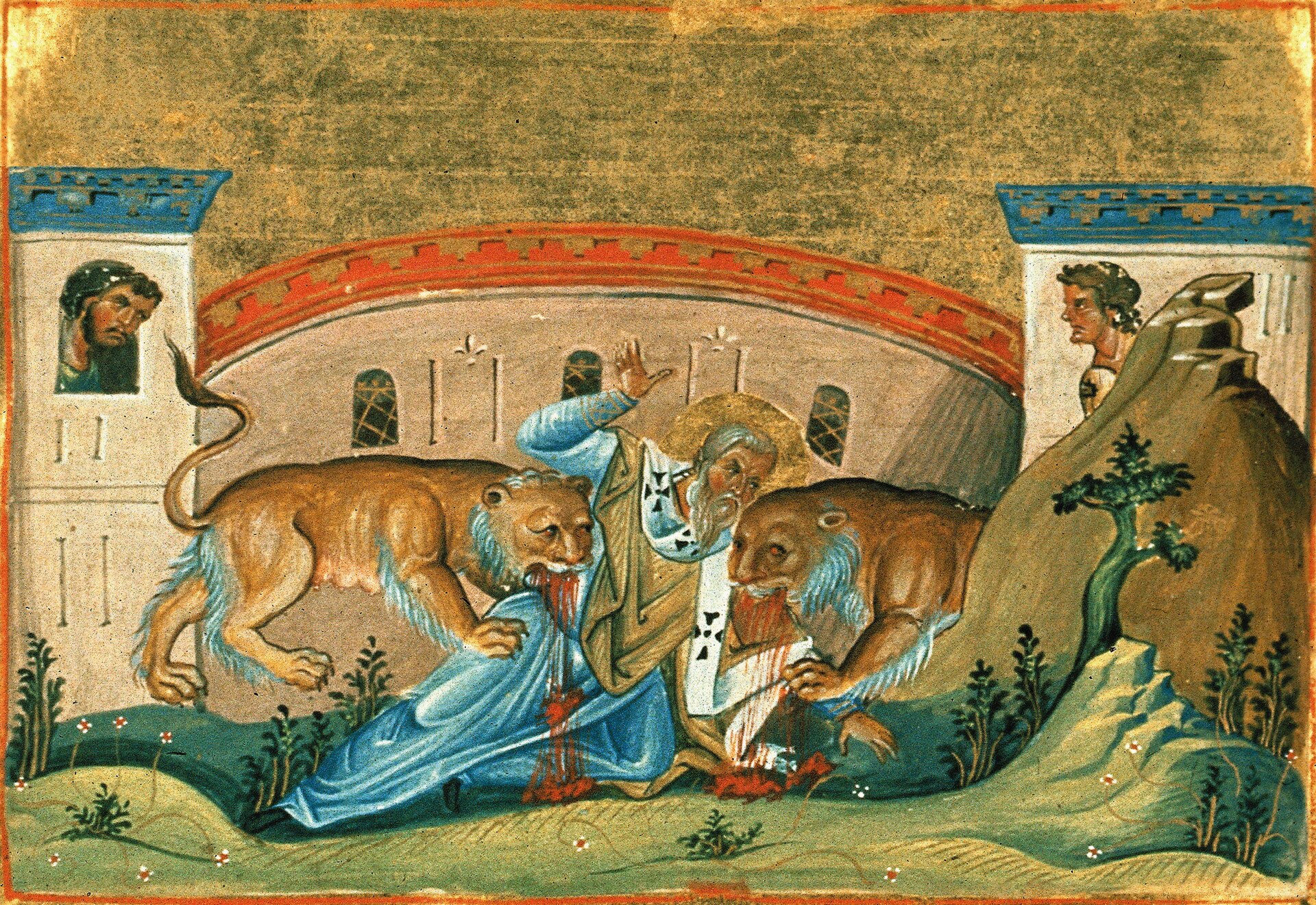
Ignatius of Antioch (; Ancient Greek: Ἰγνάτιος Ἀντιοχείας, romanized: Ignátios Antiokheías; died c. 108), also known as Ignatius Theophorus (Ἰγνάτιος ὁ Θεοφόρος, Ignátios ho Theophóros, 'the God-bearing'), was an early Christian writer and the Patriarch of Antioch. While en route to Rome, where he was to be killed, Ignatius wrote a series of letters. This correspondence forms a central part of a later collection of works by the Apostolic Fathers. He is considered one of the three most important of these, together with Clement of Rome and Polycarp. Although the authenticity of his letters has been questioned, they continue to serve as an example of early Christian theology, and address important topics including ecclesiology, the sacraments, and the role of bishops.