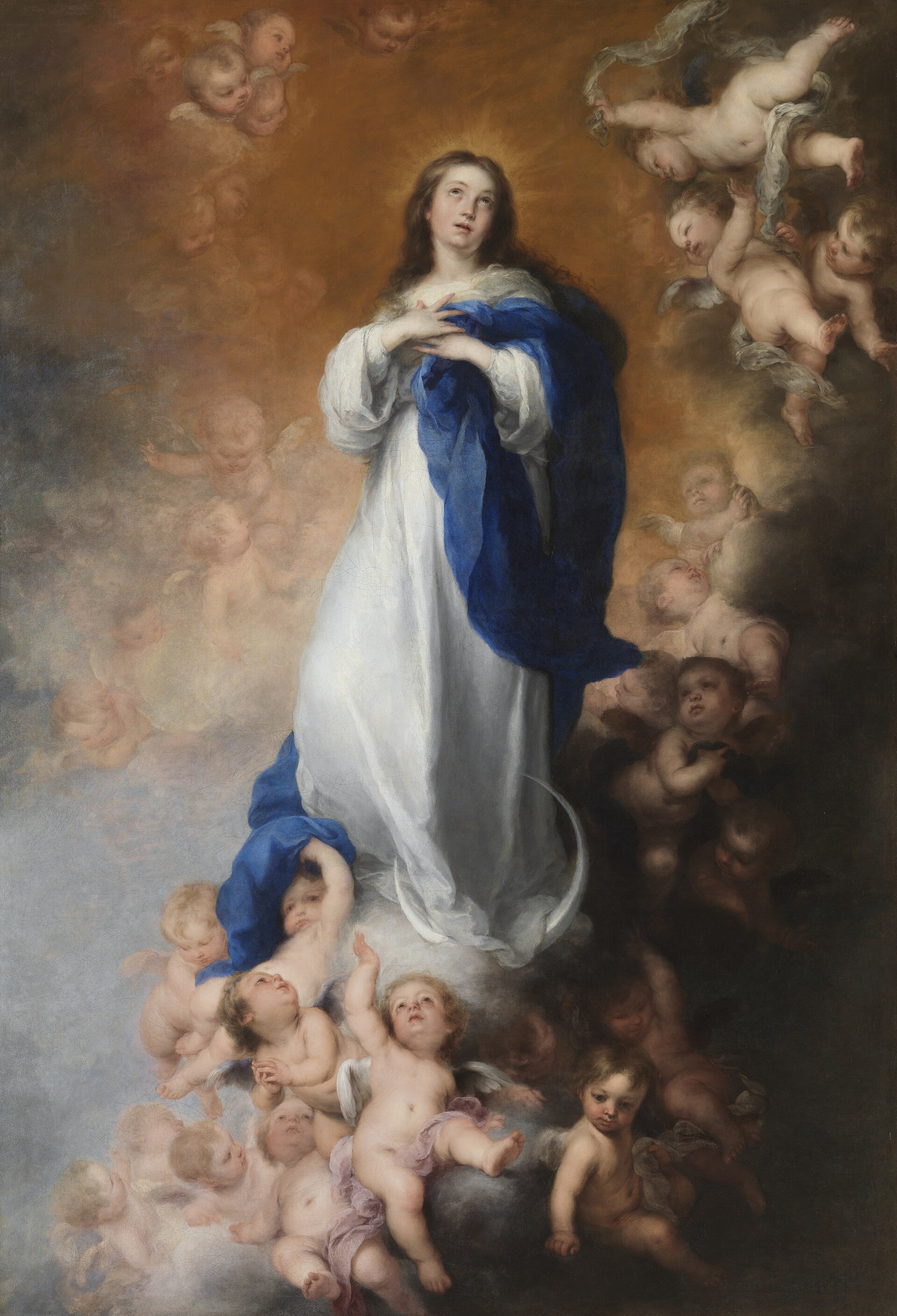
Immaculate Conception
Life and witness
Mary is preserved from original sin by the anticipated merits of Christ, prepared as the all-holy Mother of God.
The Lives Of The Saints: Volume 15, December · THE IMMACULATE CONCEPTION OF THE
THE IMMACULATE CONCEPTION OF THE B.V. MARY.
[Modem Roman Martyrology. Anciently: — “The Conception of the most sacred Virgin Mary, mother of our Lord God Jesus Christ.”
The Oriental Menseas and Kalendars have “The Conception of Anna,” on the 9th Dec. Anglican Reformed Kalendar, “ The Conception of the B. V. Mary.” According to the statement of the Abbot Engelbert, who wrote in the 13th cent., a certain Abbot Alfinus was commanded by God to introduce the festival of the Immaculate Conception by Anna of the Virgin Mary.1 This Alfinus was no doubt Helchinius, mentioned in the ancient Breviary of Tours. At first it was left free to the people to observe it or not, as by the Council of Oxford of 1222, but not so a synod of London in 1287. It was again enjoined in a synod of London in 1328. It was ordered by the Council of Sens in 1247, and by the Council of Bayonne in 1300. The festival was introduced at Rome only after Benedict XIII. Sixtus IV. published two constitutions ap- pointing this festival to be observed throughout the Church, and issued an office for it, but without making the festival one of obligation. Pope Clement VIII. elevated it to the rank of semi-double, Clement IX. gave it an octave, and Clement XI. constituted it a major festival “de praecepto” in 1708. The festival was, however, everywhere only that of the “Conception of Mary” till the promulgation of the decree of 1854 by Pius IX., making the Immaculate Conception of Mary an article of faith. The Franciscans of Naples asked permission of Pius VII. to celebrate the Immaculate Conception of S. Mary in the preface of the Mass, and this favour was accorded them by bull, dated May 17,
* * Pez. Thesaur. Novisa AnecdoL L i. p. 705.
# 9
Digitized by i^ooQle
Little pictorial lives of the saints : with reflections for every day in the year : compiled from "Butler's Lives" and other approved sources : to which are added lives of the American saints : placed on the calendar for the United States by special petition of the Third Plenary Council of Baltimore · December 8.— THE FEAST OF THE IMMACULATE CONCEPTION.
December 8.— THE FEAST OF THE IMMACULATE
CONCEPTION.
ON this day, so dear to every Catholic heart, "vve cele- brate, in the first place, the moment in which Al- mighty God showed Mary, through the distance of ages, to our first parents as the Virgin Mother of the divine Re- deemer, the woman destined to crush the head of the ser- pent. And as by eternal decree she was miraculously exempt from ail stain of original sin, and endowed witli the richest treasures of grace and sanctity, it is meet that
we should honor her glorious prerogatives by this special feast of the Immaculate Conception. We should join in spirit with the blessed in heaven, and rejoice with our dear Mother, not jniy for her own sake, but for ours, her chil
584
Biographical overview
The Immaculate Conception is the doctrine that the Virgin Mary was free of original sin from the moment of her conception. It is one of the four Marian dogmas of the Catholic Church. Debated by medieval theologians, it was not defined as a dogma until 1854, by Pope Pius IX in the papal bull Ineffabilis Deus. While the Immaculate Conception asserts Mary's freedom from original sin, the Council of Trent, held between 1545 and 1563, had previously non-dogmatically affirmed her freedom from personal sin. While they have different theological emphases, the Eastern Catholic Churches, just like the Latin Church, fully affirm the dogma. The Immaculate Conception became a popular subject in literature, but its abstract nature meant it was late in appearing as a subject in works of art. The iconography of Our Lady of the Immaculate Conception shows Mary standing, with arms outstretched or hands clasped in prayer. The feast day of the Immaculate Conception is December 8. Many Protestant churches rejected the doctrine of the Immaculate Conception as unscriptural, though some Anglicans accept it as a pious devotion. The Eastern Orthodox Church rejects the doctrine. The teaching on the Immaculate Conception among the Oriental Orthodox churches varies: Shenouda III, Pope of the Coptic Orthodox Church, and the Patriarch Ignatius Zakka I of the Syriac Orthodox Church opposed the teaching, while the Eritrean Orthodox Tewahedo Church and Ethiopian Orthodox Tewahedo Church accept it.
The Lives Of The Saints: Volume 15, December · THE IMMACULATE CONCEPTION OF THE
[Modem Roman Martyrology. Anciently: — “The Conception of the most sacred Virgin Mary, mother of our Lord God Jesus Christ.”
The Oriental Menseas and Kalendars have “The Conception of Anna,” on the 9th Dec. Anglican Reformed Kalendar, “ The Conception of the B. V. Mary.” According to the statement of the Abbot Engelbert, who wrote in the 13th cent., a certain Abbot Alfinus was commanded by God to introduce the festival of the Immaculate Conception by Anna of the Virgin Mary.1 This Alfinus was no doubt Helchinius, mentioned in the ancient Breviary of Tours. At first it was left free to the people to observe it or not, as by the Council of Oxford of 1222, but not so a synod of London in 1287. It was again enjoined in a synod of London in 1328. It was ordered by the Council of Sens in 1247, and by the Council of Bayonne in 1300. The festival was introduced at Rome only after Benedict XIII. Sixtus IV. published two constitutions ap- pointing this festival to be observed throughout the Church, and issued an office for it, but without making the festival one of obligation. Pope Clement VIII. elevated it to the rank of semi-double, Clement IX. gave it an octave, and Clement XI. constituted it a major festival “de praecepto” in 1708. The festival was, however, everywhere only that of the “Conception of Mary” till the promulgation of the decree of 1854 by Pius IX., making the Immaculate Conception of Mary an article of faith. The Franciscans of Naples asked permission of Pius VII. to celebrate the Immaculate Conception of S. Mary in the preface of the Mass, and this favour was accorded them by bull, dated May 17,
* * Pez. Thesaur. Novisa AnecdoL L i. p. 705.
# 9
Digitized by i^ooQle