Isidore of Seville
Life and witness
Scholar-bishop who preserved classical and Christian learning for medieval Europe.
The Lives Of The Saints: Volume 04, April · by S. Isidore of Seville. Next to him sat six other metro-
The fourth council of Toledo was held in 633, on Dec. 9th, in the third year of the reign of King Sisnand. It was attended by sixty-two bishops, and was presided over by S. Isidore of Seville. Next to him sat six other metro- politans, the bishops of Narbonne, Merida, Braga, Toledo, and Tarragona ; there were also present seven deputies of absent bishops. When the council had assembled in the church of S. Leocadia, King Sisnand entered, and having prostrated himself before the bishops, he requested them to pray for him. It must have been a solemn spectacle, that conclave of prelates ; and the king is said on entering to have burst into tears. The Council drew up seventy-five canons, the first of which is a profession of faith, in which the mysteries of the Trinity and the Incarnation are un- folded. In it, it is distinctly enunciated, that the Holy Ghost proceeds from the Father and the Son. The negli- gence of the bishops in the matter of holding synods was reprimanded, and they were required to convene one every
*
Digitized by
Biographical overview
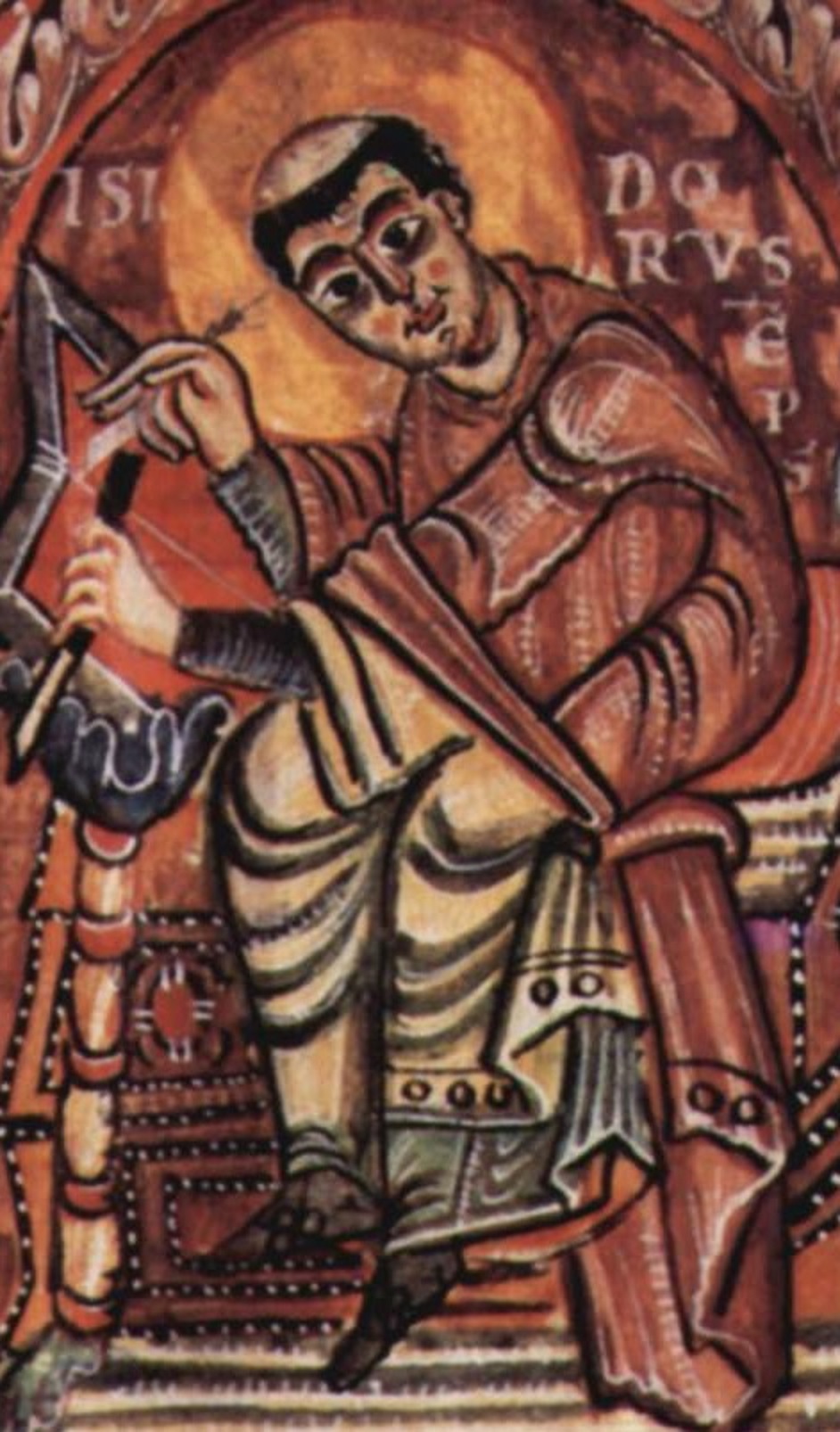
Isidore of Seville (Latin: Isidorus Hispalensis; c. 560 – 4 April 636) was a Hispano-Roman scholar, theologian and archbishop of Seville. He is widely regarded, in the words of the 19th-century historian Charles Forbes René de Montalembert, as "the last scholar of the ancient world". At a time of disintegration of classical culture, aristocratic violence, and widespread illiteracy, Isidore was involved in the conversion of the Arian Visigothic kings to Catholicism, both assisting his brother Leander of Seville and continuing after Leander's death. He was influential in the inner circle of Sisebut, Visigothic king of Hispania. Like Leander, he played a prominent role in the Councils of Toledo and Seville. His fame after his death was based on his Etymologiae, an etymological encyclopedia that assembled extracts of many books from classical antiquity that would otherwise have been lost. This work also helped to standardise the use of the full stop, comma and colon. Since the Early Middle Ages, Isidore has sometimes been called Isidore the Younger or Isidore Junior (Latin: Isidorus iunior), because of the earlier history purportedly written by Isidore of Córdoba.