
John Climacus
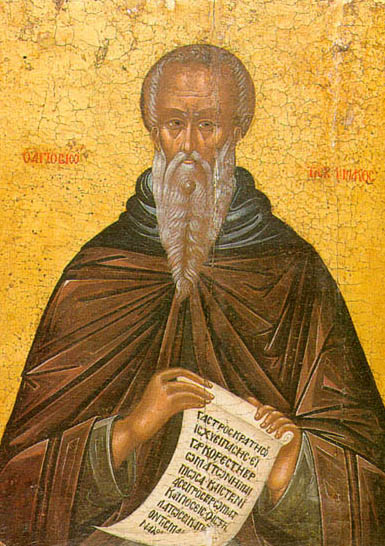
Martyrological notice
Roman Martyrology (traditional English edition; normalized OCR transcription): In Mount Sina, of St. John Climacus, abbot.
Baring-Gould: March · S. JOHN CLIMACUS, AB
[Roman Martyrology and Greek Menologium of the emperor Basil, and Menæa. Authority:--His Life by Daniel, monk of Raithu, near the Red Sea, a contemporary.]
S. John, abbot of Mount Sinai, is commonly called Climacus, from a book written by him, entitled "Climax, or the Ladder of Perfection." As this treatise shows his erudition, he is also sometimes called Scholasticus, and, as abbot of Mount Sinai, he is also designated as John the Sinaite.
The place of his birth is not known, nor is the exact year of that event, but it was probably in 525. At the age of sixteen he ascended Mount Sinai with the purpose of offering himself to God as a living acceptable sacrifice. At the age of thirty-five he became a solitary at Thola, five miles further in the desert, where, in the complete silence of the barren rocks, he could discipline his tongue, which was rather given to loquacity. He passed forty years in the service of God, and in self-mortification. From Thola he returned every Sabbath to the monastery church to assist at the divine service, and communicate at the sacred mysteries on that day and the following Sunday. Many resorted to the cell of S. John for advice, but, as it was reported, perhaps not without reason, that he made these visits an opportunity for indulging in his weakness of talking excessively, he condemned himself to rigorous silence for a whole twelvemonth.
At the age of seventy-five, in 600, S. John left his hermitage to fill the office of abbot in the monastery of Mount Sinai, and superior-general of all the monks and hermits of the deserts around.
S. Gregory the Great, who then sat in S. Peter's chair, wrote to the holy abbot, commending himself to his prayers, and sent him beds and money for his hospital, for the use of pilgrims to Mount Sinai.
At the request of John, abbot of Raithu, he drew up his "Climax, or Ladder of Perfection," containing, in thirty chapters, rules for attaining the thirty steps of religious perfection. This book contains many curious and instructive anecdotes, illustrative of the monastic life of the period.
S. John was regarded by his monastic contemporaries as a second Moses on Sinai, "for he ascended into the mountain of contemplation, talked with God face to face, and then descended to his fellows in mind and intelligence, bearing the tables of God's Law, his Ladder of Perfection."
Once, when S. John was entertaining six hundred pilgrims, a stranger, habited in linen, after the ancient Jewish fashion, appeared among the attendants, a man of very ancient and reverend mien, and ministered with his own hands to the guests. The feast being over, the stranger vanished, and S. John concluded it must have been Moses who had re-visited Sinai for a brief moment. This is a curious instance of the very widely diffused belief in the Wandering Jew. Hebrew legends are full of similar tales, but the mysterious stranger is with them Elijah; and the Arabs tell of a similar undying man, who appears at intervals, but who is El Khoudir, the friend and instructor of Moses.
When S. John was dying in his hermitage, his spiritual son, George, besought him to suffer him to depart with him. The saint replied, "Thou shalt follow me in a year's time." And so it was, at the end of a twelvemonth the disciple joined his master.
Alban Butler: January–March · ST. JOHN CLIMACUS, ABBOT.
From his life written by Daniel, a monk of Raithu, soon after his death, and from his own works. See Bulteau, Hist Monast. d'Orient, and d'Andilly, or rather his nephew, Le Maitre, in his life prefixed to the French translation of his works. See also Jos. Assemani, in Cal. Univ. ad 30 Martii, t. 6, p. 213.
ST. JOHN, generally distinguished by the appellation of Climacus, from his excellent book entitled Climax, or the Ladder to Perfection, was born about the year 525, probably in Palestine. By his extraordinary progress in the arts and sciences, he obtained very young the surname of the Scholastic. But at sixteen years of age he renounced all the advantages which the world promised him, to dedicate himself to God in a religious state, in 547. He retired to Mount Sinai, which, from the time of the disciples of St. Antony and St. Hilarion, had been always peopled by holy men, who, in imitation of Moses, when he received the law on that mountain, lived in the perpetual contemplation of heavenly things. Our novice, fearing the danger of dissipation and relaxation, to which numerous communities are generally more exposed than others, chose not to live in the great monastery on the summit, but in a hermitage on the descent of the mountain, under the discipline of Martyrius, a holy ancient anchoret. By silence, he curbed the insolent itch of talking about every thing, an ordinary vice in learned men, but usually a mark of pride and self-sufficiency. By perfect humility and obedience, he banished the dangerous desire of self-complacency in his actions. He never contradicted, never disputed with any one. So perfect was his submission, that he seemed to have no self-will. He undertook to sail through the deep sea of this mortal life securely, under the direction of a prudent guide, and shunned those rocks which he could not have escaped, had he presumed to steer alone, as he tells us.[1] From the visible mountain he raised his heart, without interruption, in all his actions, to God, who is invisible; and, attentive to all the motions of his grace, studied only to do his will. Four years he spent in the trial of his own strength, and in learning the obligations of his state, before he made his religious profession, which was in the twentieth year of his age. In his writings, he severely condemns engagements made by persons too young, or before a sufficient probation. By fervent prayer and fasting he prepared himself for the solemn consecration of himself to God, that the most intense fervor might make his holocaust the more perfect: and from that moment he seemed to be renewed in spirit; and his master admired the strides with which, like a mighty giant, the young disciple advanced, daily more and more, towards God by self-denial, obedience, humility, and the uninterrupted exercises of divine love and prayer.
In the year 560, and the thirty-fifth of his age, he lost Martyrius by death, having then spent nineteen years in that place in penance and holy contemplation. By the advice of a prudent director, he then embraced an eremitical life in a plain called Thole, near the foot of Mount Sinai. His cell was five miles from the church, probably the same which had been built a little {678} before, by order of the emperor Justinian, for the use of the monks, at the bottom of this mountain, in honor of the Blessed Virgin, as Procopius mentions.[2] Thither he went every Saturday and Sunday to assist, with all the other anchorets and monks of that desert, at the holy office and at the celebration of the divine mysteries, when they all communicated. His diet was very sparing, though, to shun ostentation and the danger of vain-glory, he ate of every thing that was allowed among the monks of Egypt, who universally abstained from flesh, fish, &c. Prayer was his principal employment; and he practised what he earnestly recommends to all Christians, that in all their actions, thoughts, and words, they should keep themselves with great fervor in the presence of God, and direct all they do to his holy will.[3] By habitual contemplation he acquired an extraordinary purity of heart, and such a facility of lovingly beholding God in all his works, that this practice seemed in him a second nature. Thus he accompanied his studies with perpetual prayer. He assiduously read the holy scriptures, and fathers, and was one of the most learned doctors of the church. But, to preserve the treasure of humility, he concealed, as much as possible, both his natural and acquired talents, and the extraordinary graces with which the Holy Ghost enriched his soul. By this secrecy he fled from the danger of vain-glory, which, like a leech, sticks to our best actions, and sucking from them its nourishment, robs us of their fruit. As if this cell had not been sufficiently remote from the eyes of men, St. John frequently retired into a neighboring cavern, which he had made in the rock, where no one could come to disturb his devotions, or interrupt his tears. So ardent were his charity and compunction, that his eyes seemed two fountains, which scarce ever ceased to flow; and his continual sighs and groans to heaven, under the weight of the miseries inseparable from his moral pilgrimage, were not to be equalled by the vehemency of the cries of those who suffer from knives and fire. Overcome by importunities, he admitted a holy anchoret named Moyses to live with him as his disciple.
God bestowed on St. John an extraordinary grace of healing the spiritual disorders of souls. Among others, a monk called Isaac, was brought almost to the brink of despair by most violent temptations of the flesh. He addressed himself to St. John; who perceived by his tears how much he underwent from that conflict and struggle which he felt within himself. The servant of God commended his faith, and said: "My son, let us have recourse to God by prayer." They accordingly prostrated themselves together on the ground in fervent supplication for a deliverance, and from that time the infernal serpent left Isaac to peace. Many others resorted to St. John for spiritual advice: but the devil excited some to jealousy, who censured him as one who, out of vanity, lost much time in unprofitable discourse. The saint took this accusation, which was a mere calumny, in good part, and as a charitable admonition; he therefore imposed on himself a rigorous silence for near a twelvemonth. This his humility and modesty so much astonished his calumniators, that they joined the rest of the monks in beseeching him to reassume his former function of giving charitable advice to all that resorted to him for it, and not to bury that talent of science which he had received for the benefit of many. He who knew not what it was to contradict others, with the same humility and deference again opened his mouth to instruct his neighbor in the rules of perfect virtue: in which office, such was the reputation of his wisdom and experience, that he was regarded as another Moses in that holy place.
St. John was now seventy-five years old, and had spent forty of them in {679} his hermitage, when, in the year six hundred, he was unanimously chosen abbot of Mount Sinai, and superior-general of all the monks and hermits in that country. Soon after he was raised to this dignity, the people of Palestine and Arabia, in the time of a great drought and famine, made their application to him as to another Elias, begging him to intercede with God in their behalf. The saint failed not with great earnestness to recommend their distress to the Father of mercies, and his prayer was immediately recompensed with abundant rains. St. Gregory the Great., who then sat in St. Peter's chair, wrote to our holy abbot,[4] recommending himself to his prayers, and sent him beds, with other furniture and money, for his hospital, for the use of pilgrims near Mount Sinai. John, who had used his utmost endeavors to decline the pastoral charge, when he saw it laid upon him, neglected no means which might promote the sanctification of all those who were entrusted to his care. That posterity might receive some share in the benefit of his holy instructions, John, the learned and virtuous abbot of Raithu, a monastery-situate towards the Red Sea, entreated him by that obedience he had ever practised, even with regard to his inferiors, that he would draw up the most necessary rules by which fervent souls might arrive at Christian perfection. The saint answered him, that nothing but extreme humility could have moved him to write to so miserable a sinner, destitute of every sort of virtue; but that he received his commands with respect, though far above his strength, never considering his own insufficiency. Wherefore, apprehensive of falling into death by disobedience, he took up his pen in haste, with great eagerness mixed with fear, and set himself to draw some imperfect outlines as an unskilful painter, leaving them to receive from him, as a great master, the finishing strokes. This produced the excellent work which he called Climax, or the ladder of religious perfection. This book being written in sentences, almost in the manner of aphorisms, abounds more in sense than words. A certain majestic simplicity, an inexpressible unction and spirit of humility, joined with conciseness and perspicuity, very much enhance the value of this performance: but its chief merit consists in the sublime sentiments, and perfect description of all Christian virtues, which it contains. The author confirms his precepts by several edifying examples, as of obedience and penance.[5] In describing a monastery of three hundred and thirty monks, which he had visited near Alexandria in Egypt, he mentions one of the principal citizens of that city, named Isidore, who, petitioning to be admitted into the house, said to the abbot: "As iron is in the hands of the smith, so am I in your hands." The abbot ordered him to remain without the gate, and to prostrate himself at the feet of everyone that passed by, begging their prayers for his soul struck with a leprosy. Thus he passed seven years in profound humility and patience. He told St. John, that during the first year he always considered himself as a slave condemned for his sins, and sustained violent conflicts. The second year he passed in tranquillity and confidence; and the third with relish and pleasure in his humiliations. So great was his virtue, that the abbot determined to present him to the bishop in order to be promoted to the priesthood, but the humility of the holy penitent prevented the execution of that design; for having begged at least a respite, he died within ten days. St. John could not help admiring the cook of this numerous community, who seemed always recollected, and generally bathed in tears amidst his continual occupation, and asked him by what means he nourished so perfect a spirit of compunction, in the midst of such a dissipating laborious employment. He said, that serving the monks, he represented to himself that he was serving not men, but God in his servants {680} and that the fire he always had before his eyes, reminded him of that fire which will burn souls for all eternity. The moving description which our author gives of the monastery of penitents called the Prison, above a mile from the former, hath been already abridged in our language. John the Sabaite told our saint, as of a third person, that seeing himself respected in his monastery, he considered that this was not the way to satisfy for his sins. Wherefore, with the leave of his abbot, he repaired to a severe monastery in Pontus, and after three years saw in a dream a schedule of his debts, to the amount in appearance of one hundred pounds of gold, of which only ten were cancelled. He therefore repeated often to himself: "Poor Antiochus, thou hast still great debt to satisfy." After passing over thirteen years in contempt and the most fervent practices of penance, he deserved to see in a vision his whole debt blotted out. Another monk, in a grievous fit of illness, fell into a trance, in which he lay as if he had been dead for the space of an hour: but recovering, he shut himself up in his cell, and lived a recluse twelve years, almost continually weeping, in the perpetual meditation of death. When he was near death, his brethren could only extort from him these words of edification: "He who hath death always before his eyes, will never sin." John, abbot of Raithu, explained this book of our saint by judicious comments, which are also extant. We have likewise a letter of St. John Climacus to the same person, concerning the duties of a pastor, in which he exhorts him in correcting others to temper severity with mildness, and encourages him zealously to fulfil the obligations of his charge; for nothing is greater or more acceptable to God than to offer him the sacrifice of rational souls sanctified by penance and charity.
St. John sighed continually under the weight of his dignity, during the four years that he governed the monks of Mount Sinai: and as he had taken upon him that burden with fear and reluctance, he with joy found means to resign the same a little before his death. Heavenly contemplation, and the continual exercise of divine love and praise, were his delight and comfort in his earthly pilgrimage: and in this imitation of the functions of the blessed spirits in heaven he placeth the essence of the monastic state.[6] In his excellent maxims concerning the gift of holy tears, the fruit of charity,[7] we seem to behold a lively portraiture of his most pure soul. He died in his hermitage on the 30th day of March, in 605, being fourscore years old. His spiritual son George, who had succeeded him in the abbacy, earnestly begged of God that he might not be separated from his dear master and guide, and followed him by a happy death within a few days. On several Greek commentaries on St. John Climacus's ladder, see Montfaucon, Biblioth. Coisliana, pp. 305, 306.
St. John Climacus, speaking of the excellence and the effects of charity, does it with a feeling and energy worthy of such a subject. "A mother," says he,[8] "feels less pleasure when she folds within her arms the dear infant whom she nourishes with her own milk, than the true child of charity does, when united, as he incessantly is, to his God, and folded as if were in the arms of his heavenly Father.[9]--Charity operates in some persons so as to carry them almost entirely out of themselves. It illuminates others, and fills them with such sentiments of joy, that they cannot help crying out: _The Lord is my helper and my protector: in him hath my heart confided, and I have been helped. And my flesh hath flourished again, and with my will I will give praise to him_.[10] This joy which they feel in their hearts, is reflected on their countenances; and when once God has united, or, as we may say, {681} incorporated them with his charity, he displays in their exterior, as in the reflection of a mirror, the brightness and serenity of their souls: even as Moses, being honored with a sight of God, was encompassed round by his glory." St. John Climacus composed the following prayer to obtain the gift of charity: "My God, I pretend to nothing upon this earth, except to be so firmly united to you by prayer, that to be separated from you may be impossible: let others desire riches and glory; for my part, I desire but one thing, and that is, to be inseparably united to you, and to place in you alone all my hopes of happiness and repose."
Footnotes: 1. Gr. l. 2. Procop. l. 5 de aedif. Justin. 3. S. Jo. Clim. gr. 27, n. 67. 4. St. Greg. l. 11; Ep. 1, l. 12; Ep. 16, t. 2, p. 1091. 5. Gr. 4 and 5. 6. Gr. 1. 7. Gr. 7, 27, 30. 8. Grad. 30, n. 12. 9. Gr {} n. 14. 10. Ps. xxvii.
Biographical overview
John Climacus (Ancient Greek: Ἰωάννης τῆς Κλίμακος; Latin: Ioannes Climacus; Arabic: يوحنا السلمي, romanized: Yuḥana al-Sêlmi), also known as John of the Ladder, John Scholasticus and John Sinaites, was a 6th–7th century Christian monk at the monastery on Mount Sinai. He is revered as a saint by the Eastern Orthodox Church and Catholic Church.
Butler Jan Mar · St. John Climacus, Abbot........................ 677
{491}
MARCH I.
SAINT DAVID, ARCHBISHOP,
PATRON OF WALES.
See his life by Giralduc Cambrensis, in Wharton's Anglia Sacra, t. 2; also Doctor Brown Willis, and Wilkins, Conc. Britain. & Hibern. t. 1.
About the year 544.
ST. DAVID, in Welsh Dewid, was son of Xantus, prince of Ceretice, now Cardiganshire. He was brought up in the service of God, and, being ordained priest, retired into the Isle of Wight, and embraced an ascetic life, under the direction of Paulinus, a learned and holy man, who had been a disciple of St. Germanus of Auxerre. He is said by the sign of the cross to have restored sight to his master, which he had lost by old age, and excessive weeping in prayer. He studied a long time to prepare himself for the functions of the holy ministry. At length, coming out of his solitude, like the Baptist out of the desert, he preached the word of eternal life to the Britons. He built a chapel at Glastenbury, a place which had been consecrated to the divine worship by the first apostles of this island. He founded twelve monasteries, the principal of which was in the vale of Ross,[1] near Menevia, where he formed many great pastors and eminent servants of God. By his rule he obliged all his monks to assiduous manual labor in the spirit of penance: he allowed them the use of no cattle to ease them at their work in tilling the ground. They were never suffered to speak but on occasions of absolute necessity, and they never ceased to pray, at least mentally, during their labor. They returned late in the day to the monastery, to read, write, and pray. Their food was only bread and vegetables, with a little salt, and they never drank any thing better than a little milk mingled with water. After their repast they spent three hours in prayer and adoration; then took a little rest, rose at cock-crowing, and continued in prayer till they went out to work. Their habit was of the skins of beasts. When any one petitioned to be admitted, he waited ten days at the door, during which time he was tried by harsh words, repeated refusals, and painful labors, that he might learn to die to himself. When he was admitted, he left all his worldly substance behind him, for the monastery never received any thing on the score of admission. All the monks discovered their most secret thoughts and temptations to their abbot.
The Pelagian heresy springing forth a second time in Britain, the bishops, in order to suppress it, held a synod at Brevy, in Cardiganshire, in 512, or rather in 519.[2] St. David, being invited to it, went thither, and in that venerable assembly confuted and silenced the infernal monster by his eloquence,{492} learning, and miracles. On the spot where this council was held, a church was afterwards built called Llan-Devi Brevi, or the church of St. David near the river Brevi. At the close of the synod, St. Dubritius, the archbishop of Caerleon, resigned his see to St. David, whose tears and opposition were only to be overcome by the absolute command of the synod, which however allowed him, at his request, the liberty to transfer his see from Caerleon, then a populous city, to Menevia, now called St. David's, a retired place, formed by nature for solitude, being, as it were, almost cut off from the rest of the island, though now an intercourse is opened to it from Milford-Haven. Soon after the former synod, another was assembled by St. David at a place called Victoria, in which the acts of the first were confirmed, and several canons added relating to discipline which were afterwards confirmed by the authority of the Roman church; and these two synods were, as it were, the rule and standard of the British churches. As for St. David, Giraldus adds, that he was the great ornament and pattern of his age. He spoke with great force and energy, but his example was more powerful than his eloquence; and he has in all succeeding ages been the glory of the British church. He continued in his last see many years; and having founded several monasteries, and been the spiritual father of many saints, both British and Irish, died about the year 544, in a very advanced age. St. Kentigtern saw his soul borne up by angels into heaven. He was buried in his church of St. Andrew, which hath since taken his name, with the town and the whole diocese. Near the church stand several chapels, formerly resorted to with great devotion: the principal is that of St. Nun, mother of St. David, near which is a beautiful well still frequented by pilgrims. Another chapel is sacred to St. Lily, surnamed Gwas-Dewy, that is, St. David's man; for he was his beloved disciple and companion in his retirement. He is honored there on the 3d, and St. Nun, who lived and died the spiritual mother of many religious women, on the 2d of March. The three first days of March were formerly holidays in South Wales in honor of these three saints; at present only the first is kept a festival throughout all Wales. John of Glastenbury[3] informs us, that in the reign of king Edgar, in the year of Christ 962, the relics of St. David were translated with great solemnity from the vale of Ross to Glastenbury, together with a portion of the relics of St. Stephen the Protomartyr.
The Lives Of The Saints: Volume 03, March · S. JOHN CLIMACUS, AB.
(a.d. 606.)
[Roman Martyrology and Greek Menologium of the emperor Basil, and Menaea. Authority : — His Life by Daniel, monk of Raithu, near the Red Sea, a contemporary.]
S. John, abbot of Mount Sinai, is commonly called Climacus, from a book written by him, entitled “ Climax, or the Ladder of Perfection.” As this treatise shows his erudition, he is also sometimes called Scholasticus, and, as abbot of Mount Sinai, he is also designated as John the Sinaite.
The place of his birth is not known, nor is the exact year of that event, but it was probably in 525. At the age of sixteen he ascended Mount Sinai with the purpose of offer- ing himself to God as a living acceptable sacrifice. At the age of thirty-five he became a solitary at Thola, five miles further in the desert, where, in the complete silence of the barren rocks, he could discipline his tongue, which was rather given to loquacity. He passed forty years in the service of God, and in self-mortification. From Thola he
Digitized by LjOOQie
A Ijjif
Marcn 3o.j S. John Climacus. 507
returned every Sabbath to the monastery church to assist at the divine service, and communicate at the sacred mys- teries on that day and the following Sunday. Many resorted to the cell of S. John for advice, but, as it was reported, perhaps not without reason, that he made these visits an opportunity for indulging in his weakness of talking ex- cessively, he condemned himself to rigorous silence for a whole twelvemonth.
At the age of seventy-five, in 600, S. John left his her- mitage to fill the office of abbot in the monastery of Mount Sinai, and superior-general of all the monks and hermits of the deserts around.
S. Gregory the Great, who then sat in S. Peter's chair, wrote to the holy abbot, commending himself to his prayers, and sent him beds and money for his hospital, for the use of pilgrims to Mount Sinai.
At the request of John, abbot of Raithu, he drew up his “ Climax, or Ladder of Perfection," containing, in thirty chapters, rules for attaining the thirty steps of religious per- fection. This book contains many curious and instructive anecdotes, illustrative of the monastic life of the period.
S. John was regarded by his monastic contemporaries as a second Moses on Sinai, “ for he ascended into the moun- tain of contemplation, talked with God face to face, and then descended to his fellows in mind and intelligence, bearing the tables of God's Law, his Ladder of Perfection.”
Once, when S. John was entertaining six hundred pil- grims, a stranger, habited in linen, after the ancient Jewish fashion, appeared among the attendants, a man of very ancient and reverend mien, and ministered with his own hands to the guests. The feast being over, the stranger vanished, and S. John concluded it must have been Moses who had re-visited Sinai for a brief moment This is a curious instance of the very widely diffused belief in the