
Andrew of Crete
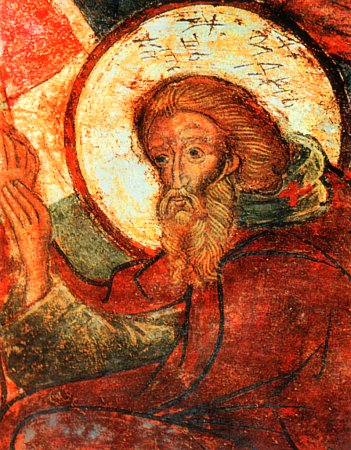
Life and witness
S. Andrew of Crete (circ. 732) uses expressions which seem to refer to it; but more distinct are the words of two anonymous writers, quoted by Grets er in his Book on the Cross.
The Lives Of The Saints: Volume 05, May · S. Andrew of Crete (circ. 732) uses expressions which
S. Andrew of Crete (circ. 732) uses expressions which seem to refer to it; but more distinct are the words of two anonymous writers, quoted by Grets er in his Book on the Cross. In these we find the whole story of how Judas was brought by S. Helena to confession, by throwing him into
* Mansius Coll. Concil. ii. 424. This letter is one of the forgeries of the Pseudo-Isidore, or at least was inserted in his collection of decretals.
* Vitt. Pontiff. Ed. Blanchini, Rom, 1718. i. 33.
* *
6o
Lives of the Saints .
[May 3.
*
*
a well, and keeping him there fasting till he confessed where the cross was. And we are told that Judas afterwards became bishop of Jerusalem. This took place, we are in- formed, in the year 303.
If we turn to quite another quarter, we find Moses of Khorene, the Armenian historian (between 450-477), say that “Constantine sent his mother, Helena, to Jerusalem, in order that she might search for the cross ; Helena found the saving wood together with five nails.”1
It has been seen that the earliest to mention S. Helena in connexion with the discovery of the cross is S. Ambrose, in the year 395. The first to mention the discovery, with- out naming S. Helena, is S. Cyril of Jerusalem, about the year 350. But this difficulty meets us, which is one sufficiently hard to overcome. Eusebius, the Father of Ecclesiastical History, lived at the time when the cross is said to have been found, and he mentions in his “ Life of Constantine,” the expedition of Helena to the East, but not one word does he say about the finding of the cross. He tells how S. Helena went to Palestine, to thank God for her son, and that she venerated the foot-prints of the Saviour (on the Mount of the Ascension) which were then shown, and that she erected two churches, one at Beth- lehem, the other on the mount of the Ascension. That is all. What makes it more extraordinary is that Eusebius was at Jerusalem in 335, at the dedication of the church of the Resurrection, which Constantine built, and has de- scribed the Church and the ceremonies used ; but again, not one word about the cross.
1 Moses of Khorene, Hist. Arm. Ed. Florival, ii. c. 87. It is not necessary to do more than note here the medals of Constantine, engraved by Freker, in 1600, and by Gretser, “De Crnce,” with a representation of the Invention of the Cross. They are not original, as the fact of the date on them being in Arabic numerals, 234, 23S, sufficiently proves. Du Cange reproduced the medal, but omitted the numerals, T. via. PI. 4.
*
Biographical overview
Andrew of Crete (Greek: Ἀνδρέας Κρήτης, c. 650 – July 4, 712 or 726 or 740), also known as Andrew of Jerusalem, was an 8th-century bishop, theologian, homilist, and hymnographer. He is venerated as a saint in both the Eastern Orthodox Church and the Catholic Church.