
Cuthbert
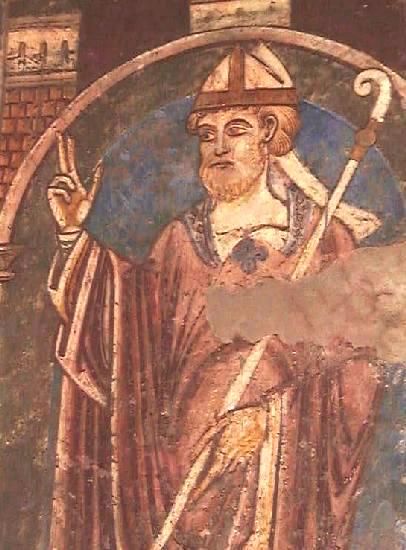
Life and witness
In England, the deposition of St. Cuthbert, bishop of Lindisfarne, who even from his childhood to his dying day, was renowned for his holy works and miracles.
Baring-Gould: March · S. CUTHBERT, B. OF LINDISFARNE
[Martyrologies of Bede, Usuardus, Ado, Rabanus Maurus; the Anglican, Scottish, and Irish Martyrologies; the Benedictine and the Roman as well. Authorities:--Bede's Life of S. Cuthbert, another by a monk of Lindisfarne, written in the reign of Egfrid (d. 705). The following life is extracted from Montalembert's "Monks of the West."]
Of the parentage of Cuthbert, nothing for certain is known. The Kelts have claimed him as belonging to them, at least by birth. They made him out to have been the son of an Irish princess, reduced to slavery, like Bridget, the holy patroness of Ireland, but who fell, more miserably, victim to the lust of her savage master. His Celtic origin would seem to be more conclusively proved by his attitude towards S. Wilfrid, the introducer of Roman uniformity into the north of England, than by the tradition of the Anglo-Saxon monks of Durham. His name is certainly Saxon, and not Keltic. But, to tell the truth, nothing is certainly known either of his place of birth, or the rank of his family.
His first appearance in history is as a shepherd in Lauderdale, a valley watered by a river which flows into the Tweed near Melrose. It was then a district annexed to the kingdom of Northumbria, which had just been delivered by the holy king Oswald from the yoke of the Mercians and Britons. As he is soon afterwards to be seen travelling on horseback, lance in hand, and accompanied by a squire, it is not to be supposed that he was of poor extraction. At the same time, it was not the flocks of his father which he kept, as did David in the plains of Bethlehem; it is expressly noted that the flocks confided to his care belonged to a master, or to several masters. His family must have been in the rank of those vassals to whom the great Saxon lords gave the care and superintendence of their flocks upon the vast extent of pastures which, under the name of folcland or common, was left to their use, and where the cowherds and shepherds lived day and night in the open air, as is still done by the shepherds of Hungary.
Popular imagination in the north of England, of which Cuthbert was the hero before, as well as after, the Norman Conquest, had thus full scope in respect to the obscure childhood of its favourite saint, and delighted in weaving stories of his childish sports, representing him as walking on his hands, and turning somersaults with his little companions. A more authentic testimony, that of his contemporary, Bede, informs us that our shepherd boy had not his equal among the children of his age, for activity, dexterity, and boldness in the race and fight. In all sports and athletic exercises he was the first to challenge his companions, with the certainty of being the victor. The description reads like that of a little Anglo-Saxon of our own day--a scholar of Eton or Harrow. At the same time, a precocious piety showed itself in him, even amid the exuberance of youth. One night, as he said his prayers, while keeping the sheep of his master, he saw the sky, which had been very dark, broken by a track of light, upon which a cloud of angels descended from heaven, returning afterwards with a resplendent soul, which they had gone to meet on earth. Next morning he heard that Aidan, the holy bishop of Lindisfarne, the apostle of the district, had died during the night. This vision determined his monastic vocation.
Some time afterwards we find him at the gates of the monastery of Melrose, the great Keltic establishment for novices in Northumbria. He was then only fifteen, yet, nevertheless, he arrived on horseback, lance in hand, attended by a squire, for he had already begun his career in the battle-field, and learned in the face of the enemy the first lessons of abstinence, which he now meant to practise in the cloister. He was received by two great doctors of the Keltic Church,--the abbot Eata, one of the twelve Northumbrians first chosen by Aidan, and the prior Boswell, who conceived a special affection for the new-comer, and undertook the charge of his monastic education. Five centuries later, the copy of the Gospels in which the master and pupil had read daily, was still kissed with veneration in the cathedral of Durham.
The robust and energetic youth very soon showed the rarest aptitude for monastic life, not only for cenobitical exercises, but, above all, for the missionary work, which was the principal occupation of monks in that country and period. He was not content merely to surpass all the other monks in his devotion to the four principal occupations of monastic life--study, prayer, vigil, and manual labour--but speedily applied himself to the work of casting out from the hearts of the surrounding population the last vestiges of pagan superstition. Not a village was so distant, not a mountain side so steep, not a village so poor, that it escaped his zeal. He sometimes passed weeks, and even months, out of his monastery, preaching to and confessing the rustic population of the mountains. The roads were very bad, or rather there were no roads; only now and then was it possible to travel on horseback; sometimes, when his course lay along the coast of the district inhabited by the Picts, he would take the help of a boat. But generally it was on foot that he had to penetrate into the glens and distant valleys, crossing the heaths and vast table-lands, uncultivated and uninhabited, where a few shepherd's huts, like that in which he himself had passed his childhood, and which were in winter abandoned even by the rude inhabitants, were thinly scattered. But neither the intemperance of the seasons, nor hunger, nor thirst, arrested the young and valiant missionary in his apostolic travels, to seek the scattered population, half Celts, and half Anglo-Saxons, who, though already Christian in name and by baptism, retained an obstinate attachment to many of their ancient superstitions, and who were quickly led back by any great calamity, such as one of the great pestilences which were then so frequent, to the use of magic, amulets, and other practices of idolatry. The details which have been preserved of the wonders which often accompanied his wanderings, show that his labours extended over all the hilly district between the two seas--from the Solway to the Forth. They explain to us how the monks administered the consolations and the teaching of religion, before the organization of parishes, ordained by archbishop Theodore, had been everywhere introduced or regulated. As soon as the arrival of one of these apostolic missionaries in a somewhat central locality was known, all the population of the neighbourhood hastened to hear him, endeavouring with fervour and simplicity to put in practice the instruction they received from him. Cuthbert, especially, was received among them with affectionate confidence; his eloquence was so persuasive that it brought the most rebellious to his feet, to hear their sins revealed to them, and to accept the penance which he imposed upon them.
Cuthbert prepared himself for preaching and the administration of the Sacraments, by extraordinary penances and austerities. Stone bathing-places, in which he passed the entire night in prayer, lying in the frozen water, according to a custom common among the Keltic saints, are still shown in several different places. When he was near the sea, he went to the shore, unknown to any one, at night, and plunging into the waves up to his neck, sang his vigils there. As soon as he came out of the water he resumed his prayers on the sand of the beach. On one occasion, one of his disciples, who had followed him secretly in order to discover the aim of this nocturnal expedition, saw two otters come up out of the water, which, while the saint prayed on his knees, lick his frozen feet, and wipe them with their hair, until life and warmth returned to the benumbed members. By one of those strange caprices of human frivolity which disconcert the historian, this insignificant incident is the only recollection which now remains in the memory of the people. S. Cuthbert is known to the peasant of Northumberland and of the Scottish borders only by the legend of those compassionate otters.
He had been some years at Melrose, when the abbot Eata took him along with him to join the community of Keltic monks established by king Alchfrid at Ripon. Cuthbert held the office of steward, and in this office showed the same zeal as in his missions. When travellers arrived through the snow, famished and nearly fainting with cold, he himself washed their feet and warmed them against his bosom, then hastened to the oven to order bread to be made ready, if there was not enough.
Cuthbert returned with his countrymen to Melrose, resumed his life of missionary preaching, and again met his friend and master, the prior Boswell, at whose death, in the great pestilence of 664, Cuthbert was elected abbot in his place. He had been himself attacked by the disease; and all the monks prayed earnestly that his life might be preserved to them. When he knew that the community had spent the night in prayer for him, though he felt no better, he cried to himself, with a double impulse of his habitual energy, "What am I doing in bed? It is impossible that God should shut His ears to such men. Give me my staff and my shoes." And getting up, he immediately began to walk, leaning upon his staff. But this sudden cure left him subject to weakness, which shortened his life.
However, he had not long to remain at Melrose. The triumph of Wilfrid and the Roman ritual at the conference of Whitby, brought about a revolution in the monastic metropolis of Northumbria, and in the mother monastery of Melrose, at Lindisfarne. Bishop Colman had returned to Iona, carrying with him the bones of S. Aidan, the first apostle of the country, and followed by all the monks who would not consent to sacrifice their Keltic tradition to Roman unity. It was of importance to preserve the holy island, the special sanctuary of the country, for the religious family of which its foundress had been a member. Abbot Eata of Melrose undertook this difficult mission. He became abbot of Lindisfarne, and was invested with a kind of episcopal supremacy. He took with him the young Cuthbert, who was not yet thirty, but whom, however, he held alone capable of filling the important office of prior in the great insular community.
The struggle into which Eata and Cuthbert, in their own persons, had entered against Wilfrid, on the subject of Roman rites, did not point them out as the best men to introduce the novelties so passionately defended and insisted upon by the new bishop of Northumbria. Notwithstanding, everything goes to prove that the new abbot and prior of Lindisfarne adopted without reserve the decisions of the assembly of Whitby, and took serious pains to introduce them into the great Keltic community. Cuthbert, in whom the physical energy of a robust organization was united to an unconquerable gentleness, employed in this task all the resources of his mind and heart. All the rebels had not left with bishop Colman; some monks still remained, who held obstinately by their ancient customs. Cuthbert reasoned with them daily in the meetings of the chapter; his desire was to overcome their objections by patience and moderation alone; he bore their reproaches as long as that was possible, and when his endurance was at an end, raised the sitting without changing countenance or tone, and resumed next morning the course of the debate, without ever permitting himself to be moved to anger, or allowing any thing to disturb the inestimable gift of kindness and light-heartedness which he had received from God.
But his great desire was the strict observance of the rule when once established; and his historian boasts, as one of his most remarkable victories, the obligation he imposed for ever upon the monks of Lindisfarne of wearing a simple and uniform dress, in undyed wool, and thus giving up the passionate liking of the Anglo-Saxons for varied and brilliant colours.
During the twelve years which he passed at Lindisfarne, the life of Cuthbert was identical with that which he had led at Melrose. Within doors this life was spent in the severe practice of all the austerities of the cloister, in manual labour, united to the punctual celebration of divine worship, and such fervour in prayer that he often slept only one night in the three or four, passing the others in prayer, and in singing the service alone while walking round the aisle to keep himself awake. Outside, the same zeal for preaching, the same solicitude for the salvation and well-being, temporal as well as spiritual, of the Northumbrian people, was apparent in him. He carried to them the Word of Life; he soothed their sufferings, by curing miraculously a crowd of diseases which were beyond the power of the physicians. But the valiant missionary specially assailed the diseases of the soul, and made use of all the tenderness and all the ardour of his own spirit to reach them. When he celebrated mass before the assembled crowd, his visible emotion, his inspired looks, his trembling voice, all contributed to penetrate and overpower the multitude. The Anglo-Saxon Christians, who came in crowds to open their hearts to him in the confessional, were still more profoundly impressed. Though he was a bold and inflexible judge of impenitent vice, he felt and expressed the tenderest compassion for the contrite sinner. He was the first to weep over the sins which he pardoned in the name of God; and he himself fulfilled the penances which he imposed as the conditions of absolution, thus gaining by his humility the hearts which he longed to convert and cure.
But neither the life of a cenobite, nor the labours of a missionary could satisfy the aspirations of his soul after perfection. When he was not quite forty, after holding his priorship at Lindisfarne for twelve years, he resolved to leave monastic life, and to live as a hermit in a sterile and desert island, visible from Lindisfarne, which lay in the centre of the Archipelago, south of the holy isle, and almost opposite the fortified capital of the Northumbrian kings at Bamborough. No one dared to live on this island, which was called Farne, in consequence of its being supposed to be the haunt of demons. Cuthbert took possession of it as a soldier of Christ, victorious over the tyranny of evil, and built there a palace worthy of himself, hollowing out of the living rock a cell from which he could see nothing but the sky, that he might not be disturbed in his contemplations. The hide of an ox suspended before the entrance of his cavern, and which he turned according to the direction of the wind, afforded him a poor defence against the intemperance of that wild climate. His holy historian tells us that he exercised sway over the elements and brute creation as a true monarch of the land which he had conquered for Christ, and with that sovereign empire over nature which sin alone has taken from us. He lived on the produce of a little field of barley sown and cultivated by his own hands, but so small that the inhabitants of the coast reported among themselves that he was fed by angels with bread made in Paradise.
The legends of Northumbria linger lovingly upon the solitary sojourn of their great national and popular saint in this basaltic isle. They attribute to him the extraordinary gentleness and familiarity of a particular species of aquatic birds which came when called, allowed themselves to be taken, stroked, caressed, and whose down was of remarkable softness. In ancient times they swarmed about this rock, and they are still to be found there, though much diminished in number since curious visitors have come to steal their nests and shoot the birds. These sea fowl are found nowhere else in the British Isles, and are called the Birds of S. Cuthbert. It was he, according to the narrative of a monk of the thirteenth century, who inspired them with a hereditary trust in man by taking them as companions of his solitude, and guaranteeing to them that they should never be disturbed in their homes.
It is he, too, according to the fishers of the surrounding islands, who makes certain little shells of the genus Entrochus, which are only to be found on this coast, and which have received the name of S. Cuthbert's Beads. They believe that he is still to be seen by night seated on a rock, and using another as an anvil for his work.
The pious anchorite, however, in condemning himself to the trials of solitude, had no intention of withdrawing from the cares of fraternal charity. He continued to receive frequent visits, in the first place from his neighbours and brethren at Lindisfarne, and in addition from all who came to consult him upon the state of their souls, as well as to seek consolation from him in adversity. The number of these pilgrims of sorrow was countless. They came not only from the neighbouring shores, but from the most distant provinces. Throughout all England the rumour spread, that on a desert rock of the Northumbrian coast there lived a solitary who was the friend of God, and skilled in the healing of human suffering. In this expectation no one was deceived; no man carried back from the sea-beaten island the same burden of suffering, temptation, or remorse which he had taken there. Cuthbert had consolation for all troubles, light for all the sorrowful mysteries of life, counsel for all its perils, a helping hand to all the hopeless, a heart open to all who suffered. He could draw from all terrestrial anguish a proof of the joys of heaven, deduce the certainty of those joys from the terrible evanescence of both good and evil in this world, and light up again in sick souls the fire of charity--the only defence, he said, against those ambushes of the old enemy which always take our hearts captive when they are emptied of divine and brotherly love.
To make his solitude more accessible to these visitors, and above all to his brethren from Lindisfarne, he had built some distance from the cave which was his dwelling, at a place where boats could land their passengers, a kind of parlour and refectory for the use of his guests. There he himself met, conversed, and ate with them, especially when, as he has himself told, the monks came to celebrate with him such a great feast as Christmas. At such moments he went freely into all their conversations and discussions, interrupting himself from time to time to remind them of the necessity of watchfulness and prayer. The monks answered him, "Nothing is more true; but we have so many days of vigil, of fasts and prayers. Let us at least to-day rejoice in the Lord." The Venerable Bede, who has preserved to us the precious memory of this exchange of brotherly familiarity has not disdained to tell us also of the reproaches addressed by Cuthbert to his brothers for not eating a fat goose which he had hung on the partition-wall of his guest's refectory, in order that they might thoroughly fortify themselves before they embarked upon the stormy sea to return to their monastery.
This tender charity and courteous activity were united in him to treasures of humility. He would not allow any one to suspect him of ranking the life of an anchorite above that of a member of a community. "It must not be supposed," he said, "because I prefer to live out of reach of every secular care, that my life is superior to that of others. The life of good cenobites, who obey their abbot in everything, and whose time is divided between prayer, work, and fasting is much to be admired. I know many among them whose souls are more pure, and their graces more exalted than mine; especially, and in the first rank my dear old Boswell, who received and trained me at Melrose in my youth."
Thus passed, in that dear solitude, and among these friendly surroundings, eight pleasant years, the sweetest of his life, and precisely those during which all Northumberland was convulsed by the struggle between Wilfrid and the new king Egfrid.
Then came the day upon which the king of the Northumbrians, accompanied by his principal nobles, and almost all the community of Lindisfarne, landed upon the rock of Fame, to beg, kneeling, and with tears, that Cuthbert would accept the episcopal dignity to which he had just been promoted in the synod of Twyford, presided over by archbishop Theodore. He yielded only after a long resistance, himself weeping when he did so. It was, however, permitted to him to delay his consecration for six months, till Easter, which left him still a winter in his dear solitude, before he went to York, where he was consecrated by the primate Theodore, assisted by six bishops. He would not, however, accept the diocese of Hexham, to which he had been first appointed, but persuaded his friend Eata, the bishop and abbot of Lindisfarne, to give up to him the monastic bishopric, where he had already lived so long.
The diocese of Lindisfarne spread far to the west, much beyond Hexham. The Britons of Cumbria who had come to be tributaries of the Northumbrian kings, were thus included in it. King Egfrid's deed of gift, in which he gives the district of Cartmell, with all the Britons who dwell in it, to bishop Cuthbert, still exists. The Roman city of Carlisle, transformed into an Anglo-Saxon fortress, was also under his sway, with all the surrounding monasteries.
His new dignity made no difference in his character, nor even in his mode of life. He retained his old habits as a cenobite, and even as a hermit. In the midst of his episcopal pomp he remained always the monk and missionary of old. His whole episcopate, indeed, seems to bear the character of a mission indefinitely prolonged. He went over his vast diocese, to administer confirmation to converts, traversing a crowd more attentive and respectful than ever, lavishing upon it all kinds of benefits, alms, clothing, sermons, miraculous cures--penetrating as of old into hamlets and distant corners, climbing the hills and downs, sleeping under a tent, and sometimes indeed finding no other shelter than in the huts of branches, brought from the nearest wood to the desert, in which he had made the torrent of his eloquence and charity to gush forth.
Here also we find illustrations, as at all previous periods of his life, of the most delightful feature of his good and holy soul. In the obscure missionary of Melrose, in the already celebrated prior of Lindisfarne, and still more, if that is possible, in the powerful and venerated bishop, the same heart, overflowing with tenderness and compassion is always to be found. The supernatural power given to him to cure the most cruel diseases was wonderful. But in his frequent and friendly intercourse with the great Anglo-Saxon earls, the ealdormen, as well as with the mixed populations of Britons, Picts, Scots, and English, whom he gathered under his crosier, the principal feature in the numerous and detailed narratives which remain to us, and which gives to them a beauty as of youth, always attractive, is his intense and active sympathy for those human sorrows which in all ages are the same, always so keen, and capable of so little consolation. The more familiar the details of these meetings between the heart of a saint and true priest, and the simple and impetuous hearts of the first English Christians, the more attractive do they become, and we cannot resist the inclination of presenting to our readers some incidents which shew at once the liveliness of domestic affections among those newly-baptized barbarians and their filial and familiar confidence in their master. One of the ealdormen of king Egfrid arrived one day in breathless haste at Lindisfarne, overwhelmed with grief, his wife, a woman as pious and generous as himself, having been seized with a fit of violent madness. But he was ashamed to disclose the nature of the attack, it seemed to him a sort of chastisement from heaven, disgracing a creature hitherto so chaste and honoured; all that he said was that she was approaching death; and he begged that a priest might be given him to carry to her the viaticum, and that when she died he might be permitted to bury her in the holy isle. Cuthbert heard his story, and said to him with much emotion, "This is my business; no one but myself can go with you." As they rode on their way together, the husband wept, and Cuthbert, looking at him and seeing the cheeks of the rough warrior wet with tears, divined the whole; and during all the rest of the journey consoled and encouraged him, explaining to him that madness was not a punishment of crime, but a trial which God inflicted sometimes upon the innocent. "Besides," he added, "when we arrive we shall find her cured; she will come to meet us, and will help me to dismount from my horse, taking, according to her custom, the reins in her hand." And so the event proved; for, says that historian, the demon did not dare to await the coming of the Holy Ghost, of which the man of God was full. The noble lady, delivered from her bondage, rose as if from a profound sleep, and stood on the threshold to greet the holy friend of the house, seizing the reins of his horse, and joyfully announcing her sudden cure.
On another occasion, a certain count Henma, from whom he sought hospitality during one of his pastoral journeys, received him on his knees, thanking him for his visit, but at the same time telling him that his wife was at the point of death, and he himself in despair. "However," said the count, "I firmly believe that were you to give her your blessing, she would be restored to health, or at least delivered by a speedy death from her long and cruel sufferings." The saint immediately sent one of his priests, without entering into the sick room himself, to sprinkle her with water which he had blessed. The patient was at once relieved; and herself came to act as cupbearer to the prelate, offering him, in the name of all her family, that cup of wine which, under the name of the loving cup, has continued since the time of the Anglo-Saxons to form a part of all solemn public banquets.
A contagious disease at another time broke out in one part of his diocese, to which Cuthbert immediately betook himself. After having visited and consoled all the remaining inhabitants of one village, he turned to the priest who accompanied him, and asked, "Is there still any one sick in this poor place, whom I can bless before I depart?" "Then," says the priest, who has preserved this story to us, "I showed him in the distance a poor woman bathed in tears, one of whose sons was already dead, and who held the other in her arms, just about to render his last breath. The bishop rushed to her, and taking the dying child from its mother's arms, kissed it first, then blessed it, and restored it to the mother, saying to her, as the Son of God said to the widow of Nain, 'Woman, weep not; have no more fear or sorrow; your son is saved, and no more victims to this pestilence shall perish here.'"
No saint of his time or country had more frequent or affectionate intercourse than Cuthbert with the nuns, whose numbers and influence were daily increasing among the Anglo-Saxons, and especially in Northumberland. The greater part of them lived together in the great monasteries, such as Whitby and Coldingham, but some, especially those who were widows or of advanced age, lived in their own houses or with their relatives. Such was a woman devoted to the service of God, who had watched over Cuthbert's childhood (for he seems to have been early left an orphan), while he kept his sheep on the hills near Melrose, from the eighth year of his age until his entrance into the convent at the age of fifteen. He was tenderly grateful to her for her maternal care, and when he became a missionary, took advantage of every occasion furnished to him by his apostolic journeys to visit her whom he called his mother, in the village where she lived. On one occasion, when he was with her, a fire broke out in the village, and the flames, increased by a violent wind, threatened all the neighbouring roofs. "Fear nothing, dear mother," the young missionary said to her; "this fire will do you no harm;" and he began to pray. Suddenly the wind changed; the village was saved, and with it the thatched roof which sheltered the old age of her who had protected his infancy.
From the cottage of his foster-mother he went to the palaces of queens. The noble queen of Northumberland, Etheldreda, the saint and virgin, had a great friendship for Cuthbert. She overwhelmed him and his monastery with gifts from her possessions, and wishing, besides, to offer him a personal token of her close affection, she embroidered for him, with her hands (for she embroidered beautifully), a stole and maniple covered with gold and precious stones. She chose to give him such a present that he might wear this memorial of her only in the presence of God, whom they both served, and accordingly would be obliged to keep her always in mind at the holy sacrifice.
Cuthbert was on still more intimate terms with the holy princesses, who, placed at the head of great communities of nuns, and sometimes even of monks, exercised so powerful an influence upon the Anglo-Saxon race, and particularly on Northumbria. While he was still at Melrose, the increasing fame of his sanctity and eloquence brought him often into the presence of the sister of king Oswy, who then reigned over the two Northumbrian kingdoms. This princess, Ebba, was abbess of the double monastery of Coldingham, the farthest north of all the religious establishments of Northumbria. Cuthbert was the guest for several days of the royal abbess, but he did not intermit on this occasion his pious exercises, nor, above all, his austerities and long prayers by night on the sea-shore.
To the end of his life he maintained a very intimate and constant friendship with another abbess of the blood-royal of Northumbria, Elfleda, niece of S. Oswald, and of king Oswy, who, though still quite young, exercised an influence much greater than that of Ebba upon the men and the events of her time. She had the liveliest affection for the prior of Lindisfarne, and at the same time an absolute confidence in his sanctity. When she was assailed by an alarming illness, which fell into paralysis, and found no remedy from physicians, she cried, "Ah! had I but something which belonged to my dear Cuthbert, I am sure I should be cured." A short time after, her friend sent her a linen girdle, which she hastened to put on, and in three days she was healed.
Shortly before his death, and during his last pastoral visitation, Cuthbert went to see Elfleda in the neighbourhood of the great monastery of Whitby, to consecrate a church which she had built there, and to converse with her for the last time. They dined together, and during the meal, seeing his knife drop from his trembling hand in the abstraction of supernatural thoughts, she had a last opportunity of admiring his prophetic intuition, and his constant care for the salvation of souls. The fatigue of the holy bishop, who said, laughingly, "I cannot eat all day long, you must give me a little rest"--the eagerness and pious curiosity of the young abbess, anxious to know and do everything, who rushes up breathless during the ceremony of the dedication to ask from the bishop a memento for a monk whose death she had just heard of--all these details form a picture complete in its simplicity, upon which the charmed mind can repose amid the savage habits and wild vicissitudes of the struggle, then more violent than ever, between the Northumbrians and the Picts, the Saxons and the Kelts.
But the last of all his visits was for another abbess less illustrious and less powerful than the two princesses of the blood, but also of high birth, and not less dear to his heart, if we may judge by the mark of affection which he gave her on his death-bed. This was Verca, abbess of one of that long line of monasteries which traced the shores of the Northern Sea. Her convent was on the mouth of the Tyne, the river which divided the two Northumbrian kingdoms. She gave Cuthbert a magnificent reception; but the bishop was ill, and after the mid-day meal, which was usual in all the Benedictine monasteries, he became thirsty. Wine and beer were offered to him, yet he would take nothing but water, but this water, after it had touched his lips, seemed to the monks of Tynemouth, who drank the remainder, the best wine they had ever tasted. Cuthbert, who retained nothing of the robust health of his youth, already suffered from the first attacks of the disease which carried him off. His pious friend was no doubt struck by his feebleness, for she offered him, as the last pledge of spiritual union, a piece of very fine linen to be his shroud. Two short years of the episcopate had sufficed to consume his strength.
After celebrating the feast of Christmas, in 686, with the monks of Lindisfarne, the presentiment of approaching death determined him to abdicate, and to return to his isle of Farne, there to prepare for the last struggle. He lived but two months, in the dear and pleasant solitude which was his supreme joy, tempering its sweetness by redoubled austerities. When his monks came to visit him in his isle, which storms often made inaccessible for weeks together, they found him thin, tremulous, and almost exhausted. One of them, who has given us a narrative of the end of his life, revived him a little by giving him warm wine to drink, then seating himself by the side of the worn-out bishop upon his bed of stone, to sustain him, received from his beloved lips the last confidences and last exhortations of the venerated master. The visits of his monks were very sweet to him, and he lavished upon them to the last moment proofs of his paternal tenderness and of his minute care for their spiritual and temporal well-being. His last illness was long and painful. He fixed beforehand the place of his burial, near the oratory which he had hollowed in the rock, and at the foot of a cross which he had himself planted. "I would fain repose," said he, "in this spot, where I have fought my little battle for the Lord, where I desire to finish my course, and from whence I hope that my merciful Judge will call me to the crown of righteousness. You will bury me, wrapped in the linen which I have kept for my shroud, out of love for the abbess Verca, the friend of God, who gave it to me."
He ended his holy life preaching peace, humility, and the love of that unity which he thought he had succeeded in establishing in the great Anglo-Keltic sanctuary, the new abbot of which, Herefrid, begged of him a last message as a legacy to his community. "Be unanimous in your counsels," the dying bishop said to him in his faint voice; "live in good accord with the other servants of Christ; despise none of the faithful who ask your hospitality; treat them with friendly familiarity, not esteeming yourself better than others, who have the same faith, and often the same life. But have no communion with those who withdraw from the unity of Catholic peace, either by the illegal celebration of Easter, or by practical ill-doing. Remember always, if you must make a choice, that I infinitely prefer that you should leave this place, carrying my bones with you, rather than that you should remain here bent under the yoke of wicked heresy. Learn, and observe with diligence, the Catholic decrees of the fathers, and also the rules of monastic life which God has deigned to give you by my hands. I know that many have despised me in my life, but after my death you will see that my doctrine has not been despicable."
This effort was the last. He lost the power of speech, received the last sacraments in silence, and died raising his eyes and arms to heaven, at the hour when it was usual to sing matins, in the night of the 20th of March, 687. One of his attendants immediately mounted to the summit of the rock, where the lighthouse is now placed, and gave to the monks of Lindisfarne, by waving a lighted torch, the signal agreed upon to announce the death of the greatest saint who has given glory to that famous isle. He was but fifty, and had worn the monastic habit for thirty-five years.
Among many friends, he had one who was at once his oldest and most beloved, a priest called Herbert, who lived as an anchorite in an island of Lake Derwentwater. Every year Herbert came from his peaceful lake to visit his friend in the other island, beaten and undermined continually by the great waves of the Northern Sea; and upon that wild rock, to the accompaniment of winds and waves, they passed several days together, in a tender solitude and intimacy, talking of the life to come. When Cuthbert, then a bishop, came for the last time to Carlisle, Herbert seized the opportunity, and hastened to refresh himself at that fountain of eternal benefits which flowed for him from the holy and tender heart of his friend. "My brother," the bishop said to him, "thou must ask me now all that thou wantest to know, for we shall never meet again in this world." At these words Herbert fell at his feet in tears. "I conjure thee," he cried, "do not leave me on this earth behind thee; remember my faithful friendship, and pray God that, after having served Him together in this world, we may pass into His glory together." Cuthbert threw himself on his knees at his friend's side, and after praying for some minutes, said to him, "Rise, my brother, and weep no more; God has granted to us that which we have both asked from Him." And, in fact, though they never saw each other again here below, they died on the same day and at the same hour; the one in his isle bathed by the peaceful waters of a solitary lake, the other upon his granite rock, fringed by the ocean foam; and their souls, says Bede, reunited by that blessed death, were carried together by the angels into the eternal kingdom. This coincidence deeply touched the Christians of Northumbria, and was long engraven in their memory. Seven centuries later, in 1374, the bishop of Carlisle appointed that a mass should be said on the anniversary of the two saints, in the island where the Cumbrian anchorite died, and granted an indulgence of forty days to all who crossed the water to pray there in honour of the two friends.
After many translations, the body of S. Cuthbert found repose in Durham cathedral, where it rested in a magnificent shrine till the reign of Henry VIII., when the royal commissioners visited the cathedral with the purpose of demolishing all shrines. The following is a condensed account of this horrible profanation, given by a writer of the period, or shortly after[67]:--
[67] "A description or briefe declaration of all ye auntient monuments, &c., written in 1593," but this seems to have been written originally in Latin somewhat earlier. It has been several times republished, lastly by Sanderson, in 1767.
"The sacred shrine of holy S. Cuthbert was defaced at the visitation held at Durham, by Dr. Lee, Dr. Henly, and Mr. Blithman. They found many valuable jewels. After the spoil of his ornaments, they approached near to his body, expecting nothing but dust and ashes; but perceiving the chest he lay in strongly bound with iron, the goldsmith, with a smith's great forge hammer, broke it open, when they found him lying whole, uncorrupt, with his face bare, and his beard as of a fortnight's growth, and all the vestments about him, as he was accustomed to say mass. When the goldsmith perceived he had broken one of his legs in breaking open the chest, he was sore troubled at it, and cried, 'Alas! I have broken one of his legs'; which Dr. Henly hearing, called to him, and bade him cast down his bones. The other answered, he could not get them asunder, for the sinews and skin held them so that they would not separate. Then Dr. Lee stept up to see if it were so, and turning about, spake in Latin to Dr. Henly that he was entire, though Dr. Henly, not believing his words, called again to have his bones cast down. Dr. Lee answered, 'If you will not believe me, come up yourself and see him.' Then Dr. Henly stept up to him, and handled him, and found he lay whole; then he commanded them to take him down, and so it happened, that not only his body was whole and uncorrupted, but the vestments wherein his body lay, and wherein he was accustomed to say mass, were fresh, safe, and not consumed. Whereupon the visitors commanded him to be carried into the revestry, till the king's pleasure concerning him was further known; and upon the receipt thereof, the prior and monks buried him in the ground under the place where his shrine was exalted."
Harpsfield, who flourished at the time, and who was a most faithful and zealous Catholic, gives a similar account; he, however, does not say that the leg bone was broken, but that the flesh was wounded; and that the body was entire except that "the prominent part of the nose, I know not why, was wanting." And he adds that, "a grave was made in the ground, in that very spot previously occupied by his precious shrine, and there the body was deposited. And not only his body, but even the vestments in which it was clothed, were perfectly entire, and free from all taint and decay. There was upon his finger a ring of gold, ornamented with a sapphire, which I myself once saw and handled and kissed. There were present, among others, when this sacred body was exposed to daylight, Doctor Whithead, the president of the monastery, Dr. Sparke, Dr. Tod, and William Wilam, the keeper of the sacred shrine. And thus it is abundantly manifest, that the body of S. Cuthbert remained inviolate and uncontaminated eight hundred and forty years."
In May, 1827, the place which these and other authorities had indicated as that where the body of S. Cuthbert was buried, was very carefully examined, and the coffin and a body were exhumed. The Anglo-Saxon sculpture, and everything about and within this coffin, left no doubt that what was discovered was the ancient coffin, the vestments, and relics which had accompanied the body of S. Cuthbert. But the body by no means agreed with the minute accounts of S. Cuthbert. There was evidence that it had not been uncorrupt when buried, and there was no trace of any injury done to the leg-bone. Hence it is difficult not to conclude that the garments and shrine were those of Cuthbert, but that the body was not his, but was one which had been substituted for it. And when we remember that the incorrupt body was left in the vestry under the charge of the prior and monks till the king's pleasure could be ascertained as to what was to be done with it, there can be little doubt that they who so highly valued this sacred treasure substituted for it another body, which they laid in the pontifical vestments of Cuthbert, which was buried as his in his coffin. Where the prior and monks concealed the holy relics, if this conjecture prove true, it is impossible to state. That there is ground for this conjecture may be concluded from the existence of a tradition to this effect, and it is said that the true place of the interment of the saint is only known to three members of the Benedictine Order, who, as each one dies, choose a successor. Another line of tradition is said to descend through the Vicars Apostolic, now Roman Catholic bishops of the district. This is the belief to which reference is made in Marmion.
The supposed place of interment indicated by the secular tradition, (under the stairs of the bell-tower), has been carefully examined. No remains were found, and it is evident that the ground had never been disturbed since the construction of the tower.[68] There can be no question as to the genuineness of all the articles found in the tomb, for they exactly agree with accounts of the things contained in the shrine, described by pre-reformation writers; but the genuineness of the body is more than questionable. Mr. Raine, who was present at the investigation, and has written an account of it, "S. Cuthbert; with an Account of the State in which his Remains were found upon the Opening of his Tomb in Durham Cathedral, in the year 1827," Durham 1828, endeavours to establish their identity by repudiating as absurd the account of the contemporary writers who assert that the body was uncorrupt, and of the breaking of the leg-bone, though he accepts all their other statements.
[68] This secular tradition was preserved in the following words:--"Subter gradus saxeos (secundum et tertium) climacis ascendentis et ducentis erga turrim campanarum in templo cathedrali civitatis Dunelmensis, prope horologium grande quod locatur in angulo australi fani ejusdem, sepultus jacet thesaurus pretiosus, (corpus S. Cuthberti.)" The earliest notice of such a tradition is in Serenus Cressy, (1688), Church History, p. 902. The next in two MSS. in Downside College by F. Mannock (1740), who states that he had heard it from F. Casse (1730.) Both these statements pointed to the removal of the body in the time of Henry VIII. The next notice of it is in 1828, when F. Gregory Robinson wrote to Lingard, (see Lingard's Remarks, p. 50), but in this account the removal was described as taking place in Mary's time. The secresy was partly broken when, in 1800, the sketch of the cathedral which exists in the archives of the Northern (R.C.) Province was allowed to be seen. Lingard's tradition (Anglo Saxon Church, ii. p. 80), about the exchange of S. Cuthbert's body for another skeleton is unknown to the Benedictines, who assert that they possess the secret. It is said that the Benedictine tradition concerning the site does not agree with the secular. What started the diggings in 1867, under the stairs, was that a hereditary Roman Catholic of Gateshead became a Protestant, and gave up a small piece of paper on which was written the above secular tradition, "subter gradus, &c." His father or grandfather had been servant to a Vicar Apostolic, after whose death he had some of his clothes, among which was a waistcoat, inside which the above was secured. It was ascertained that this was not a hoax, and the late Dean Waddington invited some of the fathers from Ushaw over, and the head of the English Benedictines to see the diggings. It was supposed that the "precious treasure" was something else, perhaps the Black Rood of Scotland, containing a portion of the true cross, and that the words above in parenthesis, (corpus Sti. Cuthberti) are a gloss. However they dug, but found nothing but concrete and rock.
Alban Butler: January–March · ST. CUTHBERT, CONFESSOR.
From his life written by Bede, and from that author's Church-History, b. 4 c. 27 to c. 32. Simeon Dunelm, or rather Turgot, Hist. Dunelm, published by Bedford: the old Latin hymn On St. Cuthbert, MS. in Bibl. Cotton. n. 41, spud Wanley, p. 184, and four Latin prayers, in honor of St. Cuthbert, MS. n. 190 in the library of Durham church. Warmley, Catal. t. 2, p. 297. Harpsiald, saec. 7, c. 34. Hearne on Langtoft, t. 2, p. 687. N.B. The history of Durham, which is here quoted, was compiled by Turgot, prior of Durham, down to the year 1104, and continued to the year 1161 by Simeon.
WHEN the Northumbrians, under the pious king Oswald, had, with great fervor, embraced the Christian faith, the holy bishop St. Aidan founded two monasteries, that of Mailros, on the bank of the Tweed, and another in the isle of Lindisfarne, afterwards called Holy Island, four miles distant from Berwick. In both he established the rule of St. Columba; and usually resided himself in the latter. St. Cuthbert[1] was born not very far from Mailros, and in his youth was much edified by the devout deportment of the holy inhabitants of that house, whose fervor in the service of God, and the discharge of the duties of a monastic life, he piously endeavored to imitate on the mountains where he kept his father's sheep. It happened one night, that, while he was watching in prayer, near his flock, according to his custom, he saw the soul of St. Aidan carried up to heaven by angels, at the very instant that holy man departed this life in the isle of Lindisfarne. Serious reflections on the happiness of such a death determined the pious young man to repair, without delay, to Mailros, where he put on the monastic habit, while Eata was abbot, and St. Boisil prior. He studied the holy scriptures under the latter, and in fervor surpassed all his brethren in every monastic exercise. Eata being called to govern the new monastery of Rippon, founded by king Alcfrid, he took with him St. Cuthbert, and committed to him the care of entertaining strangers; which charge is usually the most dangerous in a religious state. Cuthbert washed the feet of others and served them with wonderful humility and meekness, always remembering that Christ himself is served in his members. And he was most careful that the functions of Martha should never impair his spirit of recollection. When St. Wilfred was made abbot of Rippon, St. Cuthbert returned with Eata to Mailros; and St. Boisil dying of the great pestilence, in 664, he was chosen provost or prior in his place.
In this station, not content by word and example to form his monks to perfect piety, be labored assiduously among the people to bring them off from several heathenish customs and superstitious practices which still obtained among them. For this purpose, says our venerable historian, he often went out, sometimes on horseback, but oftener on foot, to preach the way of life to such as were gone astray. Parochial churches being at this time very scarce in the country, it was the custom for the country people to flock about a priest or ecclesiastical person when he came into any village, for the sake of his instructions; hearkening willingly to his words, and more willingly practising the good lessons he taught them. St. Cuthbert {626} excelled all others by a most persuasive and moving eloquence; and such a brightness appeared in his angelical face in delivering the word of God to the people, that none of them durst conceal from him any part of their misbehavior, but all laid their conscience open before him, and endeavored by his injunctions and counsels to expiate the sins they had confessed, by worthy fruits of penance. He chiefly visited those villages and hamlets at a distance, which, being situate among high and craggy mountains, and inhabited by the most rustic, ignorant, and savage people, were the less frequented by other teachers. After St. Cuthbert had lived many years at Mailros, St. Eata, abbot also of Lindisfarne, removed him thither, and appointed him prior of that larger monastery. By the perfect habit of mortification and prayer the saint had attained to so eminent a spirit of contemplation, that he seemed rather an angel than a man. He often spent whole nights in prayer, and sometimes, to resist sleep, worked or walked about the island while he prayed. If he heard others complain that they had been disturbed in their sleep, he used to say, that he should think himself obliged to any one that awaked him out of his sleep, that he might sing the praises of his Creator, and labor for his honor. His very countenance excited those who saw him to a love of virtue. He was so much addicted to compunction, and inflamed with heavenly desires, that he could never say mass without tears. He often moved penitents, who confessed to him their sins, to abundant tears, by the torrents of his own, which he shed for them. His zeal in correcting sinners was always sweetened with tender charity and meekness. The saint had governed the monastery of Lindisfarne, under his abbot, several years, when earnestly aspiring to a closer union with God, he retired, with his abbot's consent, into the little isle of Farne, nine miles from Lindisfarne, there to lead an austere eremitical life. The place was then uninhabited, and afforded him neither water, tree, nor corn. Cuthbert built himself a hut with a wall and trench about it, and, by his prayers, obtained a well of freshwater in his own cell. Having brought with him instruments of husbandry, he sowed first wheat, which failed; then barley, which, though sowed out of season, yielded a plentiful crop. He built a house at the entry of the island from Lindisfarne, to lodge the brethren that came to see him, whom he there met and entertained with heavenly conferences. Afterwards he confined himself within his own wall and trench, and gave spiritual advice only through a window, without ever stirring out of his cell. He could not, however, refuse an interview with the holy abbess and royal virgin Elfleda, whom her father, king Oswi, had dedicated to God from her birth, and who, in 680, succeeded St. Hilda in the government of the abbey of Whitby. This was held in the isle of Cocket, then filled with holy anchorets. This close solitude was to our saint an uninterrupted exercise of divine love, praise, and compunction; in which he enjoyed a paradise of heavenly delights, unknown to the world.
In a synod of bishops, held by St. Theodorus at Twiford, on the river Alne, in the kingdom of Northumberland, it was resolved that Cuthbert should be raised to the episcopal see of Lindisfarne. But as neither letters nor messengers were of force to obtain his consent to undertake the charge, king Egfrid, who had been present at the council, and the holy bishop Trumwin, with many others, sailed over to his island, and conjured him, on their knees, not to refuse his labors, which might be attended with so much advantage to souls. Their remonstrances were so pressing, that the saint could not refuse going with them, at least to the council, but weeping most bitterly. He received the episcopal consecration at York, the Easter following, from the hands of St. Theodorus, assisted by six other bishops. In {627} this new dignity the saint continued the practice of his former austerities; but remembering what he owed to his neighbor, he went about preaching and instructing with incredible fruit, and without any intermission. He made it everywhere his particular care to exhort, feed, and protect the poor. By divine revelation he saw and mentioned to others, at the very instant it happened, the overthrow and death of king Egfrid, by the Picts, in 685. He cured, by water which he had blessed, the wife of a noble Thane, who lay speechless and senseless at the point of death, and many others. For his miracles he was called the Thaumaturgus of Britain. But the most wonderful of his miracles was that which grace wrought in him by the perfect victory which it gave him over his passions. His zeal for justice was most ardent; but nothing seemed ever to disturb the peace and serenity of his mind. By the close union of his soul with God, whose will alone he sought and considered in all things, he overlooked all temporal events, and under all accidents his countenance was always cheerful, always the same; particularly in bearing all bodily pains, and every kind of adversity with joy, he was invincible. His attention to, and pure view of God in all events, and in all his actions, arose from the most tender and sweet love, which was in his soul a constant source of overflowing joy. Prayer was his centre. His brethren discovered sometimes that he spent three or four nights together in that heavenly exercise, allowing himself very little or no sleep. When St. Ebba, the royal virgin, sister to the kings St. Oswald and Oswi, abbess of the double monastery of Coldingham, invited him to edify that house by his exhortations, he complied, and stayed there some days. In the night, while others were asleep, he stole out to his devotions according to his custom in other places. One of the monks who watched and followed him one night, found that the saint, going down to the seashore, went into the water up to the armpits, and there sung praises to God. In this manner he passed the silent time of the night. Before the break of day he came out, and having prayed awhile on the sands, returned to the monastery, and was ready to join in morning lauds.
St. Cuthbert, foreseeing his death to approach, resigned his bishopric, which he had held two years, and retired to his solitude in Farne Island, to prepare himself for his last passage. Two months after he fell sick, and permitted Herefrid, the abbot of Lindisfarne, who came to visit him, to leave two of his monks to attend him in his last moments. He received the viaticum of the body and blood of Christ from the hands of the abbot Herefrid, at the hour of midnight prayer, and immediately lifting up his eyes, and stretching out his hands, sweetly slept in Christ on the 20th day of March, 687. He died in the island of Farne: but, according to his desire, his body was buried in the monastery of St. Peter in Lindisfarne, on the right side of the high altar. Bede relates many miracles performed at his tomb; and adds, that eleven years after his death, the monks taking up his body, instead of dust which they expected, found it unputrefied, with the joints pliable, and the clothes fresh and entire.[2] They put it into a new coffin, placed above the pavement, over the former grave: and several miracles were there wrought, even by touching the clothes which covered the coffin. William of Malmesbury[3] writes, that the body was again found incorrupt four hundred and fifteen years afterwards at Durham, and publicly shown. In the Danish invasions, the monks carried it away from Lindisfarne; and, after several removals on the continent, settled with their treasure on a woody hill almost surrounded by the river Were, formed by nature for a place of, defence. They built there a church of stone, which {628} Aldhune, bishop of Lindisfarne, dedicated in 995, and placed in it the body of St. Cuthbert with great solemnity, transferring hither his episcopal see.[4] Many princes enriched exceedingly the new monastery and cathedral, in honor of St. Cuthbert. Succeeding kings, out of devotion to this saint, declared the bishop a count palatine, with an extensive civil jurisdiction.[5] The great king Alfred, who honored St. Cuthbert as his particular patron, and ascribed to his intercession some of his greatest victories, and other blessings which he received, was a special benefactor to this church.[6] The present cathedral was built in 1080. When the shrine of the saint was plundered and demolished by the order of king Henry VIII., the body of St. Cuthbert, which was found still entire, as Harpsfield testifies, met with greater regard than many others; for it was not burnt, as were those of St. Edmund, king and martyr, St. Thomas, and others. After the king's officers had carried away the plunder of his shrine, it was privately buried under the place where the shrine before stood, though the spot is now unknown. His ring, in which a sapphire is enchased, was given by lord viscount Montaigne to the bishop of Chalcedon,[7] who had long been sheltered from the persecution in the house of that nobleman,[8] and was by him left in the monastery of English canonesses at Paris, which is also possessed of a tooth of St. Cuthbert. A copy of St. John's gospel, which, after the example of his master St. Poisil, he often read to nourish the fire of divine love in his soul, was put into his coffin when he was buried, and found in his tomb. It is now in the possession of Mr. Thomas Philips, canon of, Tongres, on whom the present earl of Litchfield bestowed it. The copy is judged undoubtedly genuine by our ablest Protestant antiquaries, who carefully examined it.
The life of St. Cuthbert was almost a continual prayer. There was no business, no company, no place, how public soever, which did not afford him an opportunity, and even a fresh motive to pray. Not content to pass the day in this exercise, he continued it constantly for several hours of the night, which was to him a time of light and interior delights. Whatever he saw seemed to speak to him of God, and to invite him to his love. His conversation was on God or heavenly things, and he would have regretted a single moment, which had not been employed with God or for his honor, as utterly lost. The inestimable riches which he found in God, showed him how precious every moment is, in which he had it in his power to enjoy the divine converse. The immensity of God, who is present in us and in all creatures, and whom millions of worlds cannot confine or contain; his eternity, to which all time coexists, and which has neither beginning, end, nor succession; the unfathomed abyss of his judgments; the sweetness of his providence; his adorable sanctity; his justice, wisdom, goodness, mercy, and love, especially as displayed in the wonderful mystery of the Incarnation, and in the doctrine, actions, and sufferings of our Blessed Redeemer, in a word, all the incomprehensible attributes of the Divinity, and the mysteries of his grace and mercy, successively filled his mind and heart, and kindled in his soul the most sweet and ardent affections, in which his thirst {629} and his delight, which were always fresh and always insatiable, gave him a kind of anticipated taste of paradise. For holy contemplation discovers to a soul a new and most wonderful world, whose beauty, riches, and pure delights, astonish and transport her out of herself. St. Teresa, coming from prayer, said she came from a world greater and more beautiful beyond comparison, than a thousand worlds, like that which we behold with our corporal eyes, could be. St. Bernard was always torn from this holy exercise with regret, when obliged to converse with men in the world, in which he trembled, lest he should contract some attachment to creatures, which would separate him from the chaste embraces of his heavenly spouse. The venerable priest, John of Avila, when he came from the altar, always found commerce with men insipid and insupportable.
Footnotes: 1. Cuthbert signifies Illustrious for skill: or G{}bbertus, Worthy of God. 2. Bede, Hist. b. 4, c. 30. 3. L. 4, Pontif. Angl. 4. Dunelm, or Durham, signifies a hill upon waters, from the Saxon words Dun, a bill, and Holme, a place situate in or among the waters. 5. See Dugdale's history of the cathedral of Durham; and Dr. Brown Willis on the same. 6. See Hickes, Thes. Ling. Septentr. Praef. p. 8. 7. Bp. Smith, Flores Hist. Eccles. p. 120. 8. Dr. Richard Smith, bishop of Chalcedon, relates in his life of Margaret lady Montaigne, that queen Elizabeth, out of her singular regard for this lady, from the time she had been lady of honor in the court of queen Mary and king Philip, tacitly granted her house a kind of privilege, by never, allowing it to be searched on account of religious persecution; so that sometimes sixty priests at once lay hid in it.
Biographical overview
Cuthbert () (c. 634 – 20 March 687) was a saint of the early Northumbrian church in the Celtic tradition. He was a monk, bishop and hermit, associated with the monasteries of Melrose and Lindisfarne in the Kingdom of Northumbria, today in north-eastern England and south-eastern Scotland. Both during his life and after his death, he became a popular medieval saint of Northern England, with a cult centred on his tomb at Durham Cathedral. Cuthbert is regarded as the patron saint of Northumbria. His feast days are 20 March (Catholic Church, Church of England, Eastern Orthodox Church, Episcopal Church) and 4 September (Church in Wales, Catholic Church). Cuthbert grew up in or around Lauderdale, near Old Melrose Abbey, a daughter-house of Lindisfarne, today in Scotland. He decided to become a monk after seeing a vision on the night in 651 that Aidan, the founder of Lindisfarne, died, but he seems to have experienced some period of military service beforehand. He was made guest-master at the new monastery at Ripon, soon after 655, but had to return with Eata of Hexham to Melrose when Wilfrid was given the monastery instead. About 662 he was made prior at Melrose, and around 665 went as prior to Lindisfarne. In 684 he was made bishop of Lindisfarne. By late 686 he resigned and returned to his hermitage as he felt he was about to die. He was probably in his early 50s.
Martyrologium Romanum · Latin witness
In Britannia depositio sancti Cuthberti, Episcopi Lindisfarnensis, qui, a pueritia ad obitum usque, sanctis operibus et miraculorum signis effulsit.
The Lives Of The Saints: Volume 03, March · S. Cuthbert .
347
*-
-*
they embarked upon the stormy sea to return to their monastery.
This tender charity and courteous activity were united in him to treasures of humility. He would not allow any one to suspect him of ranking the life of an anchorite above that of a member of a community. “ It must not be supposed,” he said, “ because I prefer to live out of reach of every secular care, that my life is superior to that of others. The life of good cenobites, who obey their abbot in everything, and whose time is divided between prayer, work, and fast- ing is much to be admired. I know many among them whose souls are more pure, and their graces more exalted than mine; especially, and in the first rank my dear old Boswell, who received and trained me at Melrose in my youth.”
Thus passed, in that dear solitude, and among these friendly surroundings, eight pleasant years, the sweetest of his life, and precisely those during which all Northumber- land was convulsed by the struggle between Wilfrid and the new king Egfrid.
Then came the day upon which the king of the Northum- brians, accompanied by his principal nobles, and almost all the community of Lindisfame, landed upon the rock of Fame, to beg, kneeling, and with tears, that Cuthbert would accept the episcopal dignity to which he had just been promoted in the synod of Twyford, presided over by archbishop Theodore. He yielded only after a long resist- ance, himself weeping when he did so. It was, however, permitted to him to delay his consecration for six months, till Easter, which left him still a winter in his dear solitude, before he went to York, where he was consecrated by the primate Theodore, assisted by six bishops. He would not, however, accept the diocese of Hexham, to which he had been first appointed, but persuaded his friend Eata, the
4 — 4
Digitized by v^-ooQie
34»
Lives of the Saints.
[March so.
*■