
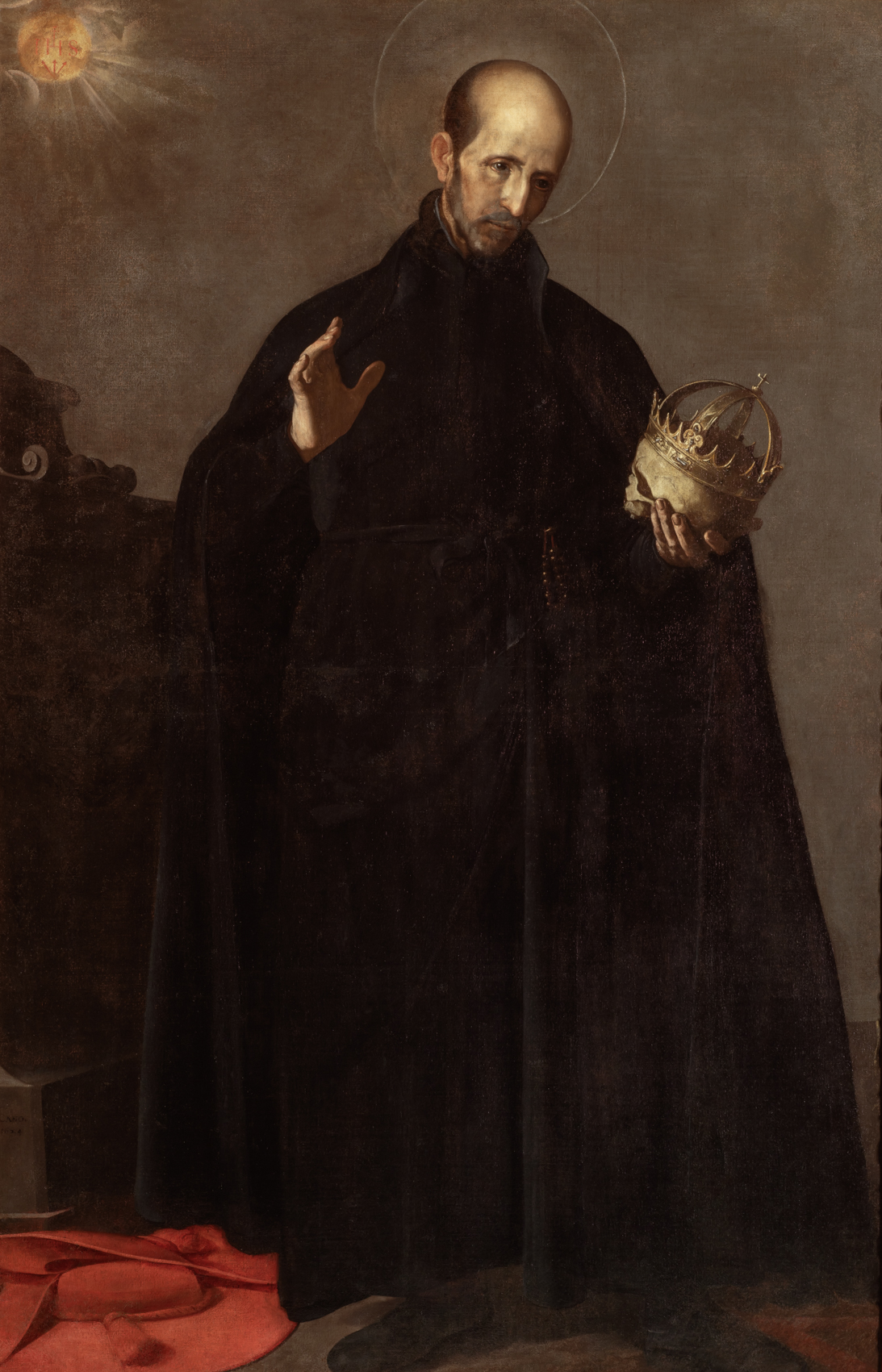
Francis Borgia
Life and witness
At Rome, the birth-day of St. Francis Borgia, confessor, general of the Society of Jesus.
The Lives Of The Saints: Volume 11, October, Pt. 1 · S. Francis Borgia, C.S.f. at Rome ; a.d. 1572.
S. Francis Borgia, C.S.f. at Rome ; a.d. 1572.
S. PINITUS B.
(ABOUT A.D. 180.)
[Roman Martyrology. Ado and Usuardus. Authority: — Eusebius,
Hist. Eccl. iv. 21-23.]
USEBIUS speaks of Pinitus, Bishop of Gnossus, in Crete, who lived at the time of Dionysius of Corinth. Dionysius wrote to Pinitus, “ not to im- pose on the brethren, without necessity, too severe a burden in regard to purity, but to pay regard to the infirmity of the great bulk of the people.” To which Pinitus, writing in reply, said that he admired and applauded Dionysius, but ex- horted him, at the same time, to impart some time or other food which was stronger to his flock, and to feed them with writings abounding in more perfect doctrine, so that they might not remain constantly imbibing the mere milk of doc- trine, and grow old under a discipline calculated for children.
“ In this epistle also, the correct views which Pinitus cherished, and his solicitude for those committed to his care, also his learning and intelligence in divine matters, appear evidently.”
* *
Digitized by LjOOQle
224
Lives of the Saints.
Oct. xa
*
*
Butler July · St. Francis Borgia, in 1551, gave a considerable sum towards building
St. Francis Borgia, in 1551, gave a considerable sum towards building the Roman college for the Jesuits. Pope Julius III. contributed largely to it; Paul IV., in 1555, founded it for perpetuity with great munificence; afterward Gregory XIII. much augmented its buildings and revenues. St. Ignatius, intending to make this the model of all his other colleges, neglected nothing to render it complete, and took care that it should be supplied with the ablest masters in all the sciences, and with all possible helps for the advancement of literature. He made it a strict rule in the Society, that every one should study to speak correctly the language of the country where he lives;[356] for, without being perfect in the vulgar tongue, no one can be qualified to preach or perform many other functions with profit. On this account he established in the Roman college daily lessons in the Italian tongue, and he carefully studied that language, and appointed others to put him in mind of all the faults which he should commit in speaking. St. Ignatius also directed the foundation of the German college in Rome made by Julius III. but afterwards finished by Gregory XIII. He often met with violent persecutions, but overcame them by meekness and patience. When the French king Henry II. gave the Society letters patent to settle in France, the parliament of Paris made the most outrageous remonstrances, and the faculty of Sorbon, though not without opposition, passed a virulent decree against it. The other fathers at Rome thought it necessary to answer these censures; but St. Ignatius would have nothing printed or written in their defence, saying, that it was better to commit their cause to God, and that the slanders raised against them would fall of themselves; and so it happened. Indeed the storm was too violent to last. Upon other occasions the saint modestly defended his institute against slanderers.
The prudence and charity of the saint in his conduct towards his religious, won him all their hearts. His commands seemed rather entreaties. The address with which he accommodated himself to every one’s particular genius, and the mildness with which he tempered his reproofs, gave to his reprehensions a sweetness which gained the affections whilst it corrected a fault. Thus chiding one for his too little guard over his eyes, he said to him, with tenderness: “I have often admired the modesty of your deportment, yet observe that unguarded glances often escape you.” When another had fixed his eye steadfastly upon him a long time, the saint enjoined him to make the government of his eye the subject of his particular examination, and to say every day a short prayer for fifteen months. He extremely recommended a strict modesty in the whole exterior as the index of the interior, and a means absolutely necessary for the regulating of it, and the government of the senses and passions. He always showed the affection of the most tender parent towards all his brethren, especially towards the sick, for whom he was solicitous to procure every spiritual and even temporal succor and comfort, which it was his great delight to give them himself. The most perfect obedience and self-denial were the two first lessons which he inculcated to his novices, whom he told at the door as they entered, that they must leave behind them all self-will and private judgment. In his famous letter to the Portuguese Jesuits, On the Virtue of Obedience, he says, this alone bringeth forth and nourisheth all other virtues; and calls it the peculiar virtue, and distinguishing mark and characteristic of his Society, in which, if any member suffer himself to be outdone by those of other Orders in fasting or watching, that he must yield to none in obedience. He adds, true obedience must reach the understanding as well as the will, and never suffer a person even secretly to complain of, or censure the precept of a superior, whom he must always consider as vested with the authority of Jesus Christ over him. He says, it is not a less fault to break the laws of obedience in watching than in sleeping, in laboring than in doing nothing.
When F. Araos, whose spiritual labors were very successful in the court of Spain, seemed to seek the conversation of the great ones of the world, upon pretence of conciliating their favor to his ministry, St. Ignatius sent him a sharp reprimand, telling him that the necessary authority for the ministers of the word of God, is to be gained only by a spirit of recollection, and the exercises of Christian humility; for the loss of everything is to be feared in an intercourse with the great ones of the world. He used to say, that prosperity caused in him more fear than joy, that when persecution ceased he should be in apprehension lest the Society should somewhat relax in the observance of its regular discipline; that good fortune is never to be trusted, and that we have most to fear when things go according to our desires. He made a most severe regulation, that in the Society no one should ever visit women, even of the highest quality, alone; and that when they discoursed with them, or heard their confessions, this should be so ordered, that the companion might see all that passed, without hearing what ought to be secret, this being a means to prevent the possibility of evil suspicions or slanders. In the assigning the employments of those under his charge, he had usually a regard to their inclinations, though he always required that, on their parts, they should be wholly indifferent and disposed cheerfully to accept and discharge any.
Biographical overview
Francis Borgia, (Valencian: Francesc de Borja; Spanish: Francisco de Borja; 28 October 1510 – 30 September 1572) was a Spanish Jesuit priest. The great-grandson of both Pope Alexander VI and King Ferdinand II of Aragon, he was Duke of Gandía and a grandee of Spain. After the death of his wife, Borgia renounced his titles and became a priest in the Society of Jesus, later serving as its third superior general. He was canonized on 20 June 1670 by Pope Clement X.
Martyrologium Romanum · Latin witness
Sancti Francisci Borgiae, Sacerdotis e Societate Jesu et Confessoris, cujus dies natalis pridie Kalendas Octobris recensetur.
The Lives Of The Saints: Volume 11, October, Pt. 1 · S. Francis Borgia, C.S.f. at Rome ; a.d. 1572.
S. PINITUS B.
(ABOUT A.D. 180.)
[Roman Martyrology. Ado and Usuardus. Authority: — Eusebius,
Hist. Eccl. iv. 21-23.]
USEBIUS speaks of Pinitus, Bishop of Gnossus, in Crete, who lived at the time of Dionysius of Corinth. Dionysius wrote to Pinitus, “ not to im- pose on the brethren, without necessity, too severe a burden in regard to purity, but to pay regard to the infirmity of the great bulk of the people.” To which Pinitus, writing in reply, said that he admired and applauded Dionysius, but ex- horted him, at the same time, to impart some time or other food which was stronger to his flock, and to feed them with writings abounding in more perfect doctrine, so that they might not remain constantly imbibing the mere milk of doc- trine, and grow old under a discipline calculated for children.
“ In this epistle also, the correct views which Pinitus cherished, and his solicitude for those committed to his care, also his learning and intelligence in divine matters, appear evidently.”
* *
Digitized by LjOOQle
224
Lives of the Saints.
Oct. xa
*
*