Fursey
Life and witness
In the monastery of Peronne, of St. Fursey, confessor.
Baring-Gould: January · S. FURSEY, AB
[Roman, Donegal, and Scottish Martyrologies, but English on March 4th; Feb. 25th is noted in several Kalendars as the festival of the translation of his relics, also Sept. 28. A very ancient life of S. Fursey, of the date of Bede, exists; later and more prolix lives exist, but are of less authority. Bede himself relates the principal events of the life of this Saint in his history, and quotes the above-mentioned life, lib. iii. c. 19.]
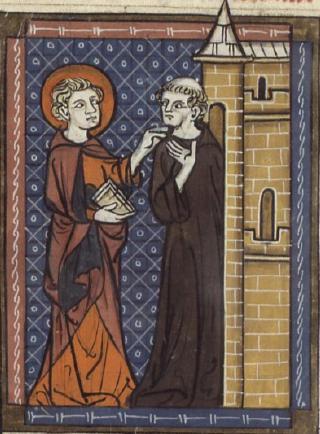
Fursey, son of Fintan, an Irish prince, was abbot of a monastery in the diocese of Tuam. Afterwards, travelling with two of his brothers, Fullan and Ultan, through England, he entered the province of Essex, and was honourably received by the king, Sigebert, "and performing his usual employment of preaching the Gospel," says Bede, "by the example of his virtue, and the efficacy of his discourse, he converted many unbelievers to Christ, and confirmed in faith and love those that already believed. Here he fell into some infirmity of body, and was thought worthy to see a vision from God; in which he was admonished diligently to proceed in the ministry of the Word, and indefatigably to continue his usual vigils and prayers. Being confirmed by this vision, he applied himself with all speed to build a monastery on the ground which had been given him by King Sigebert, and to establish regular discipline therein. The monastery was pleasantly situated in the woods, and with the sea not far off; it was built within the area of a castle called Cnobheresburg (Burghcastle, in Suffolk.) There, falling sick, he fell into a trance, and quitting his body from evening till cock-crow, he was found worthy to behold the choirs of angels, and to hear the praises which are sung in heaven."
The abbot Fursey, becoming desirous of ridding himself of all business of this world, quitted his monastery, having first confided the care of it to his brother Fullan; and resolved to end his life as a hermit. He repaired to his brother Ultan, who had already adopted the life of a solitary, and lived a whole year with him in prayer and hard labour.
Afterwards, the province being desolated by war, he crossed the sea to France, and was there honourably entertained by Clovis, King of the Franks, and then by the noble Erconwald. He built a monastery at Lagny, about six miles north of Paris, on the Marne, and falling sick not long after, departed this life.
Erconwald took his body, and deposited it in the porch of a church he was building in his town of Peronne, till the church itself should be dedicated. This happened twenty-seven days after, and the body being taken from the porch to be re-buried, near the altar, was found as entire as if he had but just died.
Fursey in French is Fourcy, and in Flemish Fro.
In art, (1), with oxen at his feet, because his body was placed on a wagon, and the oxen allowed to conduct it without guide, and they went to Peronne; or (2), making a fountain spring up at Lagny, by thrusting his staff into the soil; or beholding a vision, (3), of angels, or (4), of the flames of purgatory and hell, in reference to his remarkable vision.[60]
Alban Butler: January–March · ST. FURSEY,
SON OF FINTAN, KING OF PART OF IRELAND,
BERARDUS, PETER, ACURSIUS, ADJUTUS, AND OTTO,
WERE sent by St. Francis to preach to the Mahometans of the West, while he went in person to those of the East. They preached first to the Moors of Seville, where they suffered much for their zeal, and were banished. Passing thence into Morocco, they began there to preach Christ, and being banished, returned again. The infidel judge caused them twice to be scourged till their ribs appeared bare; he then ordered burning oil and vinegar to be poured into their wounds, and their bodies to be rolled over sharp stones and potsherds. At length the king caused them to be brought before him, and taking his cimeter, clove their heads asunder in the middle of their foreheads, on the 16th of January, 1220. Their relics were ransomed, and are preserved in the monastery of the holy cross in Coimbra. Their names stand in the Roman Martyrology, and they were canonized by Sixtus IV. in 1481. See their acts in Bollandus and Wading; also Chalippe, Vie de S. Francois, l. 3, t. 1, p. 275.
Biographical overview
Saint Fursey (also known as Fursa, Fursy, Forseus, and Furseus: died 650) was an Irish monk who did much to establish Christianity throughout the British Isles and particularly in East Anglia. He reportedly experienced angelic visions of the afterlife. Fursey is one of the Four Comely Saints.
Martyrologium Romanum · Latin witness
In castro cui nomen Maceriae, ad Altejam fluvium, in Gallia, sancti Fursei Confessoris, cujus corpus ad monasterium Peronae postmodum translatum est.