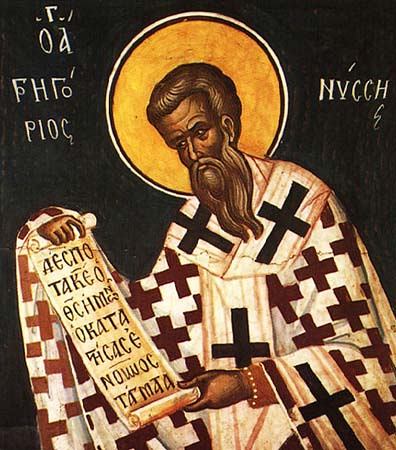
Gregory of Nyssa
Life and witness
Gregory of Nyssa (; Koine Greek: Γρηγόριος Νύσσης, romanized: Grēgórios Nýssēs, pronounced [ɣriˈɣo.ri.os ˈnys.sis]; c. 335 – c. 394), also known as Gregory Nyssen (; Γρηγόριος Νυσσηνός, Grēgórios Nyssēnós, [ɣriˈɣo.ri.os nys.siˈnos]), was an early Christian theologian who served as the bishop of Nyssa from 372 to 376 and from 378 until his death in 394. He is venerated as a saint in Eastern Orthodoxy, the Catholic Church, Oriental Orthodox Churches, Anglicanism, and Lutheranism. Gregory, his elder brother Basil of Caesarea, and their friend Gregory of Nazianzus are collectively known as the Cappadocian Fathers. Gregory lacked the administrative ability of his brother Basil or the contemporary influence of Gregory of Nazianzus, but he was an erudite Christian theologian who made significant contributions to the doctrine of the Trinity and the Nicene Creed. Gregory's philosophical writings
Biographical overview
Gregory of Nyssa (; Koine Greek: Γρηγόριος Νύσσης, romanized: Grēgórios Nýssēs, pronounced [ɣriˈɣo.ri.os ˈnys.sis]; c. 335 – c. 394), also known as Gregory Nyssen (; Γρηγόριος Νυσσηνός, Grēgórios Nyssēnós, [ɣriˈɣo.ri.os nys.siˈnos]), was an early Christian theologian who served as the bishop of Nyssa from 372 to 376 and from 378 until his death in 394. He is venerated as a saint in Eastern Orthodoxy, the Catholic Church, Oriental Orthodox Churches, Anglicanism, and Lutheranism. Gregory, his elder brother Basil of Caesarea, and their friend Gregory of Nazianzus are collectively known as the Cappadocian Fathers. Gregory lacked the administrative ability of his brother Basil or the contemporary influence of Gregory of Nazianzus, but he was an erudite Christian theologian who made significant contributions to the doctrine of the Trinity and the Nicene Creed. Gregory's philosophical writings were influenced by Origen. Since the mid-twentieth century, there has been a significant increase in interest in Gregory's works from the academic community, particularly involving universal salvation, which has resulted in challenges to many traditional interpretations of his theology. Gregory is also notable for being the first person in recorded history to have written against all forms of slavery, declaring the institution inherently sinful.
Butler Jan Mar · ST. GREGORY OF NYSSA, B.C.
HE was younger brother to St. Basil the Great; was educated in polite and sacred studies, and married to a virtuous lady. He afterwards renounced the world, and was ordained lector; but was overcome by his violent passion for eloquence to teach rhetoric. St. Gregory Nazianzen wrote to him in the strongest terms, exhorting him to renounce that paltry or ignoble glory, as he elegantly calls it.[1] This letter produced its desired effect. St. Gregory returned to the sacred ministry in the lower functions of the altar: after some time he was called by his brother Basil to assist him in his pastoral duties, and in 372 was chosen bishop of Nyssa, a city of Cappadocia, near the Lesser Armenia. The Arians, who trembled at his name, prevailed with Demosthenes, vicar or deputy-governor of the province, to banish him. Upon the death of the Arian emperor, Valens, in 378, St. Gregory was restored to his see by the emperor Gratian. Our holy prelate was chosen by his colleagues to redress the abuses and dissensions which heresy had introduced {553} in Arabia and Palestine. He assisted at the council of Constantinople in 381, and was always regarded as the centre of the Catholic communion in the East. Those prelates only who joined themselves to him, were looked upon as orthodox. He died about the year 400, probably on the 10th of January, on which the Greeks have always kept his festival: the Latins honor his memory on the 9th of March. The high reputation of his learning and virtue procured him the title of Father of the Fathers, as the seventh general council testifies. His sermons are the monuments of his piety; but his great penetration and learning appear more in his polemic works, especially in his twelve books against Eunomius. See his life collected from his works, St. Greg. Nazianzen, Socrates, and Theodoret, by Hermant, Tillemont, t. 9, p. 561; Ceillier, t. 8, p. 200. Dr. Cave imagines, that St. Gregory continued to cohabit with his wife after he was bishop. But St. Jerom testifies that the custom of the eastern churches did not suffer such a thing. She seems to have lived to see him bishop, and to have died about the year 384; but she professed a state of continency: hence St. Gregory Nazianzen, in his short eulogium of her, says, she rivalled her brothers-in-law who were in the priesthood, and calls her sacred, or one consecrated to God; probably she was a deaconess.
Footnotes: 1. [Greek: {apstzen eaostzian}], Naz. {}.