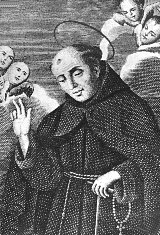
John Joseph of the Cross
Martyrological notice
At Naples, the birth-day of St. John Joseph of the Cross.
Baring-Gould: March · S. JOHN-JOSEPH OF THE CROSS, C
[Roman Martyrology. Authority:--His Life by the P. Diodati, published at Naples, in 1794. He was inscribed by Pius VI. among the number of the Beatified on May 15th, 1789; and he was canonized by Gregory XVI. on May 26th, 1839.]
S. John-Joseph of the Cross, who must not be confounded with S. John of the Cross (Nov. 16th), was born in the island of Ischia, on the Feast of the Assumption, in the year 1654, of respectable parents, Joseph Calosirto and Laura Garguito, and was baptized under the name of Charles Cajetan, The family must have been one of singular piety, for five of his brothers entered religion. The subject of our memoir, as a child, exhibited a precocious piety. He chose as his room a small chamber in the most retired portion of the house, where he erected a little altar to Our Lady, on whose great festival he had been born, and towards whom, through life, he manifested a filial devotion. From the earliest age also he manifested a great repugnance from sin. His pure childish soul shivered and shrank from the breath of evil, as a young spring flower from a frozen blast.
The knowledge of evil without bringing guilt to the soul, unless voluntarily received and harboured with delight, leaves on it a mark, so that the soul knowing evil cannot have the freshness of a guiltless and ignorant soul. The little saintly boy, taught of God, seems unconsciously to have felt this, and he manifested none of that curiosity after evil which is one of the tokens of our fallen nature, and which leads the young mind first to the knowledge of evil, and then, it may be, to the perpetration of it.
Feeling a great desire for the religious life, he entered the order of S. Francis, as reformed by S. Peter of Alcantara, in Naples, and assumed the habit at the age of sixteen, taking at the same time the name of John-Joseph of the Cross. This was in 1671. His noviciate lasted three years; and at the age of nineteen, his superior found him sufficiently perfect to be entrusted with the direction of the building of a convent at Piedimonte di Agila, and the organizing of discipline therein.
On arriving at the proper age, he was ordained priest, and soon after retired into a forest, where he built himself a cell, and resided as a hermit. Soon five little hermitages clustered around his cell, and a church was built for the accommodation of the anchorites. But his superiors recalled him to the monastery to undertake the charge of the novices, and somewhat later he was appointed superior of the house at Piedimonte di Agila, which had risen under his care. He suffered about this time from extreme dryness. It was to him as though the face of God were turned away from him, and he felt agonies of fear, thinking that through want of judgment or unbecoming example, he might have retarded the advance, and perhaps lost some, of the souls of the novices who had been entrusted to his care. But one of the brethren who had lately died appeared to him in a vision, and comforted him, assuring him that his novices were all leading an edifying life.
He was afterwards appointed Superior of the convent, an office in which he displayed great judgment, but which withdrew him too much from spiritual meditation and reading to be congenial with his tastes.
At his request he was relieved of the office of Superior, and was again made director of the novices, and fulfilled the duties of this office for four years.
He died on March 5th, 1734, in the convent of S. Lucia, at Naples.
Biographical overview
John Joseph of the Cross, OFM (born Carlo Gaetano Calosinto; 15 August 1654 – 5 March 1739) was an Italian Catholic priest and professed member of the Order of Friars Minor who hailed from the island of Ischia. He had a reputation for austerity and for the gift of miracles and served as a novice master. He was beatified in 1789 and later canonized in 1839.
The Lives Of The Saints: Volume 03, March · S. JOHN-JOSEPH OF THE CROSS, C
[Roman Martyrology. Authority : — His Life by the P. Diodati, pub- lished at Naples, in 1794. He was inscribed by Pius VI. among the number of the Beatified on May 15th, 1789; and he was canonised by Gregory XVI. on May 26th, 1839.]
S. John-Joseph of the Cross, who must not be con- founded with S. John of the Cross (Nov. 16th), was born in the island of Ischia, on the Feast of the Assump- tion, in the year 1654, of respectable parents, Joseph Calosirto and Laura Garguito, and was baptized under the name of Charles Cajetan. The family must have been one of singular piety, for five of his brothers entered religion. The subject of our memoir, as a child, exhibited a precocious piety. He chose as his room a small chamber in the most retired portion of the house, where he erected a little altar to Our Lady, on whose great festival he had been born, and towards whom, through life, he manifested a filial devotion. From the earliest age also he manifested a great repugnance from sin. His pure childish soul shivered and shrank from the breath of evil, as a young spring flower from a frozen blast
The knowledge of evil without bringing guilt to the soul, unless voluntarily received and harboured with delight, leaves on it a mark, so that the soul knowing evil cannot have the freshness of a guiltless and ignorant soul. The little saintly boy, taught of God, seems un- consciously to have felt this, and he manifested none of that curiosity after evil which is one of the tokens of our fallen nature, and which leads the young mind first
* *
Digitized by v^-ooQie
88
Lives of the Saints.
March 5.]
to the knowledge of evil, and then, it may be, to the per- petration of it.
Feeling a great desire for the religious life, he entered the order of S. Francis, as reformed by S. Peter of Alcantara, in Naples, and assumed the habit at the age of sixteen, taking at the same time the name of John-Joseph of the Cross. This was in 1671. His noviciate lasted three years; and at the age of nineteen, his superior found him suffici- ently perfect to be entrusted with the direction of the build- ing of a convent at Piedimonte di Agila, and the organizing of discipline therein.
On arriving at the proper age, he was ordained priest, and soon after retired into a forest, where he built him- self a cell, and resided as a hermit. Soon five little hermitages clustered around his cell, and a church was built for the accommodation of the anchorites. But his superiors recalled him to the monastery to undertake the charge of the novices, and somewhat later he was ap- pointed superior of the house at Piedimonte di Agila, which had risen under his care. He suffered about this time from extreme dryness. It was to him as though the face of God were turned away from him, and he felt agonies of fear, thinking that through want of judgment or unbecoming example, he might have retarded the advance, and perhaps lost some, of the souls of the novices who had been entrusted to his care. But one of the brethren who had lately died appeared to him in a vision, and comforted him, as- suring him that his novices were all leading an edify- ing life.
He was afterwards appointed Superior of the convent, an office in which he displayed great judgment, but which withdrew him too much from spiritual meditation and read* ing to be congenial with his tastes.
Digitized by ‘
Butler Jan Mar · ST. JOHN JOSEPH OF THE CROSS.
(SUPPLEMENT _to Butler's Lives of the Saints_--SADLIERS' EDITION.)
St. John Joseph of the Cross was canonized on Trinity Sunday, May 26th, 1839. His biography was written by the reverend postulator who conducted the process of his canonization, from authentic documents in his possession, and published at Rome in 1838, in a work entitled--_Compendio della Vita di Giangiuseppe della Croce_. The following account of the life of this eminent saint is compiled from the English translation of the above work, and thought worthy of being incorporated in this edition of the "Lives of the Saints."