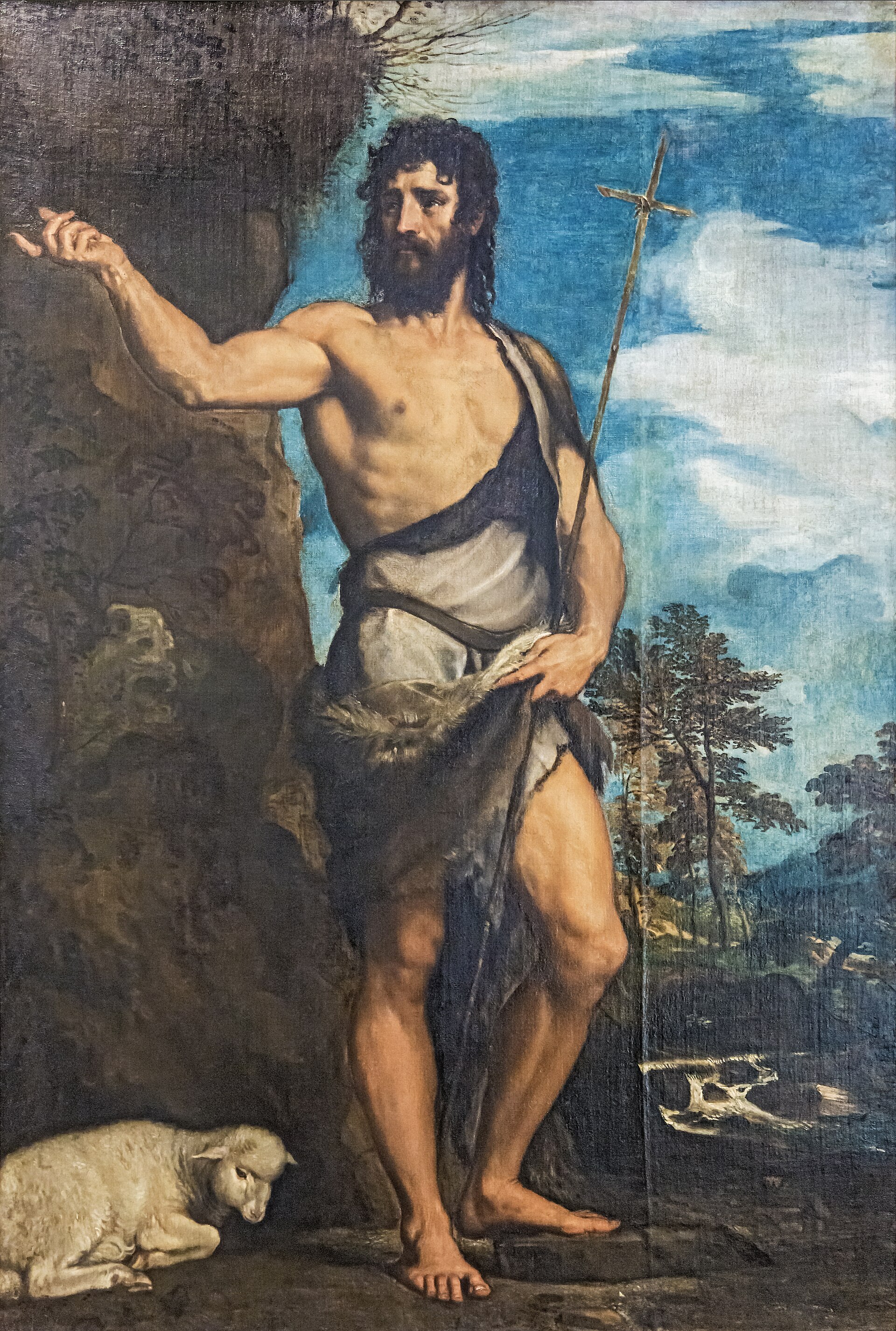
John the Baptist
Martyrological notice
CT. ZA CHARY, priest and prophet, father of ^ blessed John the Baptist. — Also, St. Elizabeth, mother of the same most holy precursor. — At Ter- racina, in Campania, the birthday of the holy mar- tyrs, Felix, priest, and Eusebius, monk. The latter having buried the holy martyrs Julian and Csesarius, and converted to the faith of Christ, many whom the priest St. Felix baptized, was arrested with him, and both being led to the tribunal of the judge, who could not succeed in intimidating them, they were shut up in prison, and as they refused to offer sacri- fice, were beheaded that same night. — At Emesa, in Phoenicia, during the persecution of Decius, the holy martyrs Galation, and Epistemis, his wife, who were scourged, had their hands, feet and tongue severed from their bodies, and finally consummated their martyrdom by decapitation. — Also, the holy mar- tyrs Domninus, Theotimus, Philotheus, Silvanus, and their companions, under the emperor Maxi- minus. — At Milan, St. Magnus, bishop and confes- sor.— At Brescia, St. Dominator, bishop. — At Treves, St. Fibitius, who was made bishop of that city while filling the office of abbot. — At Orleans, in France, St. Lsetus, priest and confessor.
Biographical overview
John the Baptist (c. 6 BC – c. AD 30) was a religious preacher active in the area of the Jordan River in the early first century AD. He is also known as Saint John the Forerunner in Eastern Orthodoxy, Eastern Catholicism, and Oriental Orthodoxy, Saint John the Immerser in the Baptist tradition, and as the prophet Yahya ibn Zakariya in Islam. He is sometimes referred to as John the Baptiser. John is mentioned by the Roman Jewish historian Josephus, and he is revered as a major religious figure in Christianity, Islam, the Baháʼí Faith, the Druze faith, and Mandaeism; in the last of these he is considered to be the final and most vital prophet. He is considered to be a prophet of God by all of the aforementioned faiths, and is honoured as a saint in many Christian denominations. According to the New Testament, John anticipated a messianic figure greater than himself; in the Gospels, he is portrayed as the precursor or forerunner of Jesus. According to the Gospel of Matthew, Jesus himself identifies John as "Elijah who is to come", which is a direct reference to the Book of Malachi (Malachi 4:5), as confirmed by the angel Gabriel, who announced John's birth to his father Zechariah. According to the Gospel of Luke, John and Jesus were relatives. Some scholars think that John belonged to the Essenes, a semi-ascetic Jewish sect who expected a messiah and practised ritual baptism. John used baptism as the central symbol or sacrament of his pre-messianic movement. Most biblical scholars agree that John baptized Jesus, and several New Testament accounts report that some of Jesus's early followers had previously been followers of John. According to the New Testament, John was sentenced to death and subsequently beheaded by Herod Antipas around AD 30 after John rebuked him for divorcing his wife and then unlawfully wedding Herodias, the wife of his brother Herod Philip I. Josephus also mentions John in the Antiquities of the Jews and states that he was executed by order of Herod Antipas in the fortress at Machaerus. Followers of John existed into the second century AD, and some proclaimed him to be the Messiah awaited by Jews. In modern times, the followers of John the Baptist are the Mandaeans, an ancient ethnoreligious group who believe that he is their greatest and final prophet. In the Roman martyrology, John is the only saint whose birth and death are both commemorated.
Historical martyrology witness · The Roman Martyrology (English, 1916)
CT. ZA CHARY, priest and prophet, father of ^ blessed John the Baptist. — Also, St. Elizabeth, mother of the same most holy precursor. — At Ter- racina, in Campania, the birthday of the holy mar- tyrs, Felix, priest, and Eusebius, monk. The latter having buried the holy martyrs Julian and Csesarius, and converted to the faith of Christ, many whom the priest St. Felix baptized, was arrested with him, and both being led to the tribunal of the judge, who could not succeed in intimidating them, they were shut up in prison, and as they refused to offer sacri- fice, were beheaded that same night. — At Emesa, in Phoenicia, during the persecution of Decius, the holy martyrs Galation, and Epistemis, his wife, who were scourged, had their hands, feet and tongue severed from their bodies, and finally consummated their martyrdom by decapitation. — Also, the holy mar- tyrs Domninus, Theotimus, Philotheus, Silvanus, and their companions, under the emperor Maxi- minus. — At Milan, St. Magnus, bishop and confes- sor.— At Brescia, St. Dominator, bishop. — At Treves, St. Fibitius, who was made bishop of that city while filling the office of abbot. — At Orleans, in France, St. Lsetus, priest and confessor.
The lives of the saints · 6 · S. John the Baptist.
Whilst still a child, his father obtained for him a bene- fice, according to the scandalous abuse of the time in Spain, in France, and elsewhere, where the benefices were often given to laymen, who appointed curates with small pay to perform the spiritual duties, whilst they enjoyed the revenues.
But as the boy grew older, his conscience reproached him, and he remonstrated with his father, who scoffed at his qualms of conscience. His uncle, John Alfonso, who was present, rebuked him sharply for thinking of resigning a lucrative endowment for an idle scruple.
His uncle introduced him to the Bishop of Burgos, who took a fancy to the intelligent and high-spirited youth, heaped on him prebends, and ordained him. But again his conscience pricked him, and he asked the bishop's leave to go away. "What 1" said the prelate, "have I not given you enough ? Well, on the next vacancy, I will give you a canonry." John assured him that this was not his desire, and resigning his prebends and benefices into the hands of the bishop, he retained only the incumbency of the parish church of S. Agnes, in Burgos. He did not long retain this, for he went to Salamanca, to study theology for four years, after which he was called to preach in the church of S. Sebastian, in that city, and this he did with great success. When he was aged thirty-three, he was forced to undergo an operation for the stone, and he then made a vow that, if his life were preserved, he would become a religious. As soon as he was able to walk, he went to a house of Augustinian Canons, in Salamanca, and asked to be received into the order. When his friends remonstrated, he said, "God alone knows what has passed between Him and my soul." He was gladly received,
£, *
* — g
r 74 Lives of the Saints. (June u.
and was almost immediately employed as master of the novices.
His character now deepened, love to God burnt within him with that fire which kindles a flame in other hearts, and he began to exercise a very remarkable power over other souls. His fervour towards the Blessed Sacrament was remarkable. He remained kneeling in his place after matins, before dawn, till it was time for him to say mass, preparing his soul for the Divine gift. And to one so pure of heart, and so burning with love, the veil which to carnal eyes is drawn across that mystery was partly lifted, and he saw the sacred Host shining with dazzling light, and contemplated therein the five wounds.
But he said nothing of this to any one. Only he was so slow in saying mass that great complaint was made, and he was forbidden by his superior to celebrate. He bore this privation for a long time with great patience, but with inward suffering, and at last, unable to endure it longer, he besought the superior's permission to say mass again. " No, you are too slow." " But I have a just impediment, which hinders me from being rapid." The superior was obdurate ; then only did the saint reveal the favours God accorded him when he sacrificed. The prohibition was instantly removed.
People began to whisper that John of Sagahun performed miracles, and the story was noised abroad that when a child had fallen into a well, he had laid his girdle on the edge of the well, and the waters had risen, so that he had drawn the child out, uninjured.
In preaching S. John was bold in attacking sin, and he said that the honeyed words and smooth platitudes where- with preachers discoursed would cut no hearts to the quick, but were base coin, betrayals of the Cross. This boldness drew down on him many enemies. One noble
*-
-*
The Lives Of The Saints: Volume 06, June · S. John the Baptist.
Whilst still a child, his father obtained for him a bene- fice, according to the scandalous abuse of the time in Spain, in France, and elsewhere, where the benefices were often given to laymen, who appointed curates with small pay to perform the spiritual duties, whilst they enjoyed the revenues.
But as the boy grew older, his conscience reproached him, and he remonstrated with his father, who scoffed at his qualms of conscience. His uncle, John Alfonso, who was present, rebuked him sharply for thinking of resigning a lucrative endowment for an idle scruple.
His uncle introduced him to the Bishop of Burgos, who took a fancy to the intelligent and high-spirited youth, heaped on him prebends, and ordained him. But again his conscience pricked him, and he asked the bishop’s leave to go away. “ What 1” said the prelate, “ have I not given you enough? Well, on the next vacancy, I will give you a canonry.” John assured him that this was not his desire, and resigning his prebends and benefices into the hands of the bishop, he retained only the incumbency of the parish church of S. Agnes, in Burgos. He did not long retain this, for he went to Salamanca, to study theology for four years, after which he was called to preach in the church of S. Sebastian, in that city, and this he did with great success. When he was aged thirty-three, he was forced to undergo an operation for the stone, and he then made a vow that, if his life were preserved, he would become a religious. As soon as he was able to walk, he went to a house of Augustinian Canons, in Salamanca, and asked to be received into the order. When his friends remonstrated, he said, “ God alone knows what has passed between Him and my soul” He was gladly received.
*-
Digitized by Google
'74
Lives of the Saints.
*-
— *
[June xa.
and was almost immediately employed as master of the novices.
His character now deepened, love to God burnt within him with that fire which kindles a flame in other hearts, and he began to exercise a very remarkable power over other souls. His fervour towards the Blessed Sacrament was remarkable. He remained kneeling in his place after matins, before dawn, till it was time for him to say mass, preparing his soul for the Divine gift And to one so pure of heart, and so burning with love, the veil which to carnal eyes is drawn across that mystery was partly lifted, and he saw the sacred Host shining with dazzling light, and contemplated therein the five wounds.
But he said nothing of this to any one. Only he was so slow in saying mass that great complaint was made, and he was forbidden by his superior to celebrate. He bore this privation for a long time with great patience, but with inward suffering, and at last, unable to endure it longer, he besought the superior's permission to say mass again. “ No, you are too slow." “ But I have a just impediment, which hinders me from being rapid.” The superior was obdurate ; then only did the saint reveal the favours God accorded him when he sacrificed. The prohibition was instantly removed.