
Macarius of Alexandria
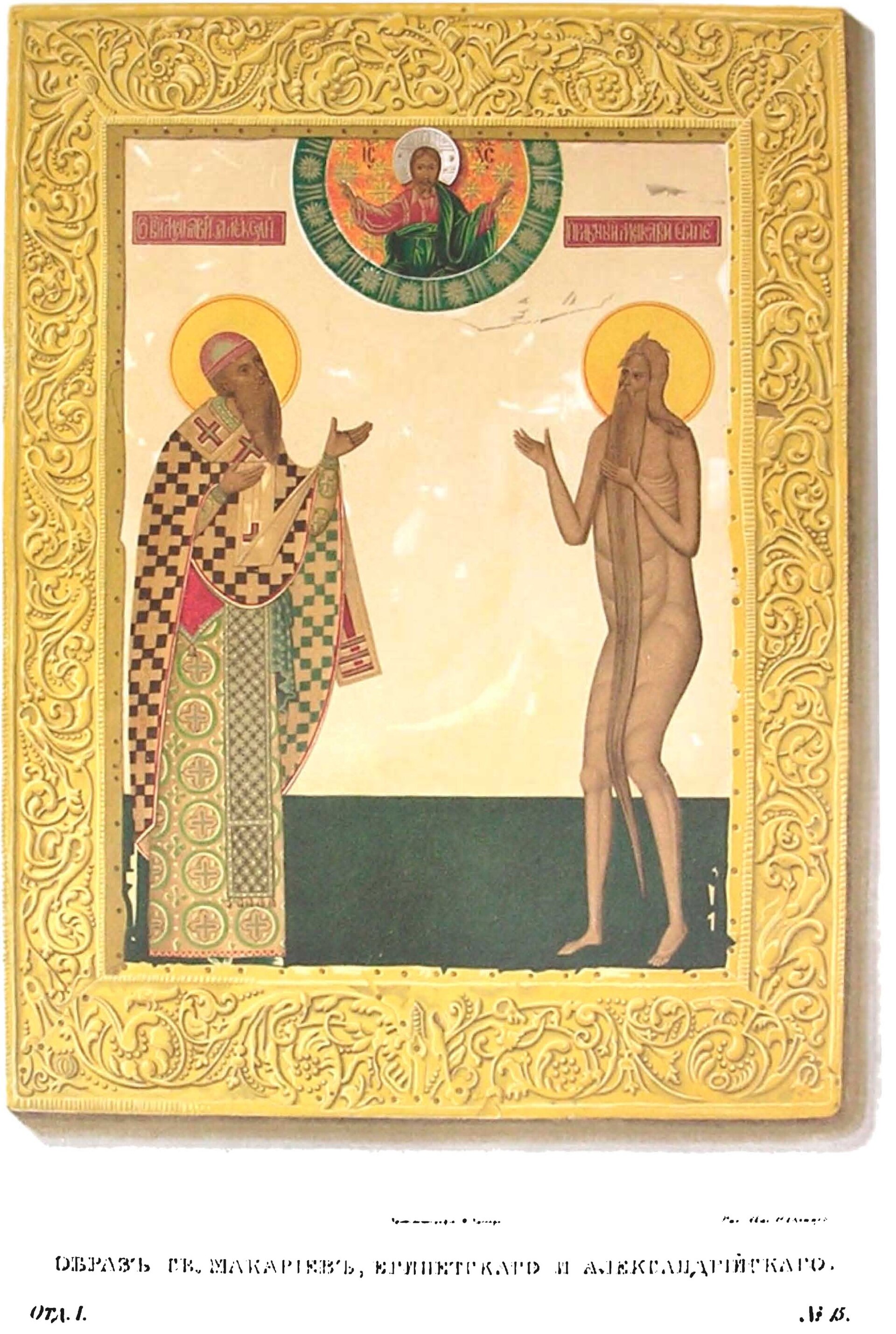
Martyrological notice
In Thebais of St. Macarius of Alexandria, abbot.
Baring-Gould: January · S. MACARIUS OF ALEXANDRIA, AB
[There were two Macarii. Both are commemorated together by the Greeks, on Jan. 19th; but the Latins commemorate S. Macarius of Alexandria, on Jan. 2nd; and S. Macarius the Egyptian, on Jan. 15th. The history of this S. Macarius is perfectly authentic, having been written by S. Palladius (B. 368,) in the year 421; the writer knew S. Macarius personally, having been nine years in "the cells," of which S. Macarius was priest. Three of these years Macarius and Palladius lived together; so that, as the author says, he had every opportunity of judging of his manner of life and actions.]
Saint Macarius the younger was born in Alexandria, of poor parents, and followed the trade of confectioner. Desirous of serving God with his whole heart, he forsook the world in the flower of his age, and spent upwards of sixty years in the deserts, in the exercise of fervent penance and prayer. He first retired into the Thebaid, or Upper Egypt, about the year 335; then, aiming at greater disengagement, he descended to Lower Egypt, in or about the year 373. Here there were three deserts almost adjoining each other; that of Scété; that of the Cells, so called because of the multitude of cells wherewith its rocks were honey-combed; and a third, which reached the western bank of the Nile, called the Nitrian desert. S. Macarius had a cell in each of these deserts. When he was in Nitria he gave advice to those who sought him. But his chief residence was in the desert of the Cells. There each hermit lived separate, assembling only on Saturday and Sunday, in the church, to celebrate the divine mysteries, and to partake of the Holy Communion. All the brothers were employed at some handicraft, generally they platted baskets or mats. All in the burning desert was still; in their cells the hermits worked, and prayed, and cooked their scanty victuals, till the red ball of the sun went down behind the sandy plain to the west; then from all that region rose a hum of voices, the rise and fall of song, as the evening psalms and hymns were being chanted by that great multitude of solitaries in dens and caves of the earth.
Palladius has recorded an instance of the great self-denial observed by these hermits. A present was made to S. Macarius of a bunch of grapes, newly gathered. The holy man carried it to a neighbouring solitary who was sick; he sent it to another, and each wishing that some dear brother should enjoy the fruit rather than himself, passed it on to another; and thus the bunch of grapes made the circuit of the cells, and was brought back to Macarius.
The severity of life practised by these hermits was great. For seven years together S. Macarius lived on raw herbs and pulse, and for the three following years contented himself with four or five ounces of bread a day. His watchings were not less surprising. He told Palladius that it had been his great desire to fix his mind on God alone for five days and nights continuously. And when he supposed he was in the proper mood, he closed his cell, and stood up, and said, "Now thou hast angels and archangels, and all the heavenly host in company with thee. Be in heaven, and forget earthly things." And so he continued for two nights and days, wrapped in heavenly contemplations, but then his hut seemed to flame about him, even the mat on which he stood, and his mind was diverted to earth. "But it was as well," said he; "for I might have fallen into pride."
The reputation of the monastery of Tabenna, under S. Pachomius, drew him to it in disguise. S. Pachomius told him he seemed too far advanced in years to begin to practise the austerities undergone by himself and his monks; nevertheless, on his earnest entreaty, he admitted him. Then Lent drew on, and the aged Macarius saw the monks fasting, some two whole days, others five, some standing all night, and sitting at their work during the day. Then he, having soaked some palm leaves, as material for his work, went apart into a corner, and till Easter came, he neither ate nor drank, nor sat down, nor bowed his knee, nor lay down, and sustained life on a few raw cabbage leaves which he ate on Sundays; and when he went forth for any need he returned silently to his work, and occupied his hands in platting, and his heart in prayer. But when the others saw this, they were astonished, and remonstrated with S. Pachomius, saying, "Why hast thou brought this fleshless man here to confound us with his austerities. Send him away, or we will desert this place." Then the abbot went to Macarius, and asked him who he was, and when he told his name, Pachomius was glad, and cried, "Many years have I desired to see thee. I thank thee that thou hast humbled my sons; but now, go thy way, sufficiently hast thou edified us; go, and pray for us." Macarius, on one occasion, to subdue his flesh, filled two great baskets with sand, and laying them on his shoulders, walked over the hot desert, bowed beneath them. A friend meeting him, offered to ease him of his burden, but "No," said the old hermit, "I have to torment my tormentor;" meaning his body.
One day, a gnat stung him in his cell, and he killed it. Then, ashamed that he had allowed himself to be irritated by the petty insect, and to have lost an opportunity of enduring mortification with equanimity, he went to the marshes of Scété, and stayed there six months, suffering greatly from the stings of the insects. When he returned, he was so disfigured by their bites, that he was only recognized by his voice.
The terrible severity with which these Egyptian hermits punished themselves is perhaps startling, but it was something needed at a time when the civilized world was sunk in luxury, profligacy, and indifference. That was a time which called for a startling and vivid contrast to lead minds into self-inspection. "Private profligacy among all ranks was such as cannot be described in any modern pages. The clergy of the cities, though not of profligate lives, and for the most part unmarried, were able to make no stand against the general corruption of the age, because--at least if we are to trust such writers as Jerome and Chrysostom--they were giving themselves up to ambition and avarice, intrigue and party spirit. No wonder if, in such a state of things, the minds of men were stirred by a passion akin to despair. It would have ended often, but for Christianity, in such an actual despair as that which had led, in past ages, more than one noble Roman to slay himself, when he lost all hope for the Republic. Christianity taught those who despaired of society, of the world--in one word, of the Roman empire, and all that it had done for men--to hope at last for a Kingdom of God after death. It taught those, who, had they been heathens and brave enough, would have slain themselves to escape out of a world which was no place for honest men, that the body must be kept alive, at least, for the sake of the immortal soul, doomed, according to its works, to endless bliss or endless torment. But that the world--such, at least, as they saw it then--was doomed, Scripture and their own reason taught them. They did not merely believe, but see, in the misery and confusion, the desolation, and degradation around them, that all that was in the world, the lust of the flesh, the lust of the eye, and the pride of life, was not of the Father, but of the world; that the world was passing away, and the lust thereof, and that only he who did the will of God could abide for ever. They did not merely believe, but saw, that the wrath of God was revealed from heaven against all unrighteousness of men; and that the world in general was treasuring up to themselves wrath, tribulation, and anguish, against a day of wrath and revelation of the righteous judgment of God, who would render to every man according to his works. That they were correct in their judgment of the world about them, contemporary history proves abundantly. That they were correct, likewise, in believing that some fearful judgment was about to fall on man, is proved by the fact that it did fall; that the first half of the fifth century saw, not only the sack of Rome, but the conquest and desolation of the greater part of the civilized world, amid bloodshed, misery, and misrule, which seemed to turn Europe into a chaos, which would have turned it into a chaos, had there not been a few men left who still felt it possible and necessary to believe in God, and to work righteousness. Under these terrible forebodings, men began to flee from a doomed world, and try to be alone with God, if by any means they might save each man his own soul in that dread day."[16]
S. Macarius, of Alexandria, and his namesake, the Egyptian, lived much together. They were both exiled in 375, at the instigation of the Arian patriarch of Alexandria, who dreaded their influence over the people, and zeal for the orthodox faith. They crossed the Nile together in a ferryboat, when they encountered two military tribunes, accompanied by a great array of horses, with decorated bridles, of equipages, soldiers, and pages covered with ornaments. The officers looked long at the two monks in their old dresses, humbly seated in a corner of the bark. They might well look at them, for in that bark two worlds stood face to face; old Rome, degraded by the emperors, and the new Christian republic, of which the monks were the precursors. As they approached the shore, one of the tribunes said to the cenobites, "You are happy, for you despise the world." "It is true," answered the Alexandrine, "we despise the world, and the world despises you. You have spoken more truly than you intended; we are happy in fact, and happy in name, for we are called Macarius, which means in Greek happy."
The tribune made no answer, but, returning to his house, renounced all his wealth and rank, and went to seek happiness in solitude.
In art, S. Macarius is represented with wallets of sand on his shoulders; sometimes with a hyaena and its young, because the story is told that one day a hyaena brought her young one and laid it at the feet of the hermit. He looked at the animal, and saw that it was blind, therefore he pitied the poor whelp, and prayed to God; then he touched the eyes of the young hyaena, and it saw plain. Next day, the mother brought a sheepskin and laid it at his feet, and this the hermit wore continually afterwards, till he gave it to S. Melania.
Baring-Gould: January · S. MACARIUS OF ALEXANDRIA, AB.
[There were two Macarii. Both are commemorated together by the Greeks, on Jan. 19th; but the Latins commemorate S. Macarius of Alexandria, on Jan. 2nd; and S. Macarius the Egyptian, on Jan. 15th. The history of this S. Macarius is perfectly authentic, having been written by S. Palladius (B. 368,) in the year 421; the writer knew S. Macarius personally, having been nine years in "the cells," of which S. Macarius was priest. Three of these years Macarius and Palladius lived together; so that, as the author says, he had every opportunity of judging of his manner of life and actions.]
Saint Macarius the younger was born in Alexandria, of poor parents, and followed the trade of confectioner. Desirous of serving God with his whole heart, he forsook the world in the flower of his age, and spent upwards of sixty years in the deserts, in the exercise of fervent penance and prayer. He first retired into the Thebaid, or Upper Egypt, about the year 335; then, aiming at greater disengagement, he descended to Lower Egypt, in or about the year 373. Here there were three deserts almost adjoining each other; that of Scété; that of the Cells, so called because of the multitude of cells wherewith its rocks were honey-combed; and a third, which reached the western bank of the Nile, called the Nitrian desert. S. Macarius had a cell in each of these deserts. When he was in Nitria he gave advice to those who sought him. But his chief residence was in the desert of the Cells. There each hermit lived separate, assembling only on Saturday and Sunday, in the church, to celebrate the divine mysteries, and to partake of the Holy Communion. All the brothers were employed at some handicraft, generally they platted baskets or mats. All in the burning desert was still; in their cells the hermits worked, and prayed, and cooked their scanty victuals, till the red ball of the sun went down behind the sandy plain to the west; then from all that region rose a hum of voices, the rise and fall of song, as the evening psalms and hymns were being chanted by that great multitude of solitaries in dens and caves of the earth.
Palladius has recorded an instance of the great self-denial observed by these hermits. A present was made to S. Macarius of a bunch of grapes, newly gathered. The holy man carried it to a neighbouring solitary who was sick; he sent it to another, and each wishing that some dear brother should enjoy the fruit rather than himself, passed it on to another; and thus the bunch of grapes made the circuit of the cells, and was brought back to Macarius.
The severity of life practised by these hermits was great. For seven years together S. Macarius lived on raw herbs and pulse, and for the three following years contented himself with four or five ounces of bread a day. His watchings were not less surprising. He told Palladius that it had been his great desire to fix his mind on God alone for five days and nights continuously. And when he supposed he was in the proper mood, he closed his cell, and stood up, and said, "Now thou hast angels and archangels, and all the heavenly host in company with thee. Be in heaven, and forget earthly things." And so he continued for two nights and days, wrapped in heavenly contemplations, but then his hut seemed to flame about him, even the mat on which he stood, and his mind was diverted to earth. "But it was as well," said he; "for I might have fallen into pride."
The reputation of the monastery of Tabenna, under S. Pachomius, drew him to it in disguise. S. Pachomius told him he seemed too far advanced in years to begin to practise the austerities undergone by himself and his monks; nevertheless, on his earnest entreaty, he admitted him. Then Lent drew on, and the aged Macarius saw the monks fasting, some two whole days, others five, some standing all night, and sitting at their work during the day. Then he, having soaked some palm leaves, as material for his work, went apart into a corner, and till Easter came, he neither ate nor drank, nor sat down, nor bowed his knee, nor lay down, and sustained life on a few raw cabbage leaves which he ate on Sundays; and when he went forth for any need he returned silently to his work, and occupied his hands in platting, and his heart in prayer. But when the others saw this, they were astonished, and remonstrated with S. Pachomius, saying, "Why hast thou brought this fleshless man here to confound us with his austerities. Send him away, or we will desert this place." Then the abbot went to Macarius, and asked him who he was, and when he told his name, Pachomius was glad, and cried, "Many years have I desired to see thee. I thank thee that thou hast humbled my sons; but now, go thy way, sufficiently hast thou edified us; go, and pray for us." Macarius, on one occasion, to subdue his flesh, filled two great baskets with sand, and laying them on his shoulders, walked over the hot desert, bowed beneath them. A friend meeting him, offered to ease him of his burden, but "No," said the old hermit, "I have to torment my tormentor;" meaning his body.
One day, a gnat stung him in his cell, and he killed it. Then, ashamed that he had allowed himself to be irritated by the petty insect, and to have lost an opportunity of enduring mortification with equanimity, he went to the marshes of Scété, and stayed there six months, suffering greatly from the stings of the insects. When he returned, he was so disfigured by their bites, that he was only recognized by his voice.
The terrible severity with which these Egyptian hermits punished themselves is perhaps startling, but it was something needed at a time when the civilized world was sunk in luxury, profligacy, and indifference. That was a time which called for a startling and vivid contrast to lead minds into self-inspection. "Private profligacy among all ranks was such as cannot be described in any modern pages. The clergy of the cities, though not of profligate lives, and for the most part unmarried, were able to make no stand against the general corruption of the age, because--at least if we are to trust such writers as Jerome and Chrysostom--they were giving themselves up to ambition and avarice, intrigue and party spirit. No wonder if, in such a state of things, the minds of men were stirred by a passion akin to despair. It would have ended often, but for Christianity, in such an actual despair as that which had led, in past ages, more than one noble Roman to slay himself, when he lost all hope for the Republic. Christianity taught those who despaired of society, of the world--in one word, of the Roman empire, and all that it had done for men--to hope at last for a Kingdom of God after death. It taught those, who, had they been heathens and brave enough, would have slain themselves to escape out of a world which was no place for honest men, that the body must be kept alive, at least, for the sake of the immortal soul, doomed, according to its works, to endless bliss or endless torment. But that the world--such, at least, as they saw it then--was doomed, Scripture and their own reason taught them. They did not merely believe, but see, in the misery and confusion, the desolation, and degradation around them, that all that was in the world, the lust of the flesh, the lust of the eye, and the pride of life, was not of the Father, but of the world; that the world was passing away, and the lust thereof, and that only he who did the will of God could abide for ever. They did not merely believe, but saw, that the wrath of God was revealed from heaven against all unrighteousness of men; and that the world in general was treasuring up to themselves wrath, tribulation, and anguish, against a day of wrath and revelation of the righteous judgment of God, who would render to every man according to his works. That they were correct in their judgment of the world about them, contemporary history proves abundantly. That they were correct, likewise, in believing that some fearful judgment was about to fall on man, is proved by the fact that it did fall; that the first half of the fifth century saw, not only the sack of Rome, but the conquest and desolation of the greater part of the civilized world, amid bloodshed, misery, and misrule, which seemed to turn Europe into a chaos, which would have turned it into a chaos, had there not been a few men left who still felt it possible and necessary to believe in God, and to work righteousness. Under these terrible forebodings, men began to flee from a doomed world, and try to be alone with God, if by any means they might save each man his own soul in that dread day."[16]
S. Macarius, of Alexandria, and his namesake, the Egyptian, lived much together. They were both exiled in 375, at the instigation of the Arian patriarch of Alexandria, who dreaded their influence over the people, and zeal for the orthodox faith. They crossed the Nile together in a ferryboat, when they encountered two military tribunes, accompanied by a great array of horses, with decorated bridles, of equipages, soldiers, and pages covered with ornaments. The officers looked long at the two monks in their old dresses, humbly seated in a corner of the bark. They might well look at them, for in that bark two worlds stood face to face; old Rome, degraded by the emperors, and the new Christian republic, of which the monks were the precursors. As they approached the shore, one of the tribunes said to the cenobites, "You are happy, for you despise the world." "It is true," answered the Alexandrine, "we despise the world, and the world despises you. You have spoken more truly than you intended; we are happy in fact, and happy in name, for we are called Macarius, which means in Greek happy."
The tribune made no answer, but, returning to his house, renounced all his wealth and rank, and went to seek happiness in solitude.
In art, S. Macarius is represented with wallets of sand on his shoulders; sometimes with a hyaena and its young, because the story is told that one day a hyaena brought her young one and laid it at the feet of the hermit. He looked at the animal, and saw that it was blind, therefore he pitied the poor whelp, and prayed to God; then he touched the eyes of the young hyaena, and it saw plain. Next day, the mother brought a sheepskin and laid it at his feet, and this the hermit wore continually afterwards, till he gave it to S. Melania.
[16] Kingsley, The Hermits, p. 4, 6.
Alban Butler: January–March · S. MACARIUS OF ALEXANDRIA,
From Palladius, bishop of Helenopolis, who had been his disciple, c. 20. Rufin, Socrates, and others in Rosweide, D'Andilly, Cotelier, and Bollandus, p. 85 See Tillemont, t. 8, p. 626. Bulteau, Hist. Mon. d'Orient, l. 1, c. 9, p. 128.
ST. MACARIUS the younger, a citizen of Alexandria, followed the business of a confectioner. Desirous to serve God with his whole heart, he forsook the world in the flower of his age, and spent upwards of sixty years in the deserts in the exercise of fervent penance and contemplation. He first retired into Thebais, or Upper Egypt, about the year 335.[1] Having learned the maxims, and being versed in the practice of the most perfect virtue, under masters renowned for their sanctity; still aiming, if possible, at greater perfection, he quitted the Upper Egypt, and came to the Lower, before the year 373. In this part were three deserts almost adjoining to each other; that of Scete, so called from a town of the same name on the borders of Lybia; that of the Cells, contiguous to the former, this name being given to it on account of the multitude of hermit-cells with which it abounded; and a third, which reached to the western branch of the Nile, called, from a great mountain, the desert of Nitria. St. Macarius had a cell in each of these deserts. When he dwelt in that of Nitria, it was his custom to give advice to strangers, but his chief residence was in that of the Cells. Each anchoret had here his separate cell, which he made his continued abode, except on Saturday and Sunday, when all assembled in one church to celebrate the divine mysteries, and partake of the holy communion. If any one was absent, he was concluded to be sick, and was visited by the rest. When a stranger came to live among them, every one offered him his cell, and was ready to build another for himself. Their cells were not within sight of each other. Their manual labor, which was that of making baskets or mats, did not interrupt the prayer of the heart. A profound silence reigned throughout the whole desert. Our saint received here the dignity of priesthood, and shone as a bright sun influencing this holy company, while St. Macarius the elder lived no less eminent in the wilderness of Scete, forty miles distant. Palladius has recorded[2] a memorable instance of the great self-denial professed and observed by these holy hermits. A present was made of a newly-gathered bunch of grapes to St. Macarius: the holy man carried it to a neighboring monk who was sick; he sent it to another: it passed in like manner to all the cells in the desert, and was brought back to Macarius, who was exceedingly rejoiced to perceive the abstinence of his brethren, but would not eat of the grapes himself.
The austerities of all the inhabitants of that desert were extraordinary; but St. Macarius, in this regard, far surpasses the rest. For seven years {074} together he lived only on raw herbs and pulse, and for the three following years contented himself with four or five ounces of bread a day, and consumed only one little vessel of oil in a year; as Palladius assures us. His watchings were not less surprising, as the same author informs us. God had given him a body capable of bearing the greatest rigors; and his fervor was so intense, that whatever spiritual exercise be heard of, or saw practised by others, be resolved to copy the same. The reputation of the monastery of Tabenna, under St. Pachomius, drew him to this place in disguise, some time before the year 349. St. Pachomius told him that he seemed too far advanced in years to begin to accustom himself to their fastings and watchings; but at length admitted him, on condition he would observe all the rules and mortifications of the house. Lent approaching soon after, the monks were assiduous in preparations to pass that holy time in austerities, each according to his strength and fervor; some by fasting one, others two, three, or four days, without any kind of nourishment; some standing all day, others only sitting at their work. Macarius took some palm-tree leaves steeped in water, as materials for his work, and standing in a private corner, passed the whole time without eating, except a few green cabbage leaves on Sundays. His hands were employed in almost continual labor, and his heart conversed with God by prayer. If he left his station on any pressing occasion, he never stayed one moment longer than necessity required. Such a prodigy astonished the monks, who even remonstrated to the abbot at Easter against a singularity of this nature, which, if tolerated, might on several accounts be prejudicial to their community. St. Pachomius entreated God to know who this stranger was; and learning by revelation that he was the great Macarius, embraced him, thanked him for his edifying visit, and desired him to return to his desert, and there offer up his prayers for them.[3] Our saint happened one day inadvertently to kill a gnat that was biting him in his cell; reflecting that he had lost the opportunity of suffering that mortification, he hastened from his cell for the marshes of Scete, which abound with great flies, whose stings pierce even boars. There he continued six months exposed to those ravaging insects; and to such a degree was his whole body disfigured by them with sores and swellings, that when he returned he was only to be known by his voice.[4] Some authors relate[5] that he did this to overcome a temptation of the flesh.
The virtue of this great saint was often exercised with temptations. One was a suggestion to quit his desert and go to Rome, to serve the sick in the hospitals; which, by due reflection, he discovered to be a secret artifice of vain-glory inciting him to attract the eyes and esteem of the world. True humility alone could discover the snare which lurked under the specious gloss of holy charity. Finding this enemy extremely importunate, he threw himself on the ground in his cell, and cried out to the fiends: "Drag me hence if you can by force, for I will not stir." Thus he lay till night, and by this vigorous resistance they were quite disarmed.[6] As soon as he arose they renewed the assault; and he, to stand firm against them, filled two great baskets with sand, and laying them on his shoulders, travelled along the wilderness. A person of his acquaintance meeting him, asked him what he meant, and made an offer of easing him of his burden; but the saint made no other reply than this: "I am tormenting my tormentor." He returned home in the evening, much fatigued in body, but freed from the temptation. Palladius informs us, that St. Macarius, desiring to enjoy more perfectly the sweets of heavenly contemplation, at least for five days without interruption, {075} immured himself within his cell for this purpose, and said to his soul: "Having taken up thy abode in heaven, where thou hast God and the holy angels to converse with, see that thou descend not thence: regard not earthly things." The two first days his heart overflowed with divine delights; but on the third he met with so violent a disturbance from the devil, that he was obliged to stop short of his design, and to return to his usual manner of life. Contemplative souls often desire, in times of heavenly consolation, never to be interrupted in the glorious employment of love and praise: but the functions of Martha, the frailty and necessities of the human frame, and the temptations of the devil, force them, though reluctant, from their beloved object. Nay, God oftentimes withdraws himself, as the saint observed on this occasion, to make them sensible of their own weakness, and that this life is a state of trial. St. Macarius once saw, in a vision, devils closing the eyes of the monks to drowsiness, and tempting them by diverse methods to distractions, during the time of public prayer. Some, as often as they approached, chased them away by a secret supernatural force, while others were in dalliance with their suggestions. The saint burst into sighs and tears; and, when prayer was ended, admonished every one of his distractions, and of the snares of the enemy, with an earnest exhortation to employ, in that sacred duty, a more than ordinary watchfulness against his attacks.[7] St. Jerom[8] and others relate, that a certain anchoret in Nitria, having left one hundred crowns at his death, which he had acquired by weaving cloth, the monks of that desert met to deliberate what should be done with that money. Some were for having it given to the poor, others to the church: but Macarius, Pambo, Isidore, and others, who were called the fathers, ordained that the one hundred crowns should be thrown into the grave and buried with the corpse of the deceased, and that at the same time the following words should be pronounced: "_May thy money be with thee to perdition_."[9] This example struck such a terror into all the monks, that no one durst lay up any money by him.
Palladius, who, from 391, lived three years under our saint, was eye-witness to several miracles wrought by him. He relates, that a certain priest, whose head, in a manner shocking to behold, was consumed by a cancerous sore, came to his cell, but was refused admittance; nay, the saint at first would not even speak to him. Palladius, by earnest entreaties, strove to prevail upon him to give at least some answer to so great an object of compassion. Macarius, on the contrary, urged that he was unworthy, and that God, to punish him for a sin of the flesh he was addicted to, had afflicted him with this disorder: however, that upon his sincere repentance, and promise never more during his life to presume to celebrate the divine mysteries, he would intercede for his cure. The priest confessed his sin with a promise, pursuant to the ancient canonical discipline, never after to perform any priestly function. The saint thereupon absolved him by the imposition of hands; and a few days after the priest came back perfectly healed, glorifying God, and giving thanks to his servant. Palladius found himself tempted to sadness, on a suggestion from the devil, that he made no progress in virtue, and that it was to no purpose for him to remain in the desert. He consulted his master, who bade him persevere with fervor, never dwell on the temptation, and always answer instantly the fiend: "My love for Jesus Christ will not suffer me to quit my cell, where I am determined to abide in order to please and serve him agreeably to his will."
The two saints of the name of Macarius happened one day to cross the {076} Nile together in a boat, when certain tribunes, or principal officers, who were there with their numerous trains, could not help observing to each other, that those men, from the cheerfulness of their aspect, must be exceeding happy in their poverty. Macarius of Alexandria, alluding to their name, which in Greek signifies _happy_, made this answer: "You have reason to call us happy, for this is our name. But if we are happy in despising the world, are not you miserable who live slaves to it?" These words, uttered with a tone of voice expressive of an interior conviction of their truth, had such an effect on the tribune who first spoke, that, hastening home, he distributed his fortune among the poor, and embraced an eremitical life. In 375, both these saints were banished for the catholic faith, at the instigation of Lacius, the Arian patriarch of Alexandria. Our saint died in the year 394, as Tillemont shows from Palladius. The Latins commemorate him on the 2d, the Greeks with the elder Macarius, on the 19th of January.
In the desert of Nitria there subsists at this day a monastery which bears the name of St. Macarius. The monastic rule called St. Macarius's, in the code of rules, is ascribed to this of Alexandria. St. Jerom seems to have copied some things from it in his letter to Rusticus. The concord, or collection of rules, gives us another, under the names of the two SS. Macariuses; Serapion (of Arsinoe, or the other of Nitria;) Paphnutius (of Becbale, priest of Scete;) and thirty-four other abbots.[10] It was probably collected from their discipline, or regulations and example. According to this latter, the monks fasted the whole year, except on Sundays, and the time from Easter to Whitsuntide; they observed the strictest poverty, and divided the day between manual labor and hours of prayer; hospitality was much recommended in this rule, but, for the sake of recollection, it was strictly forbid for any monk, except one who was deputed to entertain guests, ever to speak to any stranger without particular leave.[11] The definition of a monk or anchoret, given by the abbot Rance of la Trappe, is a lively portraiture of the great Macarius in the desert when, says he, a soul relishes God in solitude, she thinks no more of any thing but heaven, and forgets the earth, which has nothing in it that can now please her; she burns with the fire of divine love, and sighs only after God, regarding death as her greatest advantage; nevertheless they will find themselves much mistaken, who, leaving the world, imagine they shall go to God by straight paths, by roads sown with lilies and roses, in which they will have no difficulties to conquer, but that the hand of God will turn aside whatever could raise any in their way, or disturb the tranquillity of their retreat: on the contrary, they must be persuaded that temptations will everywhere follow them, that there is neither state nor place in which they can be exempt, that the peace which God promises is procured amidst tribulations, as the rose-bud amidst thorns; God has not promised his servants that they shall not meet with trials, but that with the temptation, he will give them grace to be able to bear it:[12] heaven is offered to us on no other conditions; it is a kingdom of conquest, the prize of victory--but, O God, what a prize!
Footnotes: 1. Some confound our saint with Macarius of Pisper, or the disciple of Saint Antony. But the best critics distinguish them. The latter, with his fellow-disciple Amathas, buried St. Antony, who left him his staff, as Cronius, the Priest of Nitria, related to Palladius. To this Macarius of Pisper St. Antony committed the government of almost five thousand monks as appears from the life of saint Posthumias. 2. Hist. Lausiac, c. 20. 3. Pallad. Laus. c. 20. 4. Ib. 5. Rosweide b. 8, c. 20, p. 722. 6. Pallad. Laus. c. 20. 7. Rosweide, Vit. Patr. l. 2, c. 29, p. 481. 8. S. Hier. ep. 18 (ol. 22) ad. Eustoch. T. 4, par. 2, p. 44, ed. Ben. et Rosw. Vit. Patr. l. 3, c. 319 9. Acts viii. 20. 10. Concordia Regularum, autore S. Benedicto Ananiae Abbate, edita ab Hugone Menardo, O.S.B. in 4to Parisiis, 1638. Item, Codex Regularum collectus a S. Benedicto Ananiae, auctus a Luca Holstenio, two vols. 4to. Romae, 1661. 11. C. 60, p. 809 edit. Mena{}. 12. 1 Cor. x. 13.
Are commemorated many holy martyrs throughout the provinces of the Roman empire; who, when Dioclesian, in 303, commanded the holy scriptures, {077} wherever found, to be burnt, chose rather to suffer torments and death than to be accessary {sic.} to their being destroyed by surrendering them into the hands of the professed enemies of their Author.[1]
Footnotes: 1. See Baron. n. annal. et annot. in Martyr. Rom. Eus. l. 8, c. 2. H. Vales. not. ib. p. 163. Ruinart, in Acta SS Saturn &c. and S. Felicis. Fleury. Moeurs des Chret. p. 45. Tillem. Pers. de. Dicol. art. 10, t. 5. Lactant. de mort. Pers. c. 15 et 18, cum not. Baluz. &c.
A HOLY subdeacon, who in the reign of Marcus Antoninus, was apprehended in a desert, and brought before Torquatus, governor of Umbria, then residing at Spoletto, about the year 178. The martyr, paying no regard to his promises or threats, in the first interrogatory was beaten with clubs, and in the second was hung on the rack, but in the height of his torments he cheerfully sang: "Glory be to thee, Lord Jesus!" Three days after, two soldiers were sent by Torquatus, to behead him in the dungeon, unless he would offer sacrifice to an idol, which a priest who accompanied them carried with him for this purpose. The saint showed his indignation by spitting upon the idol, upon which one of the soldiers struck off his head. In the Roman Martyrology his name occurs on the 1st, in some others on the 2d of January. See his genuine acts in Bollandus, p. 9, and Tillemont, t. 2, p. 439.
_Also_, ST. ADALARD, OR ADALARD. A.C.
THE birth of this holy monk was most illustrious, his father Bernard being son of Charles Martel, and brother of king Pepin, so that Adalard was cousin-german to Charlemagne, by whom he was called in his youth to the court, and created count of his palace. A fear of offending God made him tremble at the sight of the dangers of forfeiting his grace, with which he was surrounded, and of the disorders which reigned in the world. Lest he should be engaged to entangle his conscience, by seeming to approve of things which he thought would endanger his salvation, he determined to forsake at once both the court and the world. His sacrifice was the more perfect and edifying, as he was endowed with the greatest personal accomplishments of mind and body for the world, and in the flower of his age; for he was only twenty years old, when, in 773, he took the monastic habit at Corbie in Picardy, a monastery that had been founded by queen Bathildes, in 662. After he had passed a year in the fervent exercises of his novitiate, he made his vows; the first employment assigned him in the monastery was that of gardener, in which, while his hands were employed in the business of his calling, his thoughts were on God and heavenly things. Out of humility, and a desire of closer retirement, he obtained leave to be removed to mount Cassino, where he hoped he should be concealed from the world; but his eminent qualifications, and the great example of his virtue, betrayed and defeated all the projects of his humility, and did not suffer him to live long unknown; he was brought back to Corbie, and some years after chosen abbot. Being obliged by Charlemagne often to attend at court, he appeared there as the first among the king's counsellors, as he is styled by Hincmar,[2] who had seen him there in 796. He was compelled by Charlemagne {078} entirely to quit his monastery, and take upon him the charge of chief minister to that prince's eldest son Pepin, who, at his death at Milan in 810, appointed the saint tutor to his son Bernard, then but twelve years of age. In this exalted and distracting station, Adalard appeared even in council recollected and attentive to God, and from his employments would hasten to his chamber, or the chapel, there to plunge his heart in the centre of its happiness. During the time of his prayers, tears usually flowed from his eyes in great abundance, especially on considering his own miseries, and his distance from God. The emperor recalled him from Milan, and deputed him to pope Leo III. to assist at the discussion of certain difficulties started relating to the clause inserted in the creed, concerning the procession of the Holy Ghost from the Father and the Son. Charlemagne died in 814, on the 28th of January, having associated his son, Lewis le Debonnaire, in the empire in the foregoing September. While our saint lived in his monastery, dead to the world, intent only on heavenly things, instructing the ignorant, and feeding the poor, on whom he always exhausted his whole revenue, Lewis declared his son, Lothaire, his partner and successor in the empire, in 817: Bernard, who looked upon that dignity as his right, his father Pepin having been eldest brother to Lewis, rebelled, but lost both his kingdom and his life. Lewis was prevailed upon, by certain flatterers, to suspect our saint to have been no enemy to Bernard's pretensions, and banished him to a monastery, situated in the little island Heri, called afterwards Hermoutier, and St. Philebert's, on the coast of Aquitain. The saint's brother Wala (one of the greatest men of that age, as appears from his curious life, published by Mabillon) he obliged to become a monk at Lerins. His sister Gondrada he confined in the monastery of the Holy Cross, at Poitiers; and left only his other sister Theodrada, who was a nun, at liberty in her convent at Soissons. This exile St. Adalard regarded as his gain, and in it his tranquillity and gladness of soul met with no interruptions. The emperor at length was made sensible of his innocence, and, after five years' banishment, called him to his court towards the close of the year 821; and, by the greatest honors and favors, endeavored to make amends for the injustice he had done him. Adalard (whose soul, fixed wholly on God, was raised above all earthly things) was the same person in prosperity and adversity, in the palace as in the cell, and in every station: the distinguishing parts of his character were, an extraordinary gift of compunction and tears, the most tender charity for all men, and an undaunted zeal for the relief and protection of all the distressed. In 823, he obtained leave to return to the government of his abbey of Corbie, where he with joy frequently took upon himself the most humbling and mortifying employments of the house. By his solicitude, earnest endeavors, and powerful example, his spiritual children grew daily in fervor and divine love; and such was his zeal for their continual advancement, that he passed no week without speaking to every one of them in particular, and no day without exhorting them all in general, by pathetic and instructive discourses. The inhabitants of the country round his monastery had also a share in his pious labors, and he exhausted on the poor the revenue of his monastery, and whatever other temporal goods came to his hands, with a profusion which many condemned as excessive, but which heaven, on urgent occasions, sometimes approved by sensible miracles. The good old man would receive advice from the meanest of his monks, with an astonishing humility; when entreated by any to moderate his austerities, he frequently answered, "I will take care of your servant, that he may serve you the longer;" meaning himself. Several hospitals were erected by him. During his banishment, another Adalard, who governed the monastery by his appointment, began, upon our saint's project, to {079} prepare the foundation of the monastery of New Corbie, vulgarly called Corwey, in the diocese of Paderborn, nine leagues from that city, upon the Weser, that it might be a nursery of evangelical laborers, to the conversion and instruction of the northern nations. St. Adalard, after his return to Corbie, completed this great undertaking in 822, for which he went twice thither, and made a long stay, to settle the discipline of his colony. Corwey is an imperial abbey; its territory reaches from the bishopric of Paderborn to the duchy of Brunswick, and the abbot is one of the eleven abbots, who sit with twenty-one bishops, in the imperial diet at Ratisbon: but the chief glory of this house is derived from the learning and zeal of St. Anscharius, and many others, who erected illustrious trophies of religion in many barbarous countries. To perpetuate the regularity which he established in his two monasteries, he compiled a book of statutes for their use, of which considerable fragments are extant:[3] for the direction of courtiers in their whole conduct, he wrote an excellent book, On the Order of the Court; of which work we have only the large extracts, which Hincmar has inserted in his Instructions of king Carloman, the master-piece of that prelate's writings, for which he is indebted to our saint. A treatise on the Paschal Moon, and other works of St. Adalard, are lost. By those which we have, also by his disciples, St. Paschasius Radbertus, St. Anscharius, and others, and by the testimony of the former in his life, it is clear that our saint was an elegant and zealous promoter of literature in his monasteries: the same author assures us, that he was well skilled, and instructed the people not only in the Latin, but also in the Tudesque and vulgar French languages.[4] St. Adalard, for his eminent learning, and extraordinary spirit of prayer and compunction, was styled the Austin, the Antony, and the Jeremy of his age. Alcuin, in a letter addressed to him under the name of Antony, calls him his son;[5] whence many infer that he had been scholar to that great man. St. Adalard was returned out of Germany to Old Corbie, when he fell sick three days before Christmas: he received extreme unction some days after, which was administered by Hildemar, bishop of Beauvais, who had formerly been his disciple; the viaticum he received on the day after the feast of our Lord's circumcision, about seven o'clock in the morning, and expired the same day about three in the afternoon, in the year 827, of his age seventy-three. Upon proof of several miracles, by virtue of a commission granted by pope John XIX. (called by some XX.) the body of the saint was enshrined, and translated with great solemnity in 1040; of which ceremony we have a particular history written by St. Gerard, who also composed an office in his honor, in gratitude for having been cured of a violent headache through his intercession: the same author relates seven other miracles performed by the same means.[6] The relics of St. Adalard, except a small portion given to the abbey of Chelles, are still preserved at Corbie, in a rich shrine and two smaller cases. His name has never been inserted in the Roman Martyrology, though he is honored as principal patron in many parish churches, and by several towns on the banks of the Rhine and in the Low Countries. See his life, compiled with accuracy, in a very florid pathetic style, by way of panegyric, by his disciple Paschasius Radbertus, {080} extant in Bollandus, and more correctly in Mabillon, (Act. Ben. t. 5, p. 306, also the same abridged in a more historical style, by St. Gerard, first monk of Corbie, afterwards first abbot of Seauve-majeur in Guienne, founder by William, duke of Aquitain and count of Poitiers, in 1080. The history of the translation of the saint's body, with an account of eight miracles by the same St. Gerard, is also given us by Bollandus.)
Footnotes: 1. It was usual among the ancient French, to add to certain words, syllables, or letters which they did not pronounce; as Chrodobert, or Rigobert, for Robert: Cloves for Louis; Clothaire for Lotharie, &c. 2. Hinc. l. Inst. Regis, c. 12. 3. Published by D'Achery, Spicil. tom. 4, p. 1, 20. 4. From this testimony it is clear, that the French language, used by the common people, had then so much deviated from the Latin as to be esteemed a different tongue; which is also evident from Nithard, an officer in the army of Lewis le Debonnaire, who, in his history of the divisions between the sons of Lewis le Debonnaire, (published among the French historians by du Chesne,) gives us the original act of the agreement between the two brothers, Charles the Bald, and Lewis of Germany, at Strasburg, in 842. 5. Alcuin, Ep. 107. 6. St. Gerard, of Seauve-majeur, died on the 5th of April, 1095, and was canonized by C[oe]lestine III. in 1197. See his life, with an account of the foundation of his monastery, in Mabillon, Acts, Sanctorum ad S. Benedict. t. 9, p. 841.
Biographical overview
Macarius of Alexandria (Greek: Μακάριος; died 395) was a monk in the Nitrian Desert. He was a slightly younger contemporary of Macarius of Egypt, and is thus also known as Macarius the Younger.
Martyrologium Romanum · Latin witness
In Thebaide sancti Macarii Alexandrini, Presbyteri et Abbatis.
Alban Butler — Lives of the Saints, with Reflections for Every Day in the Year (1894) · ST. MACARIUS OF ALEXANDRIA.
/Y^ACARius when a youth left his fruit-stall at Ales- M< andria to join the great St. Antony. The patri- arch, warned by a miracle of his disciple's sanctity, named him the heir of his virtues. His life was one long conflict with self. " I am tormenting my tormentor," re- plied he to one who met him bent double with a basket of sand in the heat of the day. " Whenever I am slothful and idle, I am pestered by desires for distant travel.*' When he was quite worn out he returned to his cell. Since sleep at times overpowered him, he kept watch for twenty days and nights; being about to faint, he entered his cell and slept, but henceforth slept only at will. A gnat stung him ; he killed it. In revenge for this softness he remained naked in a marsh till his body was covered with noxious bites and he was recognized only by his voice. Once when thirsty he received a present of grapes, but passed them untouched to a hermit who was toiling in the heat. This one gave them to a third, who handed them to a fourth; thus the grapes went the round of the desert and returned to Macarius, who thanked God for his brethren's abstinence. Macarius saw demons assailing the hermits at prayer. They put their fingers into the mouths of some, and made them yawn. They closed the eyes of others, and walked upon them when asleep. They placed vain and sensual images before many of the brethren, and then mocked those who were captivated by them. None vanquished the devils effectually save those who by constant vigilance repelled them at once. Maca-
Little pictorial lives of the saints : with reflections for every day in the year : compiled from "Butler's Lives" and other approved sources : to which are added lives of the American saints : placed on the calendar for the United States by special petition of the Third Plenary Council of Baltimore · ST. MACARIUS OF ALEXANDRIA.
/T^ACARius when a youth left his fruit-stall at Alex- N^^. andria to join the great St. Antony. The patri- arch, warned by a miracle of his disciple's sanctity, named him the heir of his virtues. His life was one long conflict with self. "I am tormenting my tormentor,'^ replied he to one who met him bent double with a basket
of sand in the heat of the day. ' ' Whenever I am slothful and idle, I am pestered by desires for distant travel." When he was quite worn out he returned to his cell. Since sleep at times overpowered him, he kept watch for twenty days and nights ; being about to faint, he entered his cell and slept, but henceforth slept only at will. A gnat stung him; he killed it. In revenge for this softness he remained naked in a marsh till his body was covered with noxious bites and he was recognized only by his voice. Once when thirsty he received a present of grapes, but passed