
Mellitus
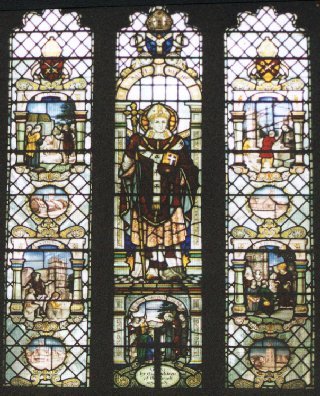
Life and witness
In England, the deposition of St. Mellitus, bishop, who being sent thither by St. Gregory, pope, converted the EastSaxons and their king to the faith.
The lives of the Fathers, martyrs, and other principal saints · 2 · ST. MELLITUS, ARCHBISHOP OF CANTERBURY, C.
ST. MELLITUS, ARCHBISHOP OF CANTERBURY, C.
He was a Roman abbot, whom St. Gregory sent over hither in 601, at the head of a second colony of missioners to assist St. Austin, by whom he was ordained the first bishop of London, or of the East- Saxons, baptized Sebert the king, with a great part of his nation : and by his liberality, in 604, laid the foundation of the cathedral church of Sv. Pi id's, and, in 609, of the monastery of St. Peter, at Thorney, which was rebuilt by king Ed- gar, and again most sumptuously by St. Edward the Confessor, and is now called Westminster. This Christian and learned prince, dying about 616, left his dominions to his three sons, Sexred, Seward, and Sigebert, whom he had not been so happy as to recover from their idolatry, though they had kept their heathenism private during theii father's life. After his death they declared themselves pagans, and gave their subjects the liberty of re- turning to their former idolatrous worship. Yet when they saw our holy Vol. IL— 20.
Biographical overview
Mellitus (; died 24 April 624) was the first bishop of London in the Saxon period, the third archbishop of Canterbury, and a member of the Gregorian mission sent to England to convert the Anglo-Saxons from their native paganism to Christianity. He arrived in 601 AD with a group of clergy sent to augment the mission, and was consecrated as Bishop of London in 604. Mellitus was the recipient of a famous letter from Pope Gregory I known as the Epistola ad Mellitum, preserved in a later work by the medieval chronicler Bede, which suggested the conversion of the Anglo-Saxons be undertaken gradually, integrating pagan rituals and customs. In 610, Mellitus returned to Italy to attend a council of bishops and returned to England bearing papal letters to some of the missionaries. Mellitus was exiled from London by the pagan successors to his patron, King Sæberht of Essex, following the latter's death around 616. King Æthelberht of Kent, Mellitus's other patron, died at about the same time, forcing him to take refuge in Gaul. Mellitus returned to England the following year, after Æthelberht's successor had been converted to Christianity, but he was unable to return to London, whose inhabitants remained pagan. Mellitus was appointed Archbishop of Canterbury in 619. During his tenure, he was alleged to have miraculously saved the cathedral and much of the town of Canterbury from a fire. After his death in 624, Mellitus was revered as a saint.
Martyrologium Romanum · Latin witness
In Anglia depositio sancti Melliti Episcopi, qui, a sancto Gregorio Papa in Angliam missus, orientales Saxones et ipsorum Regem ad fidem convertit.
The lives of the Fathers, martyrs, and other principal saints · 2 · ST. MELLITUS, ARCHBISHOP OF CANTERBURY, C.
He was a Roman abbot, whom St. Gregory sent over hither in 601, at the head of a second colony of missioners to assist St. Austin, by whom he was ordained the first bishop of London, or of the East- Saxons, baptized Sebert the king, with a great part of his nation : and by his liberality, in 604, laid the foundation of the cathedral church of Sv. Pi id's, and, in 609, of the monastery of St. Peter, at Thorney, which was rebuilt by king Ed- gar, and again most sumptuously by St. Edward the Confessor, and is now called Westminster. This Christian and learned prince, dying about 616, left his dominions to his three sons, Sexred, Seward, and Sigebert, whom he had not been so happy as to recover from their idolatry, though they had kept their heathenism private during theii father's life. After his death they declared themselves pagans, and gave their subjects the liberty of re- turning to their former idolatrous worship. Yet when they saw our holy Vol. IL— 20.