
Onuphrius
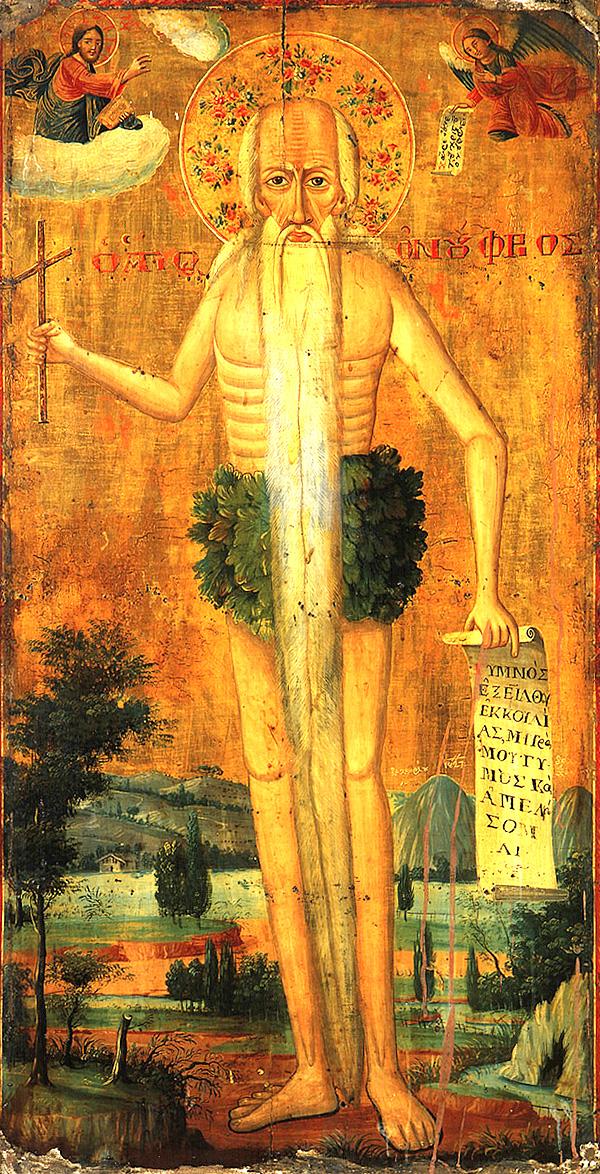
Life and witness
In Egypt, of St. Onuphrius, anchoret, who lived religiously threescore years in a vast desert, and famous for his great virtues and merits, our Lord: rested in whose memorable acts are written by Paphnutius, abbot.
The Lives Of The Saints: Volume 06, June · S. ONUPHRIUS, H.
S. ONUPHRIUS, H.
(4TH OR 5TH CENT.)
[By the Greeks and Russians on this day, and inserted by Baronius on this day in the Roman Martyrology. Authority A v ry curious account by Paphnutius, the abbot, who made a journey into the wilder- ness of Egypt, and on his return gave an account of his journey to his monks, his interview with Onuphrius, and the sayings of the hermit. All which, as he dictated, his monks took down in writing. It is not very dear what Paphnutius this was, whether Paphnutius the hermit who converted Thais the harlot, and who lived near Thebes, or he of the same name, abbot of the monastery which received S. Euphrosyne, or another Paphnutius commended by Palladius ; or again the Paph- nutius who was disciple of S. Macarius, or whether it was another alto- gether. Another version of the same journey is found in the Lives of the
ft-
Digitized by Google
June xa.]
S'. Onuphrius.
Fathers of the Desert, without the name of Paphnutius, not in the same words, yet relating the same incidents with slight variations. This is perhaps another of the accounts written by one of the monks of Paph- nutius. And it is also possible that this is the basis of the “Peregri. nation," which is an amplification. There are so many improbabilities in the latter, that it is impossible to accept it as it stands.]
Paphnutius, an abbot in Lower Egypt, went a pilgrim- age into the desert to see how the hermits who lived in desolate places were serving God. And after many days* journey he found a cave in a barren and dry land, wherein lay a dead hermit, and he knew not his name. And when he touched him, he crumbled into dust, and his sheepskin that hung against the side of the cave, in like manner fell to dust on being handled. Then Paphnutius stripped off his own coat, and folded in it the bones of the ancient hermit, and scratched up the sand in the cave, and laid him there. After that he went further into the wilds and found a cave, and traces about it, as though it had been inhabited, but none was there. So he opened his psalter and waited. Now when the sun set, he saw a monk coming over the waste towards the cave, driving a herd of oxen. And when the monk opened his door and came in, and saw a man, he was aghast, thinking he beheld a spirit, and he stood still and prayed. But Paphnutius said, 44 Fear not, servant of Jesus Christ.” Then the hermit came in, and told Paphnutius his story, and why he was now alone in the wilderness. And after a while Paphnutius left him, and plunged deeper still into the desert, and after seventeen days he saw a man covered with hair, having only an apron of palm-leaves, and his aspect was so horrible, that Paphnutius thought he saw a satyr, and he ran up the side of a mountain. But the man called to him, 44 Come down to me, man of God, for I am a man also, dwelling in the desert for the love of God.”
Then Paphnutius came down and fell at his feet, but
Digitized by ‘
152 Lives of the Saints . Uonci*.
the hermit raised him, and said, “ Arise, my son, lor thou also, I perceive, art a father of the saints.” Then the abbot arose, and the desert-dweller told him all his history. “ My name is Onuphrius, and I have spent sixty years in the wilderness, wandering among the rocks like a wild beast, and feeding on herbs and fruit" Then he said how he had been a monk in the Thebaid, but, had left the monastery, because he longed to be alone with God, and far away in the desert he found an old hermit who in- structed him in the rudiments of the eremitical life, and after that they separated, and met only once a year till the old hermit who had instructed him died.
Then Paphnutius asked Onuphrius how he managed about communicating on every Sabbath and Lord's Day. The old man told him that an angel came through the desert on the last day of the week, and also on the first day, to give the Blessed Sacrament to the dwellers in the remote solitudes.
The lives of the saints · 6 · S. ONUPHRIUS, H.
S. ONUPHRIUS, H.
(4.TH OR 5TH CENT.)
[By the Greeks and Russians on this day, and inserted by Baronius on this day in the Roman Martyrology. Authority : — A very curious account by Paphnutius, the abbot, who made a journey into the wilder- ness of Egypt, and on his return gave an account of his journey to his monks, his interview with Onuphrius, and the sayings of the hermit. All which, as he dictated, his monks took down in writing. It is not very clear what Paphnutius this was, whether Paphnutius the hermit who converted Thais the harlot, and who lived near Thebes, or he of the same name, abbot of the monastery which received S. Euphrosyne, or another Paphnutius commended by Palladius ; or again the Paph- nutius who was disciple of S. Macarius, or whether it was another alto- gether. Another version of the same journey is found in the Lires of the
lit-
Biographical overview
Onuphrius (also Onoufrios; Greek: Ὀνούφριος, romanized: Onouphrios) lived as a hermit in the desert of Upper Egypt in the 4th or 5th centuries. He is venerated as Saint Onuphrius in both the Roman Catholic and Eastern Catholic churches, as Venerable Onuphrius in Eastern Orthodoxy, and as Saint Nofer the Anchorite in Oriental Orthodoxy.
Martyrologium Romanum · Latin witness
In Aegypto sancti Onuphrii Anachoretae, qui in vasta eremo sexaginta annis vitam religiose peregit, et, magnis virtutibus ac meritis clarus, migravit in caelum. Ipsius vero insignia gesta Paphnutius Abbas conscripsit.