Peter Claver
Martyrological notice
Peter Claver, St., C..Sept. 9
Alban Butler — Lives of the Saints, with Reflections for Every Day in the Year (1894) · BLESSED PETER CLAVER.
BLESSED PETER CLAVER.
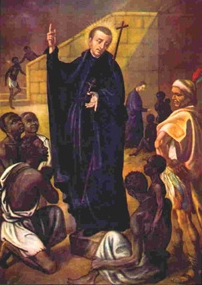
CETER Claver was a Spanish Jesuit. In Majorca he fell in with the holy lay-brother Alphonsns Eodri^ez, who, having already learned by revelation the saintly career of Peter, became his spiritual guide, foretold to him the labors he would undergo in the Indies, and the throne he wouM gain in heaven. Ordained priest in New Granada, Peter was sent to Cartagena, the great slave-mart of the West Indies, and there he consecrated himself by vow to the salvation of those ignorant and miserable creatures. For more than forty years he labored in this work. He called himself "the slave of the slaves." He was their apostle, father, physician, and friend. He fed them, nursed them with the utmost tenderness in their loathsome diseases, often applying his own lips to their hideous sores. His cloak, which was the constant covering of the naked, though soiled with their filthy ulcers, sent forth a miracu- lous perfume. His rest after his great labors was in nights of penance and prayer. However tired he might be, when news arrived of a fresh slave-ship, Blessed Peter immedi- ately revived, his eyes brightened, and he was at once on board amongst his dear slaves, bringing them comfort for body and soul. A false charge of reiterating Baptism for a while stopped his work. He submitted without a murmur till the calumny was refuted, and then God so blessed his toil that 40,000 negroes were baptized before he went to his reward, in 1654.
Reflection. — When you see any one standing in need of your assistance, either for body or soul, do not ask yourself why some one else did not help him, but think to yourself that you have found a treasure.
September lo.— ST. NICHOLAS OF TOLEN- TINO.
^P^ORN" in answer to the prayer of a holy mother, and ^bJ vowed before his birth to the service of God, Nicho- las never lost his baptismal innocence. His austerities were conspicuous even in the austere Order — the Hermits of
September 11] LIVES OF THE SAINTS 311
St. Augustine — ■ to which he belonged, and to the remon- strances which were made by his superiors he only replied, " How can I be said to fast, while every morning at the altar I receive my God ? " He conceived an ardent charity for the Holy Souls, so near and yet so far from their Saviour; and often after his Mass it was revealed to him that the souls for whom he had offered the Holy Sacrifice had been admitted to the presence of God. Amidst his loving labors for God and man, he was haunted by fear of his own sinfulness. " The heavens," said he, " are not, pure in the sight of Him Whom I serve ; how then shall I, a sinful man, stand before Him?" As he pondered on these things, Mary, the Queen of all Saints, appeared be- fore liim. " Fear not, Nicholas," she said, " all is well with you : my Son bears you in His Heart, and I am. your protection." Then his soul was at rest; and he heard, we are told, the songs which the angels sing in the presence of their Lord. He died September 10, 1310.
Reflection. — ^Would you die the death of the just ? there is only one way to secure the fulfilment of your wish. Live the life of the just. For it is impossible that one who has been faithful to God in life should make a bad or an un- happy end.
September ii.— ST. PAPHNUTIUS, Bishop.
^<HE holy confessor Paphnutius was an Egyptian, and ^^ after having spent several years in the desert, under the direction of the great St. Antony, was made bishop in Upper Thebais. He was one of those confessors who, under the tyrant Maximin Daia, lost their right eye, and were afterward sent to work in the mines. Peace being restored to the Church, Paphnutius returned to his flock. The Arian heresy being broached in Eg}'pt, he was one of the most zealous in defending the Catholic faith, and for his eminent sanctity and the glorious title of confessor (or one who had confessed the Faith before the persecutors and under torments) was highly considered in the great Council of Nice. Constantine the Great, during the celebration of that synod, sometimes conferred privately with him in his
312 LIVES OF THE SAINTS [September 12
palace, and never dismissed him without kissing respect- fully the place which had once held the eye he had lost for the Faith. St. Paphnutius remained always in a close union with St. Athanasius, and accompanied him to the Council of Tyre, in 335, where they found much the greater part of that assembly to be professed Arians. Seeing Maximus, Bishop of Jerusalem, among them, Paphnutius took him by the hand, led him out, and told him he could not see that any who bore the same marks as he in defence of the Faith should be seduced and imposed upon by per- sons who were resolved to oppress the most strenuous as- sertor of its fundamental article. We have no particular account of the death of St. Paphnutius, but his name stands in the Roman Martyrology on the 11th of September.
Reflection. — If to fight for our country be glorious, " it is likewise great glory to follow the Lord,'' saith the Wise Man.
Biographical overview
Peter Claver (Catalan: Pere Claver i Sobocano, Spanish: Pedro Claver y Corberó; 26 June 1580 – 8 September 1654) was a Spanish Jesuit priest and missionary born in Verdú, Spain, Spanish Empire, who, due to his life and work, became the patron saint of slaves, Colombia, and ministry to African Americans. During the 40 years of his ministry in the New Kingdom of Granada, it is estimated he personally baptized around 300,000 people and heard the confessions of over 5,000 people per year. He is also patron saint for seafarers. He is considered a heroic example of what should be the Christian praxis of love and of the exercise of human rights. The Congress of Colombia declared September 9 as the National Day of Human Rights in his honor.
Historical martyrology witness · The Roman Martyrology (English, 1916)
Peter Claver, St., C..Sept. 9
Alban Butler — Lives of the Saints, with Reflections for Every Day in the Year (1894) · BLESSED PETER CLAVER.
CETER Claver was a Spanish Jesuit. In Majorca he fell in with the holy lay-brother Alphonsns Eodri^ez, who, having already learned by revelation the saintly career of Peter, became his spiritual guide, foretold to him the labors he would undergo in the Indies, and the throne he wouM gain in heaven. Ordained priest in New Granada, Peter was sent to Cartagena, the great slave-mart of the West Indies, and there he consecrated himself by vow to the salvation of those ignorant and miserable creatures. For more than forty years he labored in this work. He called himself "the slave of the slaves." He was their apostle, father, physician, and friend. He fed them, nursed them with the utmost tenderness in their loathsome diseases, often applying his own lips to their hideous sores. His cloak, which was the constant covering of the naked, though soiled with their filthy ulcers, sent forth a miracu- lous perfume. His rest after his great labors was in nights of penance and prayer. However tired he might be, when news arrived of a fresh slave-ship, Blessed Peter immedi- ately revived, his eyes brightened, and he was at once on board amongst his dear slaves, bringing them comfort for body and soul. A false charge of reiterating Baptism for a while stopped his work. He submitted without a murmur till the calumny was refuted, and then God so blessed his toil that 40,000 negroes were baptized before he went to his reward, in 1654.
Reflection. — When you see any one standing in need of your assistance, either for body or soul, do not ask yourself why some one else did not help him, but think to yourself that you have found a treasure.
September lo.— ST. NICHOLAS OF TOLEN- TINO.
^P^ORN" in answer to the prayer of a holy mother, and ^bJ vowed before his birth to the service of God, Nicho- las never lost his baptismal innocence. His austerities were conspicuous even in the austere Order — the Hermits of
September 11] LIVES OF THE SAINTS 311
St. Augustine — ■ to which he belonged, and to the remon- strances which were made by his superiors he only replied, " How can I be said to fast, while every morning at the altar I receive my God ? " He conceived an ardent charity for the Holy Souls, so near and yet so far from their Saviour; and often after his Mass it was revealed to him that the souls for whom he had offered the Holy Sacrifice had been admitted to the presence of God. Amidst his loving labors for God and man, he was haunted by fear of his own sinfulness. " The heavens," said he, " are not, pure in the sight of Him Whom I serve ; how then shall I, a sinful man, stand before Him?" As he pondered on these things, Mary, the Queen of all Saints, appeared be- fore liim. " Fear not, Nicholas," she said, " all is well with you : my Son bears you in His Heart, and I am. your protection." Then his soul was at rest; and he heard, we are told, the songs which the angels sing in the presence of their Lord. He died September 10, 1310.
Reflection. — ^Would you die the death of the just ? there is only one way to secure the fulfilment of your wish. Live the life of the just. For it is impossible that one who has been faithful to God in life should make a bad or an un- happy end.
September ii.— ST. PAPHNUTIUS, Bishop.
^<HE holy confessor Paphnutius was an Egyptian, and ^^ after having spent several years in the desert, under the direction of the great St. Antony, was made bishop in Upper Thebais. He was one of those confessors who, under the tyrant Maximin Daia, lost their right eye, and were afterward sent to work in the mines. Peace being restored to the Church, Paphnutius returned to his flock. The Arian heresy being broached in Eg}'pt, he was one of the most zealous in defending the Catholic faith, and for his eminent sanctity and the glorious title of confessor (or one who had confessed the Faith before the persecutors and under torments) was highly considered in the great Council of Nice. Constantine the Great, during the celebration of that synod, sometimes conferred privately with him in his
312 LIVES OF THE SAINTS [September 12
palace, and never dismissed him without kissing respect- fully the place which had once held the eye he had lost for the Faith. St. Paphnutius remained always in a close union with St. Athanasius, and accompanied him to the Council of Tyre, in 335, where they found much the greater part of that assembly to be professed Arians. Seeing Maximus, Bishop of Jerusalem, among them, Paphnutius took him by the hand, led him out, and told him he could not see that any who bore the same marks as he in defence of the Faith should be seduced and imposed upon by per- sons who were resolved to oppress the most strenuous as- sertor of its fundamental article. We have no particular account of the death of St. Paphnutius, but his name stands in the Roman Martyrology on the 11th of September.
Reflection. — If to fight for our country be glorious, " it is likewise great glory to follow the Lord,'' saith the Wise Man.