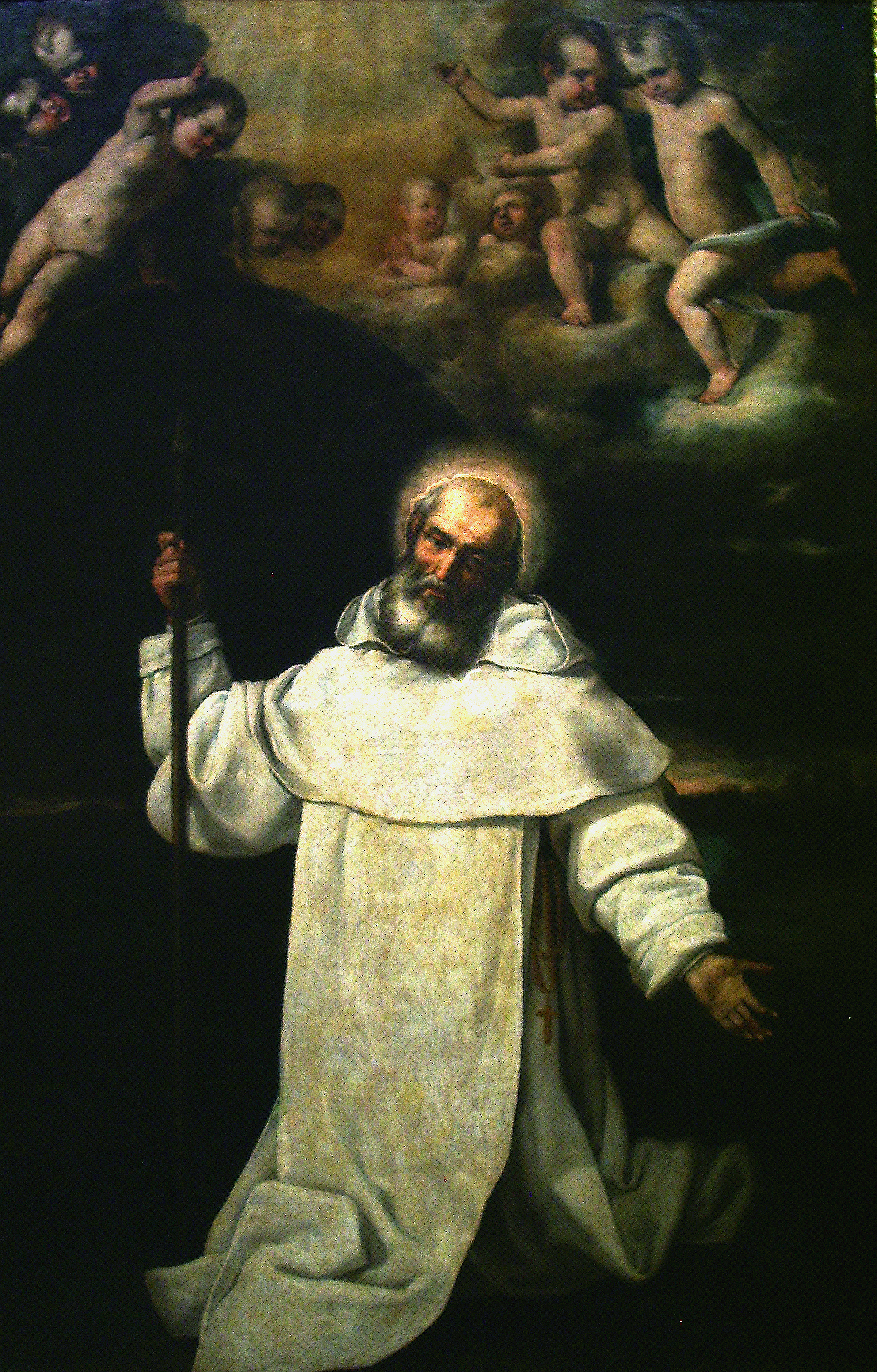
Peter Nolasco
Martyrological notice
Peter Nolasco, O. de M. (Pere Nolasc in Catalan, Pierre Nolasque in French and Pedro Nolasco in Spanish; 1189 – 6 May 1256) was a Catholic nobleman known for founding the Royal and Military Order of Our Lady of Mercy of the Redemption of the Captives (the Mercedarians) with approval by Pope Gregory IX on 17 January 1235. Though there is debate about whether Nolasco was born in France or Spain, it is clear that he was in Barcelona when he was a teenager and became part of an army fighting the Moors in the Iberian Peninsula and was appointed tutor to the young king, James I of Aragon.
Biographical overview
Peter Nolasco, O. de M. (Pere Nolasc in Catalan, Pierre Nolasque in French and Pedro Nolasco in Spanish; 1189 – 6 May 1256) was a Catholic nobleman known for founding the Royal and Military Order of Our Lady of Mercy of the Redemption of the Captives (the Mercedarians) with approval by Pope Gregory IX on 17 January 1235. Though there is debate about whether Nolasco was born in France or Spain, it is clear that he was in Barcelona when he was a teenager and became part of an army fighting the Moors in the Iberian Peninsula and was appointed tutor to the young king, James I of Aragon.
Butler Jan Mar · St. Peter Nolasco, Confessor..................... 314
{059}
JANUARY I.
THE CIRCUMCISION OF OUR LORD[1]
CIRCUMCISION was a sacrament of the Old Law, and the first legal observance required by Almighty God of that people, which he had chosen preferably to all the nations of the earth to be the depositary of his revealed truths.--These were the descendants of Abraham, whom he had enjoined it, under the strictest penalties,[2] several hundred years before the giving of the law to Moses on Mount Sinai; and this on two several accounts: First, as a distinguishing mark between them and the rest of mankind. Secondly, as a seal to a covenant between God and that patriarch: whereby it was stipulated on God's part to bless Abraham and his posterity; while on their part it implied a holy engagement to be his people, by a strict conformity to his laws. It was, therefore, a sacrament of initiation in the service of God, and a promise and engagement to believe and act as he had revealed and directed. Circumcision is also looked upon by St. Austin, and by several eminent modern divines,[3] to have been the expedient, in the male posterity of Abraham, for removing the guilt of original sin, which in those who did not belong to the covenant of Abraham, nor fall under this law was remitted by other means, probably by some external act of faith.
This law of circumcision continued in force till the death of Christ: hence our Saviour being born under the law, it _became him_, who came to teach mankind obedience to the laws of God; to _fulfil all justice_, and to submit to it. Therefore, he was _made under the law_, that is, was circumcised, that he might redeem them that were under the law, by freeing them from the servitude of it; and that those, who were in the condition of servants before, might be set at liberty, and _receive the adoption of sons_ in baptism; which by Christ's institution, succeeded to circumcision. On the {060} day he was circumcised he received the name of JESUS, the same which had been appointed him by the angel before he was conceived.[4] The reason of his being called JESUS is mentioned in the gospel:[5] _For he shall save his people from their sins_. This he effected by the greatest sufferings and humiliations; _having humbled himself_, as St. Paul says,[6] not only unto death, but even _to the death of the cross; for which cause God hath exalted him, and hath given him a name which is above all names; that at the name of JESUS every knee should bow_: agreeably to what Christ says of himself,[7] _All power is given unto me in heaven and in earth_.[8]
Christ being not only innocent, but incapable of sin, could stand in no need of circumcision, as an expedient then in use for the remission of sin. He was pleased, however, to subject himself to this humbling and painful rite of the Mosaic dispensation for several reasons: as, First, to put an end in an honorable manner to a divine, but temporary, institution, by taking it upon his own person. Secondly, to prove the reality of his human body; which, however evident from this and so many other actions and sufferings of his life, was denied by several ancient heretics. Thirdly, to prove himself not only the son of man, but of that man in particular of whose seed the Messiah was promised to come: thus precluding any future objection that might be raised by the Jews against his divine mission in quality of Messiah, under the pretence of his being an alien; and hereby qualifying himself for free conversation with them for their own spiritual advantage: setting us all a pattern of undergoing voluntarily several hardships and restraints, which, though not necessary on our own account, may be of great use to promote the good of others. Christ not being like other Jewish children, who could not know or fear the pain of circumcision, when they were going to suffer the operation, was perfectly sensible of it beforehand, and with calmness and intrepidity offered himself willingly to suffer the knife, and shed the first-fruits of his sacred blood in this painful manner. Under the smart this divine infant shed tears, but not as other children; for by them, with the most tender love and compassion, he bewailed chiefly our spiritual miseries, and at the same time presented with joy his blood as the price of our redemption to his Father. Fourthly, by thus humbling himself under this painful operation, he would give us an early pledge and earnest of his love for us, of his compassion for our miseries, and of his utter detestation of sin. The charity and zeal which glowed in his divine breast, impatient, as it were, of delay, delighted themselves in these first-fruits of humiliation and suffering for our sakes, till they could fully satiate their thirst by that superabundance of both, in his passion and death. With infinite zeal for his Father's honor, and charity for us sinners, with invincible patience, and the most profound humility, he now offered himself most cheerfully to his Father to undergo whatever he was pleased to enjoin him. Fifthly, he teaches us by the example of voluntary obedience to a law that could not oblige him, to submit with great punctuality and exactness to laws of divine appointment; and how very far we ought to be from sheltering our {061} disobedience under lame excuses and frivolous pretexts. Sixthly, by this ceremony, he humbled himself to satisfy for our pride, and to teach us the sincere spirit of humility. What greater humiliation can be imagined than for Him who is the eternal Son of God, in all things equal to his Father, to conceal these glorious titles under the appearance of a sinner? What a subject of confusion to us, who, being abominable criminals, are ashamed to pass for what we are, and desire to appear and be esteemed what we are not! Shall we not learn from this example of Christ to love humiliations, especially as we cannot but acknowledge that we deserve every reproach and all manner of contempt from all creatures? Seventhly, by beginning the great work of our salvation in the manner he was one day to finish it; suffering in his own person the punishment of sin, to deliver us from both sin and its punishment, he confounds the impenitence of sinners who will suffer nothing for their own sins; and inculcates the necessity of a spiritual circumcision, whereof the external was but the type and figure, as the apostle puts us in mind.[9]
The Lives Of The Saints: Volume 01, January · S. PETER NOLASCO, C.
(a.d. 1256.)
[Roman Martyrology. Authority : life by Franciscos ZumeL]
Peter Nolasco sprang from one of the first families of Languedoc. He was born in the year 1189, in the village of Mas des Saintes Pucelles. His pious parents took pains to give him a good education, and to cultivate the germs of virtue which appeared early in his soul They saw with gladness his compassion for the poor, and his love of prayer.
The child was wont to distribute his pocket-money in alms, and he went regularly to the matin office sung shortly after midnight When he was aged 15, he lost his father, who left him heir to a large estate, but he remained with his mother, a pious woman, who laboured to strengthen and confirm in him those graces which grew and expanded daily. Being solicited to marry, he remained some little while in hesitation, but at last, rising one night he cast him-
* — *
Digitized by CjOOQle