Prisca
Life and witness
There also, the passion of St. Prisca, virgin and martyr, who under Claudius the emperor, after many torments, received the ciwn of martyrdom.
Baring-Gould: January · S. PRISCA, V. M., AT ROME
[Roman Martyrology. She is often confounded with S. Priscilla mentioned in the Acts of the Apostles, the wife of Aquila, but called Prisca in the second epistle of Paul to Timothy. What adds to the confusion is, that S. Prisca is said in her Acts to have suffered under Claudius, but whether Claudius, who reigned from 41-54, or the second Claudius, who reigned from 263 to 270, is not stated; but it seems probable that it was under the first Claudius.[78] The Acts of S. Prisca are a forgery, and deserve no confidence. The following account is taken from the Martyrologies.]
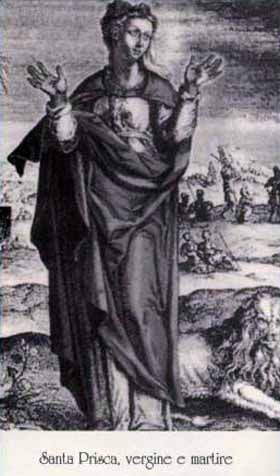
S. Prisca, a maiden of consular birth, being accused of Christianity, at the age of thirteen, was ordered by the Emperor Claudius to sacrifice to idols. On her steadfastly refusing, she was beaten with the hand and cast into prison. On the morrow she was again urged to sacrifice, but when she remained invincible, she was beaten with rods, and then taken back to prison. The third day she was exposed to a lion, which however crouched at her feet, doing her no injury. Then, having been tortured on the little horse, with hooks and pincers, she was led outside of the city, and was decapitated.
An eagle is said to have defended her body from dogs, till Christians came and buried it.
Alban Butler: January–March · ST. PRISCA, V.M.
SHE was a noble Roman lady, and after many torments finished her triumph by the sword, about the year 275. Her relics are preserved in the ancient church which bears her name in Rome, and gives title in a cardinal. {177} She is mentioned in the sacramentary of St. Gregory, and in almost all western Martyrologies. The acts of her martyrdom deserve no regard: St. Paul, in the last chapter of his epistle to the Romans, salutes Aquila, a person of Pontus, of Jewish extraction, and Priscilla, whom he and all churches thanked, because they had exposed themselves for his sake. He mentions the church which assembled in their house, which he attributes to no other among the twenty-five Christians whom he saluted, and were then at Rome. This agrees with the immemorial tradition at Rome, that St. Peter consecrated an altar, and baptized there in an urn of stone, which is now kept in the church of St. Prisca. Aquila and Priscilla are still honored in this church, as titular patrons with our saint, and a considerable part of their relics lies under the altar. Aquila and Priscilla were tent-makers, and lived at Corinth when they were banished from Rome under Claudius: she who is called Priscilla in the Acts of the Apostles, and Epistles to the Roman, and first to the Corinthians, is named Prisca in the second to Timothy. See the Roman Martyrology on the 18th of January and the 8th of July; also Chatelain, not. p. 333.
Biographical overview
Prisca was a young Roman woman tortured and executed for her Christian faith. The dates of her birth and death are unknown. She is revered as a saint and martyr in Eastern Orthodoxy, by the Catholic Church, and in the Anglican Communion. Though some legends suggest otherwise, scholars do not believe she is the Priscilla (Prisca) of the New Testament couple Priscilla and Aquila, who were friends of the Apostle Paul. She is honored, especially in England, as a child martyr. January 18 is her feast day.