
Sebastian
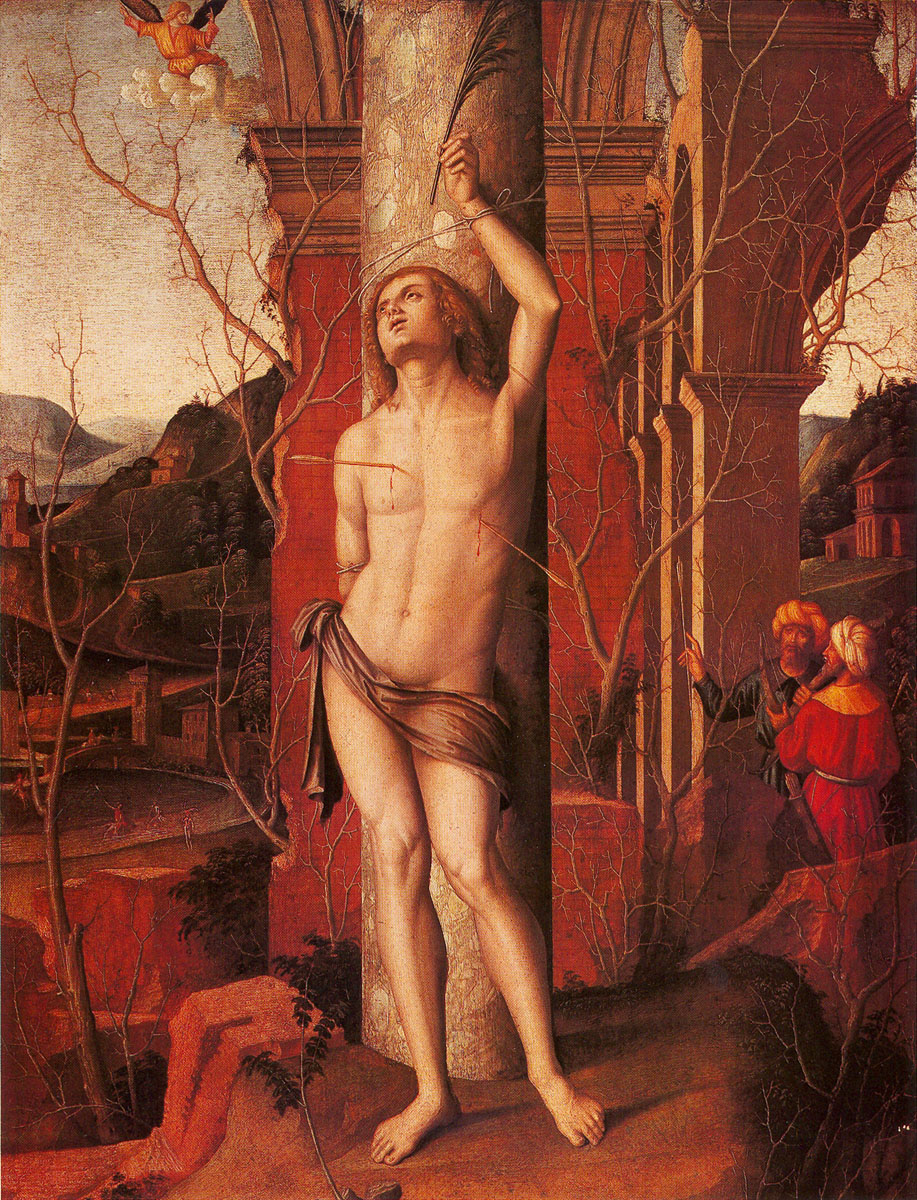
Life and witness
There also, at the place called Catacumbse, of St. Sebastian, martyr, who under Dioclesian, emperor, being chief commander of the first band of soldiers, was, for professing the christian faith, commanded to be bound in the midst of the field, and shot with arrows by the soldiers, and finally to be beaten with clubs until he died.
Baring-Gould: January · S. SEBASTIAN, M., AT ROME
[All the ancient Latin Martyrologies. The Greeks commemorate him on December 18th. The original Acts are not in our possession. What is regarded as the Acts appears to be a panegyric, falsely attributed to S. Ambrose, on S. Sebastian's Day. The incidents are no doubt taken from the original Acts, but the long sermons and theological instructions put into the mouths of S. Sebastian and Tranquillinus, are certainly oratorical compositions of the author who passes for S. Ambrose.]
S. Sebastian was born at Narbonne, in Gaul, but his parents were of Milan, in Italy, and he was brought up in that city. He was a fervent soldier of Christ at the same time that he served in the army of the Emperor. He was so greatly regarded by the Emperors Diocletian and Maximian, that he was elevated to the command of the first cohort, for he was a man prudent, upright in word and act, faithful in business, fervent in spirit. He was enabled, by his rank and office, to be of service to those who were imprisoned for the faith of Christ. He relieved their sufferings, and urged them to constancy.
Two brothers, Marcus and Marcellianus, had been accused of being Christians, and were expecting execution in prison, when their friends, admitted to see them, implored them with tears to save their lives by apostasy. They seemed to waver; they promised to deliberate. Sebastian heard of this, and rushed to save them. He was too well known to be refused admittance, and he entered their gloomy prison as an angel of light.
Tranquillinus, the father of the two youths, had obtained from Agrestius Chromatius,[94] prefect of the city, a respite of thirty days for them, to try their constancy; and, to second his efforts, they had been placed in the house of Nicostratus, the keeper of the records (primiscrinius).
Sebastian's was a bold and perilous office. Besides the two Christian captives, there were gathered in the place sixteen heathen prisoners; there were the parents of the unfortunate youths weeping over them, to allure them from their threatened fate; and there was the magistrate, Nicostratus, with his wife Zoë, drawn thither by the compassionate wish of seeing the youths snatched from their fate. Could Sebastian hope that of this crowd not one would be found whom a sense of official duty, or a hope of pardon, or hatred of Christianity, might impel to betray him, if he avowed himself a Christian?
The room was illumined only by an opening in the roof, and Sebastian, anxious to be seen by all, stood in the ray which shot through it; strong and brilliant where it beat, but leaving the rest of the apartment dark. It broke against the gold and jewels of his rich tribune's armour, and as he moved, scattered itself in brilliant reflections into the darkest recesses of the gloom; while it beamed with serene steadiness on his uncovered head.[95]
"O most happy soldiers of Christ, valiant warriors in the fight! are ye now, after having undergone so much that ye touch the palm, are ye now, I ask, about to withdraw from the fight and lay aside the crown, overcome by these blandishments? Let them see in you the fortitude of Christian soldiers, sheathed rather in fortitude than in armour of iron. Can it be that you will cast away the rewards of victory at the instigation of a woman? Can it be that half-conquering already, you will bow your necks to be trampled on by the deadly foe?" Words of reproach and threatening and promise poured from his lips.[96]
The scene that followed baffles description. All were moved; all wept. Marcus and Marcellianus were ashamed of their late hesitation. Tranquillinus and his wife were convinced; the prisoners joined in the tumult of these new affections; and Sebastian saw himself surrounded by a group of men and women smitten by grace, softened by its influences, and subdued by its power; yet all was lost if one remained behind. He saw the danger, not to himself, but to the Church, if a sudden discovery were made, and to those souls fluttering in uncertain faith.
Zoë knelt before Sebastian with a beseeching look and outstretched arm, but she spoke not a word, for, six years before, her tongue had been paralysed in a severe sickness, and she had not spoken since. Sebastian looked at her earnestly, and read in her signs, and the expression of her countenance, that she believed in her heart. Then he asked wherefore she spoke not, and it was told him that she was dumb. Then, raising his hand and signing her mouth with a cross, he said, "If I am the true servant of Christ, and those things are true which I have spoken, and thou O, woman, hast heard, may the Lord Jesus Christ, in whom I believe, restore the use of thy tongue, and open thy mouth, as he opened the mouth of his prophet Zachariah."
Then suddenly the woman cried out:--"Blessed art thou, and blessed is the word of thy mouth, and blessed are they that believe in Jesus Christ, the Son of the living God." And when Nicostratus saw the grace of God revealed by the healing of his wife, he fell at the feet of Sebastian, and offered to break the chains off the hands and feet of the confessors, and let them go; but to this they would not consent. Then Nicostratus transferred them all, with Tranquillinus and his wife, to the full liberty of his house, after having obtained leave from Claudius the keeper of the prisons (Commentariensis.) Sebastian lost no time in putting them under the care of the priest Polycarp, of the title, or parish of S. Pastor, who diligently instructed them, night and day. In the meantime, Claudius, the gaoler, came to the house of Nicostratus, and said, "The prefect is much disturbed at my having allowed the prisoners to be in your house; and therefore he requires you to appear before him and explain the reason."
Nicostratus at once went to the prefect, and told him that he had taken the Christian prisoners into his own house, with the purpose of moving them the more easily to apostasy. "You did well," said Chromatius, and he dismissed him. On his way home, the keeper of the rolls told Claudius the truth; and when he related how Sebastian had healed his wife, Claudius exclaimed in an agony of eagerness:--"Send him to my house, I have two lads, sons of my first wife, one dropsical, the other a poor wretched cripple. If he cured your wife, he can heal my sons." Then running home, he brought his two boys, one in each arm, to the house of Nicostratus, and introduced them into the company of the neophytes, and casting the boys in the midst, implored the disciples to recover his poor children, and declaring that he believed with all his heart. Then Polycarp, the priest, took the names of the whole company, they were sixty-eight in all, and he baptized them. Now when the two boys rose from the baptismal water, they were healed of their infirmities; and Tranquillinus, who had suffered excruciating torments from the gout, also felt that he was made whole.
Chromatius, the prefect, was afterwards converted, and having resigned his office, retired into privacy.
The care which Sebastian took of the Christian prisoners, and the efforts he made to stimulate their courage, could not long remain secret; and he was denounced to the Emperor Diocletian, who sent for him, and in a rage, exclaimed, "What! I have had thee about my person, and thou hast conspired against my safety!"
S. Sebastian answered, "I pray daily for thy safety and for the prosperity of the state, to the God of heaven, for I reckon no succour can be got from gods of stone."
Then Diocletian ordered him to be taken out into a field, and be shot to death with arrows. Therefore the soldiers placed him as their mark, and left him for dead, bristling with arrows. But a certain woman, named Irene, the widow of the martyr Castulus, finding that he still lived, took him to her lodgings, at the head of the great staircase of the palace, and there nursed him till he was convalescent. And one day, as he began to walk, the Emperor passed. Then he started out to the head of the stairs. He had heard the familiar trumpet notes, which told him of the Emperor's approach, and he had risen, and crept to greet him.
"Diocletian!" he cried out, in a hollow but distinct voice; "False are the words of thy idol priests, my sovereign, who say that we Christians are adversaries to the state; who cease not to pray for thy welfare and that of the realm."
"What!" exclaimed the Emperor; "Art thou Sebastian?" "I am Sebastian, raised as from death to witness against thee for thy cruel persecution of the servants of Christ."
Then the Emperor, in a rage, ordered him to be taken into the court-yard of the palace, and to be beaten to death with clubs, and his body to be cast into the sewer.
And when all this had been done, a devout woman, named Lucina, by night rescued the body from the place where it had been cast, and buried it reverently in her own garden.
A church was afterwards built over his relics by Pope Damasus.
Patron of Chiemsee, Mannheim, Oetting, Palma, Rome, Soissons; of makers of military laces, of archers, makers of fencing foils.
Relics, at Soissons, the head at Eternach, in Luxemburg, portions at Mantua, at Malaga, Seville, Toulouse, Munich, Paris, Tournai, in the Cathedral; Antwerp, in the church of the Jesuits; and at Brussels, in the Court Chapel.
In art, can always be recognized as a young man, transfixed with arrows.
Alban Butler: January–March · ST. SEBASTIAN, M.
From his acts, written before the end of the fourth age. The gladiators, who were abolished by Honorius, in 403, subsisted when these acts were compiled. See Bollandus, who thinks St. Ambrose wrote them, also Tillemont, t. 1, p. 551.
ST. SEBASTIAN was born at Narbonne, in Gaul, but his parents were of Milan, in Italy, and he was brought up in that city. He was a fervent servant of Christ, and though his natural inclinations gave him an aversion to a military life, yet to be better able, without suspicion, to assist the confessors and martyrs in their sufferings, he went to Rome, and entered the army under the emperor Carinus, about the year 283. It happened that the martyrs, Marcus and Marcellianus, under sentence of death, appeared in danger of being shaken in their faith by the tears of their friends: Sebastian seeing this, stepped in, and made them a long exhortation to constancy, which {184} he delivered with the holy fire, that strongly affected all his hearers. Zoe, the wife of Nicostratus, having for six years lost the use of speech by a palsy in her tongue, fell at his feet, and spoke distinctly, by the saint's making the sign of the cross on her mouth. She, with her husband Nicostratus, who was master of the rolls,[1] the parents of Marcus and Marcellianus, the jailor Claudius, and sixteen other prisoners, were converted; and Nicostratus, who had charge of the prisoners, took them to his own house, where Polycarp, a holy priest, instructed and baptized them. Chromatius, governor of Rome, being informed of this, and that Tranquillinus, the father of Saints Marcus and Marcellianus, had been cured of the gout by receiving baptism, desired to be instructed in the faith, being himself grievously afflicted with the same distemper. Accordingly, having sent for Sebastian, he was cured by him, and baptized, with his son Tiburtius. He then enlarged the converted prisoners, made his slaves free, and resigned his prefectship.
Not long after, in the year 285, Carinus was defeated and slain in Illyricum by Dioclesian, who, the year following, made Maximian his colleague in the empire. The persecution was still carried on by the magistrates, in the same manner as under Carinus, without any new edicts. Dioclesian, admiring the courage and virtue of St. Sebastian, who concealed his religion, would fain have him near his person, and created him captain of a company of the pretorian guards, which was a considerable dignity. When Dioclesian went into the East, Maximian, who remained in the West, honored our saint with the same distinction and respect. Chromatius, with the emperor's consent, retired into the country in Campania, taking many new converts along with him. It was a contest of zeal, out of a mutual desire of martyrdom, between St. Sebastian and the priest Polycarp, which of them should accompany this troop, to complete their instruction, and which should remain in the city, to encourage and assist the martyrs, which latter was the more dangerous province. St. Austin wished to see such contests of charity among the ministers of the church.[2] Pope Caius, who was appealed to, judged it most proper that Sebastian should stay in Rome, as a defender of the church. In the year 286, the persecution growing hot, the pope and others concealed themselves in the imperial palace, as a place of the greatest safety, in the apartments of one Castulus, a Christian officer of the court. St. Zoe was first apprehended, praying at St. Peter's tomb on the feast of the apostles. She was stifled with smoke, being hung by the heels over a fire. Tranquillinus, ashamed to be less courageous than a woman, went to pray at the tomb of St. Paul, and was seized by the populace, and stoned to death. Nicostratus, Claudius, Castorius, and Victorinus were taken, and after being thrice tortured, were thrown into the sea. Tiburtius, betrayed by a false brother, was beheaded. Castulus, accused by the same wretch, was thrice put on the rack, and afterwards buried alive. Marcus and Marcellianus were nailed by the feet to a post, and having remained in that torment twenty-four hours, were shot to death with arrows.
St. Sebastian, having sent so many martyrs to heaven before him, was himself impeached before the emperor Dioclesian; who, having grievously reproached him with ingratitude, delivered him over to certain archers of Mauritania, to be shot to death. His body was covered with arrows, and he left for dead. Irene, the widow of St. Castulus, going to bury him, found him still alive, and took him to her lodgings, where, by care, he recovered of his wounds, but refused to fly, and even placed himself one day by a staircase where the emperor was to pass, whom he first accosted, reproaching {185} him for his unjust cruelties against the Christians. This freedom of speech, and from a person, too, whom he supposed to have been dead, greatly astonished the emperor; but recovering from his surprise, he gave orders for his being seized and beat to death with cudgels, and his body thrown into the common sewer. A pious lady called Lucina, admonished by the martyr in a vision, got it privately removed, and buried it in the catacombs,[3] at the entrance of the cemetery of Calixtus. A church was afterwards built over his relies by pope Damasus, which is one of the seven ancient stationary churches at Rome, but not one of the seven principal churches of that city, as some moderns mistake; it neither being one of the five patriarchal churches, nor one of the seventy-two old churches which give titles to cardinals. Vandelbert, St. Ado, Eginard, Sigebert, and other contemporary authors relate, that in the reign of Louis Debonnaire, pope Eugenius II. gave the body of St. Sebastian to Hilduin, abbot of St. Denys, who brought it into France, and it was deposited at St. Medard's, at Soissons, on the 9th of December, in 826; with it is said to have been brought a considerable portion of the relics of St. Gregory the Great. The rich shrines of SS. Sebastian, Gregory, and Medard, were plundered by the Calvinists, in 1564, and the sacred bones thrown into a ditch, in which there was water. Upon the declaration of two eye-witnesses, they were afterwards found by the Catholics; and in 1578, enclosed in three new shrines, though the bones of the three saints could not be distinguished from each other.[4] The head of this martyr, which was given to St. Willibrord by pope Sergius, is kept at Esternach, in the duchy of Luxemburg. Portions of his relics are shown in the cathedral at St. Victor's; the Theatins and Minims at Paris; in four churches at Mantua; at Malaca, Seville, Toulouse, Munich in the ducal palace, Tournay in the cathedral, Antwerp in the church of the Jesuits, and at Brussels, in the chapel of the court, not at St. Gudula's, as some have mistaken.[5] St. Sebastian has been always honored by the church, as one of her most illustrious martyrs. We read in Paul the deacon, in what manner, in the year 680, Rome was freed from a raging pestilence, by the patronage of this saint. Milan, in 1575, Lisbon, in 1599, and other places, have experienced, in like calamities, the miraculous effects of his intercession with God in their behalf.
Footnotes: 1. Primiscrinius. 2. Ep. 180. 3. On Catacombs, see in St. Calixtus, Oct. 14. 4. Chatelain, notes, p. 355. Baillet. 5. Bollandus, Chatel. ib.
Biographical overview
Sebastian (Latin: Sebastianus; c. AD 255 – c. AD 288) was an early Christian saint and martyr. According to traditional belief, he was killed during the Diocletianic Persecution of Christians. He was initially tied to a post or tree and shot with arrows, though this did not kill him. He was, according to tradition, rescued and healed by Irene of Rome, which became a popular subject in 17th-century painting. In all versions of the story, shortly after his recovery he went to Diocletian to warn him about his sins, and as a result he was clubbed to death. He is venerated in the Catholic Church and the Eastern Orthodox Church as the patron saint of athletics, archery, and plagues. The oldest mention of Sebastian's martyrdom is in the Chronograph of 354, which says he is venerated on January 20. He is also mentioned in a sermon on Psalm 118 by 4th-century bishop Ambrose of Milan: in his sermon, Ambrose stated that Sebastian came from Milan and that he was already venerated there at that time. The full account of his martyrdom comes from the Passio Sancti Sebastiani, a 5th-century text written by an anonymous author, possibly Arnobius the Younger. Sebastian is a popular male saint, especially today among athletes. In medieval times, he was regarded as a saint with a special ability to intercede to protect from plague, and devotion to him greatly increased when plague was active.
Martyrologium Romanum · Latin witness
Item Romae, ad Catacumbas, sancti Sebastiani Martyris, qui, Diocletiano Imperatore, cum haberet principatum primae cohortis, jussus est, sub titulo christianitatis, ligari in medio campo, et sagittari a militibus, atque ad ultimum fustibus caedi, donec deficeret.