
Vitus
Life and witness
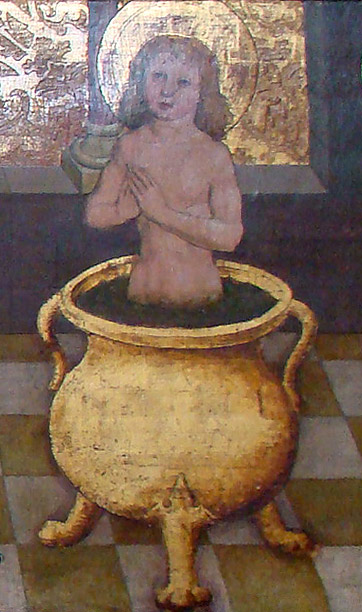
In Lucania, at the river Silar, the birth-day of the holy martyrs Vitus, Modestus, and Crescentia, under Dioclesian the emperor, who being brought thither out of Sicily, after they had endured hot boiling lead, and by the power of God overcome the beasts, and other cruel torments, ended the course of their glorious combat.
The Lives Of The Saints: Volume 06, June · SS. VITUS, MODESTUS, AND CRESCENTIA, MM.
SS. VITUS, MODESTUS, AND CRESCENTIA, MM.
(ABOUT A.D. 303.)
[Roman Martyrology. Usuardus, Ado, Hrabanus, &c. Authority : — The Acts, certainly not older than the 6th cent They are fabulous, con- tradict history, and have the appearance of being a poor attempt at a religious romance, probably founded on fact, and made out of a jumble of two saints of the name of Vitus, one who suffered in Sicily, the other in Rome. Guerin and Giry, with unruffled composure, assert what they must have known was false. “The life of these glorious martyrs is drawn from an ancient MS. worthy of belt#."]
|T is impossible to distinguish truth from fable in the legend of S. Vitus, and this is the more difficult from the legend being perhaps made up to the acts of two distinct saints of the same name. But the outline of the story may be briefly summed up thus. Vitus was the child of a Sicilian, named Hylas, who sent him to school to a teacher named Modestus, a Christian, who taught the boy the true faith, and had him baptized without his father’s knowledge. On the breaking out of persecution, Vitus was denounced to the governor as a Christian; the prefect ordered him to be flogged, and then gave him back to his father, who tried blandishments to move him to renounce the faith he had
b-
Digitized by Google
208
Lives of the Saints.
[[June 15.
adopted. Then fearing that the boy would yield, his master Modestus and his nurse Crescentia, also a Chris- tian, carried the boy away with them by boat to Italy, where they were all martyred. It is probable that the Vitus martyred at Rome was quite another person than the Vitus of Sicily, and that the latter really suffered in his native island.1
Relics at Corbey in Saxony, and at Prague.
The lives of the saints · 6 · SS. VITUS, MODESTUS, AND CRESCENTIA, MM.
SS. VITUS, MODESTUS, AND CRESCENTIA, MM.
(ABOUT A.D. 303.)
[Roman Martyrology. Usuardus, Ado, Hrabanus, &c. Authority : — The Acts, certainly not older than the 6th cent. They are fabulous, con- tradict history, and have the appearance of being a poor attempt at a religious romance, probably founded on fact, and made out of a jumble of two saints of the name of Vitus, one who suffered in Sicily, the other in Rome. Guerin and Giry, with unruffled composure, assert what they must have known was false. ' ' The life of these glorious martyrs is drawn from an ancient MS. worthy ofbelitf."']
[T is impossible to distinguish truth from fable
in the legend of S. Vitus, and this is the more
difficult from the legend being perhaps made
up to the acts of two distinct saints of the same
name. But the outline of the story may be briefly summed
up thus. Vitus was the child of a Sicilian, named Hylas,
who sent him to school to a teacher named Modestus,
a Christian, who taught the boy the true faith, and had
him baptized without his father's knowledge. On the
breaking out of persecution, Vitus was denounced to the
governor as a Christian; the prefect ordered him to be
Biographical overview
Vitus (), whose name is sometimes rendered Guy or Guido, was a Christian martyr from Sicily. His earliest known hagiography is documented in the Martyrologium Hieronymianum. The dates of his actual life are unknown. He has long been tied to the Sicilian martyrs Modestus and Crescentia but in the earliest sources it is clear that these were originally different traditions that later became combined. The figures of Modestus and Crescentia are probably fictitious. According to his hagiography, he died during the Diocletianic Persecution in AD 303. In the Middle Ages, he was counted as one of the Fourteen Holy Helpers. In Germany, his feast was celebrated with dancing before his statue. This dancing became popular and the name "Saint Vitus Dance" was given to the neurological disorder Sydenham's chorea. It also led to Vitus being considered the patron saint of dancers and of entertainers in general. He is also said to protect against lightning strikes, animal attacks and oversleeping. His feast day is celebrated on 15 June. In places where the Julian calendar is used, this date coincides, in the 20th and 21st centuries, with 28 June on the Gregorian calendar.