
Mary Magdalene
Life and witness
Mary, called Magdalene, enters the Gospel narrative not as an anonymous symbol but as a named disciple. Saint Luke records that Jesus had freed her from seven demons and places her among the women who accompanied him and the Twelve and supported the mission from their own means. The text therefore presents a concrete history of deliverance, gratitude and persevering discipleship (Luke 8:1–3).
The canonical Gospels then preserve her fidelity at the decisive hours when many disciples had fled. She is named among the women who had followed Jesus from Galilee, stood near or watched the Crucifixion, observed where the body was laid, and returned after the Sabbath intending to honour the dead Lord (Matthew 27:55–61; Mark 15:40–47; Luke 23:49–56; John 19:25).
Her place in Christian memory rests above all upon Easter morning. In Saint John’s account she comes to the tomb while it is still dark, reports the removed stone to Peter and the beloved disciple, remains weeping when they depart, encounters the risen Christ when he calls her by name, and receives the command to announce his Ascension to his brethren. Her proclamation, “I have seen the Lord,” is the first personal announcement of the Resurrection made to the apostolic circle (John 20:1–18).
A disciple healed and restored
Luke 8:1–3 distinguishes Mary Magdalene from the unnamed sinful woman of the preceding chapter and says expressly that seven demons had gone out of her. The number signifies the gravity and completeness of the affliction from which Christ delivered her; the Evangelist does not describe her as a prostitute. Her subsequent presence among the women who served the apostolic company shows that grace did not end in a private cure but became sustained discipleship and material service to the mission.
The designation “Magdalene” identifies her with Magdala or its region on the western shore of the Sea of Galilee. Beyond what the Gospels state, biographical details must be distinguished carefully from later local traditions.
Fidelity at the Cross and the tomb
Matthew and Mark name Mary Magdalene among the women who had followed Jesus from Galilee and ministered to him. They remain as witnesses of the Crucifixion when the public danger is greatest. John places Mary Magdalene near the Cross together with the Mother of Jesus and the beloved disciple. The accounts differ in viewpoint and distance, but agree in preserving her fidelity during the Passion.
She also watches the burial and knows the location of the tomb. This detail is historically important within the Gospel narrative: the woman who later reports the empty tomb is not searching at random or confusing the place. Luke adds that the women prepared spices and rested on the Sabbath according to the commandment.
The first herald of Easter
The four Gospels place Mary Magdalene at the discovery of the empty tomb. Saint John gives the most extended personal account. After Peter and the beloved disciple have inspected the tomb, Mary remains outside weeping. She first sees angels and then Jesus, whom grief and the transformed condition of the risen body prevent her from recognising until he speaks her name: “Mary.” She answers, “Rabbouni.”
Christ sends her to his brethren with the message of his return to the Father. Her words, “I have seen the Lord,” make her the first commissioned witness who carries the Easter proclamation to the apostles. The truth announced is not a private inward consolation but the bodily Resurrection of the crucified Lord and the beginning of the apostolic testimony.
Apostola apostolorum
Because she was sent to announce the Resurrection to the apostles, Latin Christian tradition honoured Mary Magdalene with the title apostola apostolorum, “apostle of the apostles.” The title describes her Easter mission as messenger; it does not identify her with the apostolic college or with the sacramental office conferred upon the Twelve. Saint Thomas Aquinas uses this traditional language when commenting on John 20.
Her witness also gives a theological pattern of conversion and contemplation: she seeks the Lord, perseveres when others depart, recognises him when called by name and is directed away from possessive attachment toward obedient proclamation.
Mary Magdalene, Mary of Bethany and the unnamed penitent
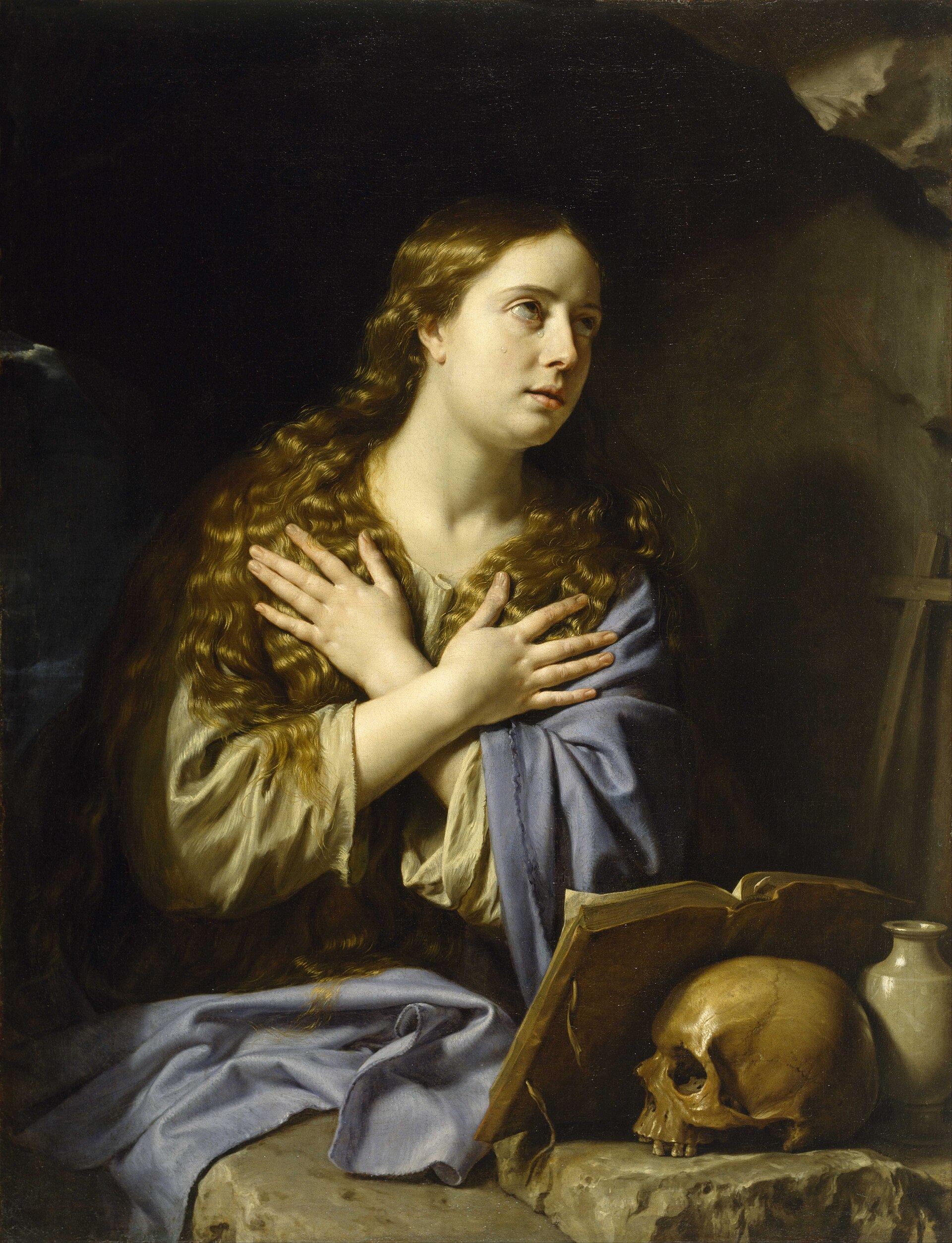
The Gospel texts do not explicitly identify Mary Magdalene with Mary of Bethany, the sister of Martha and Lazarus, or with the unnamed sinful woman who anoints Christ’s feet in Luke 7. In the Latin West these figures were often read together, especially after the preaching of Saint Gregory the Great, and this synthesis profoundly shaped medieval devotion, art and the image of Magdalene as the great penitent.
The Eastern tradition generally commemorated them as distinct persons. A historically responsible Catholic account can acknowledge the venerable Western synthesis without presenting an identification not expressly made by Scripture as though it were a defined article of faith.
Cult, feast and spiritual significance
The Roman liturgy celebrates Saint Mary Magdalene on 22 July. Her cult joins gratitude for deliverance, penitential love, contemplative perseverance and apostolic witness. She is invoked especially by penitents and converts, not because the Gospels call her a public prostitute, but because the tradition saw in her deliverance and devoted love a luminous image of grace restoring the whole person.
Her life as actually attested by Scripture is already abundant: healed by Christ, benefactor of the mission, disciple from Galilee, witness of the Passion and burial, visitor to the tomb, hearer of her risen Lord and herald to the apostles.
Traditional Roman Martyrology
The traditional Roman Martyrology commemorates her on 22 July and recalls both her deliverance by Christ and her privilege of seeing the risen Saviour. Its association with Marseille belongs to the received Western cultic tradition and should be distinguished from the events directly narrated by the canonical Gospels.
Biographical overview
Mary Magdalene (sometimes called Mary of Magdala, or simply the Magdalene or the Madeleine) was a woman who, according to the four canonical gospels, travelled with Jesus as one of his followers and was a witness to his crucifixion and resurrection. Mary Magdalene is regarded by believers as a historical figure, possibly from Magdala or some scholars suggest the term Magdalene (Tower) may have been a nickname given to her by Jesus. She is seen as a prominent follower of Jesus who was believed to have been healed by him, supported his ministry financially, and was present at his crucifixion and burial. She played a key role among his female disciples. Overall, there is limited information about her life. Apocryphal early Christian writings often portray Mary Magdalene as a prominent, spiritually insightful figure favoured by Jesus, challenging traditional patriarchal norms. These texts have inspired modern reinterpretations of her role. In the Gnostic writings, she is depicted as Jesus's closest disciple who uniquely understood his teachings, causing tension with Peter, and is honoured as the "apostle to the apostles". During the Patristic era, Mary Magdalene was mentioned only briefly by early Church Fathers, with her image evolving from a minor gospel figure to being conflated with other women in the Bible. Eventually she became viewed in Western Christianity, largely due to Pope Gregory I's influential 591 sermon, as a repentant prostitute, despite there being no biblical basis for this portrayal. The Eastern Orthodox Church has always viewed Mary Magdalene as a virtuous Myrrhbearer and "Equal to the Apostles", distinct from other biblical women. The Catholic Church historically conflated her with the repentant sinner in Luke 7 but later emphasized her role as the first witness to the resurrection and honoured her as the "Apostle to the Apostles". Many alleged relics of Mary Magdalene, including her skull, a piece of forehead flesh, a tibia, and her left hand, are preserved in Catholic sites in France and Mount Athos, with notable displays and annual processions honouring them.