Our Lady of Lourdes
Life and witness
The apparitions at Lourdes call the faithful to penance, prayer and confidence in the Immaculate Conception.
Biographical overview
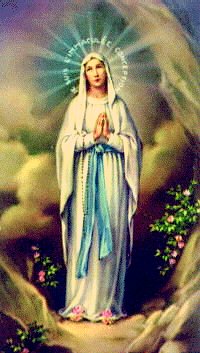
Our Lady of Lourdes (French: Notre-Dame de Lourdes; Occitan: Nòstra Senhora de Lorda) is one of the devotional names or titles under which the Catholic Church venerates the Virgin Mary. The name commemorates a series of 18 apparitions reported by a 14-year-old girl, Bernadette Soubirous, in Lourdes, France in 1858. After the first reported apparition on 11 February 1858, Bernadette told her mother that a "Lady" had spoken to her in the cave of Massabielle (1.5 kilometres (0.93 mi) from the town) while Bernadette, her sister, and a friend were gathering firewood. Bernadette reported similar apparitions of the "Lady" over the ensuing weeks, in the last of which the "Lady" identified herself as "the Immaculate Conception". On 18 January 1862, the local Bishop of Tarbes Bertrand-Sévère Laurence endorsed the veneration of the Blessed Virgin Mary in Lourdes. On 1 February 1876, Pope Pius IX officially granted a decree of canonical coronation to the image as Notre-Dame du Saint Rosaire. The coronation was performed by Cardinal Pier Francesco Meglia at the courtyard of what is now part of the Rosary Basilica on 3 July 1876. The image of Our Lady of Lourdes has been widely copied and reproduced in shrines and homes, often in garden landscapes. Bernadette Soubirous was canonized by Pope Pius XI in 1933. Marian devotion has since steadily increased as ecclesiastical investigations sanctioned her visions. In later years, a large church was built at the site that has since become a major site of religious pilgrimage.