
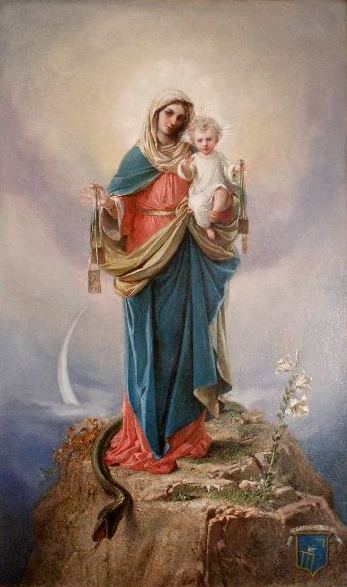
Our Lady of Mount Carmel
Life and witness
Celebration of Mary as patroness of the Carmelite family and model of contemplative listening.
The Lives Of The Saints: Volume 08, July Pt. 2 · OUR LADY OF MOUNT CARMEL.
OUR LADY OF MOUNT CARMEL.
(a.d. 1251.)
[Roman and Carmelite Martyrologies.J
The Order of Mount Carmel commemorates this day the giving of the scapular to S. Simon Stock, fifth General of the Order. It is related that the Blessed Virgin appeared to Simon, and holding in her hand a scapular, a little woollen habit of a brown colour, to cover the shoulders, stomach, and back, informed him seriously that anyone who hereafter should receive a similar strip of woollen cloth, with a hole in the middle, from the hands of a Carmelite, and should wear it, should never burn in hell eternally.
The Pere Guerin says, “I know that several modern writers have rejected the truth of this vision, but as I find it repeated in several Papal Bulls, and that it has been contained in the lessons for the Office of the Fes- tival, which have been approved by the Holy See and by the Sacred Congregration, and that Pope Clement X., of happy memory, has permitted the recitation of it by all
* *
Lives of the Saints .
[July 16.
#
408
■*
ecclesiastics, and all secular and regular communities of either sex, in lands belonging to the king of Spain, by a bull, dated Nov. 21st,, 1641, I think that I cannot err in proposing it, not as a verity of the Faith and of in- dubitable certainty , but as a thing that one may receive with respect and believe piously.”
Pope John XXII., it is pretended, was vouchsafed a vision of the Blessed Virgin on two occasions, in which she insisted on the Holy See pronouncing in favour of the scapular and its divine origin. The first of these visions took place on Aug. 7th, 1316; the second, in the following year, 1317. But the pope made no attempt to carryout what was enjoined on him, till 1320, when he was visited a third time. He then promulgated his famous bull, 11 Sabbathine ” so called, because it pro- claimed that all who wore the scapular in life would be delivered from the flames of purgatory on the ensuing Saturday ; and which, therefore, made it a matter of the greatest advantage for a member of the Congregation of the Scapular to die as late as possible on a Friday. Pope Clement VII. confirmed this decision by a brief in the year 1528.
The conditions attached to this great privilege by the bull of Pope John XXII. are — 1st. That the piece of flannel called the scapular be worn assiduously till death. 2nd. That an unmarried person maintain con- tinence, and a married person abstain from adultery.
Biographical overview
Our Lady of Mount Carmel, or Virgin of Carmel, is a Catholic title of the Blessed Virgin Mary venerated as patroness of the Carmelites of the Ancient Observance and the Discalced Carmelites. The first Carmelites were hermits living on Mount Carmel in the Holy Land during the late 12th and early to mid-13th centuries. They built in the midst of their hermitages a chapel which they dedicated to the Blessed Virgin, whom they conceived of in chivalric terms as the "Lady of the place." Our Lady of Mount Carmel was adopted in the 19th century as the patron saint of Chile. Since the 15th century, popular devotion to Our Lady of Mount Carmel has centred on the Scapular of Our Lady of Mount Carmel, also known as the Brown Scapular. Traditionally, Mary is said to have given the Scapular to the Carmelite Simon Stock (1165–1265). The liturgical feast of Our Lady of Mount Carmel is celebrated on 16 July. The liturgical feast of Our Lady of Mount Carmel was probably first celebrated in England in the later part of the 14th century. Its object was thanksgiving to Mary, the patroness of the Carmelite order, for the benefits she had accorded to it through its difficult early years. The institution of the feast may have come in the wake of the vindication of their name, Brothers of the Blessed Virgin Mary, at Cambridge, England, in 1374. The date chosen was 17 July; on the European mainland this date conflicted with the feast of Saint Alexis, requiring a shift to 16 July, which remains the Feast of Our Lady of Mount Carmel on the General Roman Calendar. The Latin poem Flos Carmeli ("Flower of Carmel") first appears as the sequence for this Mass. Traditionally, the feast is a preferred occasion for receiving the Brown Scapular.
The Lives Of The Saints: Volume 08, July Pt. 2 · OUR LADY OF MOUNT CARMEL.
(a.d. 1251.)
[Roman and Carmelite Martyrologies.J
The Order of Mount Carmel commemorates this day the giving of the scapular to S. Simon Stock, fifth General of the Order. It is related that the Blessed Virgin appeared to Simon, and holding in her hand a scapular, a little woollen habit of a brown colour, to cover the shoulders, stomach, and back, informed him seriously that anyone who hereafter should receive a similar strip of woollen cloth, with a hole in the middle, from the hands of a Carmelite, and should wear it, should never burn in hell eternally.
The Pere Guerin says, “I know that several modern writers have rejected the truth of this vision, but as I find it repeated in several Papal Bulls, and that it has been contained in the lessons for the Office of the Fes- tival, which have been approved by the Holy See and by the Sacred Congregration, and that Pope Clement X., of happy memory, has permitted the recitation of it by all
* *
Lives of the Saints .
[July 16.
#
408
■*
ecclesiastics, and all secular and regular communities of either sex, in lands belonging to the king of Spain, by a bull, dated Nov. 21st,, 1641, I think that I cannot err in proposing it, not as a verity of the Faith and of in- dubitable certainty , but as a thing that one may receive with respect and believe piously.”
Pope John XXII., it is pretended, was vouchsafed a vision of the Blessed Virgin on two occasions, in which she insisted on the Holy See pronouncing in favour of the scapular and its divine origin. The first of these visions took place on Aug. 7th, 1316; the second, in the following year, 1317. But the pope made no attempt to carryout what was enjoined on him, till 1320, when he was visited a third time. He then promulgated his famous bull, 11 Sabbathine ” so called, because it pro- claimed that all who wore the scapular in life would be delivered from the flames of purgatory on the ensuing Saturday ; and which, therefore, made it a matter of the greatest advantage for a member of the Congregation of the Scapular to die as late as possible on a Friday. Pope Clement VII. confirmed this decision by a brief in the year 1528.
The conditions attached to this great privilege by the bull of Pope John XXII. are — 1st. That the piece of flannel called the scapular be worn assiduously till death. 2nd. That an unmarried person maintain con- tinence, and a married person abstain from adultery.