
Scholastica
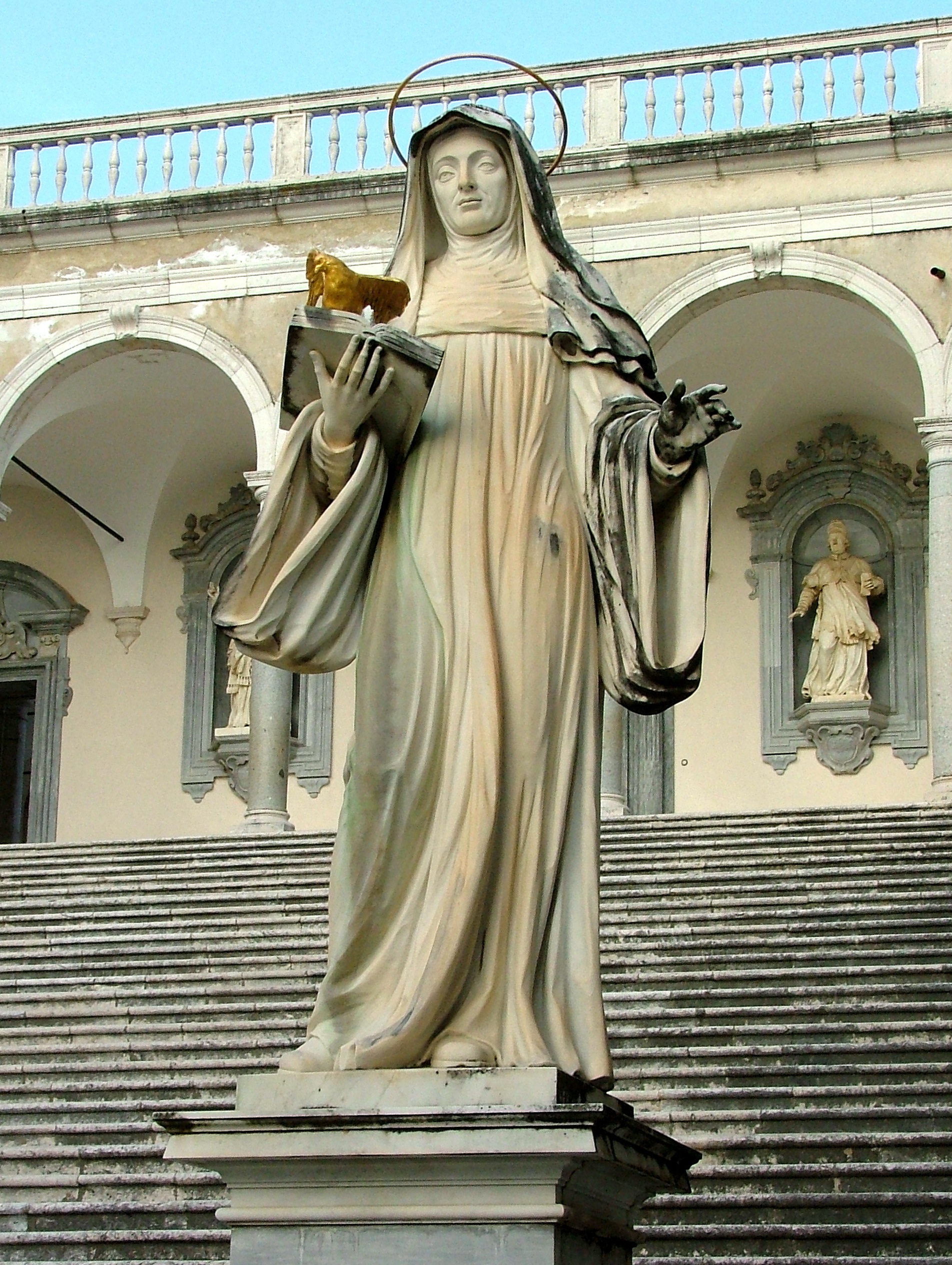
Life and witness
Roman Martyrology (traditional English edition; normalized OCR transcription): At Monte-Cassino, of St. Scholastica, virgin, sister to St. Benet, abbot, who saw her soul at her departure fly up to heaven in likeness of a dove.
Baring-Gould: February · S. SCHOLASTICA, V
[Famous wherever the name of S. Benedict, her brother, is known. Authorities for her life, the same as those for his. The following sketch of her life is extracted from Montalembert's Monks of the West.]
In the history of most saints who have exercised a reformatory and lasting influence upon monastic institutions, the name and influence of some holy woman is almost invariably found associated with their work and devotedness. These bold combatants in the war of the Spirit against the flesh seemed to have drawn strength and consolation from a chaste and fervent community of sacrifices, prayers, and virtues, with a mother or a sister, by blood or choice, whose sanctity shed upon one corner of their glorious lives a ray of sweeter and more familiar light. To instance only the greatest: Macrina is seen by the side of S. Basil, and the names of Monica and Augustine are inseparable; as in later ages are those of S. Francis of Assisi and S. Clara, S. Francis of Sales and S. Jeanne Chantal. S. Benedict had also a sister, born on the same day with himself, named Scholastica; they loved each other as twins often love, with fraternal regard, elevated into a passion. But both loved God above all. Still earlier than her brother, Scholastica had consecrated herself to God from her infancy; and, in becoming a nun, she made herself the patroness and model of the innumerable family of virgins who were to acknowledge, adopt, and follow the code of her brother. She rejoined him at Monte Cassino, and established herself in a monastery, in the depths of a valley near the holy mountain. Benedict directed her from afar, as he did many other nuns in the neighbourhood. But they met only once a year, and then it was Scholastica who left her cloister, and sought her brother. He, on his side, went to meet her: they met upon the side of the mountain, not far from the door of the monastery, in a spot which has long been venerated. There, at their last meeting, occurred that struggle of fraternal love, and the austerity of the rule, recorded by S. Gregory,[31] which is the only known episode in the life of Scholastica, and which has insured an imperishable remembrance to her name. They had passed the entire day in pious conversation, mingled with praises of God. Towards the evening they ate together. While they were still at table, and the night approached, Scholastica said to her brother, "I pray thee, do not leave me to-night, but let us speak of the joys of heaven till the morning." "What sayest thou, my sister?" answered Benedict; "on no account can I remain out of the monastery." Upon the refusal of her brother, Scholastica bent her head between her clasped hands on the table, but prayed to God, shedding torrents of tears, to such an extent, that the table was flooded with them. The weather was very serene: there was not a cloud in the air. But scarcely had she raised her head when thunder was heard, and a violent storm began; the rain, lightning, and thunder were such, that neither Benedict, nor any of his brethren, who accompanied him, could take a step beyond the roof that sheltered them. Then he said to Scholastica, "May God pardon thee, my sister, but what hast thou done?" "Ah, yes," she answered him, "I prayed thee, and thou would'st not listen to me; then I prayed God, and he heard me. Go now, if thou canst, and send me away, to return to thy monastery." He resigned himself, against his will, to remain, and they passed the rest of the night in spiritual converse. S. Gregory, who has preserved the tale to us, adds that it is not to be wondered at, that God granted the desire of the sister rather than that of the brother, because, of the two, it was the sister who loved most, and that those who love most have the greatest power with God.
In the morning they parted, to see each other no more in this life. Three days after, Benedict, being at the window of his cell, had a vision, in which he saw his sister entering heaven under the form of a dove. Overpowered with joy, his gratitude burst forth in songs and hymns to the glory of God.
Her body was translated to Le Mans, in France, of which city she is patroness, but her relics were dispersed by the Huguenots, in 1562. However, some portions have been preserved, some in the Jesuit Church at Antwerp, and a bone in the Carthusian Church at Cologne.
Alban Butler: January–March · ST. SCHOLASTICA, VIRGIN.
From St. Gregory the Great, Dial. l. 2, c. 33 and 34. About the year 543.
THIS saint was sister to the great St. Benedict. She consecrated herself to God from her earliest youth, as St. Gregory testifies. Where her first monastery was situated is not mentioned; but after her brother removed to Mount Cassino, she chose her retreat at Plombariola, in that neighborhood, where she founded and governed a nunnery about five miles distant to the south from St. Benedict's monastery.[1] St. Bertharius, who was abbot of Cassino three hundred years after, says, that she instructed in virtue several of her own sex. And whereas St. Gregory informs us, that St. Benedict governed nuns as well as monks, his sister must have been their abbess under his rule and direction. She visited her holy brother once a year, and as she was not allowed to enter his monastery, he went out with some of his monks to meet her at a house at some small distance. They spent these visits in the praises of God, and in conferring together on spiritual matters, St. Gregory relates a remarkable circumstance of the last of these visits. Scholastica having passed the day as usual in singing psalms, and pious discourse, they sat down in the evening to take their refection. After it was over, Scholastica, perhaps foreknowing it would be their last interview in this world, or at least desirous of some further spiritual improvement, was very urgent with her brother to delay his return till the next day, that they might entertain themselves till morning upon the happiness of the other life. St. Benedict, unwilling to transgress his rule, told her he could not pass a night out of his monastery: so desired her not to insist upon such a breach of monastic discipline. Scholastica, finding him resolved on going home, laying her hands joined upon the table and her head upon them, with many tears begged of Almighty God to interpose in her behalf. Her prayer was scarce ended, when there happened such a storm of rain, thunder, and lightning, that neither St. Benedict nor any of his companions could set a foot out of doors. He complained to his sister, saying: "God forgive you, sister; what have you done?" She answered: "I asked you a favor, and you refused it me: I asked it of Almighty God, and he has granted it me." St. Benedict was therefore obliged to comply with her request, and they spent the night in conferences on pious subjects, chiefly on the felicity of the blessed, to which both most ardently aspired, and which she was shortly to enjoy. The nest morning they parted, and three days after St. Scholastica died in her solitude. St. Benedict was then alone in contemplation on Mount Cassino, and lifting up his eyes to heaven, he saw the soul of his sister ascending thither in the shape of a dove. Filled with joy at her happy passage, he gave thanks for it to God, and declared her death to his brethren; some of whom he sent to bring her corpse to his monastery, where {392} he caused it to be laid in the tomb which he had prepared for himself. She must have died about the year 543. Her relics are said to have been translated into France, together with those of St. Bennet, in the seventh century, according to the relation given by the monk Adrevald.[2] They are said to have been deposited at Mans, and kept in the collegiate church of St. Peter in that city in a rich silver shrine.[3] In 1562 this shrine was preserved from being plundered by the Huguenots, as is related by Chatelain. Her principal festival at Mans is kept a holyday on the 11th of July, the day of the translation of her relics. She was honored in some places with an office of three lessons, in the time of St. Louis, as appears from a calendar of Longchamp, written in his reign.
Lewis of Granada, treating on the perfection of the love of God, mentions the miraculous storm obtained by St. Scholastica, to show with what excess of goodness God is always ready to hear the petitions and desires of his servants. This pious soul must have received strong pledges and most sensible tokens of his love, seeing she depended on receiving so readily what she asked of him. No child could address himself with so great confidence to his most tender parent. The love which God bears us, and his readiness to succor and comfort us, if we humbly confess and lay before him our wants, infinitely surpasses all that can be found in creatures. Nor can we be surprised that he so easily heard the prayer of this holy virgin, since at the command of Joshua he stopped the heavens, God obeying the voice of man. He hears the most secret desires of those that fear and love him, and does their will: if he sometimes seem deaf to their cries, it is to grant their main desire by doing what is most expedient for them, as St. Austin frequently observes. The short prayer by which St. Scholastica gained this remarkable victory over her brother, who was one of the greatest saints on earth, was doubtless no more than a single act of her pure desires, which she continually turned towards, and fixed on her beloved. It was enough for her to cast her eye interiorly upon him with whom she was closely and inseparably united in mind and affections, to move him so suddenly to change the course of the elements in order to satisfy her pious desire. By placing herself, as a docile scholar, continually at the feet of the Divine Majesty, who filled all the powers of her soul with the sweetness of his heavenly communications, she learned that sublime science of perfection in which she became a mistress to so many other chaste souls by this divine exercise. Her life in her retirement, to that happy moment which closed her mortal pilgrimage, was a continued uniform contemplation, by which all her powers were united to, and transformed into God.
Footnotes: 1. This nunnery underwent the same fate with the abbey of Mount Cassino, both being burnt to the ground by the Lombards. When Rachim, king of that nation, having been converted to the Catholic faith by the exhortations of pope Zachary, re-established that abbey, and taking the monastic habit, ended his life there, his queen Tasai and his daughter Ratruda rebuilt and richly endowed the nunnery of Plombariola, in which they lived with great regularity to their deaths, as is related by Leo of Ostia in his Chronicle of Mount Cassino, ad an. 750. It has been since destroyed, so that at present the land is only a farm belonging to the monastery of Mount Cassino. See Dom Mege, Vie de St. Benoit, p. 412. Chatelain, Notes, p. 605. Murarori, Antichita, &c. t. 3. p. 400. Diss. 66, del Monasteri delle Monache. 2. See Paul the deacon, Hist. Longob. and Dom Mege, Vie de St. Benoit, p. 48. 3. That the relics of St. Bennet were privately carried off from Mount Cassino, in 660, soon after the monastery was destroyed, and brought to Fleury on the Loire by Algiulph the monk, and those of St. Scholastica, by certain persons of Mans to that city, is maintained by Mabillon, Menard, and Bosche. But that the relics of both these saints still remain at Mount Cassino, is strenuously affirmed by Loretus Angelus de Nuce, and Marchiarelli, the late learned monk of the Order of Camaldoli: and this assertion Benedict XIV. looks upon as certain, (de Canoniz. l. 4, part 2, c. 24, t, 4, p. 245.) For pope Zachary in his bull assures us, that he devoutly honored the relics of SS. Benedict and Scholastica, at Mount Cassino, in 746. Leo Ostiensis and Peter the deacon visited them and found them untouched in 1071, as Alexander II. affirms in the bull he published when he consecrated the new church there. By careful visitations made by authority, in 1486 and 1545, the same is proved. Yet Angelus de Nuce allows some portions of both saints to be at Mans and Fleury, on the Loire. Against the supposed translation of the whole shrines of St. Benedict and St. Scholastica into France, see Muratori, Antichita, &c., dissert. 58, t. 3, p. 244.
Biographical overview
Scholastica (; c. 480 – 10 February 543) was an Italian Christian consecrated virgin and the sister of Benedict of Nursia. She is traditionally regarded as the foundress of the Benedictine nuns. Scholastica is honored as a saint of the Catholic Church, Eastern Orthodox Church and Anglican Communion. She was born in Italy, and a ninth-century tradition makes her the twin sister of Benedict. Her feast day is 10 February.
Martyrologium Romanum · Latin witness
Apud montem Cassinum sanctae Scholasticae Virginis, sororis sancti Benedicti Abbatis, qui ejus animam, instar columbae, migrantem e corpore in caelum ascendere vidit.