
Thomas Becket
Life and witness
Archbishop murdered in Canterbury Cathedral after defending the Church’s freedom against royal encroachment.
The Lives Of The Saints: Volume 15, December · vSl Thomas & Becket.
vSl Thomas & Becket.
339
*
*
to extend even justice over all, and touch the sacred pockets of the ecclesiastics, to extract something for the preservation of the commonwealth, whose protection they enjoyed with- out hitherto contributing towards its expenses — was that the king was lured on to the delusion that Becket was ready to go forward with him in the execution of his complete scheme of reformation, and to support him in his attempt to bring the Church under control. Hitherto the whole burden of taxation had fallen on the laity. The clergy were exempt. The Church possessed a large share of the land of England, and all that land was untaxed, so that the burden fell with double oppression on the lay landowners.
One day, when Becket was recovering from an illness at Rouen, the prior of Leicester came to see him, on his way from the court of the king, who was then in Gascony. He said roughly to Becket, “ How is this ? You, an ecclesiastic, are dressed as a man who goes out hawking, with a cape with sleeves ! Although but one person, you are archdeacon of Canterbury, dean of Hastings, provost of Beverley, canon of this place, and canon of that, proctor to the archbishop, and, it is whispered, likely to become archbishop yourself.” Becket said, “There are three poor priests in England, any one of whom I would rather see raised to that dignity. And, moreover, so well do I know the king, that I should either lose his favour, or that of God, were I made arch- bishop.” This shows that Becket had mapped out his own course in his own mind. Not one of the three poor priests, he knew well enough, was likely to get the archbishopric, which was certain to be his, could he but keep up the farce till the death of Theobald.
Henry II. had married Eleanor of Guienne, the divorced wife of the king of France, and laid claim to the county of Toulouse, as part of his wife’s inheritance. But Raymond of S. Gilles, who held the county by conveyance from the
*
*
Digitized by <^.ooQle
* — *
340 Lives of the Saints. [Dec. n
father of Queen Eleanor, and, moreover, as the dower of his own wife, sister of the French king, refused to give it up. Louis sustained the cause of his brother-in-law, and Henry prepared for war. As the territory in dispute was far distant, the king, by the advice of his chancellor, resolved to accept from each of his vassals a sum of money in lieu of personal service. The amount so obtained enabled him to enlist a vast body of mercenaries, with which, augmented by his chief barons and their immediate retainers, he took the field.
In his suite appeared the young king of Scotland, a prince of Walfcs, and the chancellor Becket, leading 700 men-at- arms, paid by himself. In the south, Henry was joined by Raymond-Berenger, king of Aragon, and other allies, with considerable forces. The advance of the formidable host upon Toulouse caused the count urgently to implore the aid of the king of France ; and Louis, without waiting to collect his forces, threw himself into the menaced city with a small troop. Upon this, Henry, with a politic respect for his over-lord, immediately gave up the siege, in spite of the counsel of his chancellor. Satisfied with the conquests he had already made, the king returned to Normandy, leaving Becket, with the constable, in command of the force which remained.
Biographical overview
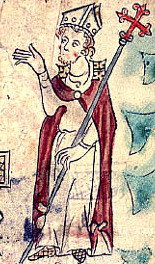
Thomas Becket ( ), also known as Saint Thomas of Canterbury, Thomas of London and later Thomas à Becket (21 December 1119 or 1120 – 29 December 1170), was an English cleric and statesman who served as Lord Chancellor from 1155 to 1162, and then as Archbishop of Canterbury from 1162 until his death in 1170. He is known for his conflict with King Henry II over the rights and privileges of the Church and was murdered by followers of the king. Becket is venerated as a saint and martyr by the Catholic Church and the Anglican Communion. Born into a Norman family in London, Becket was educated first at the Merton Priory in Surrey and then successively in London and Paris. He later found work at the household of Theobald of Bec, Archbishop of Canterbury and quickly won his confidence. Theobald would entrust him with a series of important offices and missions, and in 1154 recommended him as Lord Chancellor to King Henry II. In 1162, several months after Theobald's death, Henry appointed Becket Archbishop of Canterbury. A major rift grew between Henry and Becket as the latter became increasingly ascetic and unexpectedly resisted the king's attempt to reassert royal prerogatives. In 1164, Becket was summoned to a trial by Henry and convicted on charges of contempt of royal authority and malfeasance. Refusing to accept the sentence, he fled to the Continent and spent six years in exile under the protection of Louis VII of France. A compromise was eventually reached through papal mediation. Becket returned to England in 1170 but dispute with the crown continued, leading to his death at the hands of four knights loyal to Henry in Canterbury Cathedral later in the year. Veneration of Becket as a martyr throughout Europe began soon after his death, and he was canonised by Pope Alexander III two years later.