
Vincent of Saragossa
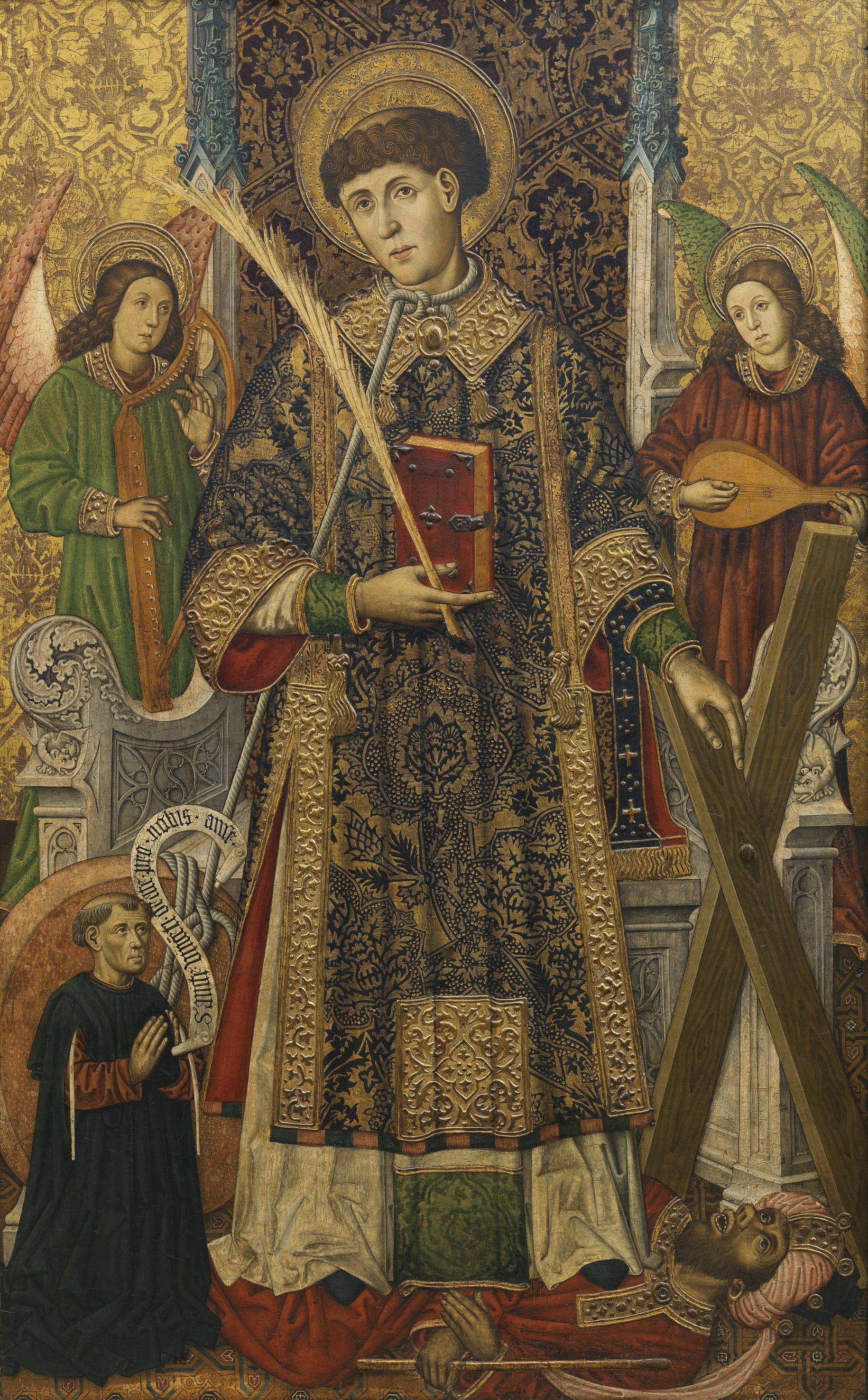
Life and witness
Spanish deacon whose steadfastness under torture made him one of the most honoured martyrs of the West.
Baring-Gould: January · S. VINCENT, D. AND M.
[All Western Martyrologies, and by the Greeks on the same day, and Nov. 11th. The Acts, very ancient, quoted by Metaphrastes, are a very early recension of the original Acts by the notaries of the Church. Also, a hymn of Prudentius.]
This most illustrious martyr of the Spanish Church was born at Saragossa in Arragon, the mother of martyrs, as Prudentius calls it. His parents are mentioned in his Acts, which are at least older than S. Augustine (August 28), in whose time they were publicly read in the church of Hippo. The name of his father was Eutychius; and his mother, Enola, was a native of Osca, or Huesca, which sometimes claims the honour of his birth. He was trained in the discipline of the Christian faith by Valerius, Bishop of Saragossa, and was in due time ordained to the office of deacon. The Bishop was a man of venerable piety, but laboured under an impediment in his speech. He therefore devoted himself to prayer and contemplation, and intrusted the care of teaching to S. Vincent, whom he also appointed his principal or archdeacon. Dacian was then Governor of Spain under Diocletian and Maximian, and had already distinguished himself by his cruelty against the Christians. The imperial edict for the seizure of the clergy had just been published in the end of the year 303, in which the laity were not included until the following year. Valerius and his deacons were accordingly loaded with chains and carried to Valencia, where the Governor then was. The pains of hunger were added to their sufferings, in the hope of subduing their fortitude. When they were brought before Dacian he first tried the effect of mild language and promises of reward if they would obey the orders of the Emperors and sacrifice to the gods. He reminded Valerius of the influence which his episcopal dignity gave him; and to Vincent he represented the honour of his family, and the sweet joys of youth which still lay before him. But the confessors of Christ were not to be thus moved. Valerius, being unable from his infirmity to reply to the artful persuasions of the tempter, Vincent made a noble profession of the faith in the name of them both.
The Bishop was condemned to exile, where he seems afterwards to have finished his course by martyrdom; and Vincent was remanded to prison, thence to pass by a more painful but a speedier way to his crown. His body was stretched upon the rack and cruelly torn with iron hooks, but no torture could shake his resolution or disturb the calm which sat upon his countenance. He defied the utmost efforts of his tormentors; and, when they began to grow weary, Dacian ordered them to be beaten, suspecting that they spared the martyr. But the Governor himself was at last moved to a faint pity by the miserable spectacle, and entreated Vincent to purchase his deliverance by at least giving up the Christian books. Vincent, still continuing firm, was taken from the rack and led to a more terrible torture called the _Question_. It was an iron frame with bars running across it, sharp as scythes, and underneath a fire was kindled, which made the whole frame red hot. To this fearful agony the martyr walked with a willing step, and even went before the executioners. And, as he lay bound upon the bed of torture, his eyes were fixed on heaven, his lips moved as if in prayer, and a peaceful smile would sometimes pass across his countenance. No cruelty was spared that diabolical ingenuity could invent, but the love of Christ surpassed the wrath of man and won the day. When the malice of his enemies could do no more, he was carried back to prison, and laid in a dark dungeon strewn with broken potsherds, which allowed his wounded body no rest. His feet, too, were fastened in the stocks. But God was mindful of His servant, and sent His angels to comfort him, bestowing a foretaste of his reward while his trial was as yet unfinished. His cell was illuminated with the light of heaven, his bonds were loosed, and the floor of his prison seemed to be strewn with flowers. The martyr and his celestial visitants sang hymns together, and the unwonted sound astonished the jailer. He looked into the cell, and, overpowered by what he saw and heard, confessed the power of God and the truth of the Christian faith. When Dacian heard of it he shed tears of rage; but, finding it was useless to continue his cruelty, he gave orders that some repose should be allowed to the martyr. His motives for this act of clemency are variously represented; perhaps he only meant to recruit the strength of Vincent that he might endure further tortures; or perhaps he feared that, if he expired under them, the Christian faith might be exalted in the eyes of the people by his constancy. But, whatever was the policy of Dacian, God overruled it to obtain for His blessed servant an easy departure. The scattered remnant of Christians gathered round him, and tended him with anxious care. They provided a soft bed, on which he was no sooner laid than he yielded up his soul to the Lord, on January 22, A.D. 304. The rage of the Governor followed his poor remains. His body was cast out into a field to become the prey of wild beasts and birds; but was defended by a raven. Then, to add further indignities to it, it was taken out in a boat and thrown into the sea with a mill-stone about the neck. During the night it was washed ashore, and at last was privately buried by some good Christians in a humble chapel near Valencia. When the fury of the persecution had ceased, it was removed with great honour, and buried under the altar of the principal church.
Alban Butler: January–March · ST. VINCENT, MARTYR.
From Prudentius, hymn 5, and St. Austin, serm, 274, 275, 276, 277, all four preached on his festivals. His ancient acts in Bollandus are also authentic, but not those in Metaphrastes and Surius. See Tillemont t. 5, p. 217.
THE most glorious martyr St. Vincent was born, some say at Saragossa, others at Valentia, but most authors, and most probably, at Osca, now Huesca, in Granada. He was instructed in the sacred sciences and in Christian piety by Valerius, the bishop of that city, who ordained him his deacon, and appointed him, though very young, to preach and instruct the people. Dacian, a most bloody persecutor, was then governor of Spain. The emperors Dioclesian and Maximian published their second and third bloody edicts against the Christian clergy in the year 303, which in the following year were put in force against the laity. It seems to have been before these last that Dacian put to death eighteen martyrs at Saragossa, who are mentioned by Prudentius, and in the Roman Martyrology, January the 16th, and that he apprehended Valerius and Vincent. They spilt some of their blood at Saragossa, but were thence conducted to Valentia, where the governor let them lie long in prison, suffering extreme famine and other miseries. The proconsul hoped that this lingering torture would shake their constancy; but when they were brought out before him, he was surprised to see them still intrepid in mind, and vigorous in body, and reprimanded his officers, as if they had not treated the prisoners according to his orders. Then, turning to the champions of Christ, he employed alternately threats and promises to induce them to sacrifice. Valerius, who had an impediment in his speech, making no answer, Vincent said to him "Father, if you order me, I will speak." "Son," said Valerius, "as I committed to you the dispensation of the word of God, so I now charge you to answer in vindication of the faith which we defend." The holy deacon then acquainted the judge that they were ready to suffer every thing for the {194} true God, and little regarded either his threats or promises in such a cause. Dacian contented himself with banishing Valerius.[1] As for St. Vincent, he was determined to assail his resolution by every torture his cruel temper could suggest. St. Austin assures us, that he suffered torments far beyond what any man could possibly have endured, unless supported by a supernatural strength; and that he preserved such a peace and tranquillity in his words, countenance, and gestures in the midst of them, as astonished his very persecutors, and visibly appeared as something divine; while the rage and distraction of Dacian's soul was as visible in the violent agitations of his body, by his eyes sparkling with fury, and his faltering voice.
The martyr was first stretched on the rack by his hands and feet, drawn by cords and pulleys, till his joints were almost torn asunder: while he hung in this posture, his flesh was unmercifully torn off with iron hooks. Vincent, smiling, called the executioners weak and faint-hearted. Dacian thought they spared him, and caused them to be beaten, which afforded the champion an interval of rest: but they soon returned to him, resolved fully to satisfy the cruelty of their master, who excited them all the while to exert their utmost strength. They twice stayed their hands to take breath, and let his wounds grow cold; then began with fresh vigor to rend and tear his body, which they did in all its limbs and parts with such cruelty, that his bones and bowels were in most places exposed bare to sight. The more his body was mangled, the more did the divine presence cherish and comfort his soul, and spread a greater joy on his countenance. The judge, seeing the streams of blood which flowed from all the parts of his body, and the frightful condition to which it was reduced, was obliged to confess, with astonishment, that the courage of the young nobleman had vanquished him; and his rage seemed somewhat abated. Hereupon he ordered a cessation of his torments, begging of the saint for his own sake, that if he could not be prevailed upon to offer sacrifice to the gods, he would at least give up the sacred books to be burnt, according to the order of the late edicts. The martyr answered, that he feared his torments less than that false compassion which he testified. Dacian, more incensed than ever, condemned him to the most cruel of tortures, that of fire upon a kind of gridiron, called by the acts the legal torture.[2] The saint walked with joy to the frightful engine, so as almost to get the start of his executioners, such was his desire to suffer. He mounted cheerfully the iron bed, in which the bars were framed like scythes, full of sharp spikes made red-hot by the fire underneath. On this dreadful gridiron, the martyr was stretched out at length, and bound fast down. He was not only scourged thereon, but, while one part of his body was broiling next the fire, the other was tortured by the application of red-hot plates of iron. His wounds were rubbed with salt, which the activity of the fire forced the deeper into his flesh and bowels. All the parts of his body were tormented in this manner, one after the other, and each several times over. The melted fat dropping from the flesh, nourished and increased the flames; which, instead of tormenting, seemed, as St. Austin says, to give the martyr new vigor and courage; for the more he suffered, the greater seemed to be the inward joy and consolation of his soul. The rage and confusion of the tyrant exceeded all bounds: he appeared not able to contain himself, and was continually inquiring what Vincent did and what he said; but was always answered, that he suffered with joy in his countenance, and seemed every moment to acquire new strength and resolution. {195} He lay unmoved, his eyes turned towards heaven, his mind calm, and his heart fixed on God in continual prayer.
At last, by the command of the proconsul, he was thrown into a dungeon and his wounded body laid on the floor strewed with broken potsherds, which opened afresh his ghastly wounds, and cut his bare flesh. His legs were set in wooden stocks, stretched very wide, and strict orders were given that he should be left without provisions, and that no one should be admitted to see or speak to him. But God sent his angels to comfort him, with whom he sung the praises of his protector. The jailer observing through the chinks the prison filled with light, and the saint walking and praising God, was converted upon the spot to the Christian faith, and afterwards baptized. At this news Dacian chafed, and even wept through rage, but ordered some repose should be allowed the prisoner. The faithful were then permitted to see him, and coming in troops wiped and kissed his wounds, and dipped cloths in his blood, which they kept as an assured protection for themselves and their posterity. After this a soft bed was prepared for him, on which he was no sooner laid but he expired, the happy moment he had not ceased to pray for ever since his torments, and his first call to martyrdom. Dacian commanded his body to be thrown on a marshy field among rushes; but a crow defended it from wild beasts and birds of prey. The acts in Ruinart and Bollandus, and the sermon attributed to St. Leo, add, that it was then tied to a great stone and cast into the sea in a sack, but miraculously carried to the shore, and revealed to two Christians. They laid it in a little chapel out of the walls of Valentia, where God honored these relics with many miracles, as the acts and St. Austin witness. Prudentius informs us, that the iron on which he lay, and other instruments of his passion, were likewise preserved with veneration. Childebert, king of France, or rather of Paris, besieging Saragossa, wondered to see the inhabitants busied continually in making processions. Being informed they carried the stole of St. Vincent about the walls in devout prayer, and had been miraculously protected by that martyr's intercession, he raised the siege upon condition that relic should be given him. This he with great solemnity brought to Paris, and enriched with it the magnificent church and abbey of St. Vincent, now called St. Germain-des-Pres, which he built in 559, and which his successor Clotaire caused to be dedicated.[3] In the year 855, his sacred bones were discovered at Valentia, and conveyed into France, and deposited in the abbey of Castres, now an episcopal see in Languedoc, where they remain; but several portions have been given to the abbey of St. Germain-des-Pres at Paris, and other churches; and part was burnt at Castres by the Huguenots about the end of the sixteenth century.[4] Aimoinus, a contemporary monk, wrote the history of this translation, with an account of many miracles which attended it.[5] St. Gregory of Tours mentions a portion of his relics to have been famous for miracles, in a village church near Poictiers.[6] In the life of St. Domnolus, mention is made of a portion placed by him in a great monastery in the suburb of the city of Mans. But it is certain that the chief part of this martyr's body was conveyed to Lisbon. To escape the cruel persecution of the Saracen king Abderamene, at Valentia, many Christians privately withdrew themselves, and, carrying with them the body of St. Vincent, took shelter on the southwest cape, called {196} the Sacred Promontory, and from these relics St. Vincent's, in the kingdom of Algarb, then under the Saracens. Alphonsus Henry, the most pious first king of Portugal, son of count Henry, having defeated five Moorish kings, at Ourique, in the year 1139, received from those faithful keepers the body of St. Vincent, sent it by sea to Lisbon, and built the royal monastery of the Cross of regular canons of St. Austin, in which he most religiously deposited this treasure, rendered more famous by miracles, in the year 1148. This account is recorded by contemporary unexceptionable vouchers in Bollandus, p. 406. Mariana, and especially Thomas ab Incarnatione, a regular canon, in his Historia Ecclesiae Lusitanae, printed at Lisbon, A.D. 1759, Saec. 4, c. 6, t. 1, p. 215. The Portuguese, ever since the year 1173, keep an annual commemoration of this translation on the 15th of September, which feast was confirmed by Sixtus V.
Prudentius finishes his hymn on this holy martyr by a prayer to him, that he would present the marks of his sufferings to Christ, to move him to compassion in his behalf.
God never more visibly manifested his power, nor gave stronger or more wonderful proofs of his tenderness and love for his church, than when he suffered it to groan under the most violent oppression and persecution; nor does his grace anywhere appear more triumphant than in the victories of his martyrs under the severest trials, and in the heroic virtues which they displayed amidst torments and insults. Under the slightest disappointments and afflictions we are apt to fall into discouragement, and to imagine, by our sloth and impatience, that our situation is of all others the most unhappy and intolerable. If nature feels, and we implore the divine mercy, and a deliverance, if this may be conducive to God's honor, we must be careful never to sink under the trials, or consent to the least secret murmuring: we must bear them if not with joy, at least with perfect submission; and remain assured that God only seems to withdraw himself from us, that we may follow him more earnestly, and unite ourselves more closely to him.
Footnotes: 1. He is named in the Roman Martyrology, January the 28th, and his relics are kept with veneration at Saragossa, famous for miracles wrought by them even in the last age. See Bollandus, January the 28th, p. 838. 2. Quaestio legitima. 3. S. Greg. Tur. Hist. Franc. l. 3, c. 29. Aimoin. de Gestis Franc. l. 2, c. 19 and 20. Ade In Chron. &c. 4. See Chatelain, Notes on the Martyrol. p. 378. 5. This Aimoinus is something more ancient than another monk of the same name, who has left a history of France. His relation depends upon the authority of Audald, a monk of Conques in the diocese of Rhodes, who brought them from Valentia into Languedoc. See his account in Bollandus, which yet the Spaniards deny, and say it could only be a small part of these bones: or the body of another martyr of the same name. 6. De Gk. Mart. l. 1, c. 90.
Biographical overview
Vincent of Saragossa (also known as Vincent Martyr, Vincent of Huesca or Vincent the Deacon) was a deacon of the Church of Zaragoza (older: Saragossa). He is considered as a Protomartyr of Spain and the patron saint of Lisbon, Algarve, and Valencia. His feast day is 22 January in the Catholic Church, Anglican Communion, and the Eastern Orthodox Church, with an additional commemoration on 11 November in the Eastern Orthodox Church. Vincent was born at Huesca and martyred under the Emperor Diocletian around the year 304.