Historia Ecclesiae

History of the Catholic Church

An ordered history map from salvation history through the apostolic Church, councils, heresies, ruptures, reforms, mission and the visible continuity of the papal line to the present.

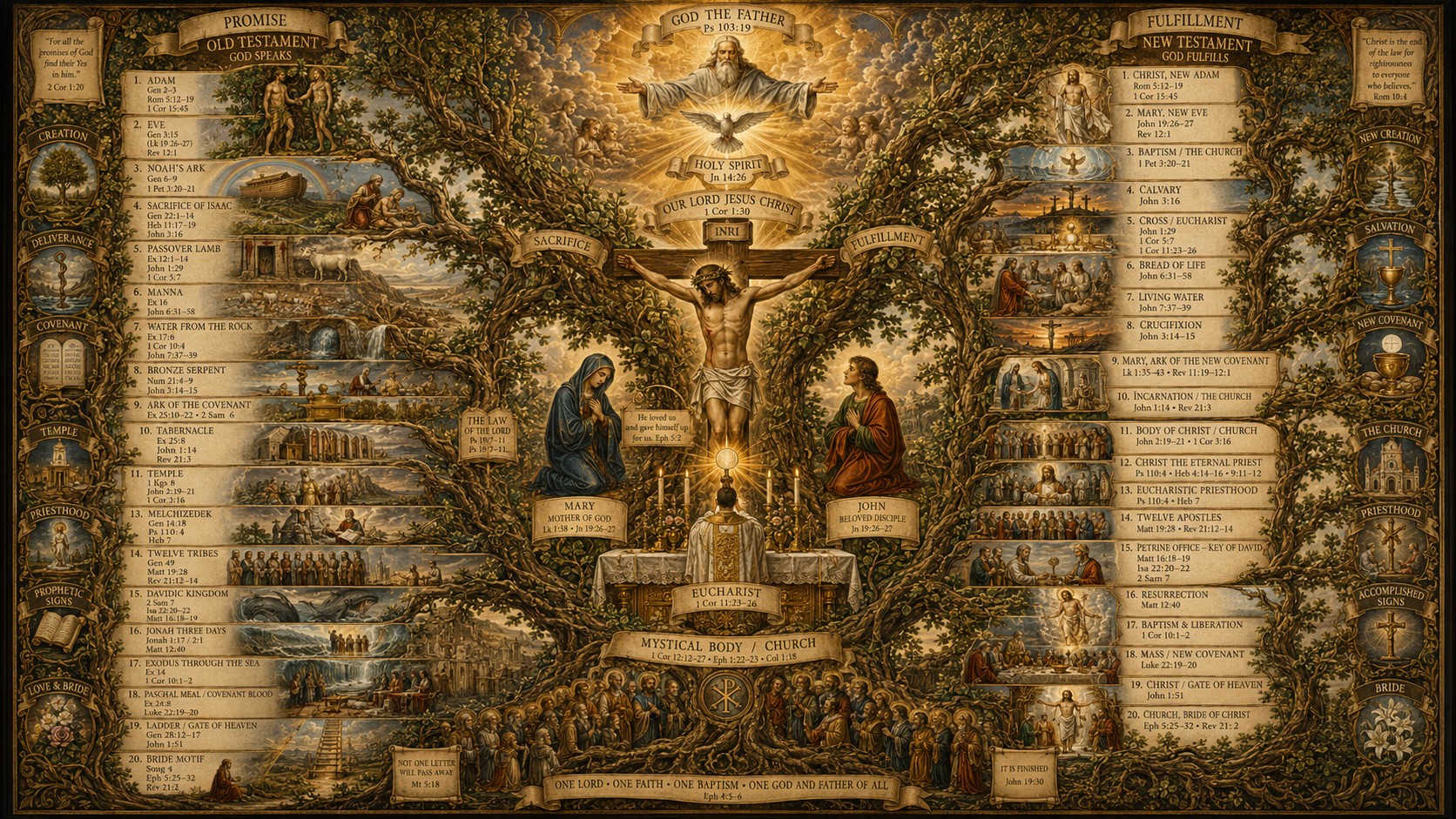
Promise and fulfillment tree from the Old Testament to Christ and the Church

History map

Arbor Historiae

The page now tells the one history of the Church in two ordered movements: first the Old Testament preparation of Christ, then the New Testament Church that is publicly manifested at Pentecost and continues visibly up to now.

Each part has its own introduction, tree, maps and study panels. Hover a node for a short note; click it for persons, places, themes, biblical witnesses, historical witnesses and links.

Part I · Old Testament

Promise, preparation and the line toward Christ

The history of the Church is not a modern institutional story that begins late in time. It is rooted in the divine economy from creation onward. God prepares a people, a covenant, a priestly worship, a royal line and a prophetic expectation so that the Incarnation is not an isolated event but the fulfilment of a long visible preparation.

Tree I therefore reads the Old Testament as sacred history ordered to Christ: Adam and Eve, Noah, Abraham, Israel, the Exodus, the tabernacle, David, the prophets, exile, return and the final expectation of the Messiah.

Reading key

  • PromiseCreation and the protoevangelium open the line of salvation.
  • CovenantNoah, Abraham, Moses and David make visible stages of preparation.
  • WorshipTabernacle, priesthood, sacrifice and temple prepare the sacramental language fulfilled in Christ.
  • FulfilmentThe Incarnation, Cross, Resurrection and Pentecost reveal the promised reality.
Tree ISalvation HistoryFrom Adam to Christ

The line of promise begins with creation, passes through the patriarchs, Israel, law, kingship, exile and return, and reaches fulfilment in the Incarnation, Cross and Resurrection of Christ.

AM 1 / 3761 BC
Creation
Cain · Abel · SethAM 1656 / c. 2105 BC
Flood
Babel · nationsAM 1948 / c. 1813 BC
Abraham
AM 2448 / c. 1313 BC
Exodus
c. 1000 BC
David
586 BC / Exilec. 167 BC
Maccabees
c. 4 BC-30 AD
Christ
Flood / Mabbul

Open a nodeSalvation History detail

Click any point to open persons, places, themes, biblical witnesses, historical witnesses and links.

Tree I maps

Tree I Map Slider — Promise, Israel and the Holy Land

These maps belong directly under Tree I: Salvation History. The active panel now carries a longer description and the principal biblical witnesses for the selected map.

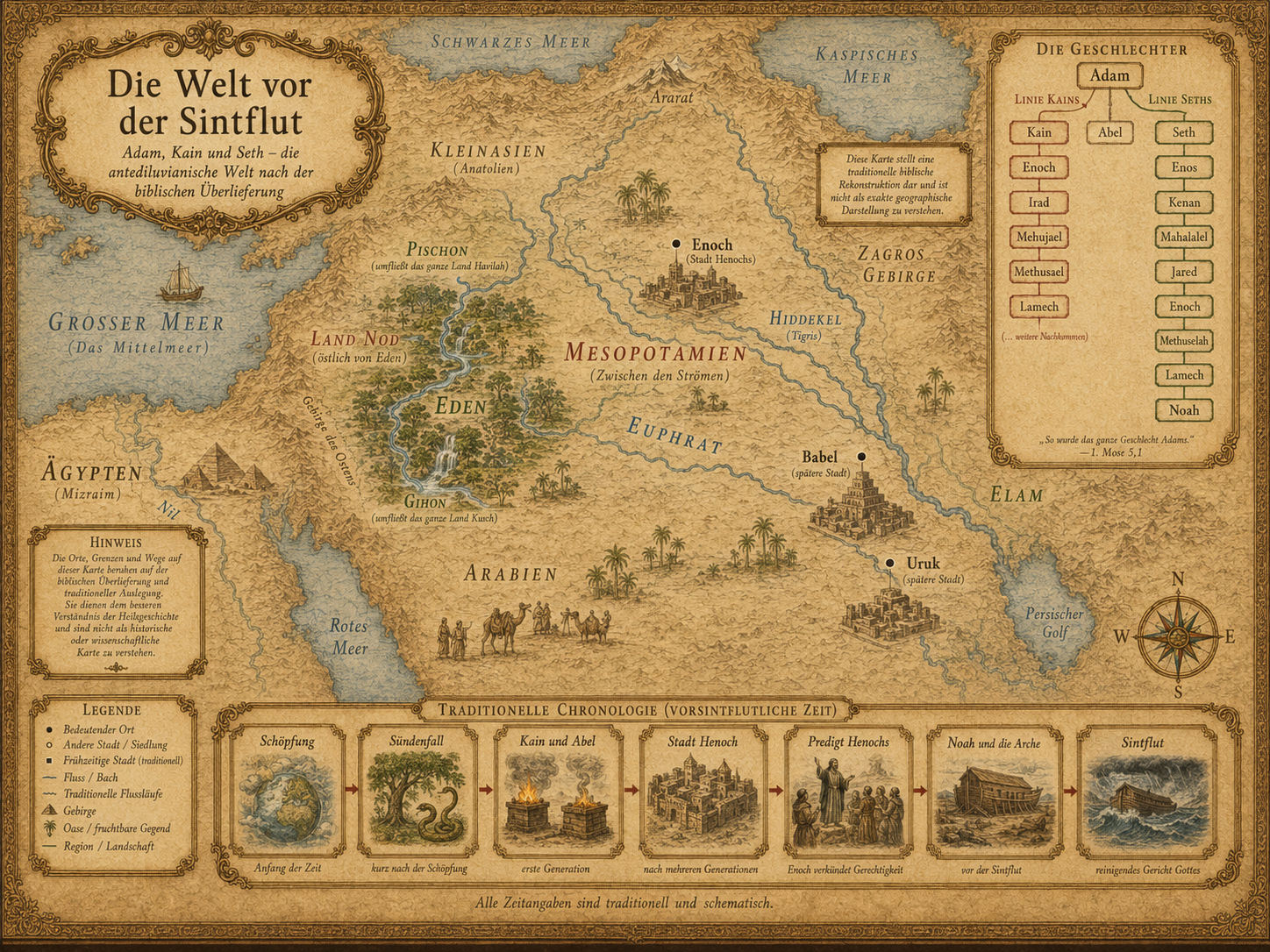
The World before the Flood
The World before the FloodBiblical witnesses: Genesis 2:8–14; Genesis 4; Genesis 5; Genesis 6–7This orientation map gathers Eden, the rivers, Cain, Seth, Enoch and Noah into one traditional antediluvian frame. It helps the reader situate creation, the first generations, the spread of sin and the approach of the flood.

Parallel biblical scenes

Tree I Parallel Slider — Old Testament Scenes, Sanctuaries and Genealogies

These supplementary images deepen the Old Testament branch with visual scenes of the flood, Babel, tabernacle, ark, temple, Jerusalem and genealogical continuity. Each active panel includes a fuller description and the main biblical references.

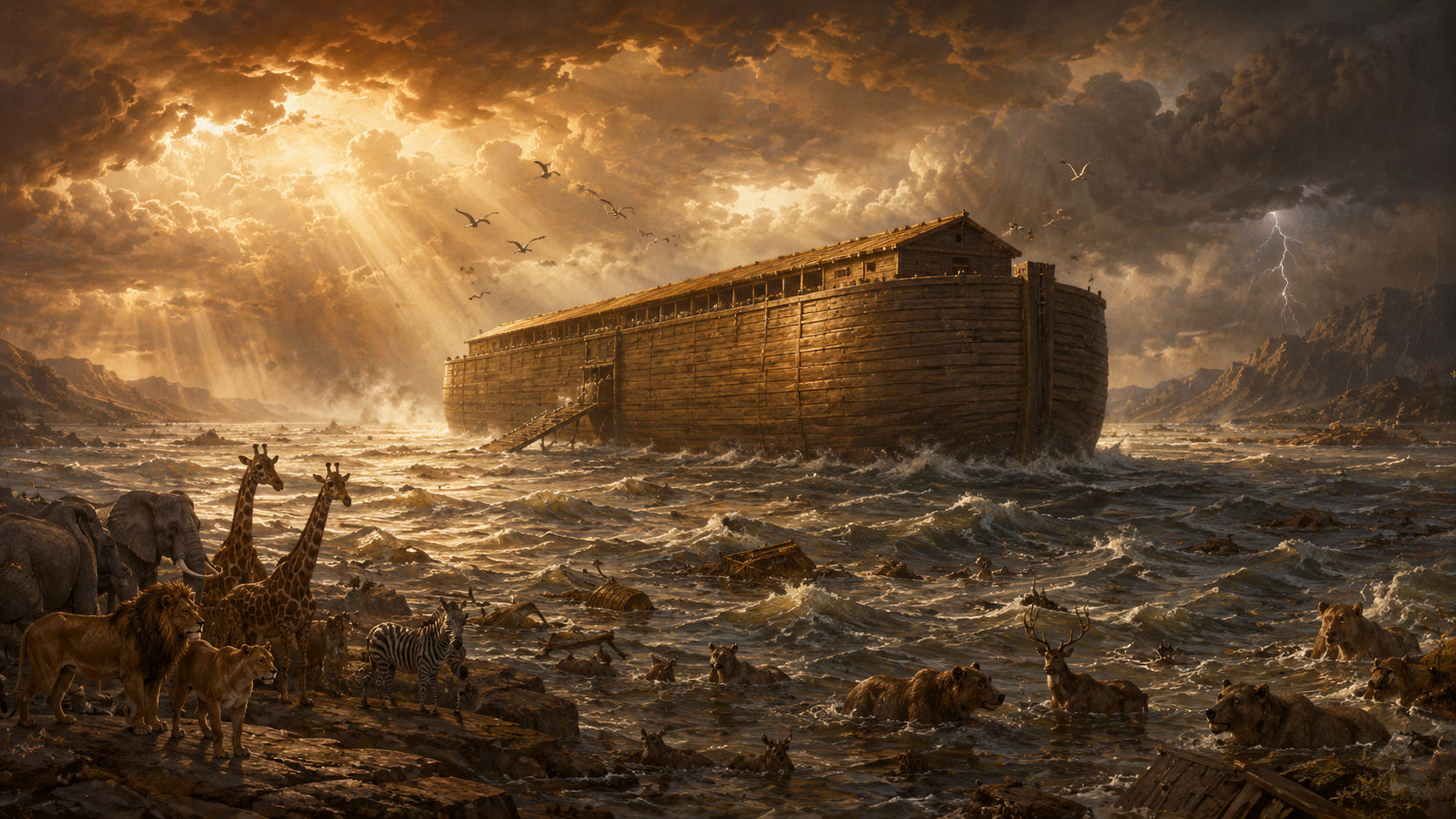
Noah’s Ark and the Flood
Noah’s Ark and the FloodBiblical witnesses: Genesis 6–9A dramatic visualisation of the flood places judgment, preservation and covenant renewal before the reader. It can accompany the biblical account of Noah, the ark and the survival of living creatures by God’s command.

Part II · New Testament and Church History

From Christ and Pentecost up to now

The Old Testament line reaches its centre in Jesus Christ. From his Incarnation, Cross and Resurrection the Church is not merely expected but visibly given. At Pentecost the Catholic Church is publicly manifested in apostolic preaching, baptism, Eucharist, hierarchy, mission and communion.

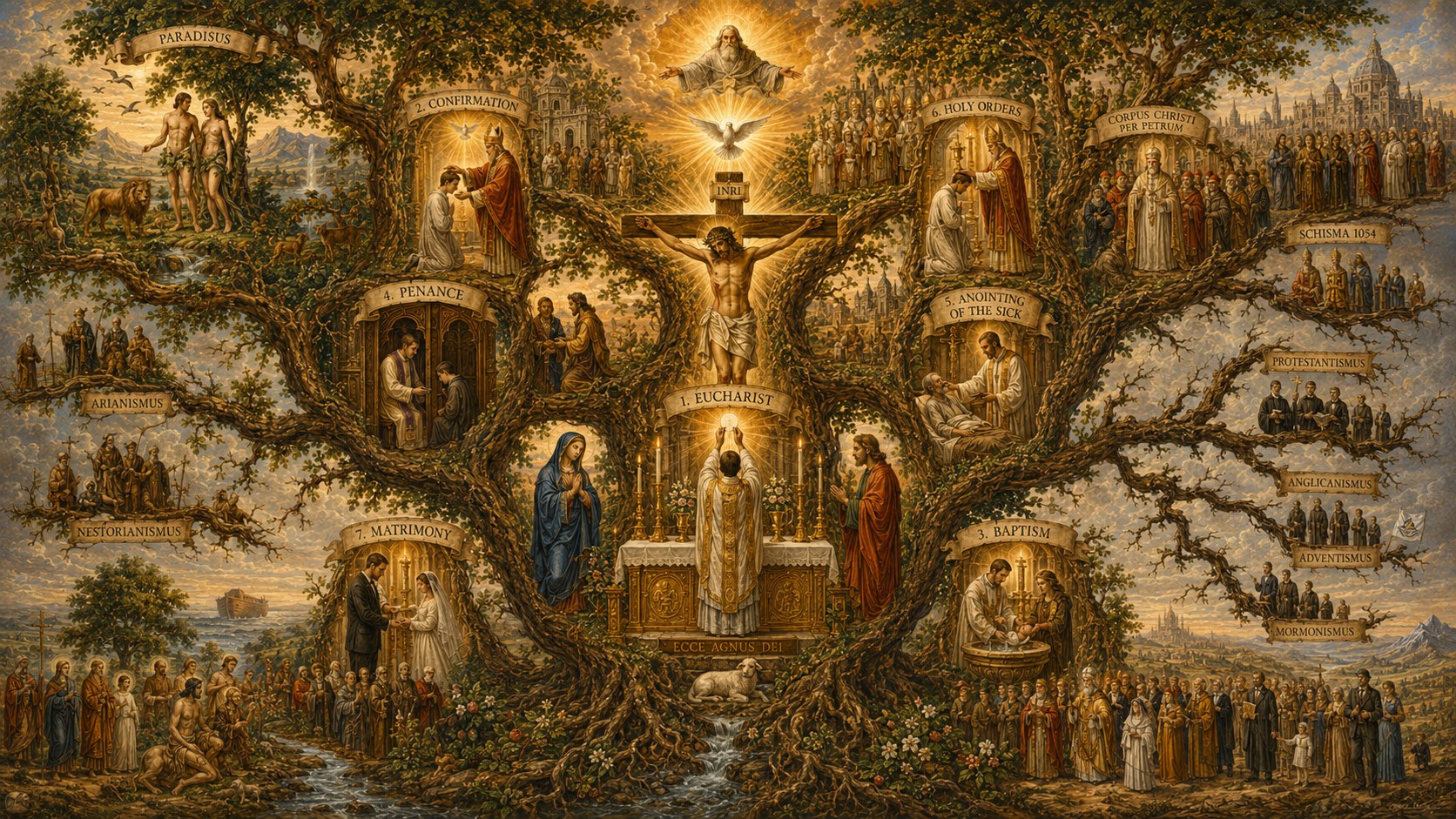
Tree II therefore does not show a movement from Pentecost to a later Catholic Church. It shows the Catholic Church from Pentecost up to now: apostolic witness, councils, Roman succession, missions, saints, reforms, doctrinal definitions and the continuing visible communion of the Church.

Sacred tree of sacramental and ecclesial continuity
Tree IIChurch HistoryFrom Pentecost up to now

The Catholic Church is public from Pentecost and continues through apostolic succession, councils, papal continuity, doctrinal clarification, missionary expansion, reforms and visible communion up to the present.

c. 303251054154518701965Today

Open a nodeChurch History detail

Click any point to open persons, places, themes, papal context, biblical witnesses, historical witnesses and links.

Branch logic: Orthodox separations and Modernism are shown as wounds from the Catholic line; Luther and Anglicanism as Western ruptures; Mormonism and Adventism as later restorationist branches from the Protestant environment; Freemasonry and revolutionary secularism as post-Reformation / Enlightenment forces outside the Catholic trunk; Old Catholicism as a post-Vatican-I rupture from the Catholic line.

Tree II maps

Tree II Map Slider — Apostolic Church, Councils, Ruptures and Mission

These maps belong directly under Tree II: Church History. Select a map for a controlled preview; click the preview for full-screen study.

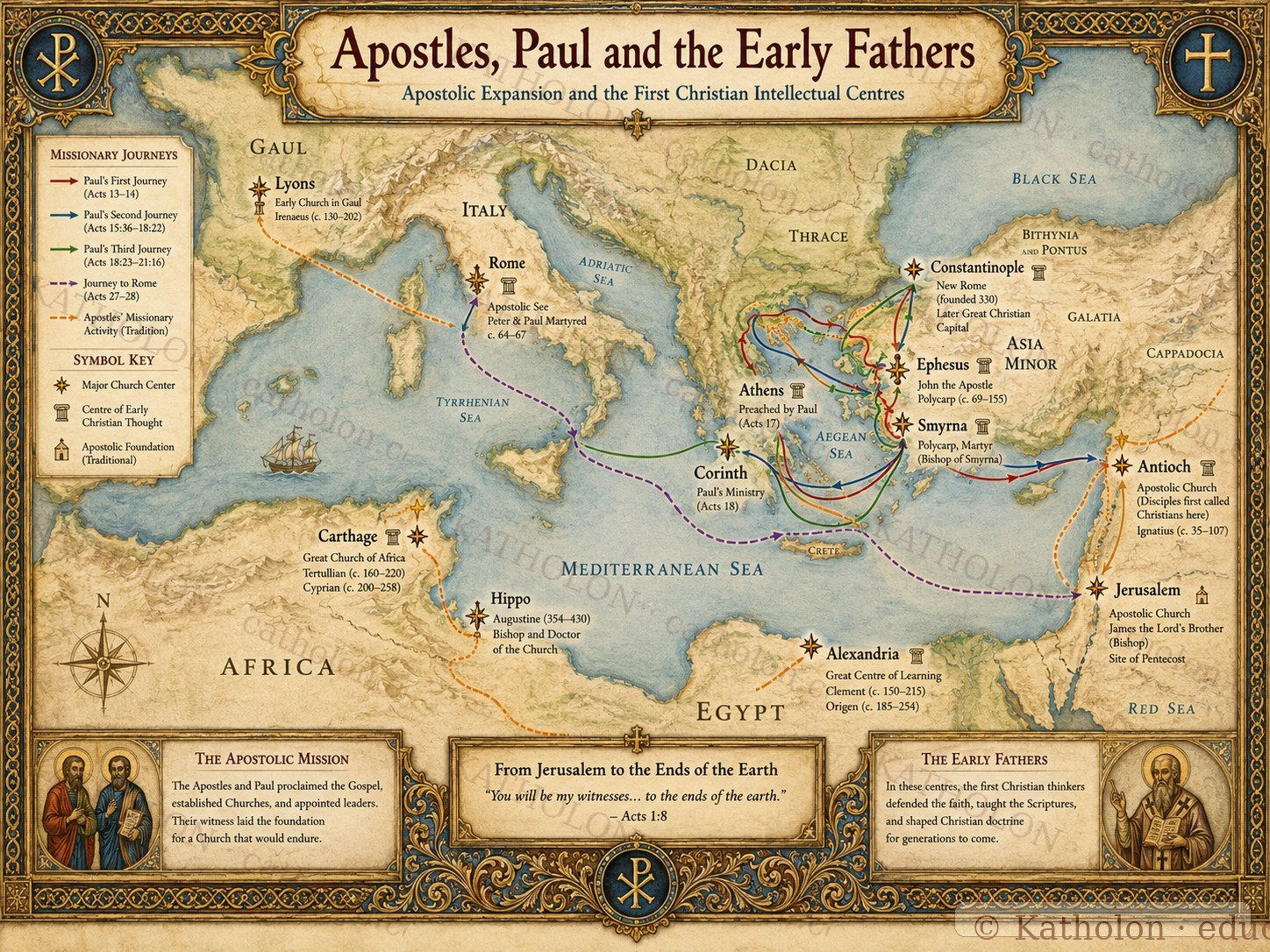
Apostles, Paul and the Early Fathers
Apostles, Paul and the Early FathersMissionary journeys, apostolic centres and early fathers show doctrine spreading through real churches.

Parallel visual study panels

Tree II Parallel Slider — Images, Manuscripts and Cultural Evidence

These supplementary panels belong beside the New Testament and Church History tree. They are not a second map line: the geographic maps remain above, while this slider gathers visual evidence, manuscript witnesses and cultural context.

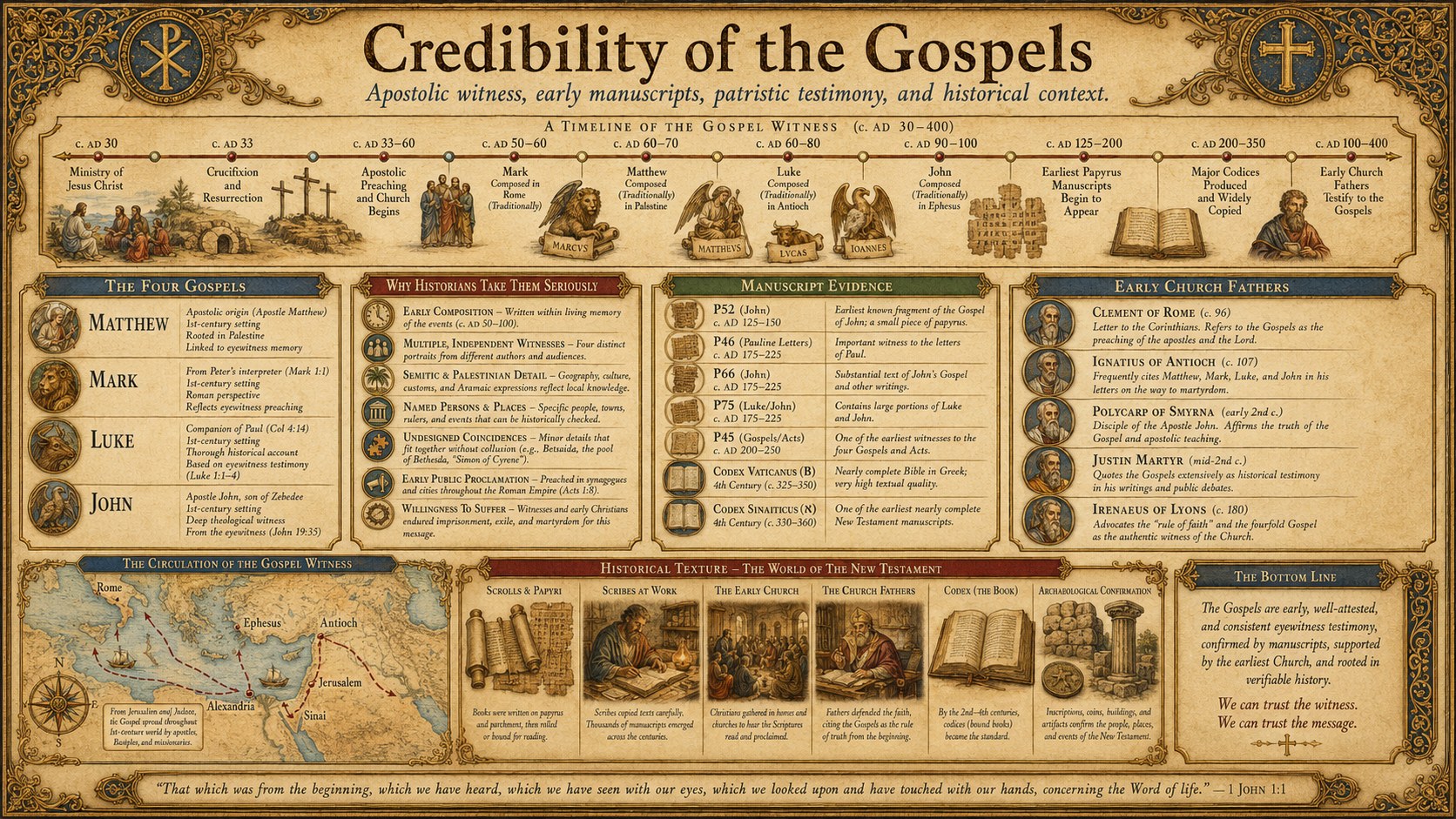
Credibility of the Gospels
Credibility of the GospelsBiblical witnesses: Luke 1:1-4; John 20:30-31; 1 John 1:1A visual apologetic summary of apostolic witness, manuscripts, patristic testimony and historical context.

Papal line

Continuous Roman Succession

From Peter to the present Roman pontiff, the papal line is presented as a visible historical succession. The portrait strip uses the imported image archive instead of generated placeholders.

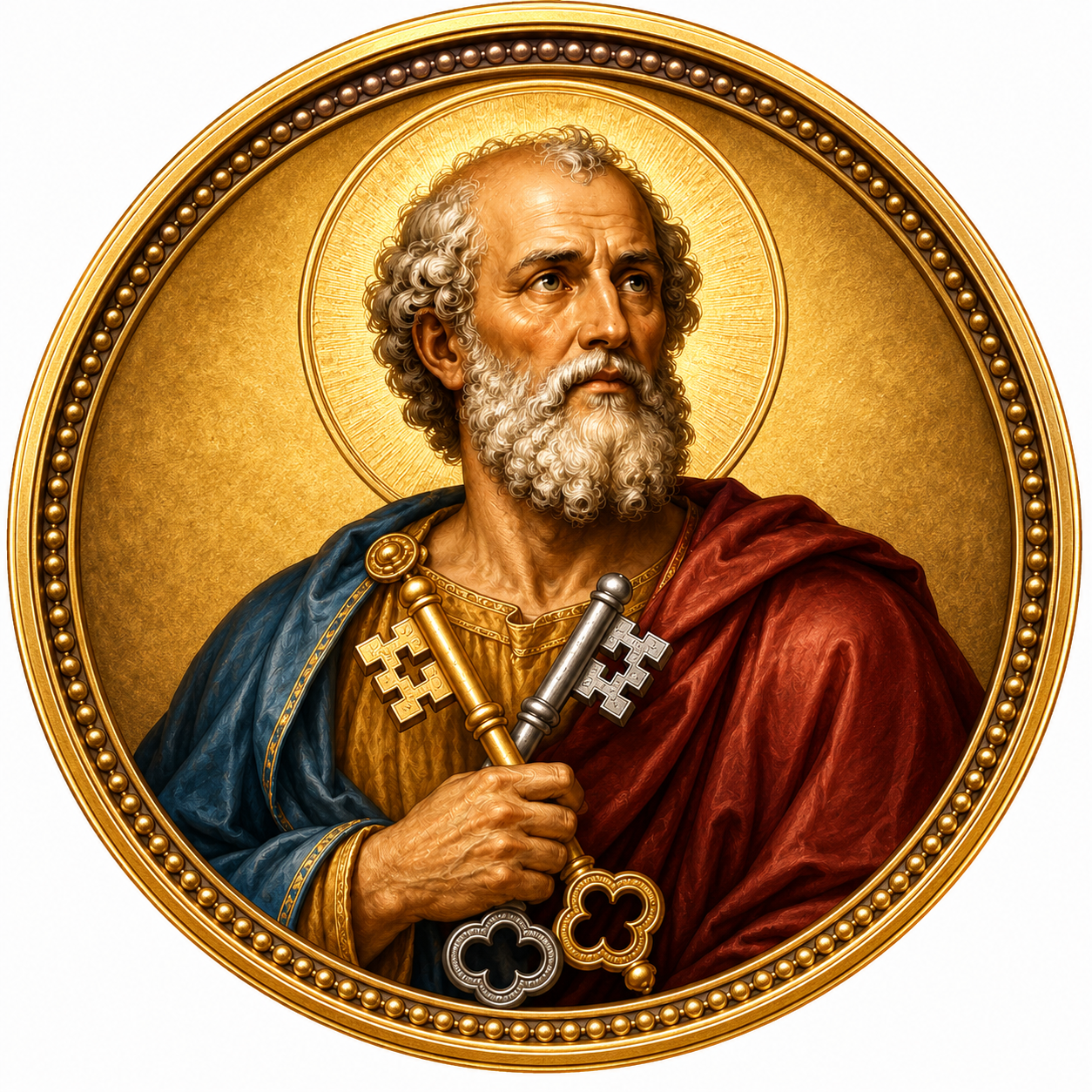
Peter portrait

Pontifex Romanus

1 · Peter

Reign: c. 30-64/67

Apostle and martyr in Rome; the visible root of the Roman succession.

Biographical summary

Peter is listed here as Roman pontiff number 1, in the visible succession from Saint Peter.

The catalogue gives his pontificate as c. 30-64/67.

He belongs to the apostolic or immediately post-apostolic age, when the Roman Church was still emerging from persecution and living memory.

Apostle of Christ and martyr in Rome, Peter is the visible root of the Roman succession.

The New Testament shows him confessing Christ, preaching at Pentecost and strengthening the brethren.

Catholic history reads the Roman line through the martyrdom and witness of Peter.

The entry should be read historically: papal biographies vary in source depth, especially for the earliest centuries.

The Catholic importance of the line is not that every pope is equally prominent, but that the Roman see remains a visible point of continuity.

This local summary is written as full page text, so the detail panel does not depend on an external biography link or pop-up.

Chronological register

Events register and filters

The register is a secondary view of the same history. It stays closed until opened, so that the main emphasis remains on the trees above.

Open chronological registerFilters and compact event cards
c. 30
Apostolic

Pentecost and the birth of the Church

The Catholic Church is publicly manifested in Jerusalem: apostolic preaching, baptism, Eucharist and the visible gathering of the Church.

c. 49
Councils

Council of Jerusalem

The apostles settle the Gentile question and establish the biblical basis for later councils.

64-67
Apostolic

Martyrdom of Peter and Paul in Rome

Rome receives the chief apostolic witness and becomes the principal apostolic see of the West.

2nd century
Heresies

Gnosticism

Secret knowledge, anti-sacramental tendencies and hostility to creation are answered by the public rule of faith, canon and apostolic succession.

4th century
Heresies

Arian crisis

The Son is reduced to a creature; the Church answers by confessing Christ as true God from true God.

325
Councils

Nicaea I

Arianism is condemned and the full divinity of the Son is confessed.

381
Councils

Constantinople I

The divinity of the Holy Spirit is confessed with renewed Nicene clarity.

431
Councils

Ephesus

The title Theotokos protects the unity of Christ's person.

451
Councils

Chalcedon

The Church confesses one person in two natures.

590-604
Reform

Gregory the Great

Pastoral government, liturgical order and mission deepen together.

680-681
Councils

Constantinople III

Two wills in Christ are confessed against Monothelitism.

787
Councils

Nicaea II

Holy images are defended through the logic of the Incarnation.

1054
Schisms

East-West schism

A grave rupture hardens between Rome and Constantinople.

1073-1085
Reform

Gregorian reform

Simony, clerical disorder and secular domination are confronted.

1215
Councils

Lateran IV

Eucharist, confession and reform are given classic medieval form.

1378-1417
Schisms

Western Schism

Multiple claimants obscure visible unity in the West.

1439
Councils

Florence

A major reunion effort with the East yields important doctrinal texts.

1545-1563
Councils

Trent

The Catholic answer to the Protestant rupture defines doctrine and reforms discipline.

5th century
Heresies

Nestorian and Monophysite crises

The councils of Ephesus and Chalcedon defend the unity of Christ's person and the integrity of his two natures.

16th century
Ruptures

Protestant ruptures

Western Christianity breaks confessionally from Roman communion.

16th-17th centuries
Mission

Catholic Reform and world mission

Seminaries, catechesis, saints and global missionary expansion mark the Catholic renewal.

1869-1870
Councils

Vatican I

Faith, reason, primacy and infallibility are clarified.

1917
Canon Law

First universal code

The Latin Church receives a universal code of canon law.

1962-1965
Councils

Vatican II

The Church addresses revelation, liturgy, the Church and mission in the modern age.

1983
Canon Law

Revised Code of Canon Law

The Latin Church receives a revised juridical structure after Vatican II.

1992
Dogma

Catechism of the Catholic Church

A universal doctrinal synthesis is promulgated.

Today
Mission

Catholic Presence today

The Catholic presence continues in visible communion throughout the world.

Concilia

Concilia Oecumenica

All 21 ecumenical councils are shown here together with the Apostolic Council of Jerusalem, because Catholic continuity presents conciliar judgement as biblically grounded from the beginning.

DateCouncilPope / Roman contextPlacePrincipal questionDoctrinal or disciplinary actContinuity note
c. 49Apostolic Council of JerusalemPeter, James and the apostlesJerusalemGentiles, circumcision and the lawProvides the biblical foundation for councils: debate, appeal to Scripture, apostolic judgement and public decree.Acts 15 establishes that the Church answers doctrinal crises publicly and authoritatively.
325Nicaea ISylvester INicaeaArianism; consubstantiality of the SonConfesses the Son as consubstantial with the Father and produces the Nicene core of the creed.Safeguards the Church's worship of Christ as true God.
381Constantinople IDamasus IConstantinopleDivinity of the Holy Spirit; Nicene faithConfirms and expands the Nicene creed, especially on the Holy Spirit.Consolidates the Trinitarian confession used by the whole Church.
431EphesusCelestine IEphesusNestorianism; TheotokosDefends the unity of Christ's person and confesses Mary as Theotokos.Shows Marian doctrine serving Christological truth.
451ChalcedonLeo IChalcedonTwo natures of ChristReceives Leo's Tome and teaches one person in two natures without confusion or division.One of the decisive Christological anchors of Catholic doctrine.
553Constantinople IIVigiliusConstantinopleThree Chapters controversyClarifies Chalcedonian Christology against divisive interpretations.Demonstrates that councils often clarify earlier councils rather than replace them.
680-681Constantinople IIIAgatho; confirmed by Leo IIConstantinopleMonothelitismDefines two wills and two operations in Christ according to his two natures.Protects the fullness of Christ's humanity and therefore the reality of redemption.
787Nicaea IIHadrian INicaeaIconoclasmDefends the veneration of holy images while distinguishing it from adoration due to God alone.Grounds sacred images in the Incarnation.
869-870Constantinople IVHadrian IIConstantinoplePhotian crisis and ecclesial orderAddresses the deposition and restoration disputes around the see of Constantinople.Shows intensifying East-West tensions before the later hard rupture.
1123Lateran ICallixtus IIRomeInvestiture settlementConfirms the settlement after the Investiture Controversy and strengthens clerical discipline.First ecumenical council held in the West.
1139Lateran IIInnocent IIRomeSchism and reformRepairs schismatic disorder and continues reform of ecclesiastical life.Reinforces the Gregorian reform trajectory.
1179Lateran IIIAlexander IIIRomePapal election and disciplineSets the two-thirds papal election rule and treats reform and heresy.Strengthens juridical stability in papal succession.
1215Lateran IVInnocent IIIRomeEucharist, confession and reformUses the language of transubstantiation and legislates annual confession and communion.One of the most consequential medieval syntheses of doctrine and discipline.
1245Lyon IInnocent IVLyonImperial conflict and reformAddresses the crisis around Frederick II and broader ecclesial reform.Illustrates the collision of papal and imperial orders.
1274Lyon IIGregory XLyonUnion, reform and conclaveAttempts reunion with the Greeks and treats papal election and reform.Visible unity remains a major conciliar aim.
1311-1312VienneClement VVienneTemplars, reform and doctrineSuppresses the Templars and deals with reform and doctrinal questions.A council of institutional crisis and re-ordering.
1414-1418ConstanceMartin VConstanceWestern SchismEnds the Western Schism and condemns major errors while treating reform.Restores a recognised Roman pontiff after a severe governance crisis.
1431-1445Basel-Ferrara-Florence-RomeEugene IVBasel / Ferrara / Florence / RomeUnion with eastern churchesIssues union decrees and doctrinal texts on procession, sacraments, purgatory and hierarchy.Politically fragile, but doctrinally significant.
1512-1517Lateran VJulius II; Leo XRomePre-Reformation reformAddresses reform, preaching and governance shortly before the Protestant rupture.Shows that reform concerns existed before 1517.
1545-1563TrentPaul III; Julius III; Pius IVTrentReformation crisisDefines Catholic doctrine on Scripture and Tradition, original sin, justification, the sacraments, the Mass and orders, while reforming discipline.The great council of Catholic reform and doctrinal clarification.
1869-1870Vatican IPius IXRomeFaith, reason, primacy and infallibilityDefines revelation, faith and reason, papal primacy and papal infallibility under strict conditions.Clarifies the Roman office within the structure of the Church.
1962-1965Vatican IIJohn XXIII; Paul VIRomeChurch, revelation, liturgy and missionTeaches on revelation, the Church, liturgy, bishops, ecumenism, religious liberty, mission and the modern world.Its reception must be read within the one continuous Catholic tradition.

Heresies

Gnosticism, Arianism, Nestorianism, Monophysitism, Iconoclasm, Jansenism and Modernism show recurring attempts to reduce creation, Christ, grace, worship or dogma.

Open historical heresies

Schisms and ruptures

Novatianism, Donatism, the East-West break, the Western Schism and the Protestant ruptures show how visible unity can be wounded without erasing the central Catholic line.

Open apologetics

Mission and reform

The same Church that defines doctrine also evangelises peoples, reforms discipline, codifies law, teaches catechisms and sends the Gospel into every continent.

Open apostolate

Arbor Historiae · expanded side branches

Read the trunk, then follow the branches

The original interactive trees remain untouched. This atlas adds lateral paths that explain how covenant, worship, doctrine, institutions, ruptures and mission relate to the principal chronological line.

I

From creation to Christ

Twelve side branches show how the Old Testament prepares the Incarnation through promise, covenant, worship, kingship, prophecy and the life of Israel among the nations.

01

Creation, fall and the first promise

Genesis 1–5 establishes creation, human vocation, sin and the protoevangelium. The branch keeps cosmological questions distinct from the theological claims carried by the sacred text.

Open related dossier
02

Noah, covenant and the nations

The flood narrative leads to covenant renewal and the table of nations. Shem, Ham and Japheth open a universal horizon that precedes the election of Abraham.

Open related dossier
03

Patriarchs and the line of promise

Abraham, Isaac, Jacob and Joseph join family history, land, blessing and providence. Their story forms the grammar of promise used by the New Testament.

Open related dossier
04

Exodus, Passover and Sinai

Deliverance from Egypt, covenant at Sinai and the Passover establish patterns of redemption, law and sacrificial memory fulfilled in Christ.

Open related dossier
05

Tabernacle, priesthood and sacrifice

The sanctuary, Aaronic priesthood, offerings and purity laws create a visible worship ordered to divine holiness and sacramental fulfilment.

Open related dossier
06

Davidic kingdom and messianic kingship

The covenant with David ties kingship, Jerusalem and the Temple to a promised enduring house, later interpreted messianically.

Open related dossier
07

Wisdom, prayer and the interior life

Psalms, Proverbs, Job, Wisdom and Sirach teach prayer, moral order, suffering and divine wisdom beyond a simple political chronicle.

Open related dossier
08

Prophets, judgement and restoration

The prophets confront idolatry and injustice while announcing covenant renewal, a faithful remnant and future restoration.

Open related dossier
09

Exile, return and the Second Temple

The destruction of Jerusalem, Babylonian exile and return transform Israel’s institutions and intensify reflection on law, Temple and identity.

Open related dossier
10

Diaspora, Greek language and synagogue

Jewish communities across the Mediterranean transmit Scripture and create the social networks first encountered by apostolic mission.

Open related dossier
11

Maccabean resistance and martyr witness

Persecution under Antiochus IV, resistance and martyrdom sharpen hope in resurrection, fidelity and purification of worship.

Open related dossier
12

Mary, Incarnation and fulfilment

Annunciation, Nativity and the public coming of Christ gather covenant, kingship, priesthood and prophecy into the mystery of the Word made flesh.

Open related dossier
II

From Pentecost to the present

Twelve side branches connect apostolic foundations with Fathers, councils, papal continuity, monasticism, universities, missions, ruptures and modern crises.

01

Apostolic churches and missionary roads

Jerusalem, Antioch, Alexandria, Asia Minor and Rome become linked centres of preaching, baptism, Eucharist and ordered ministry.

Open related dossier
02

Succession, canon and rule of faith

Public teaching offices, recognised Scriptures and the rule of faith answer the danger of secret revelation and private innovation.

Open related dossier
03

Martyrs, confessors and penitential discipline

Persecution produces not only heroic deaths but lasting questions about the lapsed, reconciliation and the limits of political obedience.

Open related dossier
04

Fathers, schools and the sacramental Church

Patristic witnesses show Catholic continuity through Scripture read in worship, episcopal communion and controversy.

Open related dossier
05

Ecumenical councils and doctrinal reception

Councils clarify Trinitarian and Christological language while their decrees pass into preaching, liturgy and ecclesial communion.

Open related dossier
06

Monasticism, mission and cultural transmission

Desert asceticism, Benedictine stability and missionary monasteries bind holiness, learning, agriculture, hospitality and evangelisation.

Open related dossier
07

Papacy, empire and ecclesial freedom

From Constantine through Charlemagne and the Investiture Conflict, spiritual and temporal authorities cooperate, compete and define their limits.

Open related dossier
08

Orders, universities and scholastic synthesis

Mendicant orders and universities organise preaching and higher study, producing new tools for theology and canon law.

Open related dossier
09

Eastern and western rupture

The long estrangement culminating in 1054 involves primacy, politics, language and liturgical custom; later union councils reveal both proximity and unresolved division.

Open related dossier
10

Protestant rupture and Catholic Reform

Competing doctrines of authority, justification, sacrifice and ministry divide the West; Trent answers while reforming Catholic institutions.

Open related dossier
11

Global mission and Catholic social engagement

Mission enters the Americas, Africa and Asia, later meeting industrialisation, labour, nationalism and the modern social question.

Open related dossier
12

Modern crises, Vatican councils and the present

Revolution, Modernism, world wars, Vatican I, Vatican II and the postconciliar period form the immediate background of contemporary Catholic life.

Open related dossier

Encyclopedia of Church History · 205 dossiers

Enter the historical encyclopedia from the great History map

The map remains the visual overview. The encyclopedia supplies the research layer beneath it: chronology, sources, people, institutions, geography, ecclesial and civil perspectives, and direct movement to the previous or next dossier.

Historyevents, sequence and reception
Lexicondefinitions and doctrinal location
Readersthe cited primary texts