Christianity: Fulfilment, not a religion detached from the beginning
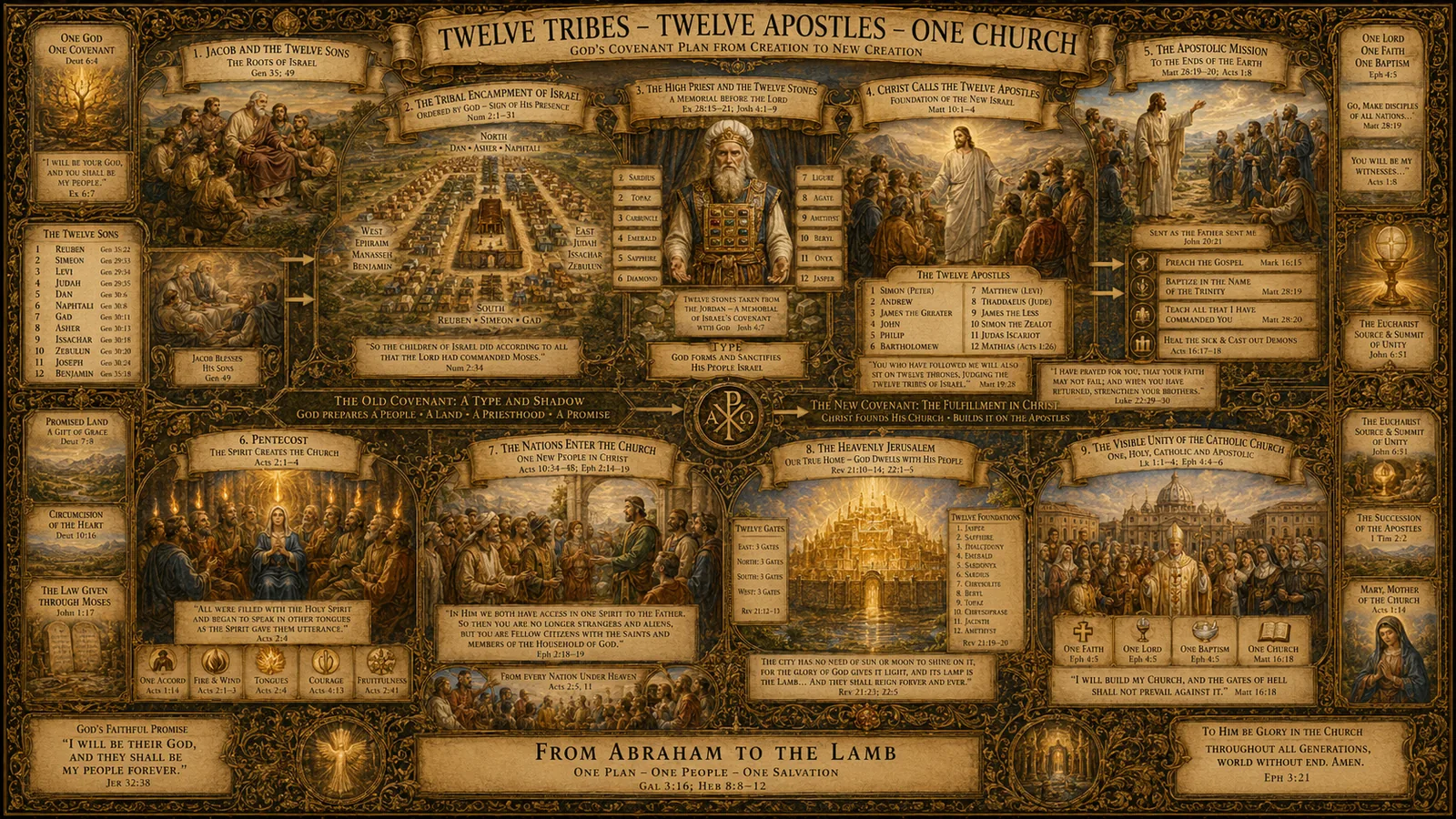
Christianity begins historically with Jesus Christ, yet it does not claim that the Creator first became known in the first century. It receives the worship of the one God, the moral law, sacrifice, covenant, prophecy and messianic promise as one ordered history reaching from creation through Israel to Christ.
The controlling question is therefore not merely when the word Christian appeared. It is whether the same God and saving purpose are present under successive economies: primordial religion, the covenants of Noah and Abraham, the Mosaic order, the Davidic promise, the prophets, the Incarnation and the apostolic Church.
The Church claims continuity through fulfilment: Israel is neither erased nor bypassed, and the nations enter the promise through Israel’s Messiah.
START HERE · FOR THE SEARCHER
Is Christianity a new religion, or the fulfilled form of the religion revealed from the beginning?
Begin by distinguishing names, rites and covenantal stages from the identity of the God worshipped and the final end promised. Then test whether the public history of Israel, Jesus and the apostolic Church supports continuity through fulfilment rather than a late religious invention.
1 · UNDERSTAND
What does Christianity claim?
That the one Creator called man from the beginning, prepared the nations through natural law and primordial revelation, formed Israel by covenant, and fulfilled the promise in Jesus Christ, whose Church is sent to all nations.
2 · WHY IT MATTERS
Why does this matter?
If Christianity is merely one later cult among others, its claim to universal truth collapses. If it is the fulfilment of a public line of revelation, then Christ is not an optional religious founder but the decisive centre of human history.
3 · WHERE THE EVIDENCE LEADS
What conclusion is being tested?
That the Catholic faith preserves the same object of worship and supernatural end while acknowledging real development in covenant, law, cult, explicit doctrine and ecclesial form.
READ IN THIS ORDER
Describe before judgingLearn Christianity’s self-understanding, sources, worship, doctrines and historical forms.
Separate identity from developmentAsk what remains numerically and formally continuous and what changes under a new covenant.
Test the fulfilment claimCompare Israel’s promises, Jesus’ public claims, the Resurrection and the constitution of the apostolic Church.
OPTIONALSource notes and argument map
The optional layer is for catechists, apologists and readers who want the premises, source hierarchy and strongest contrary case stated explicitly.
TERMS AND SCOPE
Religion, covenant, economy and fulfilment
The word religion may name the virtue of rendering God His due, a body of revealed doctrine and worship, or a historical community. These senses must not be confused.
Primeval events are known through revelation; patriarchal, Mosaic, prophetic, New Testament and patristic stages possess increasingly public documentary witnesses.
The argument depends upon the canonical sequence, the public claims of Christ and the earliest evidence for baptism, Eucharist, hierarchy and apostolic succession.
Innovation, supersession and historical discontinuity
The strongest objection grants Jewish roots but argues that Christian dogma and ecclesial structure are later constructions. It must be answered historically, not rhetorically.
One Creator and one final endTruth about God cannot become contradictory between covenants.
Successive economiesA change of rites or disciplinary law does not by itself create a different God or final end.
Messianic fulfilmentChrist must be tested against the prior promises and the public events of His life, death and Resurrection.
Apostolic embodimentThe fulfilled religion must appear in a visible body that receives doctrine, worship and mission from the apostles.
Religion profile
Christianity: Christ, New Covenant, worship and universal mission
Christianity is the religion centred upon Jesus Christ, confessed as true God and true man, crucified and risen, and upon the New Covenant established in His blood. Catholic Christianity understands itself as the visible continuation of the apostolic Church rather than as one denomination created after the apostles.
Historical centre
Jesus Christ in first-century Judea
The historical origin of the Christian name and New Covenant community lies in the public ministry, death and Resurrection claim of Jesus under Roman rule.
Prior preparation
Creation, patriarchs, Israel and prophecy
Christianity receives the Old Testament as its own inspired preparation: Adam, Noah, Abraham, Moses, David and the prophets belong to its sacred history.
Primary authorities
Old and New Testaments within apostolic Tradition
Scripture is canonical inside the Church that received, read, preached and defended the apostolic deposit.
Core confession
Trinity, Incarnation, redemption and Resurrection
The one God is Father, Son and Holy Ghost; the Son became man for salvation, offered Himself upon the Cross and rose bodily from the dead.
Worship
Baptism, Eucharist, prayer and the Lord’s Day
Christian worship is sacramental and ecclesial. It centres upon baptismal incorporation and the Eucharistic memorial of Christ’s sacrifice.
Moral life
Grace, commandments, virtues and charity
The moral law is not abolished. Grace forgives, heals and elevates man so that faith works through charity.
Visible society
Bishops, presbyters, deacons and communion
The New Testament and earliest post-apostolic sources show ordered ministry, discipline, common worship and visible unity.
Historical forms
Catholic, Orthodox and separated Western communities
Later divisions must be named. They do not erase the prior existence of the one apostolic Church whose identity is the object of the present inquiry.
A scholastic distinction is essential: Christianity is new in the sense of the New Covenant’s definitive historical form, sacraments and explicit confession of the Incarnate Son; it is not new as though it worshipped another God or pursued another final end than the religion truly revealed before Christ.
The page therefore does not treat every modern body using the name Christian as equally continuous. The question of the one Church founded by Christ is taken up in the next stages of the path.
Overview
One divine economy develops without becoming a sequence of contradictory religions
The continuity claim becomes intelligible only when the permanent elements and the changing elements are separated. The same Creator, truth and promised beatitude remain; covenantal administration, ritual law and the explicitness of revelation advance toward Christ.
Primordial religion: creation, fall and promise
Catholic theology does not imagine the first humans as religiously neutral. Man is created capable of knowing and worshipping God. The fall wounds this relation but does not erase natural law, conscience or the duty of religion.
Genesis presents sacrifice, invocation, blessing and judgement before Abraham. Abel’s offering, Noah’s altar and the promise after the fall establish a grammar later made more explicit: sin, sacrifice, covenant, mercy and hope.
Noah and the common vocation of the nations
The covenant with Noah concerns the human family and the order of creation. It precedes Israel and explains why the nations remain morally responsible even when they lack the Mosaic law.
Pagan religions are therefore not independent revelations equal to Israel. They may retain fragments of natural or primordial truth while mixing them with idolatry, mythology and political cult.
Abraham and the universal promise
Abraham is called from the nations, not for a closed ethnic privilege, but so that all families of the earth may be blessed. Faith, promise, circumcision and covenant enter a more public historical line.
The Christian claim does not bypass this election. It says that the promised seed and universal blessing reach their personal centre in Christ and their social extension in the Church among the nations.
Moses: a real divine order that is also preparatory
The Mosaic law, priesthood, sacrifices, sanctuary, calendar and national discipline are truly given by God. Calling them preparatory does not call them false. A figure is true precisely because God orders it to a reality beyond itself.
Moral precepts express enduring goods; ceremonial and judicial prescriptions govern a particular covenantal economy. The New Testament’s claim of fulfilment therefore requires distinctions rather than a simple opposition between law and grace.
David, Temple and prophetic deepening
The promise to David, the Temple and the prophetic critique of sin deepen Israel’s expectation. The prophets announce purification, a new heart, a new covenant, the gift of the Spirit, the gathering of nations and a ruler whose kingdom has extraordinary scope.
These lines are not a complete photograph of the future. Together they form a converging expectation against which Jesus’ identity and works can be examined.
Christ and the apostolic Church
Jesus acts within Israel, fulfils its feasts and Scriptures, gathers Twelve, gives covenantal commands, institutes the Eucharist, dies at Passover and is proclaimed risen. Pentecost opens the messianic gift to the nations without erasing Israel’s scriptural root.
The apostolic Church is therefore not merely a school that admires a dead teacher. It claims divine authority, sacramental life, visible ministry and a mission to teach and baptize all nations.
Chronological control
The line of promise must be read in its own order
The chronology distinguishes theological knowledge of primeval history from increasingly dense public documentation. Later institutions may fulfil earlier ones, but they may not be projected backwards as though every stage possessed the same explicit form.
01Creation and fall
Man is ordered to God and wounded by sin
Natural knowledge of God, moral responsibility and the need for reconciliation precede every later national covenant.
02Abel to Noah
Sacrifice, judgement and covenant before Moses
The biblical primeval history presents worship and divine promise before the institutions of Israel.
03Patriarchal age
Abraham, promise and universal blessing
Election becomes a public family history ordered toward the nations.
04Exodus and Sinai
Israel receives law, priesthood and sanctuary
The covenant gives a holy but preparatory public form to worship and national life.
05David and the Temple
Kingship and worship converge in Jerusalem
The Davidic promise and Temple create categories central to later messianic hope.
06Prophetic era
Judgement, remnant and New Covenant
The prophets expose sin and announce a deeper restoration, Spirit and universal mission.
07Second Temple period
Canon, sects, diaspora and expectation
The world of Jesus contains genuine diversity while remaining rooted in Israel’s God and Scriptures.
08Jesus Christ
Public ministry, Cross and Resurrection claim
The Christian fulfilment thesis stands or falls with His identity and the events proclaimed by the apostles.
09Pentecost and apostolic mission
The nations enter Israel’s promise
Baptism, Eucharist, apostolic teaching and visible communion form the New Covenant people.
10First three centuries
The Catholic pattern becomes historically explicit
Martyrs, Fathers, liturgies and episcopal succession show how the apostolic inheritance was embodied.
11Councils and doctrinal definition
The same deposit is defended under new questions
Dogmatic definition clarifies implications of received revelation; it does not create a different object of faith.
12Present inquiry
Which body continues the apostolic Church?
The comparison of Christianity as a whole leads necessarily to the question of the one visible Church of Christ.
How to reach a judgement
First establish continuity of revelation; then identify its fulfilled ecclesial form
The inquiry has two levels. Public history can establish the Jewish matrix of Christianity, the reality of Jesus and the early apostolic movement, the chronology of sources and the emergence of sacramental and episcopal structures. The full Catholic answer then interprets these facts within revelation and judges the identity of the Church.
Stage I brackets the final act of faith while examining the publicly accessible structure of the claim. It asks whether Christianity is historically parasitic upon Israel, or whether it arises as a coherent messianic fulfilment movement at the centre of Israel’s own unresolved expectations.
1
Christianity is inseparable from Israel’s Scriptures
Jesus, the apostles and the first communities argue from the Law, Prophets and Psalms. Christian language of Messiah, covenant, sacrifice, kingdom, Spirit and resurrection is unintelligible without Israel.
This dependence is not evidence of plagiarism from a foreign religion. It is exactly what a fulfilment claim predicts: the later act must receive and complete the prior word.
The historical Jesus belongs to a datable public setting
His ministry is located under Herodian and Roman rule, around Galilee, Judea and Jerusalem, in relation to named rulers, feasts, sects and institutions. Christian origins are not set in an undated mythic age.
The key historical question is the best explanation of His authority claims, execution, the early Resurrection proclamation and the rapid formation of communities centred upon Him.
The earliest movement is Jewish and then deliberately universal
The Twelve symbolically gather Israel; the mission begins in Jerusalem; disputes concern Torah, circumcision and table fellowship; Gentile inclusion is argued from promise, prophecy and the gift of the Spirit.
Paul does not introduce a new God. He proclaims Israel’s God, Israel’s Messiah and the promised blessing of Abraham to the nations.
The documentary record shows continuity and development together
The New Testament does not provide a modern constitutional manual, yet it does show apostles, appointed ministers, discipline, sacramental rites, binding teaching and inter-church communion.
The early Fathers then make explicit episcopal succession, Eucharistic unity and the catholic scope of the Church. Development is therefore real, but it occurs along identifiable lines already present in the apostolic sources.
A theory of wholesale late invention must explain why baptismal, Eucharistic, hierarchical and creedal patterns appear early across distant communities and languages.
A theory of purely private discipleship must explain why the sources consistently present a visible body with common worship, moral discipline and authoritative ministers.
In what sense is Christianity both new and the same religion?
Catholic theology answers by distinguishing the substance of revealed religion from its successive economies. The New Covenant is genuinely new because Christ has come and instituted definitive means of grace; it is continuous because the same God, promise and final end govern the whole economy.
QUAESTIO
Whether Christianity is a new religion discontinuous from the religion revealed before Christ
Distinctions before the answer
First. Distinguish the virtue of religion, by which man renders worship to God, from a historically named religious community.
Second. Distinguish identity of object and end from identity of rite and covenantal administration.
Third. Distinguish development that explicates a received principle from corruption that contradicts it.
Fourth. Distinguish material continuity of Scripture and institutions from formal fulfilment in Christ.
Fifth. Distinguish the Church before Christ in preparation and figure from the Church constituted by the Incarnate Word and the Holy Ghost.
Sed contra
Christ declares that He came not to destroy the Law and the Prophets but to fulfil them; at the Last Supper He identifies His blood with the New Covenant; the apostles preach that the promises made to the fathers are fulfilled in Him.
Therefore the Christian claim is neither simple repetition of the Mosaic economy nor abandonment of it, but fulfilment in a new and definitive covenant.
Respondeo
The same religion may remain in substance while receiving a more perfect historical form when God reveals more explicitly the same truth and gives more perfect means toward the same supernatural end. Before Christ, the true religion confessed the Creator, received His promises and awaited redemption under figures and covenants. In Christ, the promised Redeemer is present, the sacrifice is accomplished, the Spirit is poured out and the Church is visibly sent to all nations.
Thus Christianity is new according to the New Covenant’s completed object of faith, sacraments and universal mission. It is not new as a rival cult with another God or another final beatitude. The old figures cease precisely because their reality has arrived; the moral truth and inspired preparation remain; the patriarchs and prophets belong to the Church’s own sacred history.
The decisive further question is consequently ecclesiological: which present communion possesses continuity with the society Christ founded and the apostles governed? That question cannot be settled by the generic word Christianity and leads to the Church of Jesus Christ.
Conclusions
The same God. The God of creation, Abraham and Israel is the Father revealed by the Son, not a later Christian deity.
The same promise. The promise of victory over sin, blessing of the nations and communion with God reaches its centre in Christ.
A new economy. The Incarnation, Cross, Resurrection, Pentecost and sacraments constitute a definitive covenantal form.
A visible continuation. The fulfilled religion is entrusted to an apostolic Church rather than left as an invisible idea.
A necessary next inquiry. Generic Christianity must be followed by the identification of the one Church founded by Christ.
1
Fulfilment preserves the truth of the earlier covenants
A fulfilled prophecy is not exposed as false; its truth becomes manifest. Likewise the Passover, priesthood, sacrifices and Temple are not mocked by Christian fulfilment. Their God-given meaning is carried into Christ’s saving work.
The Church therefore retains the Old Testament, reads it liturgically and doctrinally, and refuses any theology that opposes the Creator to the Redeemer.
Christ is not merely another lawgiver. He forgives sins with divine authority, gives His body and blood, offers the definitive sacrifice, sends the Spirit and incorporates believers through baptism.
This explains why ceremonial forms can cease without religion becoming lawless: the reality replaces the figure, while the moral law is interiorized and elevated by grace.
Catholicity completes the universal intention of election
Abraham’s blessing and prophetic mission to the nations do not terminate in an ethnic or local cult. Pentecost and apostolic mission make the universal intention visible without denying Israel’s priority in the history of promise.
The word catholic names this wholeness and universality: one faith, sacramental life and apostolic mission for all peoples.
Development must be judged by identity of principle
Later terms such as Trinity, Incarnation and sacramental character may be more precise than biblical phrases, but their legitimacy depends upon whether they protect the apostolic reality rather than replace it.
The Church’s doctrinal history therefore requires a method: continuity of subject, source, worship, governing authority and intended meaning.
How one religion remains itself while revelation and covenant advance
The continuity thesis becomes precise only when identity, development and fulfilment are distinguished. These four syntheses gather the historical material into a coherent judgement without pretending that Adam, Abraham, Moses and the apostles possessed the same explicit institutions at every stage.
Identity through real covenantal change
A living historical reality can remain the same in subject while acquiring a fuller form. A child and an adult are not two persons merely because powers and obligations develop. In an analogous way, the religion of divine revelation has a stable subject—the one Creator who calls fallen humanity to communion—and successive covenantal forms. The Noachic, Abrahamic, Mosaic and Davidic covenants do not introduce rival gods or incompatible final ends. They specify, protect and prepare the one saving purpose under conditions suited to distinct moments of history.
This distinction prevents two opposite errors. A crude identity theory would say that every rite and institution must remain unchanged forever; then fulfilment would be impossible. A crude discontinuity theory would treat every new covenantal ordinance as a new religion; then even Abraham, Moses and David would belong to unrelated systems. Catholic theology instead asks which elements express the permanent truth of God and moral law, which govern a temporary economy, and which are figures ordered by God toward their completion in Christ.
Fulfilment neither despises nor freezes the Mosaic economy
The Mosaic law is holy because God truly gave it, yet its own structure points beyond repetition. Priesthood is hereditary and restricted; sacrifices recur; the sanctuary is geographically bounded; purification rites distinguish Israel from the nations; prophets promise a new heart, a new covenant and a wider gathering. These features do not make the old covenant a mistake. They make it pedagogy: a divinely established order that teaches the gravity of sin, the need for mediation and the form of sacrificial communion before the definitive priest and victim appear.
Christians therefore cannot speak as though grace began only after centuries of divine failure. Abraham is justified by faith, Israel is delivered before Sinai, the Psalms know mercy, and the prophets call for inward conversion. What changes in Christ is not the goodness of the Creator but the arrival of the promised reality: the Son assumes human nature, offers the once-for-all sacrifice, pours out the Spirit and opens covenantal incorporation to every nation. Ceremonial figures cease because their truth has arrived; the moral law is deepened and written within.
Israel, the nations and the danger of two opposite distortions
The Church cannot understand herself without Israel. Her Scriptures, Messiah, apostles, liturgical categories and hope arise from Israel’s history. Gentiles do not replace a failed ethnic project with a foreign religion; they are grafted into the cultivated olive tree and warned against boasting. At the same time, the fulfilment claim cannot be dissolved into two contradictory covenantal conclusions, one in which Jesus is the Messiah and another in which He is not. Respect for Israel requires truth, gratitude and rejection of contempt, not religious indifferentism.
The universal mission also corrects an ethnic reading of election. Abraham is chosen for the blessing of all families; Israel is called a priestly people; the prophets envision the nations seeking the God of Jacob; the Messiah gathers rather than merely protects a closed group. The Catholic claim is that this universal vocation becomes sacramentally concrete in the Church. Every people may enter without ceasing to be a people, because unity is founded not on race or empire but on one faith, one baptism, one Eucharistic communion and one apostolic government.
Why the profile must lead to the question of the true Church
A profile of Christianity cannot end with a catalogue of modern denominations. The New Testament does not present Christ as leaving an undefined religious inspiration to be organized later according to taste. He gathers disciples, chooses the Twelve, gives Peter a particular commission, commands baptism and Eucharist, grants authority to teach and forgive, promises the Spirit and sends a visible mission to the nations. Pentecost therefore begins an identifiable society of doctrine, worship and government, even though its institutions grow in explicitness as new circumstances arise.
The next question is consequently unavoidable. If Christianity is the fulfilled public revelation of the one God, contradictory Christian bodies cannot all possess the same authority in the same sense. The seeker must ask what Christ intended His Church to be, how the first Christians actually lived, whether apostolic ministry continued through history and what signs make the Catholic claim morally certain. That inquiry begins on the next page with the prior question: whether truth and revelation can finally authorize more than one contradictory religion.
Difficult questions
The strongest objections to continuity and fulfilment
Each objection is stated in its strongest form. The answer depends upon distinctions of covenant, rite, doctrine, historical identity and personal culpability rather than upon slogans.
1
Is Christianity simply a first-century innovation?
The historical name and institutions appear after Jesus.
Open reply
Objection stated at full strength. A religion that begins with Jesus cannot also be the oldest religion.
Catholic reply. The New Covenant begins historically with Christ, but it claims fulfilment of an older public revelation. A new covenantal form does not imply another God or final end, just as the Mosaic covenant was new relative to Abraham without being a new deity.
Necessary distinction. Distinguish chronological novelty of form from contradiction of substance.
2
Did Christians appropriate Jewish Scripture?
The Church is accused of taking another people’s books.
Open reply
Objection stated at full strength. The Old Testament belongs to Judaism and was later reinterpreted by Gentile Christians.
Catholic reply. Jesus, Mary, the apostles and the first Church are Jewish; the earliest Christian use of Israel’s Scriptures occurs within a Jewish messianic dispute. Gentile believers receive those books through incorporation into the apostolic community, not by pretending Israel never existed.
Necessary distinction. Distinguish fulfilment within Israel’s own messianic history from cultural theft.
3
Does fulfilment erase Israel?
Supersession can be presented as total historical cancellation.
Open reply
Objection stated at full strength. If Christ fulfils Israel, the Jewish people and covenants become meaningless.
Catholic reply. Fulfilment ends the preparatory ceremonial economy but preserves the inspired Scriptures, patriarchs, promises and providential significance of Israel. Romans 9–11 also forbids Gentile boasting and retains a future mystery concerning Israel.
Necessary distinction. Distinguish cessation of a covenantal administration from erasure of a people and its sacred history.
4
Are Trinity and Incarnation foreign Greek additions?
Later dogmatic vocabulary is not verbatim biblical language.
Open reply
Objection stated at full strength. Christianity was transformed by Greek metaphysics into something Jesus never taught.
Catholic reply. Greek terms were used because disputes required precision. The doctrinal content arises from Jewish monotheism combined with the New Testament’s claims about Father, Son and Spirit and about the divine and human predicates of Christ.
Necessary distinction. Distinguish conceptual vocabulary from the revealed reality it is used to protect.
5
Did Paul invent Christianity?
Paul’s Gentile mission appears to move beyond Jesus’ Jewish setting.
Open reply
Objection stated at full strength. Paul abandoned Jesus and created a new religion without law.
Catholic reply. Paul receives earlier traditions about the Eucharist, death and Resurrection, consults recognized apostles, argues from Abraham and the prophets, and insists that faith works through charity. The Gentile mission is presented as promised fulfilment, not rejection of Israel’s God.
Necessary distinction. Distinguish development of universal mission from invention of a new object of faith.
6
Do scandals disprove continuity?
Christian history contains grave sins and institutional failures.
Open reply
Objection stated at full strength. A religion guided by God would not contain corrupt leaders, violence or hypocrisy.
Catholic reply. Scandal is evidence of human sin and may expose failures of discipline or prudence. It does not by itself show that the creed, sacraments or apostolic constitution are false. The religion’s own law condemns the betrayal.
Necessary distinction. Distinguish holiness of source and means from personal holiness of every member.
7
Why did Christians divide if there is one fulfilled religion?
There are many churches and denominations.
Open reply
Objection stated at full strength. Plurality of Christian bodies proves that no visible continuity exists.
Catholic reply. Division proves that visible unity can be wounded, not that it never existed. The historical task is to identify the communion that preserves apostolic ministry, sacramental life, universal teaching authority and continuity through schisms.
Necessary distinction. Distinguish the existence of ruptures from the identity of the body from which they ruptured.
8
Can sincere non-Christians be saved?
Objective truth is confused with subjective culpability.
Open reply
Objection stated at full strength. If persons outside visible Christianity may receive grace, Christianity cannot be uniquely true.
Catholic reply. God may give grace to persons who lack explicit knowledge without making contradictory religions equally revealed. Salvation remains through Christ; ignorance and culpability are judged by God; the Church must still teach and baptize.
Necessary distinction. Distinguish the objective means of salvation from the subjective responsibility of persons.
Verify the answer
Primary sources for the continuity claim
The argument must be tested in canonical and chronological order: Old Testament promise, New Testament fulfilment, apostolic practice and the earliest witnesses to the Church’s public life.
Genesis: creation, fall, Noah and Abraham
The primeval and patriarchal sequence that establishes worship, covenant and universal promise.
Promise, covenant and fulfilment in historical sequence
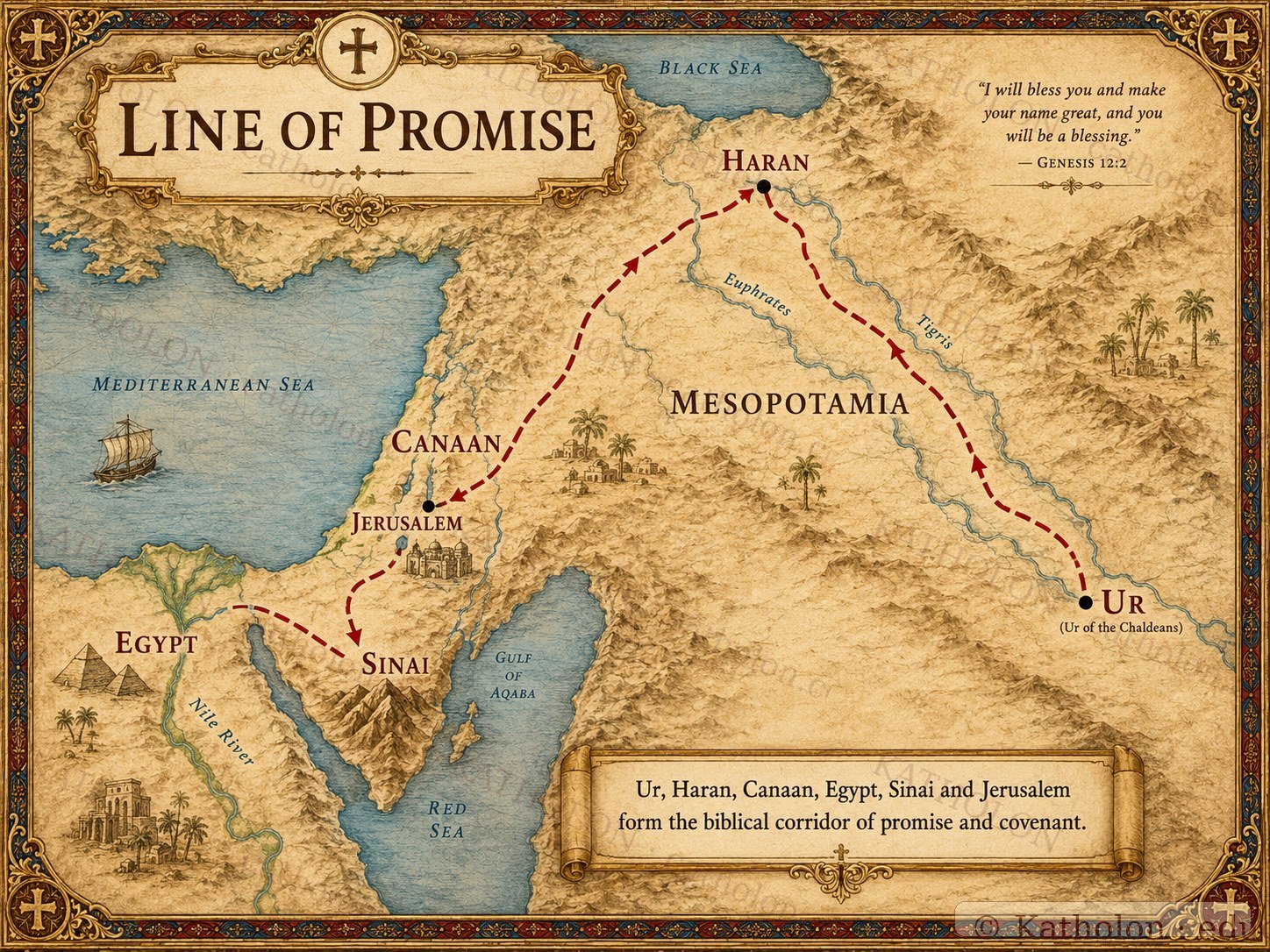
The images are arranged as a chronology, not as decoration. Read them from patriarchal promise through Exodus, kingdom, Temple and the public world of Christ.
Line of PromiseAbraham, land and universal blessingThe patriarchal promise is particular in history and universal in purpose.
WHAT THIS MEANS FOR YOUR SEARCH
Christianity should now be tested as a claim of fulfilment, not filed as one unrelated religion among others
The historical Christian name begins after Christ, but the Christian claim reaches backward through Israel to the Creator and forward through the apostolic Church. The identity is not a sameness of every rite or disciplinary law; it is continuity of the one God, promise and supernatural end under a definitive New Covenant.
The next question is formal: if God has truly revealed and fulfilled His promise in Christ, can several contradictory religious systems be equally true, or must the seeker identify the one true religion and the one Church to which it is entrusted?
The judgement concerns propositions and evidence. Personal culpability, pastoral patience and charity must be distinguished from the objective truth of a religious claim.