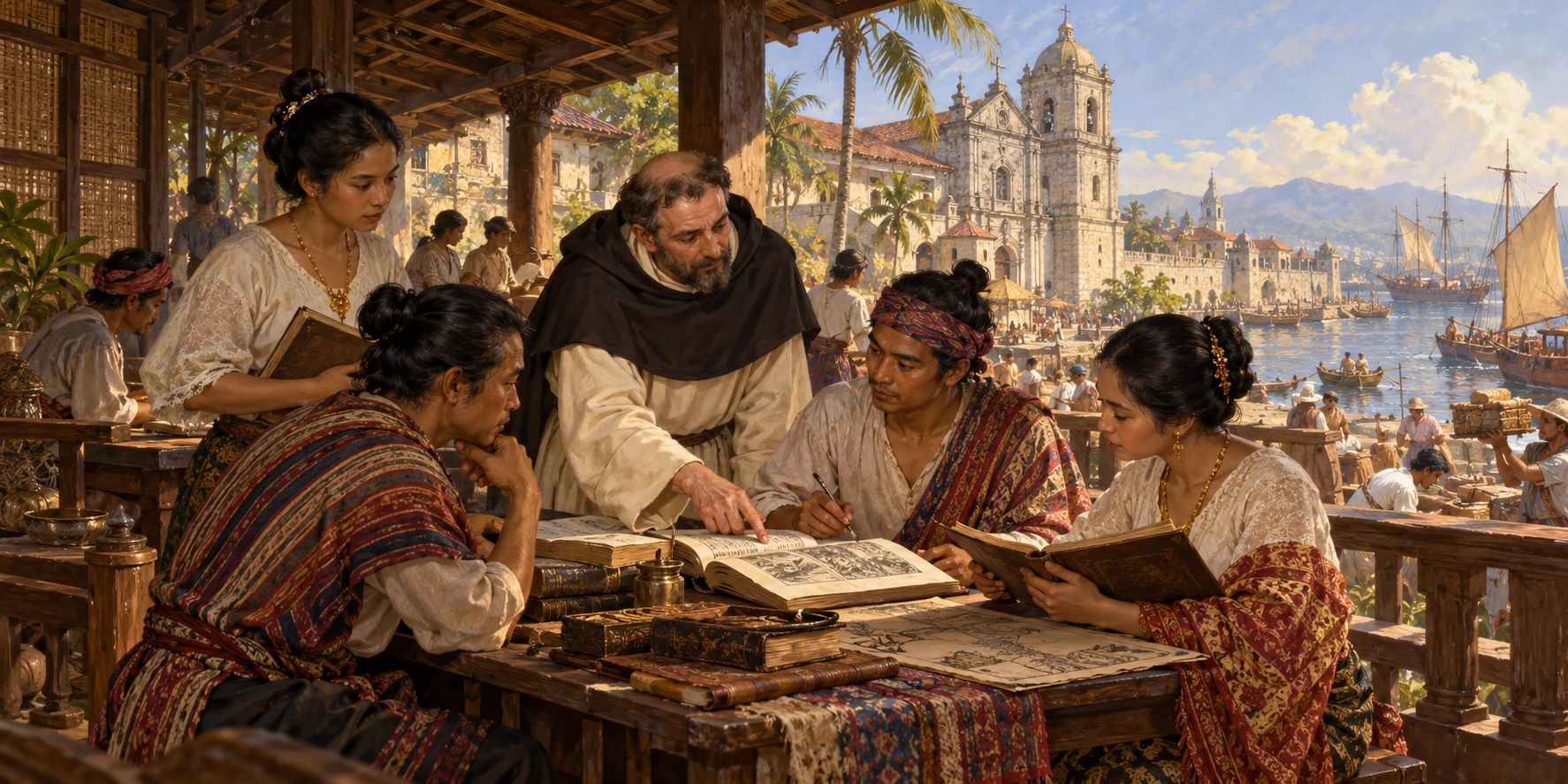
Mission carried the Gospel into new languages and formed churches that could celebrate the sacraments, teach and care for their people. Its fruits included catechisms, schools, hospitals, religious communities and local clergy. It also brought churchmen into conflict with enslavement, conquest and claims that Christianity belonged to one nation. This dossier follows the making of local Christian communities across the Americas, Africa, India and the Philippines, giving both missionaries and the people who received and transmitted the faith their place.
Missions: conversion, local churches and contested power
The routes cross several different societies: the Christian kingdom of Kongo, the established churches of India, the societies of the Americas and the islands of East Asia. Points identify schools, parishes, charitable works and conflicts in which local Christians acted as teachers, rulers, interpreters and witnesses. The sequence also follows the move towards a clergy rooted in each country, a central concern of Propaganda Fide and the later missionary teaching of Benedict XV.
The story through1491Move the timeline to reveal events
Move the timeline to reveal events in date order; previous events remain visible. Select a numbered badge to separate nearby records. Fine leader lines connect displaced symbols to their locations. Drag to move the map; use +/− to zoom. Left/Right changes year and Home fits the focused map. Dashed connections are schematic, and city locations are approximate.
Nzinga a Nkuwu received baptism as João I at the capital of Kongo in 1491. This encounter began an African history of Christian kingship and church building, subsequently developed by Afonso I. The capital was a political and religious centre whose inhabitants selected and adapted new forms. Christianity did not merely arrive as a European coastal institution: African rulers and communities became agents in its development, even while Portuguese trade created unequal and dangerous dependencies.
Antonio de Montesinos delivered his Dominican community’s challenge to the mistreatment of Indigenous people under the encomienda. The sermon questioned how Christians could reconcile their treatment of neighbours with the Gospel. It did not immediately abolish exploitation; its significance lies in a public criticism grounded in Christian moral duties and supported by a religious community. Santo Domingo therefore marks both the colonial setting of mission and a source of Catholic opposition to conduct within that setting.
Paul III’s Sublimis Deus affirmed that the peoples encountered in the Americas were rational human beings capable of receiving the faith and must not be deprived of liberty or property. The statement belongs beside Caribbean and American disputes about dominion and labour, rather than beside an assumption of universal compliance. Its theological principle provided a standard by which Christian officials and settlers could be judged. The distance between Rome’s norm and colonial enforcement is part of the history.
Francis Xavier reached Goa in 1542 after travelling through the Portuguese imperial network. Preaching, catechesis and sacramental ministry shaped his work, which soon extended beyond this port. Goa represents the logistical assistance and political dependence associated with royal patronage. It does not mark the beginning of all Indian Christianity: the Christians of Saint Thomas possessed an older ecclesiastical inheritance. The distinction prevents a European missionary arrival from erasing communities already present in the subcontinent.
Miguel López de Legazpi established a Spanish settlement at Cebu in 1565, accompanied by Augustinian friars. This supplied a durable political base for evangelisation after earlier, less lasting encounters. Conversion, military settlement and royal claims developed together without becoming the same activity. Cebu helps explain the conditions under which parish life could expand, while the later endurance of Filipino Catholicism requires attention to local households, catechists and clergy who transmitted the faith themselves.
Bernardino de Sahagún worked with Nahua elders, writers and artists to produce the manuscript now known as the Florentine Codex. Its preparation joined missionary inquiry with Indigenous intellectual labour, preserving accounts of religion, society, language and conquest. The project cannot be credited to a European friar alone, nor treated as an unmediated record untouched by its Christian purpose. Tlatelolco locates a collaboration whose bilingual texts allow readers to compare voices within colonial Catholic learning.
Archbishop Aleixo de Menezes of Goa convened the synod at Udayamperoor among the Christians of Saint Thomas. Its legislation strengthened Roman and Portuguese control and imposed changes upon an existing East Syriac inheritance. Communion and Latinisation were related in the proceedings but are not identical theological requirements. The site makes visible an Indian church older than Portuguese arrival and helps explain why later resistance involved jurisdiction, ritual and local authority rather than simple refusal to receive Christianity.
The Dominican foundation that became the University of Santo Tomas opened through the bequest of Archbishop Miguel de Benavides and the work of his confrères. A college and seminary provided institutional means for learning and clerical formation in the developing Philippine church. The map places this educational work within local Catholic life rather than treating it as a merely administrative accessory to Spain.
Jesuits and lay workers established Sainte-Marie as a headquarters among the Huron-Wendat. Workshops, worship and accommodation supported a mission dependent upon Indigenous political relationships and assistance. Epidemic disease and warfare made its position increasingly precarious, and the community abandoned and burned the settlement in 1649. The mission’s destruction should not become an accusation against an entire people. It reveals how a religious community could be drawn into a wider conflict whose actors and alliances require separate explanation.
At Mattancherry, many Christians of Saint Thomas swore the Coonan Cross Oath amid resistance to Portuguese ecclesiastical control. The subsequent divisions cannot be compressed into one moment when an ancient community suddenly acquired a single new confession. Catholic reconciliation and other ecclesiastical alignments developed afterwards. The episode shows the danger of allowing a foreign jurisdiction to appear inseparable from communion with Rome, while also showing that inherited Christian identity remained central to those disputing its government.
The reduction of Santísima Trinidad del Paraná organised church, school, workshops and dwellings around a shared settlement. Guaraní residents contributed skills and cultural forms to a Christian community intended in part to protect people from exploitative labour demands. Protection coexisted with disciplined settlement and dependence on colonial permissions. The Jesuit expulsion disrupted the personnel and wider network supporting such communities. The surviving buildings document institutions, but do not by themselves establish how every resident experienced mission life.
Junípero Serra founded Mission San Diego de Alcalá in 1769; the community moved inland in 1774. The mission joined preaching and sacramental life to the Spanish frontier’s settlement and labour arrangements. Kumeyaay people encountered both Christian instruction and new pressures on land, movement and daily work. The friars sought conversion and the growth of Christian life; coercive discipline still had to answer to the moral law. The city marker deliberately encompasses the foundation and relocation without inventing an exact itinerary.
Daniel Comboni developed his plan for the regeneration of Africa in 1864 after confronting the fragility of missions dependent upon a few foreign personnel. Formation of Africans who could teach and sustain Christian communities became central to his approach. Rome locates the plan’s ecclesiastical presentation and spiritual setting, not an African mission station. The proposal helps readers evaluate earlier missions by a concrete question: could a local church continue its life through its own well-prepared members?
Comboni founded institutes for male missionaries in 1867 and missionary sisters in 1872. Verona supplied recruitment and formation for work that required enduring support beyond the enthusiasm of a single journey. The inclusion of women’s religious work is essential to understanding schools, care and pastoral support in African mission. These European foundations were instruments toward a local ecclesiastical future; their success cannot be measured only by how many foreign personnel they sent abroad.
Charles Lavigerie founded the Missionaries of Africa at Algiers in 1868. The Society emerged within French Algeria, and its religious aims must be examined alongside that colonial setting. Language learning, formation and service supported expansion toward the Sahara and other African regions. Lavigerie later made public opposition to slavery a major cause. Distinguishing his missionary institute, humanitarian appeals and attachment to France allows a more exact assessment than either unqualified celebration or simple identification with imperial policy.
Comboni became bishop and vicar apostolic of Central Africa in 1877 and continued his work centred on Khartoum until his death in 1881. Training, schools and pastoral care required resilient institutions in circumstances of illness, limited resources and the devastation associated with slavery. Khartoum supplies the African counterpart to the Roman plan and Veronese institutes. The connection is institutional, not evidence that European direction alone made an African church or that Comboni controlled the political region around him.
Charles Lwanga and companions were killed at Namugongo during the persecution under Kabaka Mwanga II. Their fidelity places African Christians at the centre of the history, as people making costly religious decisions rather than passive recipients of European instruction. Catholic and Anglican witnesses belong to the wider persecution, though the Church’s canonised Catholic group has its own membership and dates. Namugongo represents one principal execution site; it must not be treated as the location of every Ugandan martyr’s death.
Lavigerie established the French antislavery society in Paris in 1888 as part of a public campaign against the seizure and sale of Africans. Appeals, fundraising and political pressure extended beyond the work of a single mission station. The campaign should be assessed by its specific actions and colonial entanglements, not taken as proof that every European intervention benefited Africans. Read beside Kongo and Namugongo, it shows several different forms of Christian agency confronting enslavement and coercion.
Map sources and geographical method
This map follows the dossier’s selected places and institutions. Events appear at the start of their stated date range and remain visible at later steps. Their continued visibility records the earlier event, not uninterrupted control or activity. Physical geography supplies orientation; no historical state boundaries are reconstructed. Institutional and comparison lines are schematic, and representative locations are identified in the record notes.
Related library passages supply theological and institutional background; the evidence listed for each event supplies its particular historical reference. Bibliographic addresses below are documentation, while reading links stay within Catholon.
Supports dates and distinguishes individual martyrs and sites.
Physical geography: Natural Earth, 1:10m public-domain land, coastlines, natural lakes and major rivers. Projection: Web Mercator; high latitudes are enlarged. Contemporary coastlines provide orientation rather than a reconstruction of every historical shoreline. The map’s city coordinates locate named places approximately, not exact buildings.
Extended reading
History and institutions
Chapter 01
The Americas: evangelisation and the defence of persons
The arrival of missionaries in the Americas occurred within conquest and colonisation, but it did not give every missionary, official and settler the same purpose. The encomienda, disputes about labour, the destruction caused by warfare and epidemic disease, and the establishment of Christian institutions must be distinguished rather than collapsed into one event. Epidemics brought catastrophic losses for which population estimates remain uncertain; their effects cannot be attributed simply to a deliberate missionary policy. At the same time, the existence of disease does not excuse forced labour or violence where the evidence establishes those acts.
The Dominican preaching associated with Antonio de Montesinos in Hispaniola in 1511 and the later work of Bartolomé de las Casas show that criticism of colonial conduct was not an invention imposed on the Church from outside. Their arguments appealed to the humanity of the indigenous peoples, the obligations of Christians and the nature of just rule. Francisco de Vitoria’s lectures on the Indians and on war examined whether unbelief or the discovery of inhabited lands supplied a lawful title to dominion. His distinctions were not a modern declaration that every question of contact had already been solved, but they rejected important assumptions by which conquest could be treated as self-justifying.
Paul III’s Sublimis Deus in 1537 affirmed the capacity of indigenous peoples to receive the faith and their right not to be deprived of liberty and possessions. This was a direct rejection of arguments that treated non-Christian status as sufficient ground for enslavement. The principle supplied a standard by which a Christian ruler or settler could be judged. Violations of that standard show the force of interests opposing it, not the absence of a Catholic answer.
The missionary institutions also had positive work to do. Grammars and catechisms made instruction possible in local languages; schools trained readers and future teachers; communities organised worship, music and care. Bernardino de Sahagún’s work depended upon indigenous scholars whose knowledge and language shaped the resulting record. Among the Guaraní, Jesuit reductions built churches, workshops and an agricultural life while seeking protection against slave raiding. Their regulated communal arrangements were not without costs or conflict, but they were concrete attempts to create Christian settlements whose inhabitants would not be treated simply as a labour supply for outsiders.
01“Mission was simply a theological excuse for enslavement.”+
The historical evidence
Montesinos challenged colonial conduct, Vitoria questioned claims to dominion and Sublimis Deus affirmed the humanity and rights of indigenous peoples. These interventions arose within Catholic teaching. Missionary language work, schools and local churches also had purposes beyond furnishing labour to colonists.
Answer to the objection
Christian participation in abuse must be named where established. It does not make enslavement a necessary consequence of preaching the Gospel. Catholic principles supplied grounds for resisting that conduct and for recognising people as recipients and transmitters of the faith in their own right.
Chapter 02
North America: language, martyrdom and enduring communities
North American missions developed among peoples with their own alliances, conflicts and religious traditions. French, Spanish and later other colonial settings produced different institutions. The Jesuit missions among the Wendat, for example, cannot be understood without the wider political and military relationships of the Great Lakes region. Missionaries entered communities that were already acting strategically; indigenous people were not simply an empty audience waiting for European decisions. Conversion could create new commitments within existing kinship structures, while disease and warfare could make the position of a mission precarious regardless of a preacher’s intentions.
The seventeenth-century Jesuit Relations record the practical difficulty of learning languages, establishing trust and sustaining a mission amid disease and warfare. St. Jean de Brébeuf’s study of the Wendat language served the explanation of the faith; mission could not proceed through Latin instruction alone. The deaths of Brébeuf and his companions in 1649 ended particular lives but did not erase the faith of the indigenous Christians around them. Their communities were participants in the mission’s history, not merely its audience.
In California, the eighteenth-century missions established churches, cultivated fields, workshops and systems of instruction. Their relation to colonial settlement also placed indigenous people under restrictive forms of supervision and labour. Those arrangements must be judged in their particular operation. The enduring Christian achievement is the transmission of faith and the institutions of worship and care; coercive treatment does not become a sacrament by occurring beside a church. A local Christian family or catechist who sustained the faith after political change belongs to the story as fully as the founding friar.
02“The recipients of mission had no agency.”+
The historical evidence
Kongo’s Christian rulers pursued their own plans for education and ecclesiastical life. Indigenous collaborators shaped linguistic and historical works in America. African catechists and the Ugandan martyrs made commitments that cannot be described as the continuing commands of a foreign missionary.
Answer to the objection
A mission becomes an enduring church through such people. Their religious convictions should not be dismissed merely because the first preacher came from elsewhere. The history of local clergy, families and teachers explains how the faith survived a founder’s death or a change of political government.
Chapter 03
African Christians, education and resistance to slavery
The baptism of the ruler of Kongo in 1491 opened a history of African Christian agency that should not be reduced to a European coastal enterprise. Afonso I, who ruled in the early sixteenth century, pursued Christian kingship, education and ecclesiastical development while negotiating with Portugal. His correspondence concerning the slave trade records the damage caused by the seizure and sale of people, including subjects whose status should have protected them. This is evidence of an African Christian ruler attempting to use diplomatic and religious relationships against abuses within a trade in which several kinds of actors participated.
The history is not made clearer by pretending that Christianity and the Atlantic slave trade occupied entirely separate worlds. Portuguese commercial interests, African political conflicts and the conduct of individual traders and officials intersected with missionary activity. The relevant Catholic principles concern the dignity of persons, lawful authority and the injustice of reducing innocent people to bondage. Their application was contested and often inadequate. Those principles and the people who appealed to them must be identified. The involvement of Christians in an abuse does not make the abuse a necessary expression of Christian doctrine.
In the nineteenth century, St. Daniel Comboni’s programme placed the formation of African evangelisers near the centre of the mission. Charles Lavigerie’s Missionaries of Africa and anti-slavery activity joined another network of religious training, schools and practical intervention. Their aims required establishments in which people could learn and later take responsibility. A mission that remained indefinitely dependent upon foreign personnel would be weaker than a church with trained local clergy and religious communities.
The Ugandan martyrs of the 1880s make that local responsibility unmistakable. They were not passive recipients of a European decision: their adherence to Christ determined their own conduct under pressure. African catechists, teachers and families likewise carried the faith beyond the presence of a visiting priest. Catholic mission achieved its purpose as such communities became able to sustain Christian life. Education and care served that growth; the Gospel was not the permanent possession of the country from which a missionary had sailed.
03“Catholic universality meant that every culture had to become European.”+
The historical evidence
India’s ancient Christians possessed an Eastern inheritance before the Portuguese arrived. Missionaries elsewhere learned languages and produced local instructional works. Maximum illud required the formation of local clergy and warned against identifying mission with a nation’s interests.
Answer to the objection
The faith has definite truths, but they are not the private inheritance of one people. A local church needs ministers able to teach and govern, not perpetual foreign tutelage. Where national privilege obstructed that growth, the Church’s universality supplied the principle by which it could be challenged.
Chapter 04
India and the Philippines: inherited churches and new foundations
India already possessed ancient Christian communities before the arrival of the Portuguese. The Christians of Saint Thomas therefore cannot be introduced as if their history began with sixteenth-century Latin mission. Portuguese patronage, Latin ecclesiastical structures and the existing East Syriac inheritance came into a difficult relationship. The Synod of Diamper in 1599 and the later Coonan Cross Oath in 1653 belong to that conflict. Communion with the Church does not require every local tradition to be replaced by a Latin one. The age and legitimacy of an Eastern inheritance are relevant facts, not obstacles to be omitted from a missionary success story.
Francis Xavier’s work and the later mission associated with Roberto de Nobili illustrate different approaches to evangelisation within India. Questions about language, dress, social access and the meaning of local customs were not trivial matters of presentation. They concerned whether a practice was inseparable from a false religious profession or could be used within Christian life. Accommodation required a doctrinal judgment, and it could also risk reinforcing social exclusions. The correct answer could not be obtained by declaring every indigenous practice sacred or every European practice universally necessary. The purpose was to communicate the faith truthfully to real people in a particular society.
In the Philippines, religious orders built networks of parishes and developed linguistic and educational tools. The University of Santo Tomas, founded in Manila in 1611, gave higher study an enduring institutional home. Local catechists, families and clergy carried the faith through daily life. The strength of Filipino Catholicism cannot be explained as a continuing order from a Spanish administrator: it survived changes of regime because generations received and handed on the faith.
Benedict XV’s Maximum illud in 1919 made the formation of local clergy and freedom from national self-interest explicit missionary obligations. The principle applies to these histories because it identifies their goal. A missionary builds a church for the people of a place, with ministers capable of governing and teaching, rather than a permanent outpost of his own nation. The Church’s universality therefore both explains the fruits of missionary work and supplies a judgment against colonial privilege when it obstructs that work.
Further reading
People, institutions and turning points
15th–17th centuriesLocal rulers, converts and teachers helped make the Church their own+
Mission history is not a story in which Europeans alone act. Rulers, interpreters, catechists, families and religious communities in the receiving societies made decisions, defended their people and transmitted the faith. Their agency becomes visible when letters and institutions are read alongside accounts of expeditions.
The kingdom of Kongo. Kongo’s Christian rulers pursued their own political and religious purposes. Afonso I’s complaints about the slave trade show a Christian king opposing practices that injured his subjects, not a ruler without judgement merely repeating foreign instructions.
India’s existing Christians. The ancient Christian communities of India preceded the Portuguese arrival. Relations with newcomers therefore involved an already established ecclesiastical life, including its liturgical traditions and links with the wider East.
Language in the Americas. Teaching required indigenous collaborators and the study of local languages. Catechisms, grammars and preaching depended on people able to move between linguistic worlds. Their work could preserve linguistic knowledge as well as transmit Christian doctrine.
Communities in the Philippines. Parishes, schools and local catechists gave Catholic life a continuing social form. The foundation of Santo Tomas in Manila in 1611 supplied another institutional setting for advanced education and the training of successive generations.
The Church became enduring where worship, teaching and service could be carried by the local community. External resources and missionaries mattered, but a lasting church could not remain permanently dependent on the presence of a visiting expedition.
16th–18th centuriesChristian teaching supplied arguments against exploitation+
Mission took place within systems of conquest, labour and trade that could expose converts to severe coercion. Religious institutions sometimes resisted those pressures and sometimes became implicated in them. The strongest Catholic defence follows the principles proclaimed and the actual protection supplied.
Montesinos’s challenge. The Dominican preaching associated with Antonio de Montesinos in 1511 challenged the treatment of indigenous people in Hispaniola. The challenge arose within Christian moral teaching: the humanity and obligations towards those being exploited could not be erased by conquest.
Sublimis Deus. Paul III’s declaration in 1537 affirms the humanity and capacity for faith of indigenous peoples and rejects depriving them of liberty and possessions. Its teaching should be read directly, then distinguished from the failures of enforcement in particular territories.
Valladolid’s question. The debate associated with Las Casas and Sepúlveda concerned conquest, authority and the means of evangelisation. It was not a parliamentary vote on whether indigenous people possessed souls. The actual arguments involved natural law and the justification of war.
Protection and dependency. Mission settlements could offer defence, organised production and instruction, while also regulating inhabitants’ lives under colonial conditions. The Guaraní reductions and later mission systems need to be assessed through both those protective works and the particular coercive practices recorded.
The moral principle is clear: conversion cannot cancel human dignity or make injustice an instrument of the Gospel. Its historical force appears where missionaries and local Christians used it to oppose exploitation and where institutions gave practical protection to people under threat.
17th–20th centuriesA local clergy made mission less dependent on a foreign state+
Royal patronage supplied ships, money and political access, but could also make ecclesiastical work dependent on national interests. The development of Propaganda Fide and later missionary teaching addressed the need for churches rooted in their own peoples and governed for a religious purpose.
Propaganda Fide. The congregation established in 1622 sought to coordinate mission beyond the control of individual crowns. Support for local clergy addressed the practical question of who would continue teaching and administering the sacraments when foreign personnel were absent.
Women’s institutions. Schools and hospital work in places such as Quebec show women’s communities organising services that needed continuity, trained personnel and local support. Their contribution belongs to the institutional history of the Church, not merely to an appendix about charitable sentiment.
African Christians as agents. Catechists, teachers and converts carried much of the work between mission stations and local communities. The Ugandan martyrs make personal conviction visible: fidelity to Christ could place local Christians in direct conflict with powerful authorities.
Maximum illud. Benedict XV’s 1919 letter rejects the identification of missionary work with the prestige of a missionary’s nation and stresses a well-formed local clergy. This was a concrete programme for the future government of churches, not simply a change in vocabulary.
The enduring result is measured by communities able to worship, teach and serve through their own members. Schools, hospitals and seminaries matter because they form that continuity; the Gospel is not the property of the nation from which a particular missionary travelled.
Documents and records
Read the sources
Collections and edition notesBenedictus XV, Maximum illud (1919), indigenous clergy and the missionary’s homeland
Document guide · no excerpt supplied
This entry provides context for the document; it does not reproduce its text.
The letter insists on local clergy and rejects the subordination of evangelization to national interests. These are standards by which missionary practice can be judged.
Paulus III, Sublimis Deus (1537)
Source excerpt
licet extra Fidem Christi existant sua libertate ac rerum suarum dominio privatos, seu privandos non esse
An excerpt is reproduced here; this is not the complete document.
The text denies that absence of Christian faith removes liberty or ownership. The existence of a norm does not prove that every colonial authority obeyed it.
Regional mission records; NCTR, Truth and Reconciliation Commission reports; University of Santo Tomas, institutional history
Document guide · no excerpt supplied
This entry provides context for the document; it does not reproduce its text.
Regional evidence includes local Christian testimony, institutional records and testimony concerning coercion and abuse. Different continents and institutions require distinct histories.
The papal suppression of 1773 dissolved the Society of Jesus as a religious institute where the act was implemented. The universal restoration of 1814 re-established it under Pius VII after decades of disruption and limited survival.
The formation of local clergy is the preparation of priests drawn from the people among whom a mission works, with the education, spiritual formation and authority required to sustain the Church’s pastoral life.
Subsidiarity is the principle that a larger social body should support, and should not unnecessarily absorb, the responsibilities that persons and smaller communities can properly fulfil.