
Library · documents and collections
Historical source reader
Read the document behind a passage in the historical dossiers. Each record identifies whether it contains a complete work, a selected passage, a manuscript image or a collection guide.
Source and interpretation
Clement of Rome · First Epistle to the Corinthians, chapter 44
Source excerpt
Selected passage; paragraph 89
Chapter XLIV.--The ordinances of the apostles, that there might be no contention respecting the priestly office. Our apostles also knew, through our Lord Jesus Christ, and there would be strife on account of the office of the episcopate. For this reason, therefore, inasmuch as they had obtained a perfect fore-knowledge of this, they appointed those [ministers] already mentioned, and afterwards gave instructions, that when these should fall asleep, other approved men should succeed them in their ministry. We are of opinion, therefore, that those appointed by them, or afterwards by other eminent men, with the consent of the whole Church, and who have blamelessly served the flock of Christ in a humble, peaceable, and disinterested spirit, and have for a long time possessed the good opinion of all, cannot be justly dismissed from the ministry. For our sin will not be small, if we eject from the episcopate those who have blamelessly and holily fulfilled its duties. Blessed are those presbyters who, having finished their course before now, have obtained a fruitful and perfect departure [from this world]; for they have no fear lest any one deprive them of the place now appointed them. But we see that ye have removed some men of excellent behaviour from the ministry, which they fulfilled blamelessly and with honour. Chapter XLV.--It is the part of the wicked to vex the righteous.
Selected passage only; not the complete document.
Clement discusses the appointment and succession of ministers and the unjust removal of faithful presbyters. This is an early witness to ordered ecclesiastical office, not a description of medieval election law.
Edition: Ante-Nicene Fathers · ANF01
Continue in the internal source reader →Bibliographic provenance
Existing Catholon source corpus: assets/data/patristic-references-mb32.json
Source and interpretation
Irenaeus · Against Heresies III.3
Source excerpt
Selected passage; paragraph 2
1. It is within the power of all, therefore, in every Church, who may wish to see the truth, to contemplate clearly the tradition of the apostles manifested throughout the whole world; and we are in a position to reckon up those who were by the apostles instituted bishops in the Churches, and [to demonstrate] the succession of these men to our own times; those who neither taught nor knew of anything like what these [heretics] rave about. For if the apostles had known hidden mysteries, which they were in the habit of imparting to "the perfect" apart and privily from the rest, they would have delivered them especially to those to whom they were also committing the Churches themselves. For they were desirous that these men should be very perfect and blameless in all things, whom also they were leaving behind as their successors, delivering up their own place of government to these men; which men, if they discharged their functions honestly, would be a great boon [to the Church], but if they should fall away, the direst calamity. 2. Since, however, it would be very tedious, in such a volume as this, to reckon up the successions of all the Churches, we do put to confusion all those who, in whatever manner, whether by an evil self-pleasing, by vainglory, or by blindness and perverse opinion, assemble in unauthorized meetings; [we do this, I say,] by indicating that tradition …
Selected passage only; not the complete document.
Irenaeus appeals to apostolic succession and the public tradition of the Roman church against secret claims to doctrine. Later arguments about primacy must distinguish this testimony from later legal formulations.
Edition: Ante-Nicene Fathers · ANF01
Continue in the internal source reader →Bibliographic provenance
Existing Catholon source corpus: assets/data/patristic-references-mb32.json
Source and interpretation
Justin Martyr · First Apology, chapters 65–67
Source excerpt
Selected passage; paragraph 132
Chapter LXV.--Administration of the sacraments. But we, after we have thus washed him who has been convinced and has assented to our teaching, bring him to the place where those who are called brethren are assembled, in order that we may offer hearty prayers in common for ourselves and for the baptized [illuminated] person, and for all others in every place, that we may be counted worthy, now that we have learned the truth, by our works also to be found good citizens and keepers of the commandments, so that we may be saved with an everlasting salvation. Having ended the prayers, we salute one another with a kiss. There is then brought to the president of the brethren bread and a cup of wine mixed with water; and he taking them, gives praise and glory to the Father of the universe, through the name of the Son and of the Holy Ghost, and offers thanks at considerable length for our being counted worthy to receive these things at His hands. And when he has concluded the prayers and thanksgivings, all the people present express their assent by saying Amen. This word Amen answers in the Hebrew language to genoito [so be it]. And when the president has given thanks, and all the people have expressed their assent, those who are called by us deacons give to each of those present to partake of the bread and wine mixed with …
Selected passage only; not the complete document.
Justin describes baptism, common prayer and the Eucharist in the second century. His witness grounds the discussion of sacramental continuity; it does not supply evidence for every later liturgical custom.
Edition: Ante-Nicene Fathers · ANF01
Continue in the internal source reader →Bibliographic provenance
Existing Catholon source corpus: assets/data/patristic-references-mb32.json
Source and interpretation
Martyrdom of Justin and his companions
Source excerpt
Selected passage; paragraph 4
In the time of the lawless partisans of idolatry, wicked decrees were passed against the godly Christians in town and country, to force them to offer libations to vain idols; and accordingly the holy men, having been apprehended, were brought before the prefect of Rome, Rusticus by name. And when they had been brought before his judgment-seat, Rusticus the prefect said to Justin, "Obey the gods at once, and submit to the kings." Justin said, "To obey the commandments of our Saviour Jesus Christ is worthy neither of blame nor of condemnation." Rusticus the prefect said, "What kind of doctrines do you profess?" Justin said, "I have endeavoured to learn all doctrines; but I have acquiesced at last in the true doctrines, those namely of the Christians, even though they do not please those who hold false opinions." Rusticus the prefect said, "Are those the doctrines that please you, you utterly wretched man?" Justin said, "Yes, since I adhere to them with right dogma." Rusticus the prefect said, "What is the dogma?" Justin said, "That according to which we worship the God of the Christians, whom we reckon to be one from the beginning, the maker and fashioner of the whole creation, visible and invisible; and the Lord Jesus Christ, the Son of God, who had also been preached beforehand by the prophets as about to be present with the race of men, the herald of salvation and teacher of …
Selected passage only; not the complete document.
The narrative identifies a Roman judicial proceeding and the Christian confession made before the prefect. It is evidence about this martyrdom, not an accusation against an entire later population.
Edition: Ante-Nicene Fathers · ANF01
Continue in the internal source reader →Bibliographic provenance
Existing Catholon source corpus: assets/data/patristic-references-mb32.json
Source and interpretation
Thomas Aquinas · Summa theologiae II-II, q. 10, a. 8
Source excerpt
Whether Unbelievers Ought to Be Compelled to the Faith?
_I answer that,_ Among unbelievers there are some who have never received the faith, such as the heathens and the Jews: and these are by no means to be compelled to the faith, in order that they may believe, because to believe depends on the will: nevertheless they should be compelled by the faithful, if it be possible to do so, so that they do not hinder the faith, by their blasphemies, or by their evil persuasions, or even by their open persecutions. It is for this reason that Christ's faithful often wage war with unbelievers, not indeed for the purpose of forcing them to believe, because even if they were to conquer them, and take them prisoners, they should still leave them free to believe, if they will, but in order to prevent them from hindering the faith of Christ.
Selected passage only; not the complete document.
Read article 8 together with articles 11 and 12 of the same question. Aquinas distinguishes unbelievers who have never received the faith, toleration of rites and the baptism of children against their parents’ will.
Edition: Historical English translation in the existing bilingual Catholon corpus
Continue in the internal source reader →Bibliographic provenance
Existing Catholon source corpus: assets/data/summa/questions/II_II-010.json
Source and interpretation
Thomas Aquinas · Summa theologiae II-II, q. 11, a. 3
Source excerpt
Whether Heretics Ought to Be Tolerated?
_I answer that,_ With regard to heretics two points must be observed: one, on their own side; the other, on the side of the Church. On their own side there is the sin, whereby they deserve not only to be separated from the Church by excommunication, but also to be severed from the world by death. For it is a much graver matter to corrupt the faith which quickens the soul, than to forge money, which supports temporal life. Wherefore if forgers of money and other evil-doers are forthwith condemned to death by the secular authority, much more reason is there for heretics, as soon as they are convicted of heresy, to be not only excommunicated but even put to death.
Selected passage only; not the complete document.
Aquinas’s historical argument concerning heretics and penalties is reproduced for study. Its defence of ecclesiastical judgment must be distinguished from the justice of a particular trial and from contingent civil penal arrangements.
Edition: Historical English translation in the existing bilingual Catholon corpus
Continue in the internal source reader →Bibliographic provenance
Existing Catholon source corpus: assets/data/summa/questions/II_II-011.json
Source and interpretation
Thomas Aquinas · Summa theologiae II-II, q. 40, a. 1
Source excerpt
Whether It Is Always Sinful to Wage War?
_I answer that,_ In order for a war to be just, three things are necessary. First, the authority of the sovereign by whose command the war is to be waged. For it is not the business of a private individual to declare war, because he can seek for redress of his rights from the tribunal of his superior. Moreover it is not the business of a private individual to summon together the people, which has to be done in wartime. And as the care of the common weal is committed to those who are in authority, it is their business to watch over the common weal of the city, kingdom or province subject to them. And just as it is lawful for them to have recourse to the sword in defending that common weal against internal disturbances, when they punish evil-doers, according to the words of the Apostle (Rom. 13:4): "He beareth not the sword in vain: for he is God's minister, an avenger to execute wrath upon him that doth evil"; so too, it is their business to have recourse to the sword of war in defending the common weal against external enemies. Hence it is said to those who are in authority (Ps. 81:4): "Rescue the poor: and deliver the needy out of the hand of the sinner"; and for this reason Augustine says (Contra Faust. xxii, 75): "The natural order conducive to peace among mortals demands that the power to declare and counsel war should be in the hands of those who hold the supreme authority."
Selected passage only; not the complete document.
The article distinguishes authority, just cause and right intention. It is a later scholastic criterion for analysis, not a document claimed to have governed every decision of the First Crusade.
Edition: Historical English translation in the existing bilingual Catholon corpus
Continue in the internal source reader →Bibliographic provenance
Existing Catholon source corpus: assets/data/summa/questions/II_II-040.json
Source and interpretation
Thomas Aquinas · Summa theologiae II-II, q. 66, a. 2
Source excerpt
Whether It Is Lawful for a Man to Possess a Thing As His Own?
_I answer that,_ Two things are competent to man in respect of exterior things. One is the power to procure and dispense them, and in this regard it is lawful for man to possess property. Moreover this is necessary to human life for three reasons. First because every man is more careful to procure what is for himself alone than that which is common to many or to all: since each one would shirk the labor and leave to another that which concerns the community, as happens where there is a great number of servants. Secondly, because human affairs are conducted in more orderly fashion if each man is charged with taking care of some particular thing himself, whereas there would be confusion if everyone had to look after any one thing indeterminately. Thirdly, because a more peaceful state is ensured to man if each one is contented with his own. Hence it is to be observed that quarrels arise more frequently where there is no division of the things possessed.
Selected passage only; not the complete document.
Aquinas distinguishes the lawful administration of possessions from duties concerning their use. This supports the distinction between ownership and an unlimited permission to disregard neighbours.
Edition: Historical English translation in the existing bilingual Catholon corpus
Continue in the internal source reader →Bibliographic provenance
Existing Catholon source corpus: assets/data/summa/questions/II_II-066.json
Source and interpretation
Thomas Aquinas · Summa theologiae III, q. 68, a. 10
Source excerpt
Whether Children of Jews or Other Unbelievers Should Be Baptized Against the Will of Their Parents?
_I answer that,_ The children of unbelievers either have the use of reason or they have not. If they have, then they already begin to control their own actions, in things that are of Divine or natural law. And therefore of their own accord, and against the will of their parents, they can receive Baptism, just as they can contract marriage. Consequently such can lawfully be advised and persuaded to be baptized.
Selected passage only; not the complete document.
The article treats the baptism of the children of Jews and other unbelievers against their parents’ will. Read the objections and replies with the determination, rather than isolating a phrase.
Edition: Historical English translation in the existing bilingual Catholon corpus
Continue in the internal source reader →Bibliographic provenance
Existing Catholon source corpus: assets/data/summa/questions/III-068.json
Source and interpretation
Trent · Session VI, justification, chapter 7
Source excerpt
Selected paragraph from Session 6: Justification and Reform · source block 39
This disposition, or preparation, is followed by Justification itself, which is not remission of sins merely, but also the sanctification and renewal of the inward man, through the voluntary reception of the grace, and of the gifts, whereby man of unjust becomes just, and of an enemy a friend, that so he may be an heir according to hope of life everlasting.** Of this Justification the causes are these: the final cause indeed is the glory of God and of Jesus Christ, and life everlastingwhile; the efficient cause is a merciful God who washes and sanctifies\\ gratuitously, signing, and anointing with the holy Spirit of promise, ivJio is the pledge of our inheritance i"^ but the meritorious cause is His most beloved only-begotten our Lord Jesus Christ, who, when we were enemies, for the exceeding charity wherewith he loved us,^ merited IJustification for us by His most holy Passion on the wood of the cross and made satisfaction for us unto God the Father; the instru-
Selected passage only; not the complete document.
The decree joins remission of sins with sanctification and renewal. The following chapters explain the priority of grace and the meaning of gratuitous justification.
Edition: Existing Catholon council source edition; transcription retained, including historical spelling
Continue in the internal source reader →Bibliographic provenance
Existing Catholon source corpus: assets/data/council-texts.json · trent-session-06
Source and interpretation
Trent · Session VII, sacraments
Source excerpt
Selected paragraph from Session 7: The Sacraments in General, Baptism and Confirmation · source block 9
Law were not all instituted by Jesus Christ, our Lord; or that they are more or less than seven, to wit. Baptism, Confirmation, the Eucharist, Penance, Extreme Unction, Order, and Matrimony;or even that any one of these seven is not truly and properly a sacrament; let him be anathema.
Selected passage only; not the complete document.
Read the decrees and canons concerning the sacraments, baptism and confirmation. A sacramental claim must be distinguished from the conduct of a person administering or receiving a sacrament.
Edition: Existing Catholon council source edition; transcription retained, including historical spelling
Continue in the internal source reader →Bibliographic provenance
Existing Catholon source corpus: assets/data/council-texts.json · trent-session-07
Source and interpretation
Trent · Session XXII, the sacrifice of the Mass
Source excerpt
Selected paragraph from Session 22: The Sacrifice of the Mass and Reform · source block 22
grace and gift of penitence, forgives even heinous crimes and sins. For the victim is one and the same, the same now offering by the ministry of priests who then oiTered Himself on the cross, the manner alone of offering being different. The fruits indeed of which oblation, of that bloody one, to wit, are received most plentifully through this unbloody one; so far is this (latter) from derogating in any way from that (former oblation). Wherefore, not only for the sins, punishments,* satisfactions, and other necessities of the faithful who are living, but also for those who are departed in Christ, and who are not as yet fully purified,! i^ it rightly offered, agreeably to a tradition of the Apostles.
Selected passage only; not the complete document.
The decree identifies the same victim and priest in the sacrifice of Calvary and the Mass while distinguishing the manner of offering.
Edition: Existing Catholon council source edition; transcription retained, including historical spelling
Continue in the internal source reader →Bibliographic provenance
Existing Catholon source corpus: assets/data/council-texts.json · trent-session-22
Source and interpretation
Trent · Session XXIII, reform, chapter 18
Source excerpt
Selected paragraph from Session 23: The Sacrament of Order and Reform · source block 135
Whereas the age of youth, unless it be rightly trained, is prone to follow after the pleasures of the world; and, unless it be formed, from its tender years, unto piety and religion, before habits of vice have taken possession of the whole man, it never will perfectly, and without the greatest, and well-nigh special help of Almighty God, persevere in ecclesiastical discipline; the holy Synod ordains that "all cathedral, metropolitan, and other churches greater than these shall be bound, each according to its means and the extent of the diocese, to maintain,* to educate religiously, and to train in ecclesiastical discipline, a certain number of youths of their city and diocese, or — if that number cannot be met with there — of that province, in a college to be chosen by the bishop for this purpose, near the said churches, or in some other suitable place. Into this college shall be received such as are at least twelve years old, born in
Selected passage only; not the complete document.
The reform decree establishes provisions for seminaries and clerical formation. Its prescription is evidence of a programme, not proof that every diocese implemented it immediately.
Edition: Existing Catholon council source edition; transcription retained, including historical spelling
Continue in the internal source reader →Bibliographic provenance
Existing Catholon source corpus: assets/data/council-texts.json · trent-session-23
Source and interpretation
Trent · Session XXV, indulgences
Source excerpt
Selected paragraph from Session 25: Purgatory, Saints, Relics, Images, Religious Life, Indulgences and the Conclusion · source block 250
Whereas the power of conferring Indulgences was granted by Christ to the Church; and she has, even in the most ancient times, used the said power,* delivered unto her of God; the sacred holy Synod teaches and enjoins that the use of Indulgenc es, for the Christian people most salutary, and approved of
Selected passage only; not the complete document.
The decree defends the Church’s authority concerning indulgences while ordering the correction of abuses. These two judgments should be read together.
Edition: Existing Catholon council source edition; transcription retained, including historical spelling
Continue in the internal source reader →Bibliographic provenance
Existing Catholon source corpus: assets/data/council-texts.json · trent-session-25
Source and interpretation
Florence · Laetentur caeli, 1439
Source excerpt
Selected paragraph from Florence — council-level source corpus · source block 66
For when Latins and Greeks came together in this holy synod, they all strove that, among other things, the article about the procession of the holy Spirit should be discussed with the utmost care and assiduous investigation. Texts were produced from divine scriptures and many authorities of eastern and western holy doctors, some saying the holy Spirit proceeds from the Father and the Son, others saying the procession is from the Father through the Son. All were aiming at the same meaning in different words. The Greeks asserted that when they claim that the holy Spirit proceeds from the Father, they do not intend to exclude the Son; but because it seemed to them that the Latins assert that the holy Spirit proceeds from the Father and the Son as from two principles and two spirations, they refrained from saying that the holy Spirit proceeds from the Father and the Son. The Latins asserted that they say the holy Spirit proceeds from the Father and the Son not with the intention of excluding the Father from being the source and principle of all deity, that is of the Son and of the holy Spirit, nor to imply that the Son …
Selected passage only; not the complete document.
The union decree addresses procession of the Holy Spirit and Roman primacy. The authority of the decree and the historical reception of the union are distinct questions.
Edition: Existing Catholon council source edition; transcription retained, including historical spelling
Continue in the internal source reader →Bibliographic provenance
Existing Catholon source corpus: assets/data/council-texts.json · council-source-corpus
Source and interpretation
Lyons II · Profession concerning the Holy Spirit, 1274
Source excerpt
Selected paragraph from Lyons II — council-level source corpus · source block 19
1. We profess faithfully and devotedly that the holy Spirit proceeds eternally from the Father and the Son, not as from two principles, but as from one principle; not by two spirations, but by one single spiration. This the holy Roman church, mother and mistress of all the faithful, has till now professed, preached and taught; this she firmly holds, preaches, professes and teaches; this is the unchangeable and true belief of the orthodox fathers and doctors, Latin and Greek alike. But because some, on account of ignorance of the said indisputable truth, have fallen into various errors, we, wishing to close the way to such errors, with the approval of the sacred council, condemn and reprove all who presume to deny that the holy Spirit proceeds eternally from the Father and the Son, or rashly to assert that the holy Spirit proceeds from the Father and the Son as from two principles and not as from one.
Selected passage only; not the complete document.
This doctrinal text belongs to the council’s work of union. It should be read with the political circumstances and the limited reception of the agreement.
Edition: Existing Catholon council source edition; transcription retained, including historical spelling
Continue in the internal source reader →Bibliographic provenance
Existing Catholon source corpus: assets/data/council-texts.json · council-source-corpus
Source and interpretation
Constance · Frequens and the council’s reform programme
Source excerpt
Selected paragraph from Constance — council-level source corpus · source block 306
The frequent holding of general councils is a pre-eminent means of cultivating the Lord's patrimony. It roots out the briars, thorns and thistles of heresies, errors and schisms, corrects deviations, reforms what is deformed and produces a richly fertile crop for the Lord's vineyard. Neglect of councils, on the other hand, spreads and fosters the aforesaid evils. This conclusion is brought before our eyes by the memory of past times and reflection on the present situation. For this reason we establish, enact, decree and ordain, by a perpetual edict, that general councils shall be held henceforth in the following way. The first shall follow in five years immediately after the end of this council, the second in seven years immediately after the end of the next council, and thereafter they are to be held every ten years for ever. They are to be held in places which the supreme pontiff is bound to nominate and assign within a month before the end of each preceding council, with the approval and consent of the council, or which, in his default, the council itself is bound to nominate. Thus, by a certain continuity, there will always be either a council in existence …
Selected passage only; not the complete document.
The programme for regular councils belongs to the settlement of the schism. Read it alongside the acts concerning the claimants; it is not a substitute for analysing the status of each session and decree.
Edition: Existing Catholon council source edition; transcription retained, including historical spelling
Continue in the internal source reader →Bibliographic provenance
Existing Catholon source corpus: assets/data/council-texts.json · council-source-corpus
Source and interpretation
Lateran IV · Canon 3, heresy
Source excerpt
Selected paragraph from Lateran IV — council-level source corpus · source block 38
We excommunicate and anathematize every heresy raising itself up against this holy, orthodox and catholic faith which we have expounded above. We condemn all heretics, whatever names they may go under. They have different faces indeed but their tails are tied together inasmuch as they are alike in their pride. Let those condemned be handed over to the secular authorities present, or to their bailiffs, for due punishment. Clerics are first to be degraded from their orders. The goods of the condemned are to be confiscated, if they are lay persons, and if clerics they are to be applied to the churches from which they received their stipends. Those who are only found suspect of heresy are to be struck with the sword of anathema, unless they prove their innocence by an appropriate purgation, having regard to the reasons for suspicion and the character of the person. Let such persons be avoided by all until they have made adequate satisfaction. If they persist in the excommunication for a year, they are to be condemned as heretics. Let secular authorities, whatever offices they may be discharging, be advised and urged and if necessary be compelled by ecclesiastical censure, if they wish …
Selected passage only; not the complete document.
The canon is evidence for the legal and theological setting of medieval action against heresy. Its prescription is not an archival record of every later tribunal.
Edition: Existing Catholon council source edition; transcription retained, including historical spelling
Continue in the internal source reader →Bibliographic provenance
Existing Catholon source corpus: assets/data/council-texts.json · council-source-corpus
Source and interpretation
Vatican I · Pastor aeternus
Source excerpt
Selected paragraph from Pastor aeternus · source block 5
Servant of the servants of God, with the approval of the Sacred (Council for Perpetual Remembrance Eternal Pastor and Bishop of our souls, in THE order to continue for all time the life-giving work of His Redemption, determined to build up the Holy Church, wherein, as in the house of the living GOD, all who believe might be united in the bond of one Wherefore, before He entered faith and one charity. into His glory, He prayed unto the Father, not for the Apostles only, but for those also who through their
Selected passage only; not the complete document.
The constitution concerns the primacy and teaching office of the Roman pontiff. It does not claim that every administrative act is infallible or that every disputed historical fact is immediately evident.
Edition: Existing Catholon council source edition; transcription retained, including historical spelling
Continue in the internal source reader →Bibliographic provenance
Existing Catholon source corpus: assets/data/council-texts.json · pastor-aeternus
Source and interpretation
Rerum Novarum
Source excerpt
Wages and natural justice
45. Let the working man and the employer make free agreements, and in particular let them agree freely as to the wages; nevertheless, there underlies a dictate of natural justice more imperious and ancient than any bargain between man and man, namely, that wages ought not to be insufficient to support a frugal and well-behaved wage-earner. If through necessity or fear of a worse evil the workman accept harder conditions because an employer or contractor will afford him no better, he is made the victim of force and injustice. In these and similar questions, however - such as, for example, the hours of labor in different trades, the sanitary precautions to be observed in factories and workshops, etc. - in order to supersede undue interference on the part of the State, especially as circumstances, times, and localities differ so widely, it is advisable that recourse be had to societies or boards such as We shall mention presently, or to some other mode of safeguarding the interests of the wage-earners; the State being appealed to, should circumstances require, for its sanction …
Selected passage only; not the complete document.
The agreement of employer and worker does not exhaust the moral question. Read this passage with the encyclical’s defence of property, family and associations.
Edition: English text in the existing Catholon magisterial library
Continue in the internal source reader →Bibliographic provenance
Existing Catholon source corpus: assets/data/magisterium-documents/pa/papal-rerum-novarum-a168b45460.json
Source and interpretation
Quadragesimo Anno
Source excerpt
Subsidiarity, paragraph 79
79. As history abundantly proves, it is true that on account of changed conditions many things which were done by small associations in former times cannot be done now save by large associations. Still, that most weighty principle, which cannot be set aside or changed, remains fixed and unshaken in social philosophy: Just as it is gravely wrong to take from individuals what they can accomplish by their own initiative and industry and give it to the community, so also it is an injustice and at the same time a grave evil and disturbance of right order to assign to a greater and higher association what lesser and subordinate organizations can do. For every social activity ought of its very nature to furnish help to the members of the body social, and never destroy and absorb them.
Selected passage only; not the complete document.
Larger bodies should assist without unnecessarily absorbing the responsibilities of smaller communities. This is a principle of ordered cooperation, not a ban on public protection of the weak.
Edition: English text in the existing Catholon magisterial library
Continue in the internal source reader →Bibliographic provenance
Existing Catholon source corpus: assets/data/magisterium-documents/pa/papal-quadragesimo-anno-4bc4e81b47.json
Source and interpretation
Maximum illud (30. November 1919)
Source excerpt
The formation of local clergy
15. If, however, the indigenous clergy is to achieve the results We hope for, it is absolutely necessary that they be well trained and well prepared. We do not mean a rudimentary and slipshod preparation, the bare minimum for ordination. No, their education should be complete and finished, excellent in all its phases, the same kind of education for the priesthood that a European would receive. For the local clergy is not to be trained merely to perform the humbler duties of the ministry, acting as the assistants of foreign priests. On the contrary, they must take up God’s work as equals, so that some day they will be able to enter upon the spiritual leadership of their people.
Selected passage only; not the complete document.
The establishment of a well-formed local clergy is a criterion of a mission’s maturity. The letter distinguishes the Church’s universal mission from national prestige.
Edition: English text in the existing Catholon magisterial library
Continue in the internal source reader →Bibliographic provenance
Existing Catholon source corpus: assets/data/magisterium-documents/ma/maximum-illud-0002398efc.json
Source and interpretation
PIUS XI. Enzyklika „Mit brennender Sorge“
Source excerpt
Race, nation and the limits of political authority
8. Whoever exalts race, or the people, or the State, or a particular form of State, or the depositories of power, or any other fundamental value of the human community - however necessary and honorable be their function in worldly things - whoever raises these notions above their standard value and divinizes them to an idolatrous level, distorts and perverts an order of the world planned and created by God; he is far from the true faith in God and from the concept of life which that faith upholds.
Selected passage only; not the complete document.
The encyclical rejects the elevation of race, people or state into a religious absolute. Its doctrinal judgment must be distinguished from the conduct of each person who claimed a Catholic identity.
Edition: English text in the existing Catholon magisterial library
Continue in the internal source reader →Bibliographic provenance
Existing Catholon source corpus: assets/data/magisterium-documents/mi/mit-brennender-sorge-de15d7d8ca.json
Source and interpretation
Divini Redemptoris (March 19, 1937)
Source excerpt
The ideology of atheistic communism
9. The doctrine of modern Communism, which is often concealed under the most seductive trappings, is in substance based on the principles of dialectical and historical materialism previously advocated by Marx, of which the theoricians of bolshevism claim to possess the only genuine interpretation. According to this doctrine there is in the world only one reality, matter, the blind forces of which evolve into plant, animal and man. Even human society is nothing but a phenomenon and form of matter, evolving in the same way. By a law of inexorable necessity and through a perpetual conflict of forces, matter moves towards the final synthesis of a classless society. In such a doctrine, as is evident, there is no room for the idea of God; there is no difference between matter and spirit, between soul and body; there is neither survival of the soul after death nor any hope in a future life. Insisting on the dialectical aspect of their materialism, the Communists claim that the conflict which carries the world towards its final synthesis can be accelerated by man. Hence …
Selected passage only; not the complete document.
The encyclical’s rejection of materialist communism is accompanied by duties of social justice. Its argument cannot be reduced to approval of every existing economic arrangement.
Edition: English text in the existing Catholon magisterial library
Continue in the internal source reader →Bibliographic provenance
Existing Catholon source corpus: assets/data/magisterium-documents/di/divini-redemptoris-fbca3746a6.json
Source and interpretation
Vehementer Nos (February 11, 1906)
Source excerpt
Church and state in France, 1906
Our soul is full of sorrowful solicitude and Our heart overflows with grief, when Our thoughts dwell upon you. How, indeed, could it be otherwise, immediately after the promulgation of that law which, by sundering violently the old ties that linked your nation with the Apostolic See, creates for the Catholic Church in France a situation unworthy of her and ever to be lamented? That is, beyond question, an event of the gravest import, and one that must be deplored by all the right-minded, for it is as disastrous to society as it is to religion; but it is an event which can have surprised nobody who has paid any attention to the religious policy followed in France of late years. For you, Venerable Brethren, it will certainly have been nothing new or strange, witnesses as you have been of the many dreadful blows aimed from time to time by the public authority at religion. You have seen the sanctity and the inviolability of Christian marriage outraged by legislative acts in formal contradiction with them; the schools and hospitals laicized; …
Selected passage only; not the complete document.
Pius X’s judgment concerns the French settlement and the nature of ecclesiastical authority. Distinguish the text of a law, its surrounding policies and its implementation.
Edition: English text in the existing Catholon magisterial library
Continue in the internal source reader →Bibliographic provenance
Existing Catholon source corpus: assets/data/magisterium-documents/ve/vehementer-nos-4236b96140.json
Source and interpretation
Acts 7:54–59 · Stephen
Source excerpt
Verses 54–59
54. Now hearing these things, they were cut to the heart, and they gnashed with their teeth at him.
55. But he, being full of the Holy Ghost, looking up steadfastly to heaven, saw the glory of God, and Jesus standing on the right hand of God. And he said: Behold, I see the heavens opened, and the Son of man standing on the right hand of God.
56. And they crying out with a loud voice, stopped their ears, and with one accord ran violently upon him.
57. And casting him forth without the city, they stoned him; and the witnesses laid down their garments at the feet of a young man, whose name was Saul.
58. And they stoned Stephen, invoking, and saying: Lord Jesus, receive my spirit.
59. And falling on his knees, he cried with a loud voice, saying: Lord, lay not this sin to their charge. And when he had said this, he fell asleep in the Lord. And Saul was consenting to his death.
Selected passage only; not the complete document.
Read the passage within the whole chapter in the internal Bible. The citation identifies a particular biblical argument or event; it is not a general verdict on later persons.
Edition: Douay–Rheims, existing Catholon Bible corpus
Continue in the internal source reader →Bibliographic provenance
assets/data/bible-parallel-2.18.json · ACT.7
Source and interpretation
Acts 8:1–24 · Persecution, preaching and Simon
Source excerpt
Verses 1–24
1. And at that time there was raised a great persecution against the church which was at Jerusalem; and they were all dispersed through the countries of Judea, and Samaria, except the apostles.
2. And devout men took order for Stephen's funeral, and made great mourning over him.
3. But Saul made havock of the church, entering in from house to house, and dragging away men and women, committed them to prison.
4. They therefore that were dispersed, went about preaching the word of God.
5. And Philip going down to the city of Samaria, preached Christ unto them.
6. And the people with one accord were attentive to those things which were said by Philip, hearing, and seeing the miracles which he did.
7. For many of them who had unclean spirits, crying with a loud voice, went out.
8. And many, taken with the palsy, and that were lame, were healed.
9. There was therefore great joy in that city. Now there was a certain man named Simon, who before had been a magician in that city, seducing the people of Samaria, giving out that he was some great one:
10. To whom they all gave ear, from the least to the greatest, saying: This man is the power of God, which is called great.
11. And they were attentive to him, because, for a long time, he had bewitched them with his magical practices.
12. But when they had believed Philip preaching of the kingdom of God, in the name of Jesus Christ, they were baptized, both men and women.
13. Then Simon himself believed also; and being baptized, he adhered to Philip. And being astonished, wondered to see the signs and exceeding great miracles which were done.
14. Now when the apostles, who were in Jerusalem, had heard that Samaria had received the word of God, they sent unto them Peter and John.
15. Who, when they were come, prayed for them, that they might receive the Holy Ghost.
16. For he was not as yet come upon any of them; but they were only baptized in the name of the Lord Jesus.
17. Then they laid their hands upon them, and they received the Holy Ghost.
18. And when Simon saw, that by the imposition of the hands of the apostles, the Holy Ghost was given, he offered them money,
19. Saying: Give me also this power, that on whomsoever I shall lay my hands, he may receive the Holy Ghost. But Peter said to him:
20. Keep thy money to thyself, to perish with thee, because thou hast thought that the gift of God may be purchased with money.
21. Thou hast no part nor lot in this matter. For thy heart is not right in the sight of God.
22. Do penance therefore for this thy wickedness; and pray to God, that perhaps this thought of thy heart may be forgiven thee.
23. For I see thou art in the gall of bitterness, and in the bonds of iniquity.
24. Then Simon answering, said: Pray you for me to the Lord, that none of these things which you have spoken may come upon me.
Selected passage only; not the complete document.
Read the passage within the whole chapter in the internal Bible. The citation identifies a particular biblical argument or event; it is not a general verdict on later persons.
Edition: Douay–Rheims, existing Catholon Bible corpus
Continue in the internal source reader →Bibliographic provenance
assets/data/bible-parallel-2.18.json · ACT.8
Source and interpretation
Acts 12:1–5 · Herod and the apostolic Church
Source excerpt
Verses 1–5
1. And at the same time, Herod the king stretched forth his hands, to afflict some of the church.
2. And he killed James, the brother of John, with the sword.
3. And seeing that it pleased the Jews, he proceeded to take up Peter also. Now it was in the days of the Azymes.
4. And when he had apprehended him, he cast him into prison, delivering him to four files of soldiers to be kept, intending, after the pasch, to bring him forth to the people.
5. Peter therefore was kept in prison. But prayer was made without ceasing by the church unto God for him.
Selected passage only; not the complete document.
Read the passage within the whole chapter in the internal Bible. The citation identifies a particular biblical argument or event; it is not a general verdict on later persons.
Edition: Douay–Rheims, existing Catholon Bible corpus
Continue in the internal source reader →Bibliographic provenance
assets/data/bible-parallel-2.18.json · ACT.12
Source and interpretation
James 2:14–18 · Faith and works
Source excerpt
Verses 14–18
14. What shall it profit, my brethren, if a man say he hath faith, but hath not works? Shall faith be able to save him?
15. And if a brother or sister be naked, and want daily food:
16. And one of you say to them: Go in peace, be ye warmed and filled; yet give them not those things that are necessary for the body, what shall it profit?
17. So faith also, if it have not works, is dead in itself.
18. But some man will say: Thou hast faith, and I have works: shew me thy faith without works; and I will shew thee, by works, my faith.
Selected passage only; not the complete document.
Read the passage within the whole chapter in the internal Bible. The citation identifies a particular biblical argument or event; it is not a general verdict on later persons.
Edition: Douay–Rheims, existing Catholon Bible corpus
Continue in the internal source reader →Bibliographic provenance
assets/data/bible-parallel-2.18.json · JAS.2
Source and interpretation
John 10:17–18 · Christ’s free offering
Source excerpt
Verses 17–18
17. Therefore doth the Father love me: because I lay down my life, that I may take it again.
18. No man taketh it away from me: but I lay it down of myself, and I have power to lay it down: and I have power to take it up again. This commandment have I received of my Father.
Selected passage only; not the complete document.
Read the passage within the whole chapter in the internal Bible. The citation identifies a particular biblical argument or event; it is not a general verdict on later persons.
Edition: Douay–Rheims, existing Catholon Bible corpus
Continue in the internal source reader →Bibliographic provenance
assets/data/bible-parallel-2.18.json · JHN.10
Source and interpretation
Romans 11:17–24 · Paul’s warning against boasting
Source excerpt
Verses 17–24
17. And if some of the branches be broken, and thou, being a wild olive, art ingrafted in them, and art made partaker of the root, and of the fatness of the olive tree,
18. Boast not against the branches. But if thou boast, thou bearest not the root, but the root thee.
19. Thou wilt say then: The branches were broken off, that I might be grafted in.
20. Well: because of unbelief they were broken off. But thou standest by faith: be not highminded, but fear.
21. For if God hath not spared the natural branches, fear lest perhaps he also spare not thee.
22. See then the goodness and the severity of God: towards them indeed that are fallen, the severity; but towards thee, the goodness of God, if thou abide in goodness, otherwise thou also shalt be cut off.
23. And they also, if they abide not still in unbelief, shall be grafted in: for God is able to graft them in again.
24. For if thou wert cut out of the wild olive tree, which is natural to thee; and, contrary to nature, were grafted into the good olive tree; how much more shall they that are the natural branches, be grafted into their own olive tree?
Selected passage only; not the complete document.
Read the passage within the whole chapter in the internal Bible. The citation identifies a particular biblical argument or event; it is not a general verdict on later persons.
Edition: Douay–Rheims, existing Catholon Bible corpus
Continue in the internal source reader →Bibliographic provenance
assets/data/bible-parallel-2.18.json · ROM.11
Source and interpretation
Gelasius I · Letter to Anastasius, 494
Source excerpt
Duo sunt · spiritual and temporal authority
the sacred authority of the priests and the royal power.
Selected passage only; not the complete document.
Gelasius distinguishes priestly authority and royal power, giving the spiritual office responsibility for divine things. He also recognises obedience to royal law in the sphere of public order. The letter therefore does not describe an undifferentiated single office.
Edition: J. H. Robinson, Readings in European History (1905), pp. 72–73; short excerpt
Bibliographic provenance
https://sourcebooks.web.fordham.edu/source/gelasius1.asp
Source and interpretation
Concordat of Worms · Henry V and Calixtus II, 1122
Source excerpt
Two instruments: investiture and regalia
without simony and without any violence
Selected passage only; not the complete document.
Henry V renounced investiture by ring and staff. Calixtus II’s accompanying instrument regulated elections and the reception of regalia, with different arrangements for Germany and other imperial territories. Read both acts when assessing the compromise. The emperor in 1122 was Henry V; the online edition’s heading “Henry IV” is an editorial error.
Edition: Ernest F. Henderson, Select Historical Documents of the Middle Ages (1896); phrase from the papal instrument
Bibliographic provenance
https://avalon.law.yale.edu/medieval/inv16.asp
Source and interpretation
Foundation charter of Cluny, 910
Source excerpt
Election of the abbot and protection of the endowment
a purely canonical election
Selected passage only; not the complete document.
William’s charter joins a religious endowment with provisions protecting canonical election and possessions from interference. It also provides for prayer and works of mercy. Legal protection should be distinguished from the actual operation of the later Cluniac network.
Edition: Ernest F. Henderson, Select Historical Documents of the Middle Ages, 1910 edition, pp. 329–333; short excerpt
Bibliographic provenance
https://sourcebooks.web.fordham.edu/source/chart-cluny.asp
Source and interpretation
Charlemagne · Letter on the cultivation of learning
Source excerpt
Letter to Baugulf, late eighth century
far more dangerous are errors of the understanding
Selected passage only; not the complete document.
The letter connects linguistic training with the understanding of Scripture and the instruction of others. It is a prescriptive royal document. Its educational purpose is clear, while the reach of actual schooling requires separate evidence.
Edition: D. C. Munro, Translations and Reprints, VI.5 (1900), pp. 12–14; short excerpt
Bibliographic provenance
https://history.hanover.edu/courses/excerpts/344charl.html
Imported historical text
Benedict · Rule, chapter 48
Chapter 48 assigns periods to manual labour and sacred reading. It provides for a book to be given to each monk during Lent and for supervision of the reading time. Reading is therefore part of the community’s recurring discipline, supported by an actual supply of books.
The link opens this chapter within the complete Rule. Chapters on care, hospitality, craftsmen and the reception of novices show how learning belonged to a wider organisation of common life.
Read the historical text in the library →
Edition and collection provenance
Source and interpretation
Innocent III · Constitution for the Jews, 1199
Source excerpt
Protection against forced baptism
no Christian compel them, unwilling or refusing, by violence to come to baptism
Selected passage only; not the complete document.
The constitution renews a protective tradition while retaining a definite Christian theological position. It prohibits coercive baptism and unjust injury and protects specified customs and burial. The norm and its uneven enforcement must be assessed separately.
Edition: English version transmitted by D. Andrew Byler (1994), reproduced in the Internet Medieval Sourcebook; short quotation only
Bibliographic provenance
https://sourcebooks.web.fordham.edu/source/in3-constjews.asp
Source and interpretation
Alonso de Salazar Frías · Report to the Suprema, 1612
Source excerpt
Evidence in the Logroño witchcraft controversy
external and objective evidence sufficient to convince everyone who hears it
Selected passage only; not the complete document.
Salazar distinguishes general belief in witchcraft from proof of an alleged act in a particular case. His investigation and the subsequent instructions of 1614 are evidence of restraint within an inquisitorial system. They should not be used as a verdict on every other tribunal or offence.
Edition: Report excerpt in University of Washington teaching collection, with reference to Kors and Peters and Henningsen; short quotation only
Bibliographic provenance
https://courses.washington.edu/hsteu205/Spanish%20witch%20trials.htm
Source and interpretation
Society of Jesus · Formula of the Institute, 1540
Source excerpt
Instruction and the purpose of the institute
Particularly let them hold in esteem the instruction of children and the unlettered in the Christian doctrine
Selected passage only; not the complete document.
The founding formula identifies apostolic work, teaching and the relation of the Society to papal missions. It must be distinguished from the conduct of a particular confessor or the political interests of a patron.
Edition: The Constitutions of the Society of Jesus and Their Complementary Norms, Institute of Jesuit Sources (1996), pp. 3–13; short quotation
Bibliographic provenance
https://jesuitsourcesdigital.bc.edu/3df7CMK/
Source and interpretation
French National Assembly · Civil Constitution of the Clergy, 1790
Editorial source guide · no transcript
Titles I and II: dioceses and appointments
The act reorganised ecclesiastical geography and the selection of clergy through civil institutions. The later oath requirement brought the question of jurisdiction into parish life. This entry identifies the document and its relevant provisions; it does not reproduce a complete or certified legal text.
Edition: Constitution civile du clergé, 12 July 1790; contemporary French text
Bibliographic provenance
https://fr.wikisource.org/wiki/Constitution_civile_du_clergé_du_12_juillet_1790
Source and interpretation
Concordat of 1801
Editorial source guide · no transcript
Pius VII and the French government
The agreement provided a new settlement for public Catholic life after the revolution. Compare its negotiated provisions with the unilateral Organic Articles and with the later conflict between Napoleon and Pius VII.
Edition: Concordat, 15 July 1801, articles 1–17
Bibliographic provenance
https://www.napoleon.org/en/history-of-the-two-empires/articles/the-concordat-of-1801/
Source and interpretation
Ratio studiorum, 1599
Editorial source guide · no transcript
Rules for the schools of the Society of Jesus
Read the rules for teachers and superiors to distinguish curriculum, exercises and administration. A common programme does not prove that every college achieved an identical standard or served an identical social population.
Edition: Ratio atque institutio studiorum Societatis Iesu, 1599
Bibliographic provenance
https://jesuitportal.bc.edu/research/documents/1599_ratio/
Source and interpretation
Clement XIV · Dominus ac Redemptor, 1773
Editorial source guide · no transcript
Suppression of a religious institute
The act concerns the legal existence of the Society amid extensive political and ecclesiastical controversy. Its disciplinary effect must be distinguished from a dogmatic definition of every allegation made against Jesuits.
Edition: Dominus ac Redemptor, 21 July 1773
Bibliographic provenance
https://jesuitportal.bc.edu/research/documents/1773_dominusacredemptor/
Source and interpretation
Pius VII · Sollicitudo omnium ecclesiarum, 1814
Editorial source guide · no transcript
Universal restoration of the Society
The restoration followed decades of disrupted schools and missions and limited corporate survival. It called for rebuilding in altered circumstances, rather than proving that every dispute before 1773 had been imaginary.
Edition: Sollicitudo omnium ecclesiarum, 7 August 1814
Bibliographic provenance
https://archives.jesuits-eum.org/1814-the-restoration-of-the-society-of-jesus/
Source and interpretation
Paul III · Sublimis Deus, 1537
Editorial source guide · no transcript
Humanity, freedom and capacity for faith
The bull affirms the humanity and capacity for faith of the peoples of the Americas and opposes their deprivation of liberty and property. Its norm is not proof that colonial authorities invariably complied.
Edition: Sublimis Deus, 2 June 1537
Bibliographic provenance
https://www.papalencyclicals.net/paul03/p3subli.htm
Source and interpretation
Gregory the Great · Letters concerning Jewish communities
Editorial source guide · no transcript
Register of letters: conversion, synagogues and property
Gregory’s correspondence combines a clear Christian theological judgment with interventions against coercive conversion and unlawful interference. The individual letters address different circumstances; their protective principles must not be replaced by a claim of uniform local enforcement.
Edition: Registrum epistularum; historical English edition in Nicene and Post-Nicene Fathers, second series, volume XII
Bibliographic provenance
https://www.newadvent.org/fathers/3602.htm
Source and interpretation
Clement VI · Protection during the plague, 1348
Editorial source guide · no transcript
Papal interventions against poisoning accusations
The interventions opposed attacks founded on allegations that Jews caused the plague. The episode is evidence of a specific papal protection, while the spread of violence elsewhere requires attention to local authorities and enforcement.
Edition: Clement VI, protective bulls of July and September 1348; documents in the history of Sicut Judaeis
Bibliographic provenance
https://telma.irht.cnrs.fr/outils/relmin/extrait103877/
Historical document
St. Bernard of Clairvaux · Letter 365, §2 · Against Radulf’s unauthorised preaching
Source excerpt
Letter to Henry, Archbishop of Mainz, AD1146; Letter 365, §2
Original Latin
Tria sane sunt in eo reprehensione dignissima: usurpatio praedicationis, contemptus episcoporum, homicidii approbati libertas.
S. Bernardi opera VIII, ed. J. Leclercq and H. M. Rochais, Rome 1977, pp. 320–322, letter 365; Latin excerpt reproduced in the University of Trier source dossier, p. 3.
Latin text: bibliographic provenance
https://www.uni-trier.de/fileadmin/fb3/fb3/forschung/ami/1146_Bernhard.pdf
English translation
unauthorized preaching, contempt for episcopal authority, and incitation to murder.
Selected passage in English translation; not the complete document.
St. Bernard censures Radulf’s preaching, defends episcopal authority and directs zeal toward the Church’s work of conversion. This passage replaces the previous editorial guide with a cited excerpt from his own letter.
Edition: Bruno Scott James, The Letters of St. Bernard of Clairvaux, Burns Oates, 1953; short quotation as reproduced by CCJR
Bibliographic provenance
https://www.ccjr.us/dialogika-resources/primary-texts-from-the-history-of-the-relationship/bernard-of-clairvaux
Source and interpretation
Roman Catechism · The Passion of Christ
Editorial source guide · no transcript
Part I, fourth article of the Creed
The catechism explains Christ’s voluntary saving Passion and directs the Christian sinner to repentance. Its treatment should be read as theology of redemption, not as a legal judgment assigning a historical act to later descendants.
Edition: Catechismus Romanus, 1566; English historical editions including Jeremiah Donovan, 1829
Bibliographic provenance
https://www.cin.org/users/james/ebooks/master/trent/tindex.htm
Source and interpretation
Friedrich Spee · Cautio criminalis, 1631
Editorial source guide · no transcript
Judicial proof, torture and the defence of the accused
Spee’s questions examine whether proceedings can distinguish guilt from innocence. His criticism concerns the production and testing of evidence and the responsibilities of Christian judges and advisers. This guide does not reproduce the modern copyrighted English translation.
Edition: Cautio criminalis, Latin editions of 1631 and 1632; digitised historical edition at the Erzbischöfliche Akademische Bibliothek Paderborn
Bibliographic provenance
https://digital.ub.uni-paderborn.de/eab/content/titleinfo/682102
Source and interpretation
Johannes Junius · Letter to his daughter, 1628
Editorial source guide · no transcript
Bamberg: an accused person describes coerced confession
The letter is a personal witness to the production of a confession under pressure. It should be compared with the judicial record and cannot alone supply a statistical description of every German prosecution.
Edition: Johannes Junius, prison letter, 24 July 1628; historical trial-document collections
Bibliographic provenance
https://www.stadtarchiv-bamberg.de/der-brief-des-bamberger-buergermeisters-johannes-junius-.html
Source and interpretation
Witchcraft documents of the fifteenth century
Editorial source guide · no transcript
Summis desiderantes and the Malleus maleficarum
The papal bull of 1484, a demonological treatise and an actual court proceeding are different kinds of source. Read the authorisation, the assertions of a writer and the court’s use of them separately.
Edition: Translations and Reprints from the Original Sources of European History, III.4, pp. 7–13
Bibliographic provenance
https://sourcebooks.web.fordham.edu/source/witches1.asp
Source and interpretation
The Roman congregation and its institutional history
Editorial source guide · no transcript
Licit doctrine, jurisdiction and the civil arm
The Roman congregation established in 1542 must be distinguished from medieval inquiries and the Spanish tribunals. The institutional account identifies powers and procedures; individual trial records are still needed to assess a particular sentence.
Edition: Congregation for the Doctrine of the Faith, institutional history, 19 March 2015; historical reference, not a substitute for trial records
Bibliographic provenance
https://www.vatican.va/roman_curia/congregations/cfaith/storia/documents/rc_con_cfaith_storia_20150319_promuovere-custodire-fede_en.html
Source and interpretation
Records of National Socialist persecution of Jews
Editorial source guide · no transcript
1933–1945: exclusion, deportation and systematic murder
Perpetrator records, survivor testimony, demographic research and the remains of killing sites establish the systematic murder of approximately six million Jews. The records of a particular rescue or failure must be identified separately when assessing Catholic responses.
Edition: Nuremberg evidence and archival documentation curated by the United States memorial museum; documentary research guide
Bibliographic provenance
https://encyclopedia.ushmm.org/content/en/article/evidence-from-the-holocaust
Historical document
Josephus · Jewish War VI.9.2 · Captives after the siege of Jerusalem
Source excerpt
VI.9.2 (sections 414–419), after the capture of Jerusalem in AD70
those that were under seventeen years of age were sold for slaves.
Selected passage in English translation; not the complete document.
Josephus describes prisoners selected for the triumph, forced labour, provincial spectacles and sale. The passage records the treatment of captives after the siege.
Edition: William Whiston translation; historical English edition
Bibliographic provenance
https://penelope.uchicago.edu/josephus/war-6.html
Historical document
Josephus · Jewish War VII.6.6 · The imposed Jewish tax
Source excerpt
VII.6.6 (section 218), Vespasian’s post-war settlement
he also laid a tribute upon the Jews wheresoever they were
Selected passage in English translation; not the complete document.
The annual payment formerly associated with Jerusalem was redirected to the Roman Capitol. This is a specific imperial fiscal measure, distinct from the deportation of prisoners.
Edition: William Whiston translation; historical English edition
Bibliographic provenance
https://penelope.uchicago.edu/josephus/war-7.html
Historical document
Suetonius · Domitian 12.2 · Coercive collection of the Jewish tax
Source excerpt
Life of Domitian, 12.2; the emperor reigned AD81–96
that on the Jews was levied with the utmost rigour
Selected passage in English translation; not the complete document.
Suetonius describes prosecution over tax liability and recalls a public examination imposed on an elderly man. His account identifies the imperial revenue authorities and their methods.
Edition: J. C. Rolfe translation, Loeb Classical Library, 1914; excerpt omits an editorial footnote marker
Bibliographic provenance
https://penelope.uchicago.edu/Thayer/E/Roman/Texts/Suetonius/12Caesars/Domitian*.html
Historical document
Cassius Dio · Roman History LXIX.12–14 · Aelia Capitolina and the war
Source excerpt
Roman History LXIX.12–14, preserved in the epitome; Hadrian and the revolt of AD132–135
naming it Aelia Capitolina
Selected passage in English translation; not the complete document.
Dio connects the Roman refoundation and pagan cult with revolt, and describes Julius Severus’s campaign. His reported totals are ancient literary figures, not a modern census.
Edition: Earnest Cary translation, Loeb Classical Library; excerpt from LXIX.12.1
Bibliographic provenance
https://penelope.uchicago.edu/Thayer/E/Roman/Texts/Cassius_Dio/69*.html
Historical document
Eusebius · Church History IV.6 · Hadrian’s exclusion from Jerusalem
Source excerpt
Church History IV.6.1–4, especially IV.6.3; aftermath of the revolt under Hadrian
from ever going up to the country about Jerusalem.
Selected passage in English translation; not the complete document.
Eusebius reports the siege at Bethar and Hadrian’s prohibition, citing Aristo of Pella. The passage concerns Jerusalem and its surrounding district.
Edition: Arthur Cushman McGiffert translation, Nicene and Post-Nicene Fathers, second series, volume I
Bibliographic provenance
https://www.newadvent.org/fathers/250104.htm
Historical document
St. Bernard of Clairvaux · Letter 363, §6 · Protection during the Second Crusade
Source excerpt
Letter to the clergy and faithful of Eastern France and Bavaria, AD1146; Letter 363, §6 in the collected correspondence
The Jews must not be persecuted, slaughtered, nor even driven out.
Selected passage in English translation; not the complete document.
St. Bernard gives this command while summoning Christians to the crusade. His protection of Jewish communities belongs to the same letter as his call to serve Christ.
Edition: Historical English transcript reproduced by CCJR; numbering checked against the collected French edition, Letter 363, §6
Bibliographic provenance
https://www.ccjr.us/dialogika-resources/primary-texts-from-the-history-of-the-relationship/bernard-of-clairvaux
Imported historical text
Sozomen · Ecclesiastical History, Book III
Sozomen’s third book places Egyptian monastic communities within his account of fourth-century Christianity. Its notices connect named ascetics, forms of common life and the movement of religious practice beyond one founder. The imported edition includes the whole book, so a passage can be read in its surrounding narrative.
The account is a later ecclesiastical history, not a surviving administrative register from Pachomius’s monastery. For daily organisation, compare the institutional detail in Cassian’s Institutes. The two works describe related worlds through different kinds of evidence.
Read the historical text in the library →
Edition and collection provenance
https://www.newadvent.org/fathers/26023.htm
Imported historical text
John Cassian · Institutes
The twelve books move from the outward organisation of a monastery to the habits that make common life possible. Books I–IV discuss dress, prayer and the formation of those entering a community. Books V–XII examine gluttony, fornication, avarice, anger, dejection, acedia, vainglory and pride.
Cassian transmitted experience associated with Egyptian monastic life to a Latin readership in Gaul. His instructions connect prayer to the management of sleep, possessions, work and obedience. All twelve books are available here, rather than a catalogue entry or a link to a volume containing them.
Read the historical text in the library →
Edition and collection provenance
https://www.newadvent.org/fathers/3507.htm
Collection guide
St. Columbanus · Luxeuil and Bobbio
Columbanus’s continental mission produced communities in Gaul and, after conflict and movement across political boundaries, at Bobbio in Italy. Luxeuil and Bobbio became centres in which religious discipline, patronage and the acquisition of books could support successors beyond the founder’s lifetime.
The foundation history should be followed through letters, rules and Jonas’s Life, rather than treated as one uninterrupted travel route. The monastic dossier places the foundations on the map and distinguishes Gallus’s settlement from Otmar’s later organisation of St. Gall.
Edition and collection provenance
Collection guide
Order of St. Augustine · the Grand Union
The Grand Union of 1256 gathered several groups of hermits into the Order of Hermits of St. Augustine under papal authority. Its government and pastoral direction belong to the thirteenth-century development of mendicant life; it was not a new event in Augustine’s own lifetime.
Augustine’s Rule supplied a common religious reference, while papal organisation gave the later order its institutional form. His treatise On the Work of Monks is available internally as a distinct earlier work about labour and the responsibilities of a religious community.
Related primary text in the library →
Edition and collection provenance
Collection guide
Joseph II · the suppression of contemplative houses
Joseph II’s programme judged religious houses by a state definition of public usefulness. Contemplative communities were particularly vulnerable, while resources were redirected towards approved pastoral, educational and administrative purposes.
Suppression affected people, obligations and practices as well as property. A transferred library could preserve books while ending the community that had used them. The dossier follows that institutional change without assuming that every building, school or charitable service had the same later fate.
Edition and collection provenance
https://www.habsburger.net/en/chapter/question-utility-klostersturm-under-joseph-ii
Collection guide
Secularisation in Bavaria and the imperial settlement
The imperial settlement of 1803 redistributed ecclesiastical territories and properties in the German lands. In Bavaria, suppression transformed the ownership and use of monasteries, their lands and collections.
The consequences need to be traced through inventories, transfer records and the later use of each institution. Preservation of a manuscript in a state library and destruction of a religious community can both result from the same process. Neither fact cancels the other.
Edition and collection provenance
https://www.historisches-lexikon-bayerns.de/Lexikon/Säkularisation
Imported historical text
St. Athanasius · Life of St. Antony
St. Athanasius describes Antony’s renunciation, ascetic formation, withdrawal and relations with visitors. The narrative also brings Antony into contact with ecclesiastical conflict and the needs of other Christians. His solitude is not presented as indifference to the Church.
The work became a vehicle through which an Egyptian vocation was known far beyond Egypt. Its speeches and miracles belong to the author’s account of sanctity. The complete Life and its preface are retained, allowing the episodes used in the dossier to be read as parts of that account.
Read the historical text in the library →
Edition and collection provenance
https://www.newadvent.org/fathers/2811.htm
Imported historical text
St. Gregory of Nazianzus · Oration 43 on St. Basil
St. Gregory’s funeral oration follows Basil’s family, education, friendship, ecclesiastical responsibilities and service to the poor. Section 63 describes the charitable establishment outside Caesarea and the care of people suffering from disease. It connects a named bishop’s resources and teaching to organised assistance.
The oration praises a friend and fellow bishop; its literary purpose is commemoration. Its concrete description nevertheless provides evidence for a form of Christian care with buildings, personnel and sustained provision. The internal reader contains all 82 numbered sections.
Read the historical text in the library →
Edition and collection provenance
https://www.newadvent.org/fathers/310243.htm
Imported historical text
St. Jerome · Letter 108 to Eustochium
Letter 108 recounts St. Paula’s family, departure from Rome, pilgrimage and religious foundation at Bethlehem. Jerome describes the ordering of the women’s communities, their prayer, work and scriptural study, as well as hospitality and the demands placed on their resources.
This is a memorial addressed to Paula’s daughter Eustochium. Reading the complete letter makes visible the journey, property and organisation behind a learned religious community. Paula’s participation cannot be reduced to a decorative reference beside Jerome’s scholarship.
Read the historical text in the library →
Edition and collection provenance
https://www.newadvent.org/fathers/3001108.htm
Imported historical text
St. Augustine · On the Work of Monks
Augustine wrote in response to a dispute about monks who declined manual work while relying on the support of others. He examines the Pauline command to work, the example of the apostles and claims made from the Gospel’s teaching about anxiety and providence.
The treatise asks how religious life can avoid idleness while making room for prayer and teaching. It is especially useful beside Benedict’s later timetable: a community needs a principled account of work as well as a schedule. The complete treatise is available in numbered sections.
Read the historical text in the library →
Edition and collection provenance
https://www.newadvent.org/fathers/1314.htm
Collection guide with related primary text
St. Augustine · Rule
Augustine’s Rule centres common life on unity of heart, prayer, shared possessions, discipline and mutual care. Its reception extended across different later communities, including canons regular and mendicant orders. Those communities did not all have the same foundation or government.
The present import includes On the Work of Monks, a separate complete treatise, not a text relabelled as the Rule. It supplies direct evidence for Augustine’s reasoning about labour. The Rule’s edition remains identified in the provenance as a separate work.
Related primary text in the library →
Edition and collection provenance
Imported historical text
St. Benedict · Rule, care of the sick
Chapter 36 directs the community to serve the sick, providing a separate place and an attendant. It permits adaptations in food and bathing according to need. The provision is specific: religious discipline includes a duty to accommodate illness.
This chapter concerns the monastery’s own sick. It should not be presented as a charter establishing a modern public hospital. Hospitality in chapter 53 and later hospital foundations supply related but distinct evidence for care beyond the community.
Read the historical text in the library →
Edition and collection provenance
Imported historical text
St. Benedict · Rule, guests and further reading
Chapter 53 orders the reception of guests and gives particular attention to the poor and pilgrims. It addresses greeting, prayer, accommodation and the arrangements needed so that hospitality does not overturn the whole community’s timetable.
Chapter 73 then names further reading, including the Conferences and Institutes and the Rule of St. Basil. Benedict’s text thus points beyond itself to a received body of religious learning. Both chapters are available in the complete internal edition.
Read the historical text in the library →
Edition and collection provenance
Collection guide
Cassiodorus · Institutions, preface
Cassiodorus’s Institutions joins instruction in Christian reading to an account of the liberal arts. His programme at Vivarium encouraged the acquisition, correction and use of books. The work represents a deliberate organisation of learning after the end of his political career.
This record identifies the work rather than claiming that an entire English translation has been imported. For an internally readable institutional comparison, Benedict’s chapter 48 specifies the allocation of books and time for reading; Bede’s final autobiographical notice records the work of a later monastic scholar.
Related primary text in the library →
Edition and collection provenance
Imported historical text
St. Bede · Ecclesiastical History
Bede’s five books follow the history of the English Church through missions, kings, bishops and religious communities. The preface identifies sources and assistance; the final chapter includes Bede’s account of his life and writings at Wearmouth–Jarrow.
The edition permits comparison between a particular foundation story and the wider narrative. It also shows the work of compilation: testimony, correspondence and earlier writings were assembled within a community able to support sustained study.
Read the historical text in the library →
Edition and collection provenance
Collection guide
St. Bede · On the Reckoning of Time
Bede’s On the Reckoning of Time explains calendars and the calculation of Easter within a wider treatment of time. Computus required arithmetic, astronomical cycles and rules that could be taught and applied repeatedly. It was practical learned work serving the Church’s calendar.
The imported Ecclesiastical History is another work by Bede, not a substitute transcription of this treatise. Its final chapter lists his writings and describes his teaching life. The distinction keeps a bibliographical reference from being presented as a full text it does not contain.
Related primary text in the library →
Edition and collection provenance
https://www.tha.de/~harsch/Chronologia/Lspost08/Bede/bed_ra00.html
Manuscript collection guide
Codex Amiatinus and the Northumbrian Bible project
The Codex Amiatinus is the great Latin Bible produced in the Wearmouth–Jarrow environment and taken towards Rome under Abbot Ceolfrith. Its scale required parchment, skilled copying, exemplars and an organised community able to support a large project.
The manuscript’s survival documents the material achievement; it does not by itself measure literacy throughout Northumbria. Bede’s Ecclesiastical History supplies a complementary account of the religious and learned setting. The collection record identifies the manuscript and its present custody.
Related primary text in the library →
Edition and collection provenance
https://www.sunderland.gov.uk/article/12882/23-Codex-Amiatinus
Collection guide
St. Gall · foundation, reform and manuscripts
The settlement associated with Gallus and the community organised under Otmar belong to different stages in St. Gall’s development. Later manuscript production and the preservation of the library made the abbey an enduring centre of learning, rather than merely a remembered foundation site.
The plan is available below as an internal facsimile. It shows a proposed institutional arrangement; surviving manuscripts provide separate evidence for copying, annotation and use. The catalogue provenance identifies the repository, shelfmark and manuscript descriptions.
Edition and collection provenance
Imported manuscript facsimile
Plan of St. Gall · Cod. Sang. 1092
Codex Sangallensis 1092 is a ninth-century plan made at Reichenau for Abbot Gozbert of St. Gall. Its drawn buildings and Latin annotations set out an organised monastic settlement. The plan is evidence of planning and institutional priorities; it is not a survey proving that every proposed building was erected in that form.
The church and cloister organise the central religious life. The drawing also assigns spaces to books and writing, an external school, an infirmary, guests, food production and crafts. Their relationship explains how prayer, education, work and care could be supported by one community.
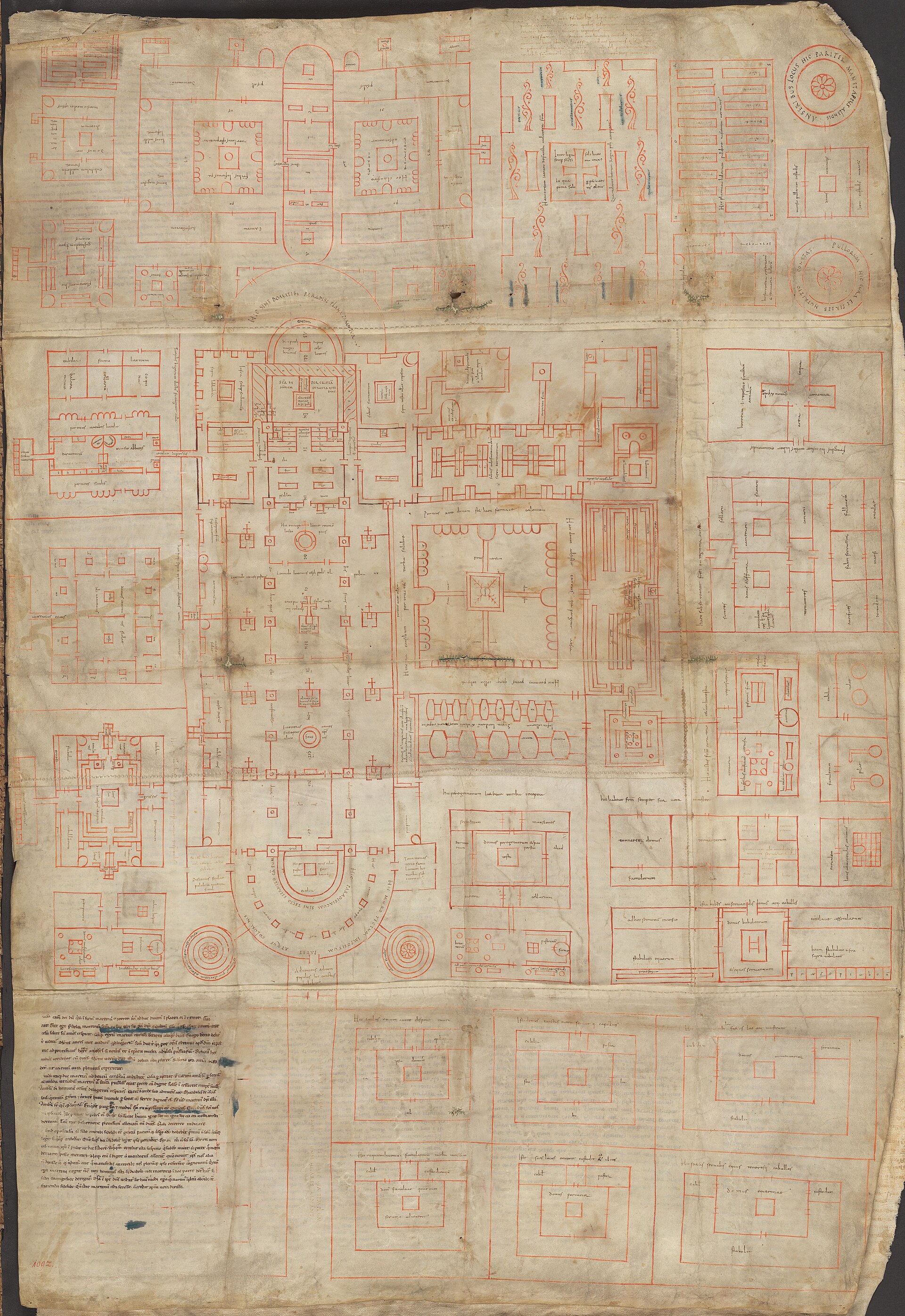
- Church and cloister: the central arrangement joins worship to the daily movement of the community.
- Learning: the school and the provision for books and writing give education a physical place.
- Care and reception: distinct accommodation for the sick and for different guests requires staff and supplies.
- Production: gardens, kitchens, workshops and agricultural provision support those services.
Edition and collection provenance
https://e-codices.unifr.ch/en/list/one/csg/1092
https://commons.wikimedia.org/wiki/File:Codex_Sangallensis_1092_recto.jpg

Existing internal magisterial text
St. Hildegard of Bingen · writings and community
The apostolic letter of 7 October 2012 recounts St. Hildegard’s formation, communities and writings in connection with her proclamation as a Doctor of the Church. It names the major theological works, letters, music and writings on nature and medicine associated with her.
The complete letter already belongs to the magisterial library. The link below opens that record directly. Hildegard’s own works are different sources: the letter is a biographical and doctrinal account, not a substitute edition of Scivias or her musical compositions.
Read the complete apostolic letter →
Edition and collection provenance
https://www.vatican.va/content/benedict-xvi/en/apost_letters/documents/hf_ben-xvi_apl_20121007_ildegarda-bingen.html
Collection guide with internal works
St. Thomas Aquinas · the order’s programme of study
Dominican study prepared friars for preaching, teaching and the examination of difficult questions. St. Thomas’s commentaries and disputed questions reveal the labour involved: identifying an objection, distinguishing terms and answering with reasons.
The internal Summa reader supplies the work itself. The historical notice about the order’s programme is a different kind of evidence, concerned with the organisation of study. Both belong in the dossier, but a modern biographical account should not replace access to Thomas’s own text.
Related primary text: study in religious life · II-II, q. 188, a. 5 →
Edition and collection provenance
https://www.vatican.va/content/benedict-xvi/en/audiences/2010/documents/hf_ben-xvi_aud_20100602.html
Collection guide with internal works
Paris · recognition of St. Bonaventure and the mendicant masters
The place of the mendicant masters at Paris was contested within the university’s corporate life. Recognition of St. Thomas and St. Bonaventure in 1257 followed conflict over teaching and the position of the orders.
The university was not created from nothing by the friars. Their houses of study participated in an existing learned corporation and supplied enduring works of theology. The internal library provides access to works for which the dossier names the author and the historical setting.
Related primary text: study in religious life · II-II, q. 188, a. 5 →
Edition and collection provenance
https://www.vatican.va/content/benedict-xvi/en/audiences/2010/documents/hf_ben-xvi_aud_20100303.html
Complete historical Latin edition
Guido of Arezzo · Micrologus
Guidonis Monachi Aretini Micrologus, edited by Ambrosius Maria Amelli, Rome: Desclée, Lefebvre et S., 1904. Latin original.
Latin verses, dedicatory letter, prologue and all 20 chapters; musical tables and nine diagrams retained; 3 historical edition notes included (some in Italian).
The twenty chapters explain the organisation and teaching of music: the monochord, intervals, modes and the relationship between voices. Tables and the historical diagrams accompany the text in the library reader. The chapter menu gives direct access to each part.
Read the complete Latin work in the library →
Edition and transcription provenance
Guido's eleventh-century Latin text and Amelli's 1904 edition are public domain. Amelli died in 1933. Mechanical figure reproductions are marked public domain individually. The Wikisource transcription is credited with permanent revision and CC BY-SA provenance.
Collection guide
Richard of Wallingford · astronomical clock
Richard of Wallingford, abbot of St. Albans, joined mathematical astronomy to the design of an elaborate astronomical clock. The project belongs to a setting of written calculation, instruments and the resources of a religious institution.
The clock and his mathematical writings answer different historical questions: a reconstruction can demonstrate a mechanism, while a treatise preserves the reasoning and instructions. The collection provenance should therefore be read as information about surviving records and later study, not as the original clock itself.
Edition and collection provenance
https://www.cabinet.ox.ac.uk/astronomical-clock-richard-wallingford-d-1336
Collection guide
Jean Mabillon · De re diplomatica, 1681
Mabillon’s De re diplomatica, published in 1681, developed the comparison of documentary materials, scripts, formulas and seals. Its importance lies in establishing criteria by which an apparently authoritative charter could be examined rather than accepted simply because it favoured an institution.
This method grew within Benedictine scholarship and archival controversy. The work helped make the history of institutions more exact by testing the documents on which claims depended. The edition record remains distinct from the complete patristic and monastic texts newly imported into this library.
Edition and collection provenance
Collection guide
Bernard de Montfaucon · Palaeographia graeca, 1708
Montfaucon’s Palaeographia graeca of 1708 organised evidence for the history of Greek handwriting. Comparison across manuscripts, especially dated examples, made script a source for identifying and situating written witnesses.
Palaeography and diplomatics overlap but are not identical. A handwriting comparison may help date a manuscript; a diplomatic examination asks further questions about a document’s form, production and authenticity. The dossier presents both as concrete scholarly methods rather than a general compliment to learned monks.
Edition and collection provenance
Collection guide
Kremsmünster · Mathematical Tower and observatory
Kremsmünster’s Mathematical Tower brought astronomical observation, instruments and natural collections into a monastic setting. The achievement depended on continuing work: equipment had to be maintained, observations recorded and collections ordered.
A building and its collections make institutional support visible, while surviving observations and catalogues establish the particular scientific work. The linked repository record documents the institution; the dossier’s map places it within the broader history of early modern religious scholarship.
Edition and collection provenance
Archive collection guide
Paris Charité · hospital archive
The Paris Charité belonged to a history of religious hospital care with its own buildings, personnel, patients and accounts. Its archive can answer concrete questions about admission, expenditure, staffing and the resources required for treatment.
A change of government does not establish a universal date on which all hospitals began charging every patient. That claim would require admission and payment evidence from the hospitals concerned. This collection is relevant because it allows care before and after institutional change to be investigated at that level.
Edition and collection provenance
https://blogs.aphp.fr/wp-content/blogs.dir/113/files/2013/04/37_Charit%C3%A9.pdf
Archive collection guide
Hospital Cochin · foundation for the poor
The Cochin foundation in Paris directed resources towards care for the poor in the late eighteenth century. It belongs to the history of endowed charity: a founder’s intention had to be translated into property, administration, staff and admissions.
Its records can distinguish the intended beneficiaries from the people actually admitted and show how the foundation was financed. The example gives substance to the Church’s contribution to care without making an unsupported claim about identical arrangements in every hospital.
Edition and collection provenance
https://blogs.aphp.fr/wp-content/blogs.dir/113/files/2020/09/20200910_Cochin.pdf
Archive collection guide
English monasteries · dissolution, 1536–1540
The English dissolution of 1536–1540 transferred monastic property to the Crown and dispersed communities. Buildings, books, pensions, local services and the subsequent sale of land followed different paths.
Administrative records make those transfers traceable. They can show what was inventoried, who received property and which former religious received support. A surviving church or manuscript is therefore part of the history of dissolution, not proof that the community and all its work continued unchanged.
Edition and collection provenance
https://www.english-heritage.org.uk/learn/histories/dissolution/
Imported original-language text
Gregor Mendel · Experiments on Plant Hybrids
Mendel’s paper reports controlled crosses between pea varieties, the appearance of contrasting characters and the results of subsequent generations. Its numerical series and combinations are the argument: the conclusions can be checked against the observations printed in the paper.
The internal edition contains the complete German paper of 1866, including its original fertilisation diagram and tables transcribed row by row. Superscripts in formulas are written as ^(…). The later Hieracium paper and the twentieth-century editor’s notes are not included.
Read the historical text in the library →
Edition and collection provenance
Collection guide
Gregor Mendel · Augustinian life and scientific work
Mendel entered the Augustinian community at Brno in 1843. Study, teaching, the monastery garden and the local scientific society formed the setting in which his experiments became a published investigation. His election as abbot in 1868 added administrative responsibilities to this work.
The surviving experimental paper is the primary text imported here. It establishes his procedure and results; a modern museum’s biography supplies additional collection context. Keeping those functions separate makes it possible to read the discovery itself before consulting later accounts of its reception.
Related primary text in the library →
Edition and collection provenance
https://mendelmuseum.muni.cz/en/about-the-museum/gregor-johann-mendel
Collection guide
Solesmes · restoration of Benedictine life in 1833
Dom Prosper Guéranger’s restoration of Benedictine life at Solesmes in 1833 re-established a living community, not merely a preserved monument. The work joined common prayer and formation to study and later efforts concerning liturgy and chant.
Solesmes belongs to the history of rebuilding after suppression. It was not an administrative continuation of every dissolved abbey. The Rule is available internally, allowing the religious framework of the restoration to be read directly.
Related primary text in the library →
Edition and collection provenance
https://www.abbayedesolesmes.fr/notre-histoire/la-restauration/
Comparative source guide
Urban II at Clermont · the surviving accounts
The surviving accounts of Urban II’s preaching at Clermont differ in wording, emphasis and distance from the event. They should be compared as accounts, not combined into a supposedly verbatim transcript of a speech for which no such transcript survives.
The common historical setting includes the appeal from the East, the pope’s preaching and the mobilisation that followed. The dossier’s chapters explain those connections; the campaign catalogue separates the launch of the movement from the experience of the armies that reached Jerusalem.
Edition and collection provenance
Institutional source guide
The crusading orders · rules and institutions
Crusading generated obligations that continued beyond a battlefield: vows, financing, protection of dependants and institutions caring for pilgrims or maintaining garrisons. The Hospitallers and Templars developed different beginnings and responsibilities.
Rules, papal privileges and financial records document those institutions more precisely than a single image of a medieval knight. The internal dossier follows their formation and the relation between a religious vocation, military service and the resources required to sustain both.
Edition and collection provenance
Comparative source guide
Richard I and Saladin · peace in 1192
The settlement between Richard I and Saladin in 1192 followed campaigning, supply problems and limits on what either army could secure. Christian access to Jerusalem and control of coastal positions formed part of a negotiated outcome rather than a final military conquest of the city.
Narratives from the opposing sides help explain the interests and constraints behind the agreement. The dossier places the settlement beside Frederick II’s different negotiations in 1229, so diplomacy appears as a recurring historical activity rather than an exception without context.
Edition and collection provenance
Comparative source guide
The Fourth Crusade · accounts and papal responses
The Fourth Crusade’s movement through Zara to Constantinople involved debts, transport, promises of support and competing claims to Byzantine power. The sack of 1204 cannot be explained by its original destination alone.
Papal instructions and responses must be distinguished from the decisions and acts of participants. Western and Byzantine accounts record different experiences of the crisis. The dossier traces that sequence and its consequences for relations between the churches, instead of treating the sack as the fulfilment of an uncomplicated papal plan.
Edition and collection provenance
Digitised primary manuscript and research edition
Sergius of Reshaina · the Syriac Galen Palimpsest
Galen, On Simple Drugs, in the Syriac translation of Sergius; ninth-century medical undertext, later hymn book
The surviving palimpsest preserves part of a Syriac translation of Galen's pharmacological writing beneath a later collection of hymns. Sergius of Reshaina made the translation in the sixth century; the medical copy and the later reuse belong to different periods. Imaging and textual comparison allow the older writing to be recovered. This is evidence for Christian participation in the transmission of Greek medicine before the Arabic translation movement.
Manuscript, edition and collection record
University of Pennsylvania Libraries project. Distinguish the sixth-century translation from the date of the surviving manuscript and its eleventh-century reuse.
Primary account in a historical printed edition
Hunayn ibn Ishaq · account of the Syriac and Arabic Galen translations
G. Bergsträsser, 1925 edition; Arabic text with German translation
Hunayn describes the practical work behind a translation: finding copies, examining the state of a Greek text and judging earlier Syriac or Arabic versions. His account supplies evidence about a network of collaborators and patrons rather than a single anonymous transfer of books. The ninth-century Christian physician belongs to the history of scientific translation; he should not be represented as a Latin Benedictine monk.
Manuscript, edition and collection record
Hunayn's own account identifies books, previous translations and patrons. Use the historical edition for any future full import, after checking its scan and edition rights; the MB45 author data do not constitute an import.
Manuscript collection record
Constantine the African · Pantegni and the Latin medical corpus
British Library, Harley MS 5098: Theorica Pantegni
The Pantegni was an extensive Latin adaptation of Arabic medicine associated with Constantine the African at Monte Cassino. Its surviving copies document circulation and revision within western medical learning. Its place in this dossier is the practical achievement of bringing a body of advanced material into Latin, not a claim that the monastery independently invented the medicine translated.
Manuscript, edition and collection record
The catalogue identifies Constantine as a monk at Monte Cassino. The University of Edinburgh's records identify translations from Arabic and Ibn al-Jazzar; Pantegni derives from al-Majusi.
- https://searcharchives.bl.uk/catalog/040-002050942
- https://archives.collections.ed.ac.uk/agents/people/16418
- https://www.cambridge.org/core/journals/arabic-sciences-and-philosophy/article/abs/almagusis-kitab-almalaki-and-its-latin-translation-ascribed-to-constantine-the-african-the-reconstruction-of-pantegni-practica-liber-iii/F32D27C36E557535F6C6C8031E8C70B7
Library study with manuscript witnesses
Gerard of Cremona · Latin Almagest
Late-twelfth-century Arabic-to-Latin translation; British Library Burney MS 275 and other witnesses
Gerard's version became a major Latin witness to Ptolemaic astronomy. It drew upon Arabic versions and assistance available in Toledo; its wide circulation contrasts with other medieval Latin versions that remained much less influential. The comparison shows why a history of translation must follow specific texts and manuscripts, rather than assume that every Greek scientific work reached Latin readers by one route.
Manuscript, edition and collection record
The account distinguishes Gerard's Arabic translation from other Latin versions, including a direct Greek version. It dates publication and revision approximately 1175–1185.
Primary autograph manuscript, institutional exhibition record
William of Moerbeke · autograph translation of Archimedes
Vatican Library, Ottob. lat. 1850; translations made at Viterbo in 1269
Moerbeke's own manuscript preserves his Latin Archimedes with the commentaries of Eutocius. He completed the translations at the papal court in Viterbo in 1269. Because the Greek books he used have disappeared, the autograph is evidence both for a Dominican translator's method and for the mathematical text available to him.
Manuscript, edition and collection record
The Library of Congress/Vatican exhibition identifies the autograph and the two lost Greek exemplars. The museum's object record independently identifies Ottob. lat. 1850 and the Viterbo translation of 1269.
Primary manuscript and scholarly catalogue
Priscian in an Irish school · St. Gall Codex 904
Cod. Sang. 904, Prisciani grammatica; ninth century, catalogue date 851
The manuscript contains Priscian's Latin grammar with more than nine thousand glosses, thousands of them in Old Irish. Its annotations preserve the labour of explaining an ancient grammatical text to later pupils. The surviving book belongs to the Abbey Library of St. Gall, while its Irish production and uncertain precise workshop must be kept distinct from that later location.
Manuscript, edition and collection record
Ireland is the production region; Bangor or Nendrum are proposals. Do not treat the date of copying as a dated arrival at St. Gall.
Primary musical manuscript and scholarly catalogue
St. Gall Cantatorium · Codex 359
St. Gallen, Stiftsbibliothek, Cod. Sang. 359; 922–926
The Cantatorium was copied and notated at St. Gall in the early tenth century. It records the solo portions of the Mass chant with refined neumes. These signs preserve information about musical movement and delivery within a living oral tradition, allowing later scholars to compare readings and performance indications in an actual medieval witness.
Manuscript, edition and collection record
The book supplies concrete evidence for fine-grained neumatic notation. Staffless neumes should not be described as modern pitch-and-duration notation.
Primary Latin treatise; historical music-theory edition
Guido of Arezzo · Letter to Brother Michael
Epistola ad Michaelem, passage on Ut queant laxis and the recognition of intervals
Guido's letter explains a method for recognising pitches through familiar sung phrases. The successive openings of Ut queant laxis supply the syllables ut, re, mi, fa, sol and la. Read alongside the Micrologus, this gives a specific account of musical teaching. It does not support attributing all later rhythmic notation or the modern five-line system to one act of invention.
Manuscript, edition and collection record
Indiana's original TML endpoint currently redirects to the service notice. The university links its provisional service from that notice. Preserve provenance; do not publish a claim that the unavailable endpoint is an already imported full text.
University instrument history and biographical evidence
Hermann of Reichenau · astrolabe, mathematics and musical theory
De mensura astrolabii and the associated usage tradition, c. 1050
Hermann's work includes mathematical instruction, computus, astronomical instruments and musical theory. An astrolabe joins a representation of the sky to measurement and calculation; its use could help determine the relation between altitude, horizon and hour. The surviving tradition also shows dependence on earlier learning, a normal part of developing a usable scientific textbook.
Manuscript, edition and collection record
FAU distinguishes construction instructions from material derived from Gerbert. HLS confirms the fields of work and ordination around 1043. Do not repeat MacTutor's erroneous statement that Hermann became abbot in 1048.
University mathematical account of a primary treatise
Hermann of Reichenau · the lunar month and units of calculation
Epistola de quantitate mensis lunaris, c. 1040; Abbreviatio compoti, 1042
The calendar calculation apportions nineteen Julian years among 235 lunar months. In the units reported for Hermann's treatment, the average is 29 days, 12 hours, 29 moments and 348 atoms. The denominator is important: a moment is one fortieth of an hour and an atom one 564th of a moment. This example demonstrates exact computistical reckoning without establishing priority for the modern sixty-minute and sixty-second system.
Manuscript, edition and collection record
The calculation uses 40 moments/hour and 564 atoms/moment. Its historical units cannot be equated with the invention of modern minutes and seconds. A complete primary edition has not been imported by these author data.
Primary manuscript and scholarly catalogue
Bede's astronomical teaching in the St. Gall collection
Cod. Sang. 250, late ninth century; De temporum ratione, pp. 164–425; chapter 32 for daylight and terrestrial roundness
St. Gall Codex 250 is an astronomical and computistical compilation from the late ninth century. It includes a substantial copy of Bede's On the Reckoning of Time with diagrams and other instructional material. The manuscript demonstrates the deliberate assembly of a scientific reference book within the monastic collection. Bede's discussion of varying daylight uses the roundness of the Earth; the imported Ecclesiastical History should not be presented as if it contained that separate treatise.
Manuscript, edition and collection record
The catalogue identifies the monastic scientific compilation. Consult Bede's De temporum ratione for the actual astronomical argument; his internally imported Ecclesiastical History is a different work.
Digitised primary map and museum research edition
Fra Mauro · the world map and its inscriptions
Mid-fifteenth-century map; cosmographical sources and inscriptions discussing Ptolemy
Fra Mauro's map joins geographical drawing to extensive written discussion. Its inscriptions compare inherited authorities with more recent reports and explain decisions in representing the world. The work supplies evidence for active geographical criticism in a Camaldolese setting, while the digital edition allows individual inscriptions to be examined in their place on the map.
Manuscript, edition and collection record
Museo Galileo/Biblioteca Marciana digital research project. Fra Mauro was a Camaldolese lay brother. The circular map is not a physical globe.
- https://mostre.museogalileo.it/framauro/it/
- https://mostre.museogalileo.it/framauro/it/contesto-storico-m/fra-mauro/fra-mauro-cosmografo.html
- https://mostre.museogalileo.it/framauro/it/cosmografia-e-fonti-m/fonti-cosmografiche/tolomeo.html
- https://www2.museogalileo.it/it/biblioteca-e-istituto-di-ricerca/progetti/teche/2207-il-mappamondo-di-fra-mauro.html
Surviving instruments and museum collection records
Vincenzo Maria Coronelli · terrestrial and celestial globes
Great globes of 1683; Venetian published series and Accademia degli Argonauti
Coronelli's globes represented both the Earth and the heavens. The large pair made for Louis XIV was followed by published globes and atlases associated with his Venetian work. Their construction required information gathering, spherical representation, engraving or painting and skilled manufacture. They are specific surviving achievements of a Franciscan cosmographer, rather than evidence that he originated the idea of a globe.
Manuscript, edition and collection record
The Museo Galileo identifies Coronelli as a Conventual Franciscan. The BnF holds and documents the great royal pair. Distinguish these surviving works from an unsupported invention-of-the-globe claim.
University biography and historical calendar documents
The Gregorian reform · Lilius, Clavius and the commission
Reform promulgated in 1582; Clavius's mathematical exposition and defence
The Gregorian calendar addressed the accumulated drift of the Julian calendar and the calculation of Easter. Lilius's proposal and the papal commission led to the reform; Clavius supplied sustained mathematical explanation and defence. The result arose from several contributors. The historical bull is Inter gravissimas of 1582, which must be distinguished from later papal documents with the same opening words.
Manuscript, edition and collection record
The existing Catholon magisterium ID inter-gravissimas refers to 1910, not the bull of 1582. It must not be used as a link to Gregory XIII's calendar bull.
Primary printed map in a research-library exhibition
Riccioli and Grimaldi · the lunar map of 1651
Almagestum novum, Bologna, 1651; lunar map and nomenclature
The map provided a durable vocabulary for lunar observation. Grimaldi's mapping and Riccioli's arrangement of names allowed subsequent observers to discuss the same physical features. Many names remain in use. That continuing value can be recognised while keeping it separate from Riccioli's arguments for a stationary Earth.
Manuscript, edition and collection record
Linda Hall credits Grimaldi's mapping and Riccioli's names. The Library of Congress records the 1651 work and offers a digitised copy.
Research translation and analysis of a primary scientific work
Riccioli · arguments, falling bodies and the Earth's motion
Almagestum novum, 1651; arguments for and against the Copernican hypothesis
Riccioli assembled physical and astronomical arguments on both sides of the Earth's motion. His treatment included observations and experiments as well as inherited discussions. The surviving numerical work on falling bodies permits a modern reader to inspect the calculation, units and possible measurement errors. It records a serious research programme whose conclusions must still be distinguished from later mechanics.
Manuscript, edition and collection record
Christopher M. Graney gives the arguments and their observational context. Patrick B. Warren examines the numerical free-fall calculations; neither source licenses treating Riccioli's cosmology as the modern result.
Institutional observatory history with archival references
Placidus Fixlmillner · the Kremsmünster observatory and Uranus
Director 1762–1791; instruments, stellar observations and Uranus orbit tables
Fixlmillner worked from the Benedictine observatory with instruments acquired, built and improved for measurement. After Uranus was discovered, he contributed observations and improved orbital tables while corresponding with other astronomers. The abbey sustained a working research institution whose results were compared beyond its own walls.
Manuscript, edition and collection record
The abbey's account identifies the actual observing programme and instruments. Avoid claiming that Fixlmillner discovered Uranus; Herschel's discovery preceded this orbital work.
Institutional history of editions and manuscript research
Solesmes · Paléographie musicale and manuscript comparison
Dom Jausions's manuscript work; Gradual of 1883; facsimile series begun in 1889
Solesmes's restoration of Gregorian chant was accompanied by the collection and comparison of medieval witnesses. Mocquereau's facsimile series, begun in 1889, made manuscripts available for checking editorial claims. The work connected daily liturgical practice to a research collection and to printed evidence that other scholars could examine.
Manuscript, edition and collection record
The abbey describes the collection, publication and comparison of manuscript witnesses. Its current description is bibliographic provenance, not a newly imported historical primary text.