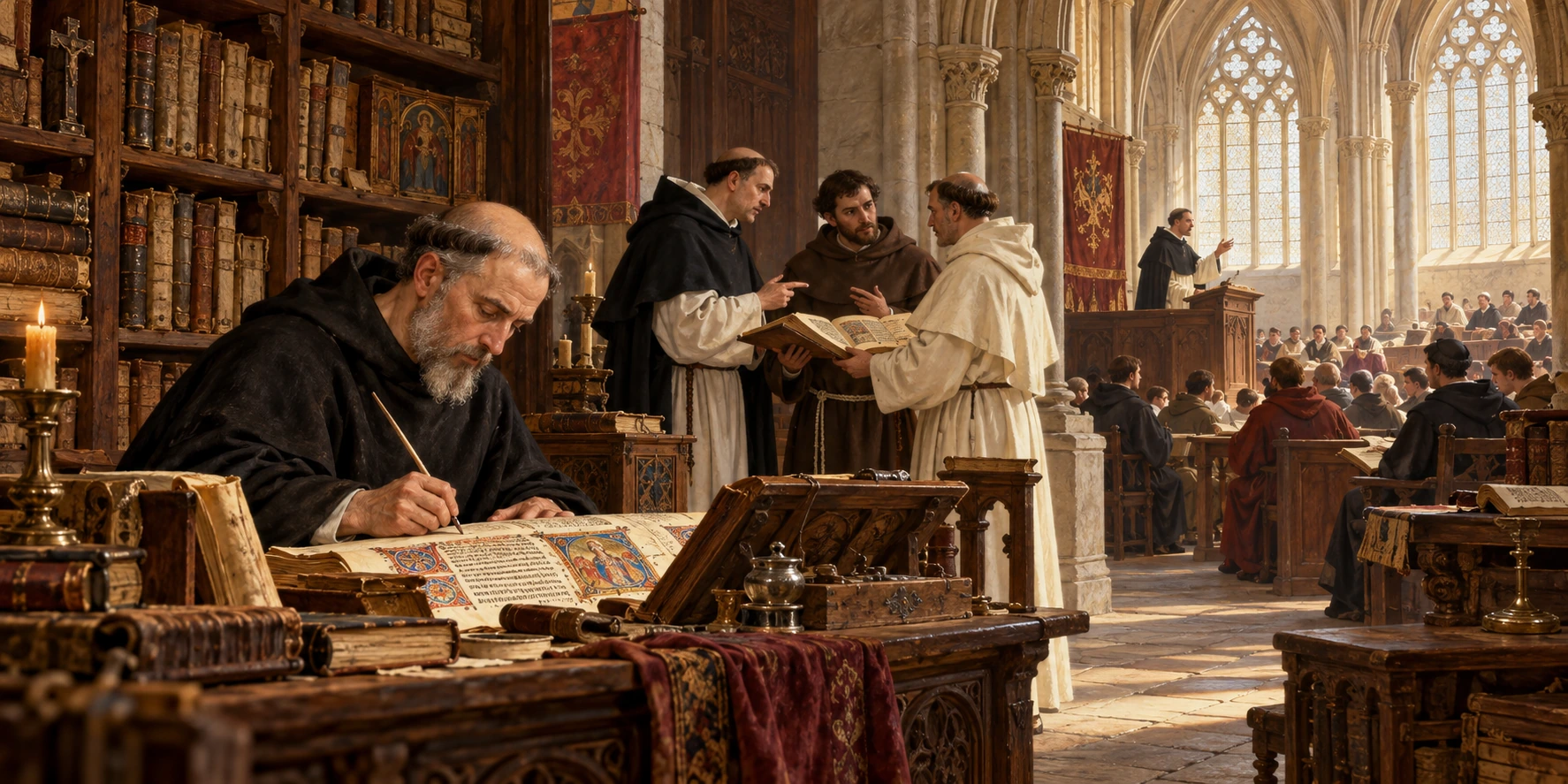
From the Egyptian desert to an Augustinian garden in Brno, religious communities turned a life of prayer into lasting schools of work, care and learning. This dossier follows the people, rules, books and institutions through which that service spread: St. Antony and St. Basil, St. Jerome and St. Augustine, St. Benedict, the Irish missions, medieval abbeys and friars, early modern scholars, and Mendel. It also follows the losses caused by dissolution and the work of rebuilding.
Monastic life, books, music and science: from the desert to Solesmes
The route now branches east to Syriac and Arabic translation workshops and west to the Irish manuscripts preserved at St. Gall. Monte Cassino, Toledo and Viterbo show scientific books changing languages. Reichenau, Venice, Bologna and Paris add instruments, maps and observations; the sequence closes at Solesmes, where medieval chant manuscripts entered a modern photographic edition.
The story through270Move the timeline to reveal events
Earlier events stay visible as the story unfolds.
↑ N
Monastery / religious houseHospital / organised careSchool / scholarshipPapal office / electionCharter / law / decree
Move the timeline to reveal events in date order; previous events remain visible. Select a numbered badge to separate nearby records. Fine leader lines connect displaced symbols to their locations. Drag to move the map; use +/− to zoom. Left/Right changes year and Home fits the focused map. Dashed connections are schematic, and city locations are approximate.
St. Antony’s response to the Gospel led him from ordinary household life into ascetic discipline. Other Christians sought counsel and adopted a similar vocation. The Egyptian beginning supplied a pattern of prayer, work and formation which later travellers carried into the wider Christian world.
Pachomian communities gave the ascetical vocation a shared discipline, with superiors and organised work. This common life could train many members and continue beyond one founder. It supplied another model beside the solitary life associated with St. Antony.
Near Caesarea, St. Basil developed care for people excluded by poverty and disease. St. Gregory of Nazianzus describes the work in his funeral oration. The religious community’s service gave Christian charity a continuing material form rather than leaving the sick to occasional individual gifts.
Religious communities and patronage supported biblical translation, reading and common worship at Bethlehem. Paula’s women’s houses combined scriptural learning with assigned work. The books produced and studied here would shape the Latin West’s inherited learning.
Augustine’s community joined common possessions and prayer to mutual responsibility. His later defence of labour challenged monks who used religious arguments to avoid work. The rule became an inheritance for later institutions, including distinct traditions of canons and mendicant friars.
John Cassian brought the teaching of eastern ascetics into the monasteries of southern Gaul. His Institutes and Conferences made experience available through written instruction. Benedict later recommended these works, linking western formation to an older monastic inheritance.
The traditional date locates Benedict’s foundation amid the instability of sixth-century Italy. The Rule ordered reading, labour, authority and care as parts of a durable common life. Its later reception gave widely separated houses a shared vocabulary of religious responsibility.
Cassiodorus gathered books and organised instruction for religious readers after a career in government. His Institutions connected Scripture with grammar and other tools of study. The house provided a setting in which learned work could continue despite the disruption of Italian political life.
Iona became a centre of mission and formation in northern Britain. Sea travel connected the island to a wider Christian network. Trained members could leave to establish or strengthen other communities, so the island’s influence extended beyond its small physical size.
Columbanus and his companions brought Irish religious discipline into Frankish territory. Luxeuil trained successors and helped transmit monastic observance. The foundation became a point from which communities and learning could spread through the Continent.
The settlement of St. Gall supplied the religious beginning remembered by the later abbey. It preceded Otmar’s organisation of the monastery in 719. Keeping both dates reveals the growth from a missionary place of prayer into a durable Benedictine institution.
Bobbio carried the Irish monastic current into Lombard Italy. Its community and later library became part of the network through which books and religious formation circulated. The sequence from Ireland through Gaul to Italy makes the transmission visible without treating every foundation as identical.
Abbot Ceolfrith set out with the Bible now known as the Codex Amiatinus. Its production required a coordinated monastic copying project. The journey connected a Northumbrian community to Rome, while the surviving volume preserves the result of its material and scholarly work.
St. Otmar organised the community at the place associated with St. Gall. The settlement could now develop as an enduring abbey, with common discipline and resources for care and learning. Its later adoption of the Benedictine Rule in 747 and its manuscript production show successive stages of growth. The Irish missionary beginning became a major centre of the Christian culture north of the Alps.
The calculation of Easter required arithmetic and knowledge of calendrical cycles. Bede’s treatise organised that learning for readers. Worship thus gave a practical reason for sustained mathematical instruction and the transmission of natural knowledge.
The Plan of St. Gall coordinated worship, school, guests, care and production. Drawn at Reichenau for the community at St. Gall, it records an intended arrangement rather than a survey of completed buildings. Its separate facilities show how many duties a large religious house was expected to support.
Irish scribes copied Priscian's Latin grammar and filled it with explanations, including thousands in Old Irish. The manuscript now kept as St. Gall Codex 904 records an active school culture: an inherited text was being parsed, translated and taught. Its later presence on the continent connects Irish scholarship with the surviving abbey collections.
Hunayn ibn Ishaq's account identifies Greek medical works, earlier translations and the people who requested new versions. This Christian scholar and his collaborators made Syriac and Arabic texts through comparison and revision. Their work explains one of the eastern routes by which ancient medicine reached later Arabic and Latin readers.
William of Aquitaine endowed Cluny for prayer and protected the community’s possessions and choice of abbot. These legal arrangements supported a religious life intended to continue beyond the donor’s lifetime. The later network of dependent houses carried observance across regions and supplied a durable framework for worship, hospitality and the care of books.
The Cantatorium preserves the solo chants of the Mass with carefully drawn neumes. These signs helped trained singers retain fine distinctions of musical delivery. They make the abbey's musical achievement inspectable today and establish the older written tradition against which later staff notation and modern chant editions can be compared.
Guido’s Micrologus made the relationships of music a subject of systematic teaching. Written methods helped pupils learn chant with less dependence on repeated oral demonstration. The achievement enlarged the means of handing on a skilled practice.
Hermann's work joined lunar calculations, the abacus, astronomical instruments and musical theory. His calendar arithmetic divided the hour into forty moments, not the sixty-minute clock face familiar today. The achievement was practical mathematical instruction: pupils could follow a calculation and learn how an instrument related the sky to their own horizon.
Constantine the African worked within the community of Monte Cassino on Latin versions and adaptations of Arabic medical books. The Pantegni and related texts gave readers a connected body of medical teaching. Manuscript copies then carried the work to other houses and schools, extending the abbey's influence beyond its own infirmary.
Robert of Molesme and companions founded Cîteaux in pursuit of a stricter Benedictine observance. Their work began as the reform of a common religious life. The later use of daughter houses, visitation and a general chapter gave expansion an organised structure. New communities could share discipline while carrying cultivation, hospitality and learning into their own local settings.
St. Stephen Harding sent St. Bernard and companions from Cîteaux to found Clairvaux. The new house became a powerful centre of Cistercian expansion. Training members and sending communities to further foundations gave the reform an influence beyond Bernard’s personal preaching and correspondence. The monastery’s resources sustained a continuing form of work and prayer.
St. Hildegard established a women’s community at Rupertsberg around 1150. As abbess she organised religious and material life while producing writings, music and correspondence. The house supplied the setting in which those works could be composed, performed and transmitted. It places women’s learned religious activity within the same history of institutions that sustained books and education elsewhere.
Gerard of Cremona's Almagest drew on Arabic versions of Ptolemy and the help available in Toledo. Its later circulation made a demanding mathematical system accessible to Latin astronomers. This urban translation work complemented monastic study and supplied texts that religious teachers and universities could examine in detail.
St. Francis and his companions sought and received Innocent III’s approval for the beginnings of their evangelical life. The later Rule received formal confirmation in 1223. A growing movement now had a place within the Church’s government and a means of extending its vocation. Its houses would bring preaching, poverty and eventually organised study into the towns.
St. Clare entered the religious life associated with St. Francis and established a community at San Damiano. The women’s house gave stability to a vocation within the wider Franciscan movement. Worship, formation and material provision had to be maintained together. The foundation adds another distinct form of women’s religious life to the map, alongside Hildegard’s Benedictine community.
St. Dominic established a preaching fraternity at Toulouse. The religious controversies of the region required teachers able to explain the faith and answer objections. A community could train and sustain those preachers beyond the work of one individual. Study consequently became part of the practical equipment of the new vocation.
Honorius III confirmed St. Dominic’s community in December 1216. Papal recognition gave the developing order a stable ecclesiastical position from which to expand. The next stage was the sending of friars to important centres of study and ministry. The movement from Toulouse to wider recognition connected a local need with an enduring institution.
St. Dominic sent friars to places that included Paris. The growing school environment offered teachers, books and students, making it an important setting for the preparation of preachers. The order’s investment in study tied its urban ministry to serious intellectual formation. Later masters emerged from this decision to place religious houses close to advanced learning.
Franciscan friars established themselves at Oxford in 1224. Their community entered an expanding university setting where books and teachers could serve the order’s formation. The presence of the friars connected an evangelical vocation with advanced study. Their intellectual tradition developed through the continuing work of a house, not a renunciation of the order’s religious purpose.
The union brought several hermit communities into the mendicant Order of St. Augustine. It was a thirteenth-century institution drawing upon an older rule, rather than the unchanged survival of Augustine’s own house. Its friars joined the developing world of urban ministry and study.
Papal intervention helped secure recognition of the mendicant masters at Paris after disputes over their place in the university. St. Bonaventure’s recognition and election as minister general in 1257 show the relation between learned work and government of an order. The university gained teachers whose religious communities had sustained their formation; the communities also needed those masters to train successors.
The Dominican general chapter at Valenciennes organised the order’s programme of studies with the involvement of masters including St. Thomas Aquinas. Teaching required a curriculum, suitable books and responsibilities shared across houses. This internal work complemented the public recognition obtained at universities. The learned apostolate depended on a system able to prepare the next generation of teachers.
William of Moerbeke translated Archimedes and Eutocius directly from Greek. His autograph survives in the Vatican Library, while the Greek exemplars he used have been lost. The manuscript provides a tangible measure of the friar's service: later readers can consult mathematical evidence that would otherwise have disappeared with those copies.
Richard of Wallingford became abbot while pursuing astronomical instruments and clock design. The abbey supported mathematical work with a mechanical application. The result was a specific contribution to modelling celestial motion, not a claim to have invented every form of clock.
Fra Mauro assembled a world map from authorities, travel reports and geographical argument. Its numerous inscriptions explain decisions and discuss information that older maps could not supply. Made in the setting of a maritime trading city, the work shows a religious community participating in the correction and expansion of geographical knowledge.
Royal legislation began the suppression of religious houses, completed on a much wider scale by 1540. Communities lost their corporate life and property; buildings and collections were dispersed or adapted. London locates the central political decision, not every house affected.
The royal foundation of 1551 establishes the university in Lima. Its first academic home is the Dominican Convent of the Rosary, where theology and arts connect religious study with university teaching.
Monks from Tibães establish São Bento da Bahia in Salvador. The house becomes a starting point for further Brazilian foundations, preserving records and books alongside its liturgical life.
Pope Gregory XIII promulgated a calendar reform developed through a commission and the proposal of Aloysius Lilius. The Jesuit Christoph Clavius explained and defended its mathematics. The change addressed accumulated drift through revised rules, bringing a long ecclesiastical concern with the date of Easter into the administration of everyday time.
The Dominicans establish the college in Intramuros using Miguel de Benavides’s bequest and library. Founded in 1611, it receives university status in 1645 and develops into the University of Santo Tomas.
Grimaldi's mapping and Riccioli's nomenclature appeared in the Almagestum novum. The named features allowed observers to refer to the same craters and dark regions. Many names survived later changes in astronomical theory, showing how useful observations and reference tools could endure even when an author's larger celestial model was superseded.
Mabillon used writing, seals, formulae and other evidence to test documentary authenticity. The Maurist Benedictine project made historical criticism a disciplined comparison of witnesses. Its methods could identify a false document even where its contents appeared convenient.
The Conventual Franciscan Vincenzo Maria Coronelli produced a terrestrial and a celestial globe for Louis XIV, each approximately four metres across. Reports, maps and star positions had to be organised on a spherical surface. The later smaller globes and atlases extended this work beyond a single royal commission.
Palaeographia graeca compared scripts and supplied specimens for other scholars to inspect. It advanced the dating and reading of Greek manuscripts. Monastic scholarship was developing new critical tools, rather than only repeating the contents of old books.
The abbey began a tower combining an observatory, instruments and scientific collections. Largely complete in 1758, it gave repeated observation a lasting institutional home. The project required the sustained resources of the community, beyond the interests of one visitor.
Placidus Fixlmillner directed astronomical work from 1762 to 1791. The building’s purpose was fulfilled through observations, instruments and records maintained over time. The abbey’s scientific life therefore continued beyond the initial construction project.
Father Cochin’s foundation opened with thirty-eight beds for poor patients. His resources became a building and a continuing provision of care. Its later survival under changed names shows both the original charitable achievement and the complexity of revolutionary institutional change.
The ruler’s programme judged religious communities by a state-defined standard of public usefulness. Contemplative houses lost the freedom to continue their vocation on their own terms. Resources could be redirected to other purposes while the suppressed community’s common life ended.
The transfer of church property preceded measures against religious vows and communities. It changed the resources upon which worship, schools and charity depended. The consequences had to be worked out institution by institution: acquiring a building did not automatically preserve its community or duties.
The hospital passed to a new administration and was known as the Hospice de l’Unité. Its brothers continued caring for patients until 1801. This documented sequence shows why confiscation, departure of religious staff and the financing of care cannot all be assigned one universal date.
Secularisation transferred the property of many religious institutions and dispersed their communities. Some collections passed into public libraries while other goods were lost. The survival of selected books did not continue the school, prayer and service of the suppressed house.
The religious community’s long institutional history ended under the new political settlement. Its library and archive survived as an inheritance of the abbey’s work. The event distinguishes the preservation of cultural objects from the continuation of the life that had produced them.
Dom Prosper Guéranger established a living community in the former priory. Restoration required people, formation and a daily order of worship and study. It renewed a vocation after suppression rather than merely conserving an old building.
Edward Sorin and brothers of the Congregation of Holy Cross establish Notre Dame in Indiana. This teaching congregation adds another form of religious educational work alongside the monastic foundations.
Achievement and legacy
A later fruit of this university was the chemistry of Father Julius Nieuwland, C.S.C. His acetylene research helped DuPont researchers, including Wallace Carothers and Arnold Collins, develop neoprene, announced in 1931. Chloroprene rubber is still used in hoses, cable insulation, gloves and wetsuits.
The community at St. Thomas provided a setting for religious life, teaching and study. Mendel’s later experimental work grew within this educational and material environment. The map now reaches a nineteenth-century continuation of the monastic intellectual tradition.
José Benito Serra and Rosendo Salvado begin the New Norcia mission in 1846. The Benedictine community combines prayer, agriculture and teaching, establishing a monastic presence far beyond Europe.
Boniface Wimmer and his companions establish Saint Vincent in Pennsylvania. Monastic life, pastoral care and the college develop together; the foundation becomes a centre of Benedictine expansion in the United States.
Monks from Melleray establish Gethsemani in Kentucky on 21 December 1848. The foundation carries Cistercian communal prayer and work into the United States and becomes an abbey in 1851.
Mendel selected contrasting traits and controlled fertilisation, then counted offspring through successive generations. A garden became a place for testing a precise question about inheritance. Sustained records made it possible to distinguish a pattern from a casual resemblance.
Seven Benedictine sisters arrive at Atchison in November 1863. Under Mother Evangelista Kremmeter they found Mount St. Scholastica and open an academy that December, joining communal prayer with girls’ education.
The lectures of 1865 and paper of 1866 reported regular numerical relationships in plant crosses. The results joined experimental design to a model of inheritance. They supplied a major scientific discovery without depending on the later chromosomal explanation.
The Benedictine community moves to the site beside Lake Sagatagan. Its college, opened near Saint Cloud in 1857, grows with the abbey into the educational tradition of Saint John’s University.
Achievement and legacy
From 1965, the manuscript-preservation initiative begun by Saint John’s Benedictines photographed endangered collections on microfilm. HMML later expanded to digital preservation with local partners in Europe, Africa and Asia; its online reading room makes manuscript images available to researchers worldwide.
Herman Wolfe comes from Saint Vincent to establish a monastery and educational institution in North Carolina. The foundation of 1876 becomes Belmont Abbey and Belmont Abbey College.
Francis Pfanner establishes a Trappist monastery near Durban. The expanding missionary undertaking eventually develops into the separate Congregation of the Mariannhill Missionaries in 1909.
Mendel died after serving as abbot from 1868. His published work remained available for later readers, while the community continued its own history. The dossier closes with this completed life: the contribution of religious communities to knowledge had extended far beyond the medieval period.
Missionary Benedictines open a community at Pugu in present-day Tanzania. The station is destroyed in January 1889; Sister Martha Wansing and two brothers are killed.
Dom André Mocquereau began Paléographie musicale by publishing facsimiles of medieval chant manuscripts. Comparison of actual witnesses could now accompany the printed restoration of a melody. The enterprise extended monastic preservation into modern research and made the reasoning behind an edition more open to examination.
Map sources and geographical method
This map follows the dossier’s selected places and institutions. Events appear at the start of their stated date range and remain visible at later steps. Their continued visibility records the earlier event, not uninterrupted control or activity. Physical geography supplies orientation; no historical state boundaries are reconstructed. Institutional and comparison lines are schematic, and representative locations are identified in the record notes.
Physical geography: Natural Earth, 1:10m public-domain land, coastlines, natural lakes and major rivers. Projection: Web Mercator; high latitudes are enlarged. Contemporary coastlines provide orientation rather than a reconstruction of every historical shoreline. The map’s city coordinates locate named places approximately, not exact buildings.
Extended reading
History and institutions
Chapter 01
The desert becomes a school of Christian life
Christian monastic life began before the collapse of the Western Roman Empire. In third- and fourth-century Egypt, Christians left ordinary households to devote themselves to prayer, conversion and the service of God. St. Antony, born around 251, became the best-known representative of the solitary life. St. Pachomius developed communities in which brethren lived under an agreed discipline, with superiors, common worship and organised work. The distinction mattered: a vocation that depended on the endurance of an exceptional hermit could become a stable way of life for many people. Egypt, Palestine and Syria supplied the Latin West with models of religious life long before the medieval European abbey existed.
Withdrawal from the world did not mean that every obligation to other people disappeared. St. Athanasius describes Antony counselling visitors and reconciling disputes; the communities around him combined prayer with work and almsgiving. The monk renounced competition for honour and wealth so that his life could be ordered to a different end. Food still had to be produced or obtained, younger brethren trained and the sick cared for. Common discipline made those duties repeatable. It provided the small institutions through which a religious ideal could survive its founder.
In Cappadocia, St. Basil joined the ascetical life to the commandment of charity. His complex outside Caesarea cared for people whose poverty and disease had driven them from normal society. St. Gregory of Nazianzus, in his funeral oration for Basil, describes care for sufferers who had been shunned. Here the Christian obligation to recognise a neighbour in the destitute acquired buildings, resources and attendants. This was a fourth-century achievement, not a service first discovered by a modern state. It also shows why the histories of contemplation and practical charity belong together.
The first monks were not planning European universities. Their purpose was to follow Christ. Yet a community built around a rule, a remembered body of teaching, a timetable and the training of successors already possessed the means of transmitting knowledge. The desert supplied disciplines of attention, reading and mutual responsibility. Later monasteries would apply those disciplines in different landscapes, from the Mediterranean to Ireland and the forests north of the Alps.
01“Monks fled the world and contributed nothing.”+
The historical evidence
A monastery’s religious purpose does not erase its public consequences. The Plan of St. Gall assigns space to school, guests, the sick and practical production. The surviving Codex Amiatinus and Bede’s works identify results of monastic labour. These are buildings planned, books made and subjects taught, not promises about usefulness.
Answer to the objection
Withdrawal from ordinary family and commercial life made sustained common work possible. Prayer remained the end of the vocation; education and service were concrete fruits. The existence of a bad or declining house cannot cancel the documented work of another.
Chapter 02
St. Jerome, St. Paula and St. Augustine: books and a common life
Bethlehem became one of the places where the ascetical movement and Christian scholarship met. St. Jerome settled there in 386; St. Paula supported religious communities and the material conditions of his work. His biblical translations and commentaries required comparison of languages, manuscripts and interpretations. The Latin Bible associated with his labours would shape worship and learning in the West for centuries. This work was neither a rejection of difficult learning nor the casual copying of whatever lay nearest. It depended on linguistic study and sustained attention to the text.
Paula was an organiser as well as a benefactor. In Letter 108, Jerome describes communities of women who shared the psalmody, learned Scripture and performed allotted work. Their common religious life required instruction. Wealth that might have supported a great Roman household instead sustained women’s communities, hospitality and biblical scholarship in Palestine. The labour of these women belongs inside the story of Christian learning, rather than in a footnote to a male scholar’s achievement.
In North Africa, St. Augustine gathered companions into a common life, first after his conversion and later at Hippo. His rule ordered the community toward unity in God, common possessions and provision according to need. Its brief instructions address food, clothing, correction, prayer and care of the sick. Augustine also confronted a practical abuse: monks who invoked religious arguments to avoid working. In On the Work of Monks he defended the apostolic example of labour. Christian contemplation was not a licence to transfer every burden to someone else.
Several later traditions drew upon Augustine, but their dates must remain clear. Canons regular developed communal life around a clerical and pastoral vocation. The mendicant Order of Hermits of St. Augustine arose from thirteenth-century unions, culminating in the Grand Union of 1256. Mendel’s nineteenth-century community at Brno belonged to that order. These were successive appropriations of an Augustinian inheritance, not one unchanged organisation operating from the fourth century onward. Their continuity lay in a rule and a spiritual purpose transmitted through new foundations.
John Cassian provided another bridge from the eastern ascetics to the Latin world. His Institutes and Conferences brought the experience of Egyptian communities into the monasteries of southern Gaul in the early fifth century. Benedict would later recommend Cassian’s writings. The formation of western monasticism was therefore a connected history of travellers, translations and communities: Egypt and Palestine were active sources of the tradition that took root in Europe.
Chapter 03
Greek, Hebrew and Syriac: Christian learning before the Arabic translations
Christian scholarship began with a demanding task: to proclaim and explain the Scriptures across languages without losing their meaning. St. Jerome's work at Bethlehem joined the comparison of Latin and Greek versions to sustained study of Hebrew. St. Paula supplied material support for the communities around him and shared their scriptural study. In Letter 108, Jerome describes her learning Hebrew and singing the Psalms in their original language. This was more than the storage of books. It required teachers, linguistic training, the comparison of readings and the patient correction of a text used in preaching, prayer and instruction.
East of the Greek-speaking Mediterranean, Syriac-speaking Christians carried another part of ancient learning forward. Sergius of Reshaina, a priest and physician who died in 536, translated Greek medical writings into Syriac. His translation of Galen's On Simple Drugs survives in a manuscript copied centuries later and subsequently reused for a hymn book. Modern imaging has recovered much of the erased writing. The surviving object records both the labour of translation and the precarious material life of a book: parchment could be scarce, a text could cease to be read, and reuse could preserve traces which ordinary copying had failed to transmit.
In ninth-century Baghdad, the Christian physician Hunayn ibn Ishaq and his collaborators compared Greek manuscripts and produced Syriac and Arabic versions of Galen. Hunayn's own account of his translations identifies works, earlier versions, commissions and problems in the available copies. Arabic scientific culture thus received part of its Greek inheritance through Christian linguistic expertise, while its scholars also developed new arguments, observations and medical writing. The route was a chain of identifiable acts of scholarship, rather than a single civilisation handing an untouched package to another.
These eastern scholars belonged to different Christian communities; they should not all be called Latin monks. Their work nevertheless belongs beside Bethlehem and the western scriptoria because it explains how Christian schools, clergy, ascetics and learned households helped keep difficult languages usable. When Latin religious houses later acquired Arabic medical and astronomical books, they sometimes encountered ancient knowledge that other Christians had already translated and examined. The Church's service to learning included the formation of people capable of crossing those linguistic distances, as well as the preservation of the resulting texts.
Chapter 04
Monte Cassino, Toledo and Viterbo: making advanced works readable in Latin
A monastery's contribution can be followed through particular books. Constantine the African, who entered the Benedictine community at Monte Cassino in the late eleventh century, translated and adapted Arabic medical works into Latin. His Pantegni drew on the medical compendium of Ali ibn al-Abbas al-Majusi. Other translations brought the writings of Ibn al-Jazzar into Latin medical teaching. They supplied connected accounts of the body, disease and treatment, extending the range of material available to western readers. Surviving manuscripts show the texts leaving southern Italy and reaching other religious houses and centres of instruction.
This was an achievement of selection, terminology and teaching. A Greek medical concept might have acquired a Syriac expression and then an Arabic one before a Latin translator confronted it. The translator had to choose usable terms and decide how to organise the material. Copies could be revised, supplemented or rearranged by later readers. The distinction between the Pantegni's Theorica and Practica provided an organised framework for learning medical principles and their application. Religious houses that acquired such books were participating in a connected technical literature, not simply collecting isolated remedies.
Toledo supplied another route. Gerard of Cremona went there to obtain knowledge of Ptolemy's Almagest and worked with Arabic texts and local assistance, including an Arabic-speaking Christian collaborator. His Latin Almagest circulated widely from the late twelfth century. It transmitted the mathematical machinery of ancient planetary astronomy through Arabic versions that had themselves been studied and revised. Toledo was a city of translators and patrons rather than a Benedictine monastery; its place in this story is the learned exchange through which ecclesiastical schools and later universities acquired major scientific texts.
Direct translation from Greek also mattered. At the papal court in Viterbo in 1269, the Dominican William of Moerbeke translated works of Archimedes with the commentaries of Eutocius. His own manuscript survives in the Vatican Library, whereas the two Greek exemplars he used have disappeared. The result is unusually concrete: the work of a friar preserves evidence for Greek mathematics that the surviving Greek tradition alone cannot supply. Arabic-to-Latin and Greek-to-Latin translation therefore complemented one another. Religious scholarship did not end at collecting authorities; it put demanding texts into a form in which new generations could read, compare and argue with them.
Chapter 05
After Roman government: St. Benedict and the work of rebuilding
The disappearance of the western imperial government in 476 did not extinguish every city, farm or school. Its consequences nevertheless became severe in particular regions. Warfare, insecure roads, the contraction of public revenues and repeated changes of rulers damaged the institutions on which settled learning depended. The sixth-century wars in Italy were especially destructive. A library required more than surviving books: it needed a roof, income, readers, trained copyists and the expectation that another generation would continue the work. Religious communities could supply that continuity when political arrangements broke down.
St. Benedict’s communities at Subiaco and Monte Cassino belong to this world. The traditional foundation date of Monte Cassino is 529; the lasting achievement is the rule associated with his name. It orders worship, authority, correction and material work as parts of one life. Chapter 48 allocates periods for reading and labour. During Lent each member receives a book to read. The abbot must take differences of age, strength and ability seriously. A disciplined house is consequently a place where books are used, work is expected and the weak have a claim upon the strong.
The Rule also makes the sick and the stranger institutional responsibilities. Chapter 36 requires particular care for sick brethren; chapter 53 sets out the reception of guests, with special attention to the poor and pilgrims. These are distinct obligations, and an infirmary for monks was not automatically a public hospital. Together, however, they ensured that a monastery’s resources were not directed only to able-bodied residents. A traveller could seek shelter, a sick monk could receive care and a poor guest could be received as someone whose dignity did not depend on payment.
Cassiodorus, a former servant of the Ostrogothic government, organised a different but complementary undertaking at Vivarium in southern Italy during the sixth century. His Institutions guided religious readers through scriptural study and the liberal arts. Grammar, careful copying and the correction of texts were useful because reading badly could produce understanding badly. The tools of ancient education acquired a place within a Christian community after the administrative world in which Cassiodorus had served had fractured.
Monasteries did not rebuild the West by a single programme issued from one office. Foundations grew through gifts, local labour and the arrival of trained communities. Where woodland was cleared or drainage improved, monks, lay brethren, tenants and hired workers all contributed. The achievement was the creation of durable centres: a church, workshops, cultivated land, stores, a guesthouse and books could support one another over generations. The moral purpose of the house gave this material organisation a direction beyond the fortune of one family.
Chapter 06
Ireland, Iona, Luxeuil and St. Gall: a network takes root
Irish monasticism added a powerful missionary current to the Christian West. Monasteries trained clergy, cultivated Latin learning and sent religious communities overseas. St. Columba’s foundation on Iona in 563 became a centre for the evangelisation of northern Britain. Travel by sea linked islands and coasts that can look peripheral on a map centred upon Rome. A small community could establish a foothold, train successors and connect new churches to a much wider Christian world.
St. Columbanus travelled from Ireland to the Continent near the end of the sixth century. Foundations associated with him at Luxeuil and, in 614, Bobbio carried an exacting religious discipline into Frankish and Lombard territories. His communities brought books, a rule of life and the capacity to train new members. They also faced conflicts with rulers and local ecclesiastical arrangements. Mission was not simply geographical expansion; it required a community to survive disputes, secure a place to live and transmit its observance after the founder moved on.
St. Gall, a companion of Columbanus, remained in the region of Lake Constance. His settlement around 612 supplied the religious memory from which St. Gallen developed. St. Otmar organised the abbey in 719; the Benedictine Rule was adopted there in 747. These stages should not be collapsed into one foundation ceremony. The Irish missionary beginning, the formation of a stable abbey and its later Benedictine life together explain the institution. Otmar’s care for the poor and sick also belongs to this history: the community served people as well as preserving books.
The growing library and archive at St. Gall were products of this settled life. Charters recorded property and obligations; liturgical books supported the daily office; biblical and scholarly manuscripts trained readers. The monastery could receive a text, copy it, correct it and pass it to another community. Such work needed agricultural income and skilled labour. The relationship between cultivated land and cultivated learning was practical, not merely a metaphor: food, parchment, buildings and time supported the school and the scriptorium.
The pattern spread by multiplication rather than by uniformity. Irish foundations, Anglo-Saxon missions and Benedictine reform intersected without becoming identical. Houses could change observance or enter a new network. What persisted was the capacity to build a disciplined Christian community that handed on worship, literacy and useful skills. For regions with fragile political structures, that continuity was a considerable public good.
Chapter 07
The book, the calendar and the school: knowledge made durable
At Wearmouth and Jarrow, founded in the later seventh century, Benedict Biscop and his successors assembled books and brought continental learning to Northumbria. The great Bible now called the Codex Amiatinus was produced by this monastic world and taken toward Rome by Abbot Ceolfrith in 716. Its scale required an organised supply of materials, skilled scribes and editorial supervision. It survives as a physical result of that labour. The monastery did not merely praise Scripture; it invested heavily in producing an accurate and usable text.
St. Bede spent his life within the same network. His Ecclesiastical History, completed in 731, preserved documents, names, chronological sequences and accounts obtained from other churches. His On the Reckoning of Time, written in 725, taught the calculation of the Christian calendar through arithmetic and astronomical cycles. Determining Easter required more than memorising a feast day: readers had to coordinate lunar and solar reckonings and understand the conventions of the calendar. Religious need supported mathematical instruction and the transmission of natural knowledge.
The Plan of St. Gall, drawn at Reichenau around 820 and sent to Abbot Gozbert, puts the breadth of monastic organisation on a single sheet. It provides for worship and communal life together with schooling, guests, the sick, gardens, crafts and food production. It is a design, not proof that every proposed building was constructed. Its value is nevertheless substantial: the planners understood a monastery as a coordinated settlement in which care, work and learning required different spaces and resources.
Carolingian rulers and churchmen extended this work through schools and the correction of texts. The Epistola de litteris colendis links good language to sound understanding of Scripture. Copying more legibly and teaching grammar could reduce errors that otherwise multiplied with each generation of manuscripts. Caroline minuscule made the written page more regular and helped later readers recover ancient works. Monasteries and cathedral schools provided the people and collections through which these reforms could spread.
This culture did not educate every child or preserve every ancient book. Its importance is more concrete: named communities made expensive copies, taught readers and maintained collections through centuries of disruption. Without those acts, particular texts now available to historians would be absent. The argument against a wholly ignorant medieval Christianity begins with those surviving objects, not with an unsupported claim that every medieval institution excelled equally.
02“The medieval Church kept Europe ignorant.”+
The historical evidence
A society intent on preventing learning does not spend scarce resources producing great Bibles, teaching calendar arithmetic, maintaining scriptoria and supporting schools of advanced argument. Bede, Guido and the mendicant masters left identifiable works. The accusation of universal suppression is contradicted by those works and by the institutions that trained their authors.
Answer to the objection
Medieval access to education was limited, and learning developed in other civilisations too. Neither fact turns the Church’s own schools and intellectual work into ignorance. The actual comparison is between the charge of systematic hostility and the documented provision of books, teachers and corporate study.
Chapter 08
Inside the scriptorium: the work behind a surviving library
A manuscript required an organised chain of work. Someone had to obtain an exemplar, prepare or purchase the writing material, rule the page, copy the text, correct mistakes and assemble a durable volume. A community then had to store it, teach readers to use it and replace worn copies. St. Benedict's Rule made sustained reading part of the timetable and directed that each monk receive a book for Lent. The rule did not turn every monk into a professional scribe, but it created a recurring demand for books and for the literacy needed to use them.
Cassiodorus gave that work an explicit intellectual programme at Vivarium. His Institutiones guided readers through Scripture and its interpreters and then through the liberal arts. Grammar helped distinguish a corrupt reading from an unfamiliar construction; arithmetic and astronomy assisted the calendar; music joined number to the practice of worship. His concern for correct copying and the care of books linked the manual task to the responsibility of transmitting a reliable text. Vivarium was one important experiment, not the sole origin of monastic copying, but its programme makes the purpose of that labour visible.
The scale of collective production appears in Codex Amiatinus. The great Bible taken towards Rome in 716 came from a project at Wearmouth–Jarrow that produced three large single-volume Bibles. The surviving volume combines skilled writing, a planned layout and the coordination of considerable resources. A less monumental object can be just as revealing. St. Gall's Codex 904 preserves Priscian's late-antique Latin grammar in an Irish copy dated to the ninth century, with more than nine thousand glosses, including thousands in Old Irish. The annotations show readers explaining and teaching an inherited text rather than merely displaying it.
Scientific collections were equally deliberate. St. Gall's Codex 250, assembled in the late ninth century, brings together astronomical and computistical material, including Bede's On the Reckoning of Time. Its diagrams and tables made a collection usable for calculation and instruction. These books answer the claim that preservation was passive. A working library connected an ancient author to a teacher, a pupil and a practical question. Its achievement was cumulative: every corrected copy and taught reader increased the chance that knowledge would remain intelligible after its first institutional home had disappeared.
Chapter 09
Gregorian chant and notation: making a melody teachable across generations
The daily sung prayer of the Church created a demanding educational problem. A large body of chant had to be learned accurately and handed on to people who had not heard its first teachers. Oral instruction remained indispensable, but musical writing allowed a singer to consult a stable record. In St. Gall's Cantatorium, Codex 359, copied between 922 and 926, the neumes preserve a remarkably refined account of melodic movement and vocal delivery. These signs do not simply reproduce a modern staff in an unfamiliar script: their strengths lie in the detail they give a singer already formed in the tradition.
Guido of Arezzo addressed a related difficulty in the eleventh century: how a pupil could recognise intervals and sing an unfamiliar melody without depending on repeated demonstration. His teaching brought pitch relations into a more readily readable system of lines and reference pitches. His Micrologus explained musical organisation, while the Letter to Brother Michael described a method using the opening syllables of phrases in the hymn Ut queant laxis: ut, re, mi, fa, sol and la. Familiar sung phrases became a practical aid to finding new notes.
The gain was not merely a list of note names. The relationship between a written position, a remembered interval and a sung sound made instruction more systematic. A competent reader could recover more of a melody from a page, and a teacher could diagnose a mistake more precisely. The later five-line staff, modern rhythmic notation and the full range of present-day musical conventions developed through further stages. Guido's achievement is stronger when stated exactly: a Benedictine musician helped make written pitch an effective instrument of teaching and transmission.
Solesmes extended the work into the age of photography. Nineteenth-century monks compared medieval chant books to recover older melodic readings, and in 1889 Dom André Mocquereau began publishing manuscript facsimiles in Paléographie musicale. Readers could inspect the evidence behind an editorial decision rather than accept an unsupported preference. The project joined liturgical service to the criticism of sources. Across these centuries the monastery was at once a place where music was sung, a school where singers were trained and an archive in which the written evidence could be tested.
Chapter 10
Hermann of Reichenau: calculating the calendar and reading the sky
Monastic prayer required dependable arrangements for the hours of the day and the annual feasts. Easter also presented a mathematical problem: a lunar cycle had to be related to the solar year and the seven-day week. Computus was the discipline that taught these relationships. It joined arithmetic, tables and observation to the practical government of a Christian community. Bede had already made this field a substantial subject of instruction; Hermann of Reichenau carried it forward in the eleventh century.
Hermann, known as Hermannus Contractus, lived with severe physical disability and received his formation in the Reichenau community. His surviving work ranges across the abacus, astronomy, chronology and musical theory. Instructions associated with him explain the construction and use of an astrolabe. The instrument turned the geometry of the sky into a portable working model: an observer measured an altitude and used the graduated parts to relate a star or the Sun to the hour and the local horizon. Its Greek and Arabic history did not prevent a Benedictine scholar from adapting and teaching it within a Latin school.
His treatment of the lunar month illustrates the precision sought. The calendar reckoning examined in his letter on the subject distributes nineteen Julian years across 235 lunar months. It yields 29 days, 12 hours, 29 moments and 348 atoms, using forty moments to an hour and 564 atoms to a moment. These are computational units, not the minute and second hands of a modern clock. The frequently repeated claim that Hermann invented our complete division of time into sixty minutes and sixty seconds goes beyond this evidence. His documented contribution is the exact reckoning and practical exposition of astronomical time, a substantial achievement in its own right.
Later Catholic work continued to connect calculation with a usable calendar. The Gregorian reform of 1582, based on the proposal of Aloysius Lilius and defended mathematically by the Jesuit Christoph Clavius, corrected the accumulated displacement of the calendar and adjusted its leap-year rules. Hermann did not produce that later system, and the monks did not invent every unit they used. They supplied something more historically demonstrable: institutions in which time could be measured, astronomical methods taught and a calculation revised when its inherited rules no longer served adequately.
Chapter 11
Cluny and Cîteaux: prayer, cultivation and organised charity
William of Aquitaine’s foundation charter for Cluny in 910 endowed a community whose life was directed to prayer. Its provisions sought to protect the monks’ possessions and the choice of their abbot from appropriation by outside powers. A secure endowment allowed work to continue beyond the patron’s lifetime. Cluny’s dependent houses transmitted observance across a large network. The daily office, care for the community and assistance to guests required grain, buildings, workers and administration; religious purpose and material provision were inseparable in practice.
The foundation of Cîteaux in 1098 arose from a desire to live the Benedictine Rule more strictly. Expansion through daughter houses, regular visitation and the general chapter gave the Cistercians a means of maintaining relationships among widely separated communities. St. Bernard’s foundation at Clairvaux in 1115 became one of the great centres of that expansion. The reform was an act within the Church: monks judged comfortable practices by the obligations they had professed and built institutions to restore observance.
Cistercian granges organised agriculture outside the central enclosure. Lay brothers and other workers contributed to cultivation, animal husbandry, storage and the transport of produce. The order’s houses adapted watercourses for practical uses and managed landed resources over long periods. These were contributions to the working economy of medieval regions. They do not require the implausible claim that the monks invented farming or personally cleared every field they owned. Their distinctive strength was organised continuity: capital, labour, a written record and a community whose life was not dissolved whenever one individual died.
Hospitality and almsgiving formed part of this economy. A guesthouse, an almoner and provisions distributed to the poor were maintained through recurring income, not only through an occasional generous impulse. Care differed between houses and between periods. The religious obligation was clear even when fulfilment fell short: wealth held by the community existed to sustain its duties. Reformers could therefore condemn luxury or neglect without repudiating endowed religious life itself.
Cluny and Cîteaux also show why the Middle Ages cannot be reduced to unchanging stagnation. A successful institution generated problems of scale and resources; new foundations answered with different patterns of authority and work. The results included changed landscapes, new settlements, cultivated estates, books and durable networks of charity. Their history is one of Christian initiative and repeated renewal.
03“Monastic poverty was a disguise for idleness and wealth.”+
The historical evidence
The Benedictine Rule requires labour and regulates reading, goods and care; Augustine directly rebuked monks who refused to work. A community could own an endowment while its members renounced private property. The endowment paid for buildings, food, books, hospitality and the support of people unable to work.
Answer to the objection
This arrangement could be abused, but its purpose was not logically fraudulent. Cluny protected community resources from appropriation; Cîteaux renewed stricter observance. Their rules supplied standards by which luxury and neglect could be condemned from within religious life.
Chapter 12
Women’s learning, mendicant schools and the university
St. Hildegard’s community at Rupertsberg near Bingen, established around 1150, supported theological writing, music, correspondence and works concerning the natural world. Her religious vocation and her responsibilities as abbess shaped that activity. Women’s communities possessed books, trained singers and readers, and could educate girls. Hildegard’s surviving compositions and writings provide an identifiable achievement; they are stronger evidence than either the assertion that medieval women were universally excluded from learning or the opposite claim that educational opportunities were equal everywhere.
The growth of towns brought another setting for religious life. St. Dominic’s Order of Preachers joined disciplined study to the public explanation of the faith. The Franciscans carried evangelical poverty into towns and soon developed important schools. The Augustinian unions of 1244 and 1256 added another mendicant family. Friars could move between houses of study and preaching assignments, carrying learning through networks that differed from the older rural abbey.
Paris was a meeting place of these traditions. St. Thomas Aquinas and St. Bonaventure taught within an academic corporation whose members argued over privileges, appointments and the place of religious orders. Recognition of the mendicant masters in 1257 followed serious conflict, rather than a frictionless expansion. Papal support helped secure their place. The dispute mattered because it concerned the legitimacy of a religious life devoted to preaching and study as well as the distribution of university offices.
The university itself was not simply a monastery that became larger. Cathedral schools, associations of masters and students, legal privileges, royal protection and papal authority contributed to the development of universities in different cities. Monasteries supplied books and trained people; friars supplied teachers and colleges; bishops and popes protected or regulated teaching. These were distinct contributions to an institution with its own corporate life. The Church’s role is more substantial when these mechanisms are explained than when every university is assigned an imaginary monastic foundation.
Aquinas’s articles make the intellectual discipline visible. A difficulty is stated, distinctions are drawn and reasons are offered before objections receive individual replies. Aristotle could be studied because natural reason could discover real truths; philosophical conclusions could also be challenged. Bonaventure produced a different synthesis within the same faith. Medieval Catholic learning cultivated sustained disagreement about important questions without treating truth as a matter of personal taste.
Chapter 13
Measurable achievements: music, astronomy and the criticism of documents
The charge that religious communities merely repeated old books fails when tested against their actual work. Guido of Arezzo, a monk and teacher in the eleventh century, developed practical methods of musical instruction. His Micrologus, written around 1026, explained musical relationships for learners. The associated teaching tradition made unfamiliar chant easier to learn from written signs. This was an improvement in the transmission of skilled knowledge: a singer need not depend entirely on hearing the same melody repeatedly from a master.
Richard of Wallingford, abbot of St. Albans from 1327, worked on astronomical instruments and an elaborate clock. His mathematical and mechanical projects addressed the movements of the heavenly bodies and the representation of time. He was not the inventor of every mechanical clock. His importance lies in identifiable designs, treatises and calculations produced within the resources of an abbey. The combination of mathematical reasoning and construction is difficult to reconcile with a picture of cloisters hostile to all investigation of nature.
The Benedictine Congregation of St. Maur made historical scholarship a major collective undertaking in seventeenth-century France. Jean Mabillon’s De re diplomatica of 1681 studied how to judge documents through their scripts, formulae, seals and other features. A charter could not be authenticated simply because its contents were convenient. Different kinds of evidence had to agree. This work helped establish diplomatics as a systematic discipline, with lasting use far beyond monastic property disputes.
Bernard de Montfaucon’s Palaeographia graeca of 1708 extended systematic study to Greek handwriting and the dating and interpretation of manuscripts. The examination of material evidence thus grew from the very religious libraries sometimes dismissed as warehouses of credulity. These scholars compared witnesses, published specimens and exposed problems in attribution. They made it easier for later historians to detect mistakes and forgeries, including those that might support an attractive ecclesiastical story.
The achievements below distinguish preservation, improved teaching, observation and discovery. All are useful, but they are not interchangeable. A manuscript preserves evidence; an instructional method makes knowledge more accessible; an instrument measures or models; an experiment tests an explanation. Monastic and mendicant scholarship contributed in each of these ways. Its record deserves the names of the works and the results obtained, rather than a list of legendary inventions.
04“The monasteries only copied; they never discovered anything.”+
The historical evidence
Copying preserved irreplaceable texts, but the record extends beyond preservation. Mabillon developed tests of documentary authenticity; Montfaucon systematised the study of Greek scripts; Richard of Wallingford designed astronomical instruments; Mendel used controlled crosses and numerical results to explain patterns of inheritance.
Answer to the objection
These achievements belong to different disciplines and periods. Their precision defeats the blanket charge more effectively than attributing every useful invention to a monk. Mendel’s discovery is nineteenth-century; it should not be backdated into the Middle Ages.
Chapter 14
A spherical world: Fra Mauro's map and Coronelli's globes
The educated medieval discussion of the Earth did not begin with a flat surface awaiting correction by the Renaissance. Bede's On the Reckoning of Time used the Earth's roundness to explain differences in the length of daylight. A sphere was a mathematical object on which positions, horizons and changing visibility could be considered. Monastic astronomy preserved this inherited account and taught it in relation to the calendar. A diagram on parchment was necessarily flat; its shape should not be mistaken for the author's judgment about the shape of the Earth.
What remained difficult was the content of geography: the positions of coasts, routes, peoples and places. In fifteenth-century Venice, Fra Mauro, a Camaldolese lay brother at San Michele in Isola, brought reports of travel into conversation with written authorities. His surviving world map, made around the middle of the century, contains thousands of explanatory inscriptions. He did not merely redraw Ptolemy. Where reports and geographical arguments seemed stronger, he explained why inherited outlines required alteration. The monastery's work here was the examination and arrangement of knowledge reaching a major trading city.
Fra Mauro's work is a circular map, not a three-dimensional terrestrial globe. The distinction matters because a later friar made outstanding examples of the latter. Vincenzo Maria Coronelli, a Conventual Franciscan, produced the great terrestrial and celestial globes presented to Louis XIV in 1683. Each was about four metres in diameter. They brought geographical reports and astronomical positions into an object that could be inspected as a sphere, while their inscriptions and decoration also served the political setting of the commission.
Coronelli subsequently organised the Accademia degli Argonauti in Venice and published maps, atlases and globes in more manageable sizes. The practical sequence ran from collecting reports to comparing locations, designing a representation and making it reproducible. Neither Fra Mauro nor Coronelli invented the globe or the spherical Earth. Their specific achievements were to improve, explain and disseminate knowledge of it. Together with the older monastic textbooks, their surviving works make the supposed incompatibility between religious life and serious geography difficult to sustain. They are objects of skilled inquiry, not merely declarations that learning was valued.
Chapter 15
From celestial models to measured positions: the Moon and the planets
A model of the heavens had to explain what an observer could actually see: the changing positions of planets, the duration of their apparent reversals and the relationship between tables and observation. New instruments made that comparison more exact. Religious scholars participated in this work as teachers, mathematicians, instrument users and correspondents. Their institutions could maintain a programme over years, keep records and train another observer to continue it. The important question is what they measured and published, rather than whether every model they preferred survived.
In Bologna, the Jesuits Giovanni Battista Riccioli and Francesco Maria Grimaldi combined telescopic observation with an ambitious review of astronomy. The lunar map published in Riccioli's Almagestum novum in 1651 supplied the basis of much lunar nomenclature still used today. Grimaldi carried out much of the mapping; Riccioli organised the names. Craters and dark regions became features that different observers could identify and discuss using a common vocabulary. This was an enduring contribution even though Riccioli argued against the Earth's motion and accepted a geocentric arrangement of the planetary system.
The same work set out arguments and experiments rather than relying only on inherited authority. Riccioli and his collaborators used timed falling-body experiments, and his astronomical discussion weighed competing explanations of the observed heavens. Some objections to a moving Earth rested on the apparent sizes of stars seen through early telescopes or on effects that their methods could not yet detect. Later science resolved those problems differently. Stating the limits of their conclusions identifies how inquiry advanced; it does not erase the observations, measurements and techniques they contributed.
At the Benedictine abbey of Kremsmünster, Placidus Fixlmillner directed the observatory from 1762 to 1791. He improved instruments and observed stars, occultations, sunspots, comets and planets. After Herschel's discovery of Uranus in 1781, he worked on the new planet's orbit and exchanged results with other astronomers. Here the solar system was an object of continuing research within an active monastery. The community supplied an observatory and a sustained scholarly vocation, while the calculations belonged to an international discussion. This combination of stable institutional support and publicly examinable results is one of religious life's most concrete contributions to the growth of science.
Chapter 16
The eighteenth-century monastery: observatories, collections and hospitals
The scientific life of monasteries continued after the medieval period. At Kremsmünster in Upper Austria, construction of the Mathematical Tower began in 1749 and the building was largely complete in 1758. It brought astronomical observation together with scientific instruments and collections. The project placed the natural world within the regular intellectual work of a Benedictine abbey. Such a building required financial commitment, technical skill and a community willing to maintain the undertaking after its first patrons had died.
Placidus Fixlmillner directed the observatory from 1762 to 1791. The institution enabled repeated observations rather than a single spectacular demonstration. Instruments had to be acquired, maintained and used; records had to be kept so that one observation could be compared with another. This is the ordinary infrastructure of science. A religious community could supply time, continuity and a place for that work alongside the liturgy, teaching and its other responsibilities.
The same centuries contain concrete examples of organised Catholic care. At the Charité in Paris, the Brothers Hospitallers of St. John of God staffed an institution dedicated to the sick. Father Jacques-Denis Cochin used his own resources to establish a hospital for the poor of his parish; it opened in 1782 with thirty-eight beds. These were separate foundations with distinct histories. Their charitable purpose was embodied in an endowment, a building and people assigned to care, rather than in a promise that illness would somehow be met by spontaneous benevolence.
Such institutions supplied goods that a chronological narrative of rulers and battles can overlook. A bed, food during illness, care when a household could not provide it, or access to instruction had immediate value. Their survival depended on income and personnel. When states confiscated resources or dissolved religious communities, those functions had to be replaced, reorganised or allowed to disappear. The charitable work cannot be credited to the confiscating authority merely because it later acquired the building.
The monastery was not the only setting of eighteenth-century science or care. Its demonstrated contribution remains its own: observatories, records, teaching collections and endowed service existed within a religious framework. The persistence of these institutions long after the medieval centuries disproves the claim that monastic intellectual life ended when printing or the modern state appeared.
Chapter 17
Dissolution and confiscation: what disappeared, what survived
Between 1536 and 1540, the English Crown dissolved the monasteries and religious houses under its authority. The process transferred land and possessions, displaced communities and ended their corporate religious life. Buildings were demolished, adapted or allowed to decay; books and objects were dispersed, with some preserved by collectors and other institutions. The loss was not only architectural. A house’s regular prayer, training of successors, hospitality and distribution of alms could cease together, even where a purchaser continued to farm its land.
The consequences were uneven because the institutions themselves were different. A wealthy abbey, a small convent and a mendicant house did not supply identical services. A pension to a former religious did not recreate the community or its obligations to a locality. Nor did a library’s transfer preserve the school and habits of reading that had used it. The defensible charge against indiscriminate dissolution is therefore institutional: an entire form of service was removed by sovereign decision rather than reformed house by house according to its duties.
Late eighteenth-century suppressions had another political setting. Joseph II targeted contemplative houses judged insufficiently useful to the state. In France, ecclesiastical property was placed at the nation’s disposal in 1789; legislation in 1790 attacked the legal continuation of religious vows and communities, and subsequent measures extended suppression. The German secularisations of 1803 and the dissolution of St. Gall in 1805 further altered the landscape. Libraries and schools sometimes entered public collections or new institutions. Their survival as collections did not make the extinction of their religious communities imaginary.
Hospital history requires a local account. The Paris Charité continued during the Revolution under the name Hospice de l’Unité; its administration changed in 1791, and the brothers continued caring for patients until 1801. This record does not support the assertion that every hospital immediately ceased to treat poor patients without charge. It shows a more exact sequence: confiscation and administrative transfer could precede the departure of religious caregivers, while some charitable treatment continued. Cochin’s hospital also survived under changed names and government.
What was lost can be stated without inventing a universal fee regime. Religious endowments were diverted, communities dispersed, their freedom of recruitment curtailed and their services made dependent on new political decisions. Some replacement arrangements succeeded; others disrupted access or continuity. The Church’s earlier care deserves credit because it existed and served people, not because every institution after a revolution must be depicted as incapable of charity.
The English dissolutions removed communities, diverted endowed income and dispersed buildings and collections. Religious observance, formation, almsgiving and hospitality could disappear together. Later public use of some property preserved certain goods but did not preserve the institution that had created and maintained them.
Answer to the objection
Reform of a failing house and suppression of all houses are different measures. A government’s acquisition of an abbey does not prove that its earlier services were useless. Particular results must be followed through the local school, library, hospital or distribution of alms.
Chapter 18
Restoration and Mendel: religious life continues to produce knowledge
Suppression did not end monastic life. Nineteenth-century foundations and restorations rebuilt communities in a different political world. At Solesmes, Dom Prosper Guéranger re-established Benedictine life in 1833. Restoration meant recruiting and forming people, recovering buildings, securing income and renewing the daily round of worship. It was not enough to preserve an attractive ruin. A monastery became alive again when people could sustain its rule and transmit it to successors.
At the Augustinian Abbey of St. Thomas in Brno, Gregor Mendel entered religious life in 1843. The community supplied a setting in which teaching and scientific study could accompany religious duties. His experiments with pea plants belong to the nineteenth century: he carried out the principal series in the years 1856–1863, presented his results in 1865 and published them in 1866. He became abbot in 1868 and died in 1884. These dates place his contribution after the great eighteenth-century monasteries and their suppressions, as part of the renewed religious and intellectual world that followed.
Mendel selected contrasting characteristics, controlled fertilisation and counted offspring across generations. In the published results for seed shape, 5,474 round seeds and 1,850 angular or wrinkled seeds give a ratio close to three to one. The achievement was the combination of experimental design, numerical records and a model of the transmission of characters. He then distinguished the outwardly similar offspring that bred true from those that segregated again. This provided evidence for hereditary factors rather than a loose resemblance between parents and descendants.
His paper did not contain every later discovery of genetics. The conditions under which traits segregate independently required further explanation, and the physical relation to chromosomes emerged through later work. Mendel’s result remains a major discovery without those additions. The abbey is part of its real history: it gave a religious teacher a community, a garden, educational opportunities and sustained support. The discovery was not produced by a doctrine of plant heredity deduced from theology; it came from careful experiments undertaken by a man whose religious vocation did not exclude such work.
From the desert communities to Mendel, the continuity is not a single research programme. It is a form of life capable of sustaining attention, instruction, work and service beyond one individual’s lifetime. Its fruits changed with circumstances: hospitality and literacy in one place, agriculture and manuscript copying in another, historical criticism or experimental science in another. The record answers the accusation of sterile withdrawal through concrete institutions and surviving results. Prayer was their reason for living together; the good they handed on also became part of the inheritance of society.
06“After the Revolution every poor patient had to pay.”+
The historical evidence
The Paris Charité contradicts that universal sequence: it continued under revolutionary administration, and its brothers cared for patients until 1801. Cochin’s charitable hospital also survived under changed administration. Confiscation was real, but it did not produce the same financial arrangement in every institution.
Answer to the objection
The stronger argument concerns the resources and freedom of the religious foundations actually suppressed. Their work can be defended through named beneficiaries and documented services without inventing a universal charge for admission.
Across the world
Religious education also took root outside Europe: the Dominicans in Lima and Manila, the Benedictines in Brazil and North America, and communities in Australia and Africa. The Congregation of Holy Cross belongs to this wider educational history through Notre Dame. The later work of Nieuwland and HMML shows how a religious foundation can continue to serve chemistry, industry and the preservation of manuscripts long after its beginning.
A Christian priest and physician made Greek medical learning readable in Syriac; a later manuscript of On Simple Drugs preserves evidence of his translation.
Detailed neumes recorded the movement and delivery of liturgical chant, preserving evidence of musical practice beyond the lifetime of an individual teacher.
Published manuscript facsimiles allowed the evidence behind restored Gregorian melodies to be inspected and compared.
Further reading
People, institutions and turning points
6th–11th centuriesA rule, a book cupboard and the means to keep a school+
A school needs more than an inspiring founder. It needs time in the day, books that can be replaced, people trained to read them and resources that survive a change of ruler. Monastic discipline joined these requirements to the community’s worship. Its contribution can be followed through instructions and surviving institutions.
An organised day. Benedict’s chapter 48 assigns periods to manual labour and reading. During Lent each monk receives a book to read through; senior monks check whether the reading time is actually used. This is an institutional provision for literacy, not merely praise of learning.
Care with its own provision. Chapter 36 requires a separate place and a reliable attendant for the sick. Chapter 53 regulates hospitality; chapter 57 governs craftsmen and prices. The same community that reads and prays must arrange food, work, reception and care.
Books that outlast their makers. Wearmouth–Jarrow’s production of the Codex Amiatinus required a large supply of parchment, trained scribes and access to biblical exemplars. Bede’s account of his own work shows a life divided among observance, teaching and writing.
Reform through institutions. Cluny’s charter placed the foundation under the protection of the Apostles Peter and Paul and sought freedom from lay seizure. Gorze developed a different reform network; Anselm’s work at Bec later joined monastic formation with sustained reasoning about faith.
The result was not a universal school system. It was a durable set of communities in which teaching, copying and correction could be repeated. A damaged book or the death of a teacher need not end the work when the institution could train successors and acquire new exemplars.
11th–13th centuriesDifferent vocations built different centres of learning+
Medieval renewal did not produce a single kind of monastery. Some houses sought greater solitude; others organised agricultural work or lived beside a cathedral. The variety explains why different forms of knowledge developed in different settings and why a cathedral school cannot simply be renamed a monastic university.
Carthusian solitude. The community founded at the Grande Chartreuse in 1084 combined individual cells with common worship and supervision. Copying books fitted this quiet vocation: intellectual work did not require every religious house to run a public school.
Cistercian organisation. Cîteaux, founded in 1098, and its daughter houses linked observance with visitation and common government. Granges and lay brothers helped organise estates. Such arrangements could support sustained work, although neither agricultural improvement nor technical invention belonged exclusively to Cistercians.
Bernard’s reach. St. Bernard’s abbacy at Clairvaux, beginning in 1115, made a contemplative house a centre of correspondence, reform and counsel. His letters intervened in affairs beyond the cloister, including opposition to attacks on Jews during the Second Crusade.
Cathedrals, canons and law. Canons regular joined common life to pastoral work. Cathedral schools served another institutional setting. At Bologna, masters and students studying law developed their own corporate organisation; Gratian’s treatment of conflicting authorities supplied material for teaching and argument.
These houses and schools exchanged people and books without becoming one organisation. Their importance lies in the institutions they made possible: the solitary scholar, the estate administrator, the pastoral community and the professional school all had places within the Church’s learned world.
12th–13th centuriesWomen, friars and the university classroom+
The growth of towns changed where learning was practised. Religious communities entered a world of travelling students, licensed masters and newly translated philosophical works. Their contribution was both intellectual and organisational: they trained readers, sustained houses of study and argued over what a teacher owed the truth.
Hildegard’s own community. At Rupertsberg, St. Hildegard’s writing depended on a religious community, secretarial assistance and correspondence. Her Scivias, music and letters show a learned woman addressing bishops, rulers and fellow religious, rather than an isolated exception without institutional support.
Poverty and preparation. St. Francis’s fraternity and St. Clare’s enclosed community gave distinct forms to evangelical poverty. Dominican preaching required trained judgement as well as zeal. Study therefore became a practical obligation for friars expected to teach and answer questions.
A corporate university. Paris was an association of masters and scholars with privileges and disputes over jurisdiction. Mendicant houses participated in that corporation; they did not create it from nothing. The recognition of St. Bonaventure and St. Thomas in 1257 followed a serious conflict with secular masters.
A new philosophical vocabulary. Latin access to Aristotle’s works and their commentators expanded the questions teachers could ask. St. Thomas distinguished an objection, an authoritative counterstatement, his own answer and replies to the objections. That structure made disagreement part of disciplined teaching.
The presence of religious teachers did not remove intellectual conflict. It provided institutions able to sustain it over generations. The decisive evidence is the surviving work: commentaries, disputed questions, letters, musical compositions and the organisation of study within the orders.
13th–19th centuriesFrom inherited learning to methods that could be tested+
Religious scholarship did not stop at preserving old books. Its later history includes improved musical instruction, astronomical calculation, the identification of forged documents and experiments that counted inherited traits. These achievements differ in method; listing their actual works shows more than a general claim that monks favoured science.
Teaching and measurement. Guido of Arezzo’s Micrologus helped organise musical instruction. Richard of Wallingford combined mathematical astronomy with an ambitious clock project at St. Albans. These works made procedures teachable or measurable rather than leaving them to individual intuition.
Testing documents. Mabillon’s De re diplomatica (1681) compared scripts, seals, materials and documentary formulas. Montfaucon’s Palaeographia graeca (1708) studied Greek handwriting across dated examples. Their conclusions depended on comparison, not on accepting every document that favoured an institution.
Collections with continuity. Kremsmünster’s Mathematical Tower brought instruments, observations and natural collections into a monastic setting. Such work needed trained personnel and continuing maintenance. Suppression could break that continuity even when individual books later entered a public collection.
An experiment with counted outcomes. Mendel selected contrasting traits, controlled crosses and counted offspring. His report includes 5,474 round and 1,850 wrinkled seeds in one series. The numbers, subsequent generations and proposed combinations are the substance of the discovery; his Augustinian community supplied part of its working environment.
Printing and later secular institutions widened the circulation of this knowledge. Their growth does not erase the religious communities that helped produce it. Equally, the value of a contribution is established by its method and result, not simply by the clerical status of its author.
Documents and records
Read the sources
Collections and edition notesBenedictus Nursinus, Regula, 53.1
Source excerpt
Omnes supervenientes hospites tamquam Christus suscipiantur
An excerpt is reproduced here; this is not the complete document.
The sixth-century rule commands the reception of guests as Christ. This supports the religious meaning of hospitality, not every later claim about a particular monastery.
Gregorius IX, Parens scientiarum (1231)
Document guide · no excerpt supplied
This entry provides context for the document; it does not reproduce its text.
This papal act concerning the University of Paris is a witness to the regulation and protection of university life. It is not a charter founding every medieval university.
Correctio was the programme of religious, educational and moral correction pursued under the Carolingian rulers, especially through legislation, episcopal oversight, schools and the improvement of books and worship.
Monastic exemption is a legal arrangement that removes a religious house, in specified matters, from ordinary local ecclesiastical control and places it under another authority, often direct papal protection.