Historical Dossiers · English edition

Avignon, the Western Schism and the recovery of unity

1309–1449

The papacy’s residence at Avignon and the later rivalry between papal claimants tested the government of the Church. They did not extinguish her sacramental life, religious orders or pursuit of unity. St. Catherine of Siena urged the return to Rome; churchmen sought a way to end rival obediences; the Council of Constance finally restored a recognised single papacy. The dossier separates these stages and follows the work by which a grave crisis was overcome.

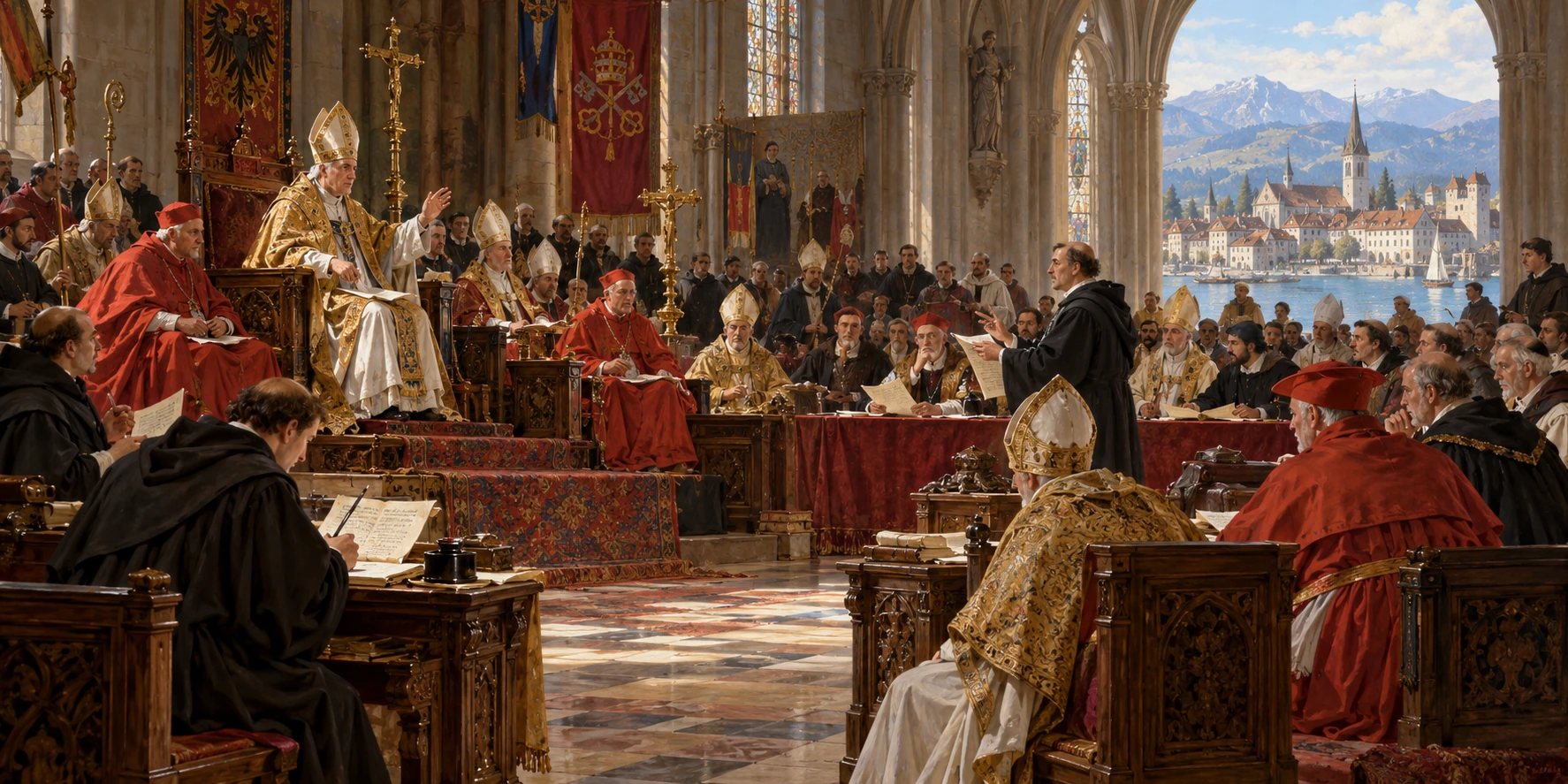
The Council of Constance and the restoration of ecclesiastical unity, 1414–1418
The Council of Constance and the restoration of ecclesiastical unity, 1414–1418.
3Long-form chapters3Disputed questions4Internal source connections

Historical geography · 1309–1417

Avignon and the Western Schism: residence, rival claims and restored unity

Avignon was first a papal residence, not a rival church. The sequence therefore separates residence beside the Rhône from the competing Roman and Avignon obediences that followed the elections of 1378. Pisa added a third claimant in 1409; Constance used deposition, withdrawal of obedience and an authorised resignation before electing Martin V. The locations reveal the part played by courts, universities and councils in a crisis that ordinary dioceses also had to endure.

The story through1309Move the timeline to reveal events
Earlier events stay visible as the story unfolds.
Avignon and the Western Schism: residence, rival claims and restored unityAvignon · 1309Clement V settles the papal court at Avignon
Papal office / electionSchool / scholarshipCouncil / synod

14 dated records · 4 historical periods

Link to this view

Move the timeline to reveal events in date order; previous events remain visible. Select a numbered badge to separate nearby records. Fine leader lines connect displaced symbols to their locations. Drag to move the map; use +/− to zoom. Left/Right changes year and Home fits the focused map. Dashed connections are schematic, and city locations are approximate.

Chronological index · all 14 dated records
  1. 01 · 1309 · AvignonClement V settles the papal court at Avignon → chapter 1

    Clement V’s residence at Avignon began the period conventionally called the Avignon papacy. Its central questions concerned the court’s location, relationships with rulers and the administration of the Church, rather than several ordinary competing papal successions. Proximity to French power mattered without making every papal policy a royal instruction.

  2. 02 · 1348 · AvignonClement VI purchases the city → chapter 1

    Clement VI purchased Avignon from Joanna, queen of Naples and countess of Provence. The transaction changed the court’s territorial setting after decades of residence there. It also prevents the city from being treated casually as an ordinary department of the French monarchy. Papal possessions, diplomatic relationships and the spiritual office must be distinguished. Administrative independence could be strengthened by property while the expense and use of resources remained open to questions of prudence.

  3. 03 · October 1367 · RomeUrban V enters Rome → chapter 1

    Urban V returned to Italy and entered Rome after preparations for his security. Repairing the papal presence there involved buildings, government and relations with local powers, not merely a ceremonial change of address. His return demonstrates that the question of residence was taken seriously within the Avignon period itself. Yet a successful arrival did not guarantee permanence; the pope remained exposed to the unsettled political conditions that had made residence in Italy difficult.

  4. 04 · 1370 · AvignonUrban V returns to Avignon → chapter 1

    Urban V left Italy and returned to Avignon, where he died later in the year. Political insecurity and his concern with wider European affairs helped shape the decision. The reversal makes the earlier return to Rome more intelligible as an attempted settlement with practical limits. Neither residence determined a new papal title. The sequence concerns how a recognised pope exercised his office amid competing pressures, before the rival elections that began in 1378.

  5. 05 · 17 January 1377 · RomeGregory XI restores papal residence at Rome → chapter 1

    Gregory XI entered Rome after leaving Avignon in 1376. Catherine of Siena’s appeals belonged to the wider pressure for the return, but the decision and its implementation remained matters of papal government. His arrival did not end conflict in Italy or ensure an orderly succession. The map therefore treats 1377 as an important restoration of residence while keeping it distinct from the election crisis that followed Gregory’s death the next year.

  6. 06 · April 1378 · RomeUrban VI is elected under crowd pressure → chapter 1

    The cardinals elected Bartolomeo Prignano as Urban VI while a Roman crowd pressed for a Roman or Italian pope. Their subsequent recognition of him and later assertion that fear had invalidated the election became central to the competing legal narratives. The Catholic line of succession recognises Urban, but the historical argument still requires the sequence of acts and claims. Personal hostility, pressure and canonical consent cannot be replaced by a simple division of national preferences.

  7. 07 · 20 September 1378 · FondiCardinals elect a rival claimant at Fondi → chapter 1

    Dissident cardinals elected Robert of Geneva at Fondi; he took the name Clement VII in opposition to Urban VI. The election created a rival claim to the same universal office, not a doctrine that the Church should possess two equal heads. Its consequences spread through rulers, bishops and religious communities assessing conflicting reports. Explaining the existence of an obedience does not establish the legitimacy of its claimant, or prove bad faith in every person who followed him.

  8. 08 · 28 November 1379 · PerpignanClement VII confirms university privileges → chapter 3

    The Avignon claimant Clement VII confirmed the foundation and privileges of the University of Perpignan. Such acts show how a disputed papal title affected ordinary institutional life: universities, bishops and religious houses needed decisions and protections while the larger crisis continued. Seeking a claimant’s authority expressed an obedience, but could not by itself resolve his title. Perpignan makes visible the practical administration that persisted inside a division its adherents generally wanted to end.

  9. 09 · 1409 · PisaPisa’s attempted solution produces a third line → chapter 2

    The assembly at Pisa rejected the existing rival claimants and elected Alexander V. Gregory XII and Benedict XIII did not accept the decision, so the intended remedy produced a third obedience. The episode shows that an assembly’s declaration of success was insufficient when its authority and the titles it judged remained contested. Restoring unity required lawful authority and a settlement of the competing titles; another election alone could not supply either.

  10. 10 · May 1410 · BolognaThe Pisan succession continues with John XXIII → chapter 2

    After Alexander V’s death, cardinals of the Pisan obedience elected Baldassare Cossa at Bologna, where he took the name John XXIII. This was the medieval claimant later deposed at Constance, not the twentieth-century pope of that name. The continuation of the Pisan succession confirms that Pisa had created a functioning administration without extinguishing the older claims. Institutional continuity and widespread support remained historically important but did not independently settle canonical legitimacy.

  11. 11 · 1414–1415 · ConstanceThe council confronts three obediences → chapter 2

    The assembly at Constance began under the Pisan claimant John XXIII with Sigismund’s support and confronted rival papal lines as well as demands for reform. The decree Haec sancta in April 1415 asserted a strong account of conciliar authority. Its status and later interpretation require distinction from the acts through which unity was restored. Treating every session as an identical dogmatic authority obscures both the emergency and the importance of the later legal settlement.

  12. 12 · 4 July 1415 · ConstanceGregory XII authorises convocation and resigns → chapter 2

    Gregory XII’s representatives formally convoked the council in his name and communicated his resignation. This act secured a lawful basis for the settlement following the removal of the Pisan claimant John XXIII. It cannot be replaced by the claim that a council simply deposed an undisputed lawful pope. Carefully distinguishing resignation, disputed titles and conciliar acts explains how a remedy could secure unity without establishing a permanent alternative constitution for the Church.

  13. 13 · 1417 · PeñíscolaBenedict XIII maintains his claim → chapter 2

    Benedict XIII maintained his papal claim from Peñíscola despite the loss of major supporters and the council’s action against him in July 1417. His refusal reminds the reader that the settlement did not persuade every remaining adherent immediately. A claimant’s continuing household could persist while broader recognition shifted elsewhere. The marker locates that residual claim without colouring a whole kingdom as permanently obedient to it or treating sincerity as proof of lawful jurisdiction.

  14. 14 · 11 November 1417 · ConstanceMartin V is elected and broadly recognised → chapter 3

    The electors at Constance chose Oddo Colonna as Martin V after the principal rival claims had been addressed. His broad recognition restored a common centre of visible government, though residual claimants and unresolved reform questions remained. The outcome does not make the preceding decades harmless. It shows how legal acts, cooperation and reception repaired a grave disorder while the parties had continued to seek the one papal office they disputed.

Map sources and geographical method

This map follows the dossier’s selected places and institutions. Events appear at the start of their stated date range and remain visible at later steps. Their continued visibility records the earlier event, not uninterrupted control or activity. Physical geography supplies orientation; no historical state boundaries are reconstructed. Institutional and comparison lines are schematic, and representative locations are identified in the record notes.

Related library passages supply theological and institutional background; the evidence listed for each event supplies its particular historical reference. Bibliographic addresses below are documentation, while reading links stay within Catholon.

  1. Palais des Papes: the popes at Avignon — Clement V’s residence and Clement VI’s purchase in 1348

    Site institution distinguishes the seven recognised Avignon popes and later schismatic claimants, and identifies Joanna of Naples as seller.

  2. Catholic Encyclopedia: Urban V — Return to Rome in October 1367 and to Avignon in 1370

    Historical account supplies dates and practical circumstances; evaluative rhetoric is not copied.

  3. Catholic Encyclopedia: Gregory XI — Departure in 1376 and entrance into Rome on 17 January 1377

    Historical chronology for the return and continuing Italian difficulties.

  4. Catholic Encyclopedia: Urban VI — Election of April 1378 and later challenge by the cardinals

    Detailed historical reference for the sequence of recognition and repudiation; national obedience lists are not converted into fixed borders.

  5. Catholic Encyclopedia: Robert of Geneva — Election at Fondi, 20 September 1378

    Historical account of the claimant Clement VII and the beginning of the rival line.

  6. Catholic Encyclopedia: University of Perpignan — Clement VII’s bull of 28 November 1379

    Dated institutional act illustrating the practical effect of obedience in university life.

  7. Catholic Encyclopedia: Council of Pisa — Assembly and election of Alexander V in 1409

    Historical account of Pisa’s proposed remedy and the continuation of rival claims.

  8. Catholic Encyclopedia: the antipope John XXIII — Bologna election and installation in May 1410

    Historical reference for Baldassare Cossa’s Pisan succession; no disputed exact election day is asserted.

  9. Council of Constance: acts and decrees — Sessions 5, 14 and 41; Haec sancta, Gregory XII’s resignation and Martin V’s election

    Primary conciliar documents. The website’s added editorial judgments are distinct from the translated acts and are not treated as conciliar definitions.

  10. Catholic Encyclopedia: Pedro de Luna — Retirement to Peñíscola and refusal of the 1417 settlement

    Historical chronology; its conflicting day references for the deposition and uncertainty about death are not converted into false precision.

  11. Municipality of Peñíscola: the castle — Benedict XIII’s residence in the castle

    Municipal heritage account verifies the locality of the residual papal claim.

Physical geography: Natural Earth, 1:10m public-domain land, coastlines, natural lakes and major rivers. Projection: Web Mercator; high latitudes are enlarged. Contemporary coastlines provide orientation rather than a reconstruction of every historical shoreline. The map’s city coordinates locate named places approximately, not exact buildings.

Extended reading

History and institutions

Chapter 01

Avignon: government, criticism and the return to Rome

The papal residence at Avignon from 1309 and the rival obediences that began in 1378 belong to different phases of history. During the Avignon period the Church did not ordinarily recognise several competing lines of popes. The problem was the location of the papal court, its relationship with the French monarchy and the expanding administrative and fiscal machinery of the curia. Calling the entire period a schism obscures what was actually contested. It also encourages the mistaken inference that an unpopular residence or an objectionable financial policy by itself establishes that an otherwise recognised pope has ceased to hold office.

The papal court’s proximity to French interests was a genuine political fact, but Avignon was not simply a department of the French royal government. Popes pursued their own policies, negotiated among rulers and confronted problems in Italy that made residence in Rome difficult. Administration required income, yet the mechanisms used to obtain it could generate serious resentment. Reservations of benefices, fees and provisions affected local churches and careers. These institutional needs were real, but they did not make every fiscal practice prudent or immune from abuse. The spiritual office of the papacy and the quality of a particular administrative arrangement remain distinct questions.

Avignon developed a substantial papal administration. Documents, appointments and judicial business continued to connect distant churches to the curia. Residence outside Rome did not make those acts automatically void, but dependence upon a particular political environment damaged confidence and made the papacy appear too closely attached to French interests. Administrative capacity and political vulnerability could grow together.

The appeal for return concerned more than geographical sentiment. Rome was the see associated with St. Peter and the centre from which the pope’s universal office was publicly understood. St. Catherine of Siena’s interventions joined a call for reform of conduct to insistence on that vocation. Gregory XI’s return in 1377 answered the question of residence. His death the next year opened a different crisis over the legitimacy of an election, which cannot be treated as merely another name for the Avignon period.

01“A pope outside Rome had ceased to be pope.”

The historical evidence

The Avignon pontiffs continued to govern, appoint and judge from a residence outside Rome. The later Western Schism arose from rival claims after the elections of 1378, not simply from an earlier change of address. The two periods have different institutional problems.

Answer to the objection

Residence could damage independence and public confidence without automatically extinguishing the office. St. Catherine’s call for return was meaningful because the holder of that office had duties toward Rome and the wider Church, not because no pope existed until he crossed the city boundary.

Chapter 02

Pisa and Constance: ending rival obediences

The Council of Pisa in 1409 attempted to end the division by rejecting both existing claimants and electing another. Because the previous claimants did not accept the decision, the practical result was three obediences rather than one. Pisa demonstrates why a declaration that a crisis has been solved is not enough. The authority to judge, the status of those being judged and the reception of the outcome all matter. A council acting without a settlement of these questions could enlarge the very uncertainty it intended to remove.

The Council of Constance, meeting from 1414 to 1418, succeeded through a more complex sequence. The Pisan claimant John XXIII was removed, Gregory XII’s representatives formally convoked the council in his name and communicated his resignation, and Benedict XIII eventually lost the support necessary to maintain a broad obedience. The election of Martin V in 1417 then supplied a generally accepted successor. These steps should not be compressed into the proposition that a council simply deposed a universally acknowledged pope and thereby proved the permanent superiority of every council over the papacy. The disputed identities of the claimants and Gregory XII’s act are central to understanding the settlement.

The attempted solution at Pisa in 1409 illustrates why good intentions were insufficient. A gathering sought to end the rivalry but produced another claimant when the existing obediences did not accept its judgment. Christians consequently faced competing claims to the same office. Disputes over legitimacy affected appointments, jurisdiction and the reliability of official communications, even while parishes continued to celebrate the sacraments.

Constance succeeded through a combination of negotiation, resignation, deposition claims and a new election. Gregory XII’s authorised representatives formally convoked the council before his resignation in 1415; Martin V’s election in 1417 established a broadly accepted pontiff. The restoration of unity was thus an institutional act with concrete legal steps. It did not require three contradictory papacies to become permanently valid. The Church worked to identify and re-establish the single visible government her constitution required.

02“Rival claimants prove that the papacy itself was imaginary.”

The historical evidence

The crisis concerned who lawfully held one office. Constance’s settlement and Martin V’s election restored a recognised single pontiff; they did not create a permanent constitution of several contradictory papacies. Ending rival obediences was the work to be done.

Answer to the objection

A disputed title does not abolish the office being disputed. It requires judgment and a settlement. The Church’s recovery of visible unity supplies the historical answer: division was treated as a grave disorder to be overcome, not as an alternative form of normal government.

Chapter 03

The office survives the failure of its claimants

Indefectibility does not mean that every member of the Church will always know the answer to every contested ecclesiastical fact. It means that the Church will not cease to be the Church established by Christ or lose the faith and sacramental constitution entrusted to her. The Western Schism placed tremendous strain on visible government, but the faithful generally continued to seek one lawful pope, celebrate the sacraments and profess the inherited faith. The rival claimants did not ordinarily announce different religions. Their very competition presupposed the singular office they each claimed to possess.

This does not make the practical consequences harmless. Rival appointments, divided religious communities, fiscal demands and the uncertainty of obedience affected ordinary ecclesiastical life. A local bishop or a religious house could not solve the entire controversy by private preference, yet choices had to be made. Advice from recognised authorities could be mistaken. Such a distinction neither declares all claimants legitimate nor turns sincerity into a substitute for law. It identifies the difference between the objective question of office and the subjective responsibility of those trying to obey.

The Church’s indefectibility is not a promise that every election will be peaceful or every officeholder prudent. The Western Schism caused genuine uncertainty and damage. The men and women who laboured to end it acted because the visible unity of the Church was a duty, not an optional administrative convenience. Their success gave that conviction a public result: the rival obediences ceased to define the normal government of Latin Christendom.

The claim that the crisis disproves the papacy confuses a disputed title with the non-existence of the office. Competing claimants to a bishopric do not prove that episcopal office is imaginary. They create an urgent need to settle who holds it. At Constance that problem was addressed through the restoration of one recognised pope. The theological controversies about councils and papal authority continued, but they were no longer a reason to accept permanent division as the constitution of the Church.

03“The crisis left the Church incapable of reform.”

The historical evidence

The failed council at Pisa was followed by another effort with legal acts and a different outcome. Gregory XII’s authorised convocation and resignation formed part of the process at Constance; Martin V’s election gave it a durable result. The sequence contains failure followed by correction.

Answer to the objection

Institutional recovery is not disproved by the severity of the problem it solves. Sacramental and religious life continued while churchmen sought to end the competing obediences. The result was restored government, though further reform and theological controversy remained.

Further reading

People, institutions and turning points

1309–1377Residence at Avignon and the government it supported

Avignon’s significance was administrative as well as political. A resident curia employed officials, received petitions and handled appointments and revenue. Its proximity to the French monarchy affected perceptions, but the city’s papal history cannot be reduced to the later existence of a rival obedience.

  • Pressure before the move. The conflict between Boniface VIII and Philip IV concerned taxation, jurisdiction and claims of authority. The attack at Anagni in 1303 showed that physical coercion could enter a dispute conducted through solemn legal and theological language.
  • Clement V and Vienne. The Templar case combined royal arrests, accusations, ecclesiastical proceedings and the council’s deliberations. Suppression of the order did not amount to a simple judicial finding that every accused member had committed every alleged offence.
  • Administration and controversy. John XXII’s pontificate enlarged curial activity and became involved in the Franciscan poverty controversy. The papacy dealt simultaneously with revenue, appointments, doctrine and the claims of rulers; one policy does not explain the whole period.
  • Return required more than a journey. Albornoz’s work in the papal territories and Urban V’s temporary return show the practical problems of governing from Rome. Gregory XI returned in 1377 after sustained pressure, including the counsel of St. Catherine of Siena.

Avignon residence ended before the Western Schism began. Keeping that sequence clear allows criticism of political dependency or administration without mistakenly describing every Avignon pope as a rival claimant.

1378–1409How two elections became competing obediences

The crisis of 1378 forced bishops, rulers, universities and ordinary clergy to decide which claimant they believed had been canonically elected. Their decisions rested on reports about an election held under pressure, subsequent declarations and the advice available to them. The resulting division spread through existing institutions.

  • Urban VI’s election. The Roman election took place amid demands for an Italian pope. Later claims that coercion invalidated it became central to the opposing position. Accounts of pressure and the electors’ subsequent conduct both mattered to the dispute.
  • Clement VII’s election. The later election at Fondi created a rival claimant and eventually an Avignon obedience. Courts aligned themselves differently, and appointments and benefices followed those alignments. The division was reproduced inside diocesan administration.
  • Ways proposed for reunion. Resignation, arbitration and a general council were proposed as possible means of restoring unity. Universities contributed arguments, but a persuasive academic proposal still needed claimants and political supporters to act.
  • Pisa’s unintended result. The council at Pisa in 1409 attempted to remove the two competing lines and elect a recognised pope. Because neither existing line accepted the outcome, the immediate result was three claimants rather than the desired unity.

The episode shows the difference between identifying an institutional remedy and obtaining a settlement that can actually be received. The Church’s need for one visible head made the multiplication of obediences a wound to be healed, not a normal plurality of interchangeable authorities.

1414–1449Constance restored unity through a sequence of different acts

Constance succeeded where Pisa had failed because it combined ecclesiastical action with the practical withdrawal and resignation of claimants. Its history must therefore be read as a sequence. Treating every decree and every session as if it had the same authority obscures how the settlement was achieved.

  • Ending rival claims. The council deposed the Pisan claimant John XXIII. Gregory XII’s representatives authorised the council in his name before announcing his resignation in 1415. Benedict XIII refused to yield and lost the support on which his position depended.
  • The election of Martin V. Martin’s election in 1417 supplied a broadly recognised successor. Recognition allowed ordinary government to be repaired: rival grants, appointments and expectations had to be addressed rather than simply forgotten.
  • Reform and periodic councils. Frequens prescribed the regular holding of councils. It expressed a desire to prevent prolonged institutional neglect, but it did not by itself settle every contested theory about the relation of pope and council.
  • Basel reopened the question. The later conflict at Basel and the election of Felix V demonstrated that a reunion did not eliminate conciliarist claims. The resolution of that later schism in 1449 again required the end of a rival obedience, not merely a new argument on paper.

The achievement was the recovery of a common government and sacramental unity after decades of uncertainty. The record supports the importance of resignation and recognition alongside conciliar action, rather than a simplified account in which an assembly permanently replaced the papal office.

Documents and records

Read the sources

Collections and edition notes
Concilium Constantiense, Frequens (1417); J. H. Robinson, 1912, pp. 31–32

Source excerpt

A frequent celebration of general councils is an especial means for cultivating the field of the Lord

An excerpt is reproduced here; this is not the complete document.

The decree prescribes regular councils. Its procedural programme should not be confused with an unrestricted doctrine of conciliar supremacy.

Concilium Constantiense, reform articles (1417)

Source excerpt

reform the Church before this council dissolves, in head and members, as well as the Roman Curia

An excerpt is reproduced here; this is not the complete document.

The reform programme names institutional abuses and duties. It shows that ending the disputed succession did not complete every necessary reform.

Cyprian on the unity of the episcopate: read the early Christian source and its limits.

Continue studying

Terms, related dossiers and source readers

Filioque and the councils of union

Filioque is the Latin phrase “and the Son” in the Western profession that the Holy Spirit proceeds from the Father and the Son. Its doctrinal meaning and its insertion into the liturgical Creed are related but distinct questions.

Obedience during the Western Schism

An obedience was the body of churches, rulers and individuals that recognised a particular papal claimant during the Western Schism. The existence of an obedience records allegiance; it does not by itself establish the claimant’s legitimacy.