
Chapter 01
From shared communion to the rupture of 1054
The events of 1054 are often presented as if two previously identical halves of Christianity separated in a single administrative act. The actual history is longer and less symmetrical. Greek and Latin Christians shared the Scriptures, the sacraments and the doctrinal inheritance of the early councils, yet they lived within different political and linguistic worlds. The disappearance of imperial government in much of the West and the continuing role of the emperor at Constantinople affected expectations about ecclesiastical authority. Disputes concerning jurisdiction, liturgical practice and the wording of the Creed accumulated within that setting. They were not merely misunderstandings, but neither were all differences equivalent to a denial of the faith.
The ninth-century controversy involving Photius, Ignatius and Rome already exposed tensions over episcopal legitimacy and the jurisdiction of newly evangelised territories. Bulgaria mattered because mission and political alignment were intertwined: the question of who would organise its church carried consequences for both Rome and Constantinople. The later history of restored communion also matters. It prevents the ninth-century controversy from being treated as an irreversible rupture whose outcome was already fixed. Relations could deteriorate and be repaired, and different participants understood the authority of the relevant councils and decisions differently.
The legation of Cardinal Humbert and the conflict with Patriarch Michael Cerularius in 1054 arose within disputes over jurisdiction, customs and political relationships. The legates’ sentence and the Constantinopolitan response were directed against named parties. They did not instantly cause every Latin and Greek Christian to cease all contact. Later conflict, institutional estrangement and the memory of injuries hardened a breach whose effects developed over time.
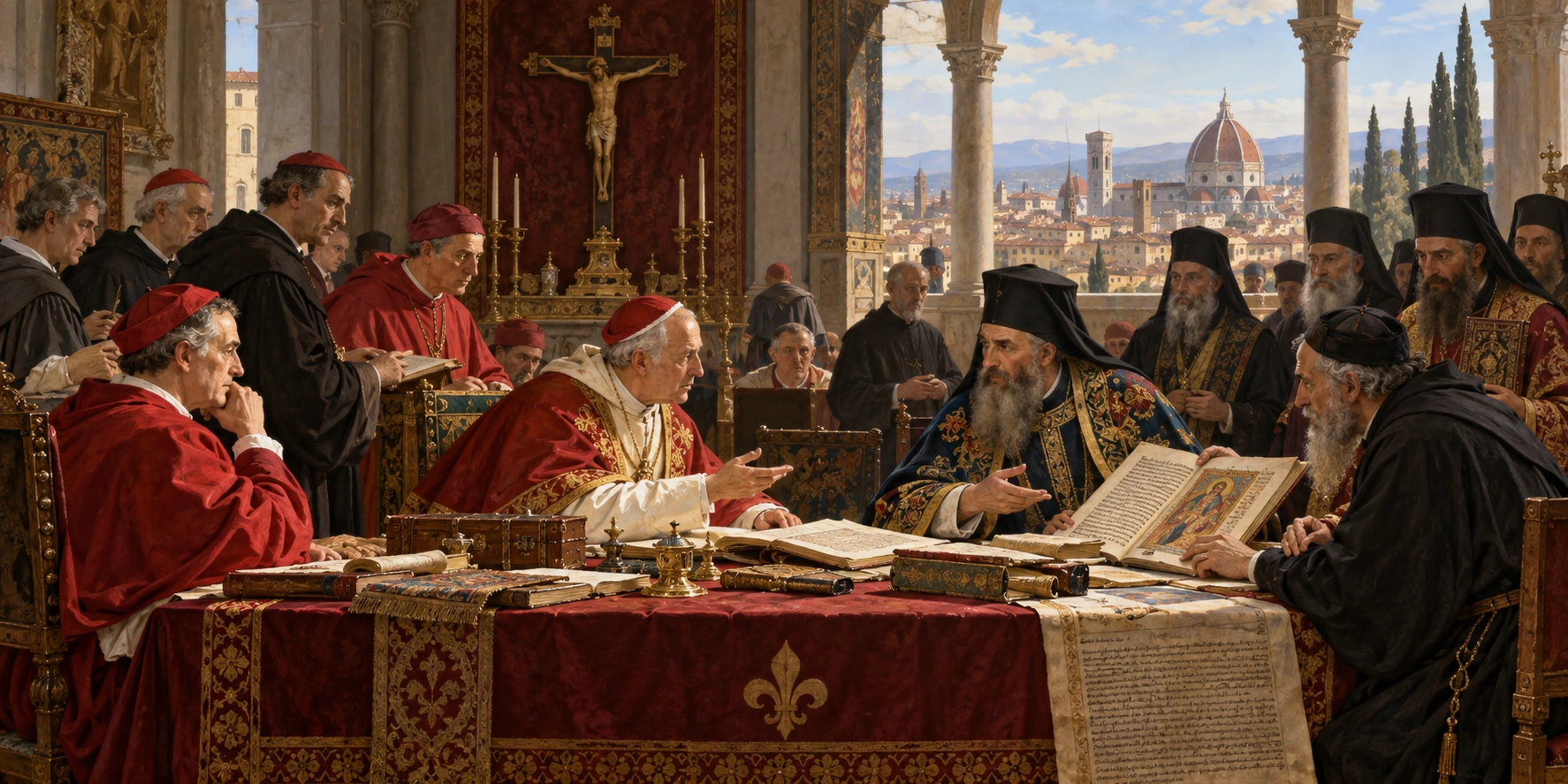
The distinction between custom and doctrine offered a path toward reunion. Differences in language, fasting practice or the liturgical use of bread did not necessarily imply a different sacramental faith. Where a question concerned the procession of the Holy Ghost or the authority of the Roman pontiff, careful doctrinal agreement was required. The Catholic pursuit of unity was therefore neither the abolition of every Eastern inheritance nor a declaration that contradictory professions were equally true. It sought communion in the same faith with legitimate differences retained.
01“Catholic unity required destroying the Eastern inheritance.”+
The historical evidence
Florence addressed specified doctrinal questions while recognising the validity of Eucharistic celebration with leavened or unleavened bread. The agreement did not require every legitimate Eastern practice to become Latin. The distinction between doctrine and custom was part of the work of reunion.
Answer to the objection
Unity required a common faith and communion, not identical languages or every local observance. Political domination and attempts to impose unnecessary uniformity could damage that purpose. Such injuries do not turn the doctrinal search for communion into a demand to erase the East.